
George Selth Coppin, an indefatigable powerhouse, was responsible for much of the popular culture that entertained theatre going audiences in the second half of the 19th century. Moving beyond the theatrical sphere, Coppin served in the Victorian parliament, created the Old Colonists Homes in North Fitzroy for retired theatrical performers, was sometime owner of the Cremorne Pleasure Gardens and much more.
…perhaps it is Coppin’s role as ringmaster that stands as his greatest legacy. He opened up spaces for performances by others — bellringers and minstrels, conjurors and Shakespearean actors — and the parade of tricks and marvels he orchestrated over 60 crowded years hugely enriched Australia’s popular culture. Late in life, Coppin delighted in telling friends how his 1840’s journey from England to the Antipodes was decided on the flip of a coin. It was heads America, he said, and tails Australia.
‘Fortunately for the colonies — and myself — Australia won!’ 1
We are fortunate to have in our collection a significant archive of material relating to Coppin, donated by his daughter Lucy Coppin. Components of the collection have been digitised over time — most recently the collection of more than 1200 playbills, which show us the breadth of theatrical performance — and the busy programs for an evening’s diversion and entertainment available for the price of just one ticket.
George Coppin and Maria Burroughs arrived in Sydney in March 1843. George was a seasoned performer having performed with the Coppin family troupe from infancy, while Maria was an actress.2 The playbills trace the touring company’s triumphs in Hobart, Launceston, Sydney, Melbourne and Adelaide as well as Geelong, Ballarat and more. The collection includes English playbills from the 1820s and onwards, and some from Coppin’s brief returns to England in 1854, and again in 1863.
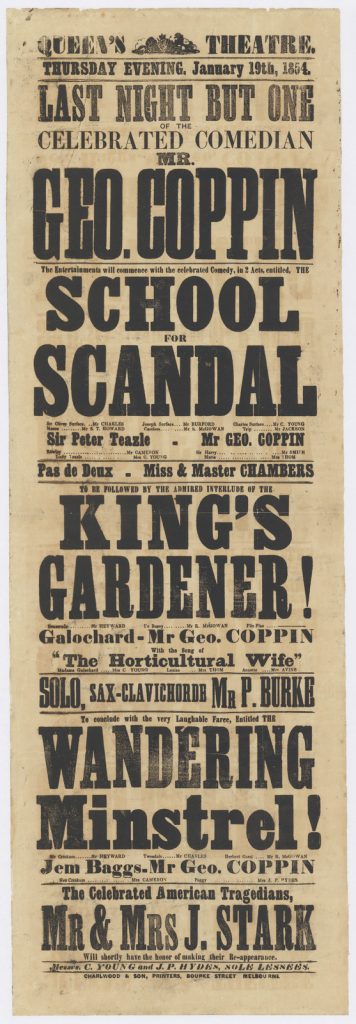
Left: Queen’s Theatre, Melbourne: School for Scandal; The King’s Gardener; The Wandering Minstrel, 1854; MS8827/11/989
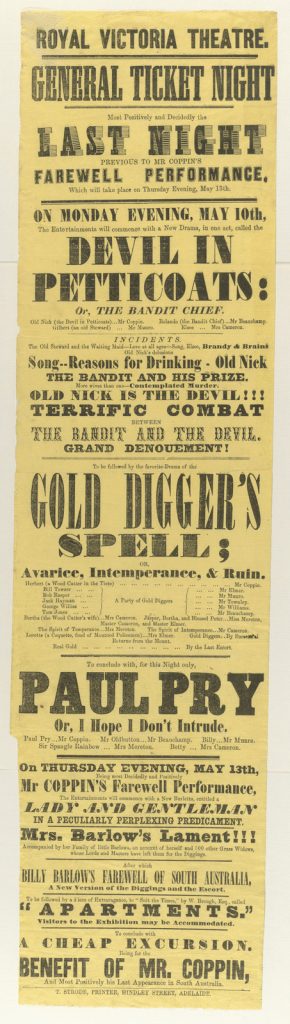
Right: Royal Victoria Theatre, Adelaide: Devil in Petticoats, or the Bandit Chief; Gold Digger’s Spell, or Avarice, Intemperance, & Ruin; Paul Pry or, I Hope I Don’t Intrude, 1852; MS8827/11/550
Joseph Bland Holt staged several shows with Coppin, also running his own production company. He became known as the ‘Monarch of melodrama’, and the prospect of such an engaging show, along with the spectacular staging of his productions, were drawcards for audiences. 3
Written by Henry Pettitt, A Woman’s Revenge first appeared on Australian stages in April 1894, coming from a London run. The theatre-going public of Melbourne were encouraged to ‘not miss seeing it, as it is considered one of the most thrilling pieces ever staged’ (Coburg Leader, 14 April 1894). A later review noted that:
The story of the drama is powerful and telling without approaching the ultra-sensational, the dialogue is forcible and the situations strong, while the balance between tragedy and comedy is held in such a manner that laughter follows tears as a natural sequence. (The Express and Telegraph, 23 August 1894)
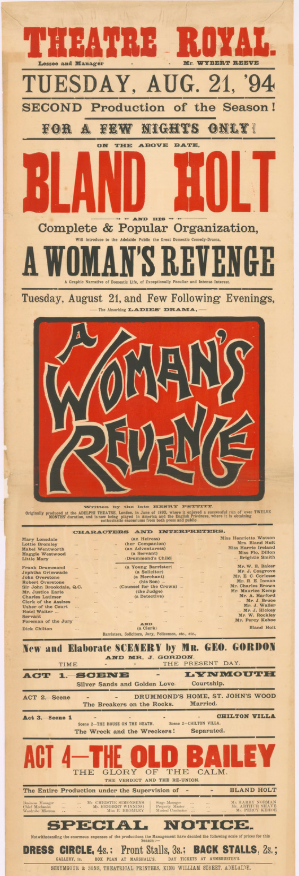
Left: Theatre Royal, Adelaide: A Woman’s Revenge, 1894; MS8827/11/1172
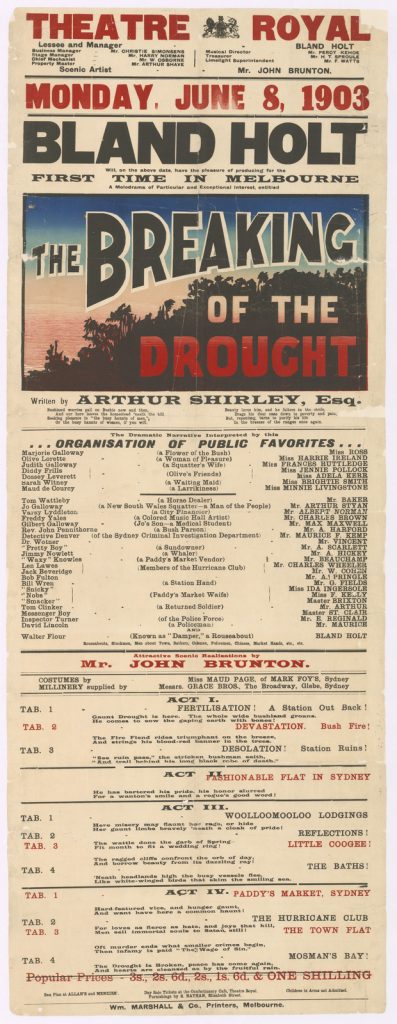
Right: Theatre Royal, Melbourne: The Breaking of the Drought, 1903; MS8827/11/1122
First staged on 26 December 1902, the Breaking of the Drought drew many favourable reviews — including this one, even commenting on the crows in the cast:
Mr Bland Holt’s latest bill of fare at the Lyceum Theatre is obviously to the public taste, and it is simply impossible to secure anything but standing room after the curtain rises. Even last night, when the attendance is supposed to decrease somewhat, the audience showed no falling off, and the appreciation of the thrilling bush fire scene, with its weird foreground of dead animals and extremely lively and well trained crows was marked. The local scenes are also popular, especially that representing Paddy’s Market, and here plenty of comedy comes to the surface. (Sydney Morning Herald, 10 January 1903).
The play was made as a film in 1920 that included footage of the drought in western New South Wales, which fortunately had broken by the time the film was screened. 4
While writing this post, I was shown this gem from the collection in the Library’s Kershaw Studio. This is where much of our collection work occurs. Created for War on Wealth, the model for the stage set helped with design, production and direction of the play, and also — from this evocative piece, taken from the Lavender Bay vantage point — helped the cast and crew to project themselves into the play. Opening on 20 October 1900, this opening night review highlighted the play’s local provenance, along with a complicated plot involving a bank robbery and the comings and goings of many characters:
Not only is it an Australian drama, but it is a Sydney play, played in spirit as in actual fact right here….The play is an exceedingly lively one, yet full of taking situations, and of much seriousness. There is no heavy bloodthirsty events to turn the audience grey with horror, but it is a drama full of life-like possibilities, which might be enacted in the present time without overstepping the possibilities. (The Australian Star, 22 October 1900)
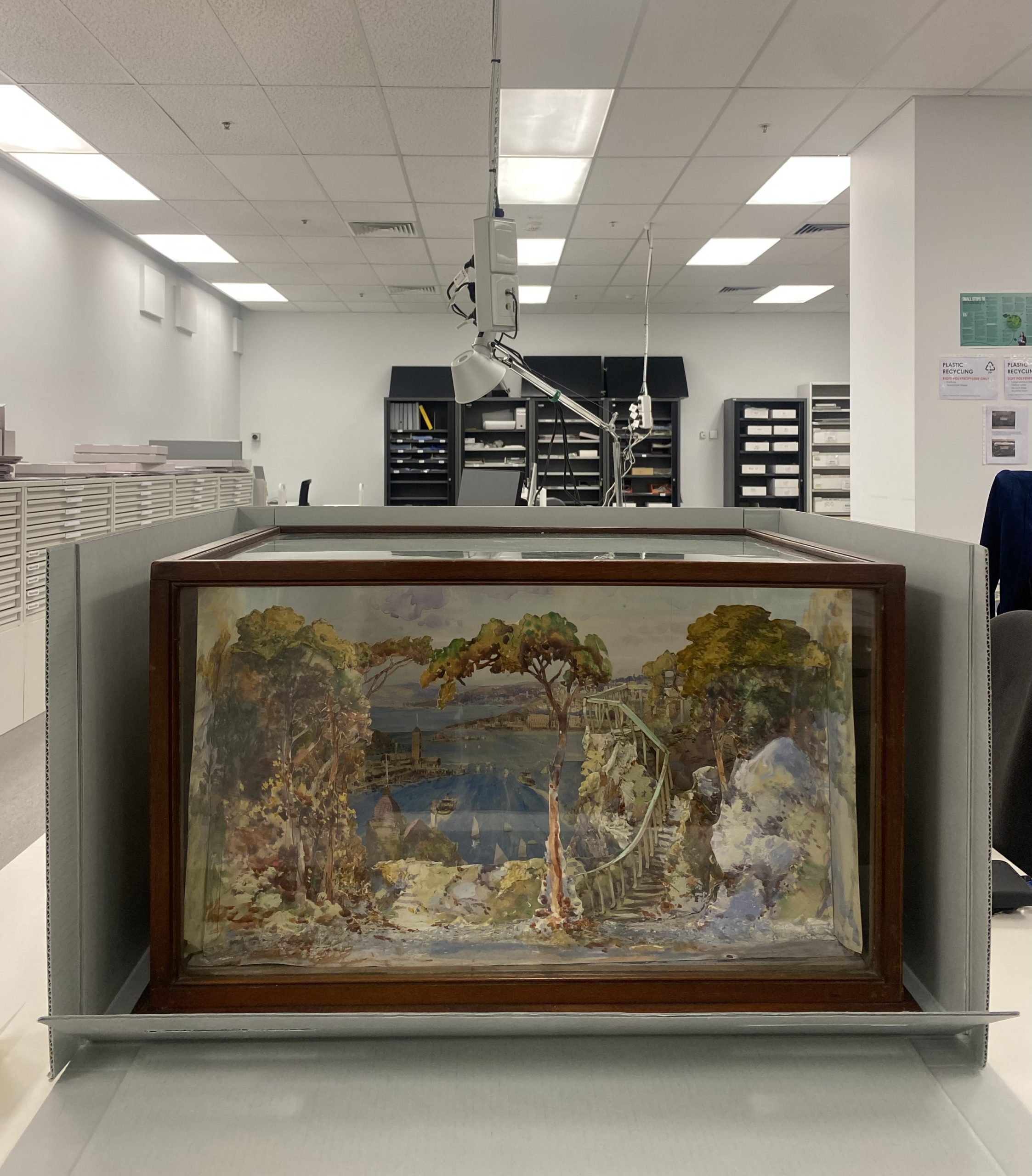
Model of stage set for Bland Holt’s play The War of Wealth, John Brunton, 1899; H2025.54
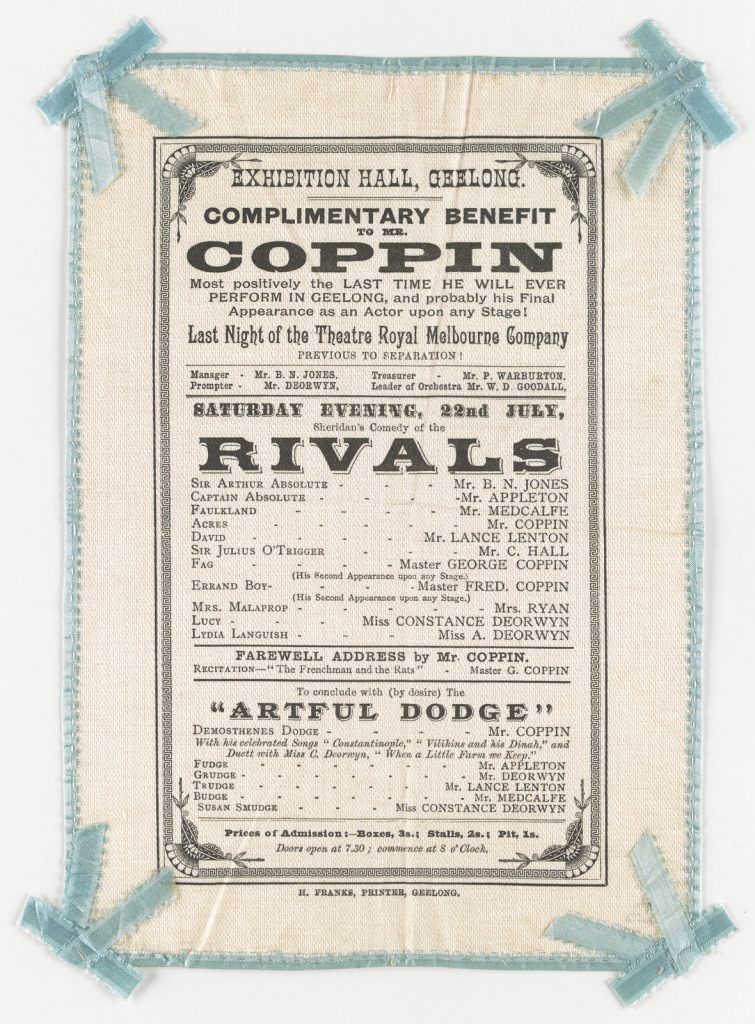
To conclude this very brief survey, this benefit for Coppin, staged at his last appearance in Geelong in July 1882, included The Rivals by Sheridan and the farce, The Artful Dodge(r). We can see the cast included Coppin senior, and two younger Coppins, brother Master Fred and son Master George, each appearing for just the second time. The program was a great success, and from this vivid description of his performance, we get a sense of the force of his personality, and the attraction for Coppin of treading the boards:
“The Rivals” was the opening piece, and, being excellently cast, it went admirably. Mr Coppin, as Bob Acres, was, of course, the life and soul of the play, and, in the famous duel scene, when, on the approach of his supposed adversary, he declared that he felt his courage “oozing out at his fingers’ ends!” he fairly brought down the house. (Geelong Advertiser, 24 July 1882)
In a merging of cultural worlds, and canny marketing, Coppin invited the Geelong Football Club to a performance, following on from their return from a match in Sydney (Geelong Advertiser, 20 July 1882). The cast in turn were invited to the South Melbourne match the following weekend (The Argus, 24 July 1882) — where, fortunately, Geelong was victorious.
George Coppin died in 1906, at his Richmond home, Pine Grove,5 leaving his wife Lucy and 10 children. After a career spanning more than 60 years as a comedian, theatrical manager, politician, bank director and philanthropist, Coppin left this rich and evocative documentary legacy, telling us something of the way we lived then.
More to explore
Tsara, O (2025) The Coppin Collection at the State Library Victoria, Theatre Heritage Australia
Plant, S (2019) Show Time: George Coppin turns 200, Theatre Heritage Australia
Plant, S (2025) Entertaining Mr Coppin: an Australian showman in Civil War America, Theatre Heritage Australia
Leech, J (2014) George Coppin & Bland Holt, Theatre Heritage Australia
O’Neill, S (1969) George Selth Coppin (1819-1906), Australian Dictionary of Biography
Engledow, S (2004) The multifarious career of George Selth Coppin, National Portrait Gallery
Best, K (2018) On a visit to the Cremorne Gardens, State Library Victoria
Bagot, A (1965) Coppin the great, London, Melbourne University Press
AusStage (2025) Bland Holt
AusStage (2025) Mr George Selth Coppin
References
- Plant, S (2019) Show Time: George Coppin turns 200, Theatre Heritage Australia, accessed 6 June 2025
- O’Neill, S (1969) George Selth Coppin (1819-1906), Australian Dictionary of Biography, National Centre of Biography, Australian National University, Canberra
- Leech, J (2014) George Coppin & Bland Holt, Theatre Heritage Australia, accessed 6 June 2025
- NFSA (1920) The Breaking of the Drought, Australian Screen, accessed 6 June 2025
- The view from Richmond Hill, melway44g4, accessed 5 June 2025


Fascinating collection. Nice to know more is now available.
Hello !
HUGE thanks for this wonderful collection !
Enjoying it very much.
Suggestion….it would be great to see this as a live exhibition..not just online.
Even better would be to combine it with a collection/exhibition of the history of live theatre in Melbourne….e.g the current site of K-Mart in Burke Street was once the site of the incredible Theatre Royal,,,and there is much more about Melbourne’s theatre world to be discovered and shared.
Happy to help if needed !
Thanks again for this exciting collection !!