
It happens with a surprising regularity – a story has been passed down, generation to generation, without question, in a kind of whisper game of false memories and exaggeration. Finally, someone decides they want to start their formal family history research and they’ve come into the State Library Victoria for help – perhaps they want the picture of themselves as a baby that was definitely on the front page of the newspaper; their grandfather’s service records detailing the story of his heroic escapades that ended his valiant military career; or information about their ancestor, who was the first in the family to be sent to Australia as a convict, and all for just stealing one loaf of bread – definitely nothing serious…
…but now we’re finding that the story is getting hard to corroborate. You’ve been through all of the front pages of the paper, and there are no babies to be found. The military records are proving vague, or they don’t mention a battle but instead a disease caught overseas referred to only in initials…if the records exist at all. Success – you’ve found your ancestor’s sentencing in London! But deary me, that wasn’t a loaf of bread they stole!
The above stories are fictional examples, but they are based on many real stories that SLV’s Family History Librarians hear every day in the Newspapers and Family History Reading Room, and they demonstrate some of the ways that misinformation can creep into your own family tree. We tend to think of misinformation and disinformation as modern phenomena, but people have been deceiving each other, either intentionally or not, since before we had the records to prove it. In this blog I will highlight some of the common kinds of misinformation, disinformation and deception that you might come across, the kinds of trouble they can cause down the track, and how you can avoid spreading it further down the line.
What’s in a name?
Names can be the source of all kinds of family history research woes. Innocuous examples of name changes that researchers generally know to look out for include a woman taking her husband’s last name after marriage (or reverting back after divorce), or families changing their lengthy European names to better assimilate with more simple Australian tastes. These are accepted cultural practices in Australia and not examples of deception (and in fact will often leave a neat paper trail of traceable records).
But sometimes a change in name could be a deliberate choice to hide the truth. In an age before video surveillance and photo ID, providing a false name could be your key to a new life, or a chance to go unnoticed.
Take this example of Leonard Stockland, who police found had been charged fifteen times under eight different names:
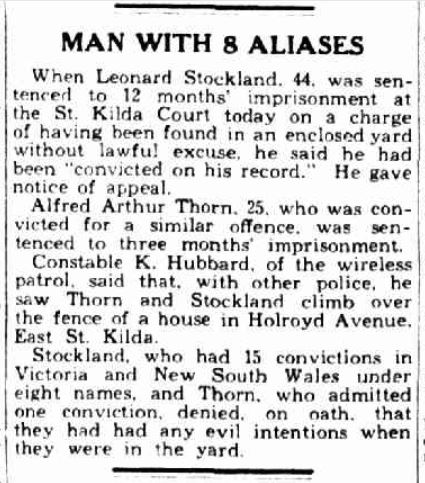
If you were researching Stockland, you might find that there was a period of his life that is seemingly missing from all written records. Or maybe he’s unwittingly used the name of one of your ancestors, and the timeline of your grandfather is suddenly looking quite fragmented.
As an example, let’s take the case of Thomas Langley: a Tasmanian man whose origins were largely unknown to his great-granddaughter trying to find out more. He lived with his wife, Eva, in Tasmania, although both of them appeared to have been born in New Zealand. Immigration records were proving elusive, as were marriage records in either Tasmania or New Zealand. Neither person seemed to have much of a life documented before they started having children in Australia. Given that Thomas was born in the 1890s, he would have been of service age during the Great War, which triggered a search of the National Archives of Australia’s service records. It turns out that Thomas Langley served in World War One as part of the 40th Battalion, Australian Imperial Force. His father is listed as George Langley, in NZ.

And this is where it pays to decipher the hand writing. Within the service records are letters from his parents, George and Elizabeth Wells sent to the war office regarding their son: William James Wells.
…my son went in another name but his right name is William James Wells and he was born hear (sic.) and me his father George Wells…

It seems that ‘Thomas Langley’ was an alias, but why?
Wanting to learn more about the Wells family, we looked at the Birth, Death and Marriage records from New Zealand, and discovered that Thomas/William had a brother back home: Charles. Charles was also married, very coincidentally to a woman also named Eva. Eva Langley. The family story was that Eva had run off with ‘some fella’ to Australia…
Thomas and Eva Langley had no immigration records because their names were William and Eva Wells. They had no marriage records because they were never officially married – Eva was already married to Charles Wells, William’s brother. When William enrolled in the Australian Imperial Forces he used Eva’s father’s name: Thomas Langley.
Seeing double
The above are examples of disinformation: people intentionally misrepresenting themselves in order to hide the truth. But mistakes in family history are often the result of innocent mix-ups. A frequent culprit is the plight of the ‘common man’ – or the person with a terribly common name.

Is your ancestor’s name Bridget Riley? Elizabeth Jones? John Smith? If so, you may already know how difficult this can make researching the Australian, Irish, and UK branches of your family tree. A search for ‘Elizabeth Jones’ in the death index on the Births, Deaths and Marriages Victoria website yields 144 results pre-1900 – too many to even display, let alone check through. So how do we wade through all these names to find our ancestors?
Let’s take the example of a Robert Brown. His granddaughter contacted us on the Ask a Librarian desk to verify some information that they had found about him, but it quickly became clear that some of the story didn’t quite fit.
The information that was presented: Robert Brown migrated from Liverpool to Victoria with his family as a child in the 1850s, and married his wife Dorothy (who outlived him by many years) in the 1870s. He was an engine driver by trade, and was admitted to the Cheltenham Benevolent Asylum in 1894, where he died in 1927. His probate notice mentioned that he was living at a gentleman’s club before he was transferred to the asylum. Can anyone spot a possible discrepancy?
The sources found and quoted from included this probate notice from the Public Record Office Victoria (PROV):

Something didn’t sit quite right. The probate said this Robert Brown died in 1926, not the 1927 that we had expected. I double checked the death index on the Births, Deaths and Marriages Victoria website, and the Robert Brown who died in 1926 was only 56 at the time of death. Far too young to have been the Robert Brown from Liverpool. Furthermore, the probate mentioned that he was living at a gentleman’s golf club before he entered the Asylum. Where was Dorothy at this time?
I checked the death index again. There was indeed a Robert Brown who died in 1927, in Cheltenham, at the age of 90. And his spouse at death is listed as Dorothy. Surely this Robert Brown is the correct man, and the one with the Will is an imposter in our story.
And what about the engine driver profession? Which Robert Brown was this? And where did the information come from? The answer could be found within one of the most popular family history databases – Ancestry Library Edition. And here’s where the misinformation really started to seep in to the story.
Checking your sources
Ancestry Library Edition1 is a fantastic database that contains a wealth of material, but like all tools, you need to know how to use it.

A feature of the subscription version of Ancestry is the ability to create your own family tree and add sources to it. Often, people will make their trees public. This is a great way for other family historians to link their research together, and piggyback off of the research that has already been done by others.
The issue is that Ancestry doesn’t check the accuracy of the public trees before allowing them to be made available. The onus is on anyone using these trees to do their own research and ensure the citations are valid. When I started to research Robert Brown on Ancestry, I came across a family tree with his name attached which several people had saved – it looked legitimate enough, with lots of references included. It would be easy to assume that whoever had put it together had done the work to verify the information already. However on further inspection it was clear that many of the sources linked to various life events were actually from several different Robert Brown’s lives. There was the record of an immigration from Liverpool in the 1850s, but also the probate from a 56-year-old’s death in 1926. And then there was the 1919 electoral roll entry, listing his occupation as ‘railway employee’:
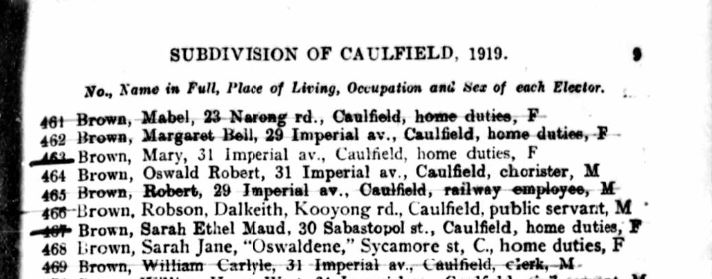
Remember that our Robert Brown was happily married to Dorothy, who appeared as his living widow on his death certificate. If railway employee was the same Robert, we would expect to see a Dorothy Brown listed at the same Imperial Avenue address – she should be visible at the top of this page, just above Mabel Brown. But alas, there’s no Dorothy in sight. It seemed likely to me that our Robert Brown was probably never an engine driver, and we should shut down that line of enquiry now.
Many people had saved this family tree, and had probably assumed that it was credible due to all of the primary sources that had been attached. It’s unclear how many people had checked whether or not the sources could possibly have belonged to the same person. With every new save, the misinformation was embedding itself in Robert’s life.
I had a similar issue recently when researching one Elsie May Cameron (often known as “May”) – a nurse who had completed her training at Bendigo Hospital in 19262. There were a few Elsie May Camerons around at the time, and I was trying to ascertain which one was the nurse. The below Supplementary Register of General Nurses found in the Victorian Government Gazette ultimely gave me the best clue:

The above clearly showed Elsie May completing her training in Bendigo in 1926, so I knew that this was the woman I was looking for. It also listed her current address as Barellan in NSW, which was a little unexpected, but not altogether unusual.
A few years later in 1929, Elsie May married a Richard John Craig Pilkington in NSW. I learned this after I found a wedding notice on Trove, which mentions her address in Barellan:
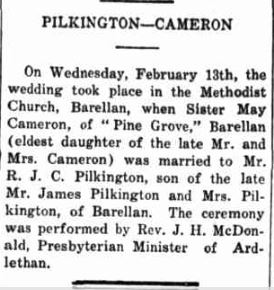
I found many family trees on Ancestry for many different Elsie May Camerons. Interestingly, none of them mentioned her nursing career, but even more surprising was that over thirty of these trees incorrectly identified Elsie May Cameron’s parents as Donald Cameron and Anne McKee, and her birthplace as Grafton, NSW. Many of these trees cited the above article as a source, and it’s easy to see why the assumption of a NSW background would have been made, and how it might fit an existing narrative.
However I knew Elsie May’s parents were actually Dugald Cameron and Martha Ritchie and that she was born in Kerang, Victoria. And that’s because I didn’t stop after finding the Narandera Argus wedding note, I kept going until I found this engagement notice from the Melbourne newspaper Table Talk, which includes more information:

It’s easier to verify that the information is about the person you are researching if you have approached your research systematically, and have built up a picture of a person using sources that can be checked against each other. This is why the Family History Librarians at SLV recommend that when starting your family history you begin with yourself, and then move back one generation at a time3. Birth, marriage, or death certificates for one generation will often contain information about the generation before. Keep in mind that some documents are more reliable than others – certificates are filled out by whoever is around at the time, so death certificates may be completed by people who didn’t know the deceased that well, and who may not remember the names of their spouse or where they were born. Similarly, marriage certificates are only as good as the information that the bride and groom want to provide.
Ghosts in the machine
Human error is inevitable, but nowadays you can’t always be sure exactly when the misinformation has entered the chat. Artificial Intelligence (AI) chat services are becoming increasingly popular as a research tool, with mixed results.
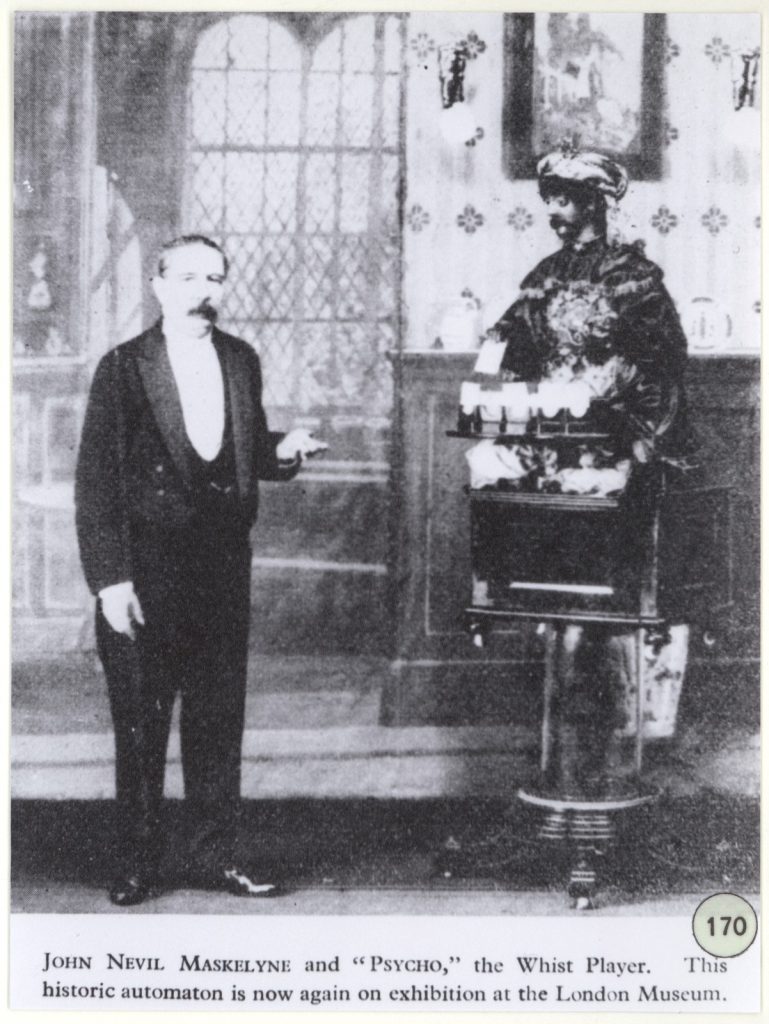
Services like ChatGPT have been known to ‘hallucinate’, or cobble together references out of multiple sources4. These AI models are trained to mimic human responses, but they do not have the ability to check the accuracy of their own output. As a result, citations provided by large language models (LLMs) such as ChatGPT are made up of ‘plausible components’ such as a real journal, or names of real academics writing in the field, but merged in such a way that the resulting reference does not exist5. This has been talked about in academic circles for several years now, but many amateur family historians may not be aware of the issue. The Ask a Librarian desk at State Library Victoria has encountered more than one confused family historian looking for an item that they have heard mentions their ancestor, swearing black and blue that the reference exists and is held by our Library. The only trouble is, we can’t find evidence of such an item ever existing. It’s only after some discussion that we can we deduce that the reference (and/or the link to SLV) has been created by ChatGPT. If you do decide to use these kinds of tools, be aware of their limitations, and make sure that you follow any new information gleaned back to its source to check it.
The age of convenience
So you’ve taken the above advice and you’re meticulously cross checking all new information against what you already know, but something isn’t quite right. Names and birth dates aren’t matching up. What’s going on?
There are many reasons why people may have intentionally misrepresented their ages in their “official” documentation. A common one is men or boys who wanted to enlist in the army, but were outside of the accepted age limit. The propaganda machine sold the first World War as a great adventure, and made it clear that anyone who didn’t sign up wasn’t doing their part. It is of little surprise that boys would have adjusted their ages upwards so they could join what must have felt like a once-in-a-lifetime calling.
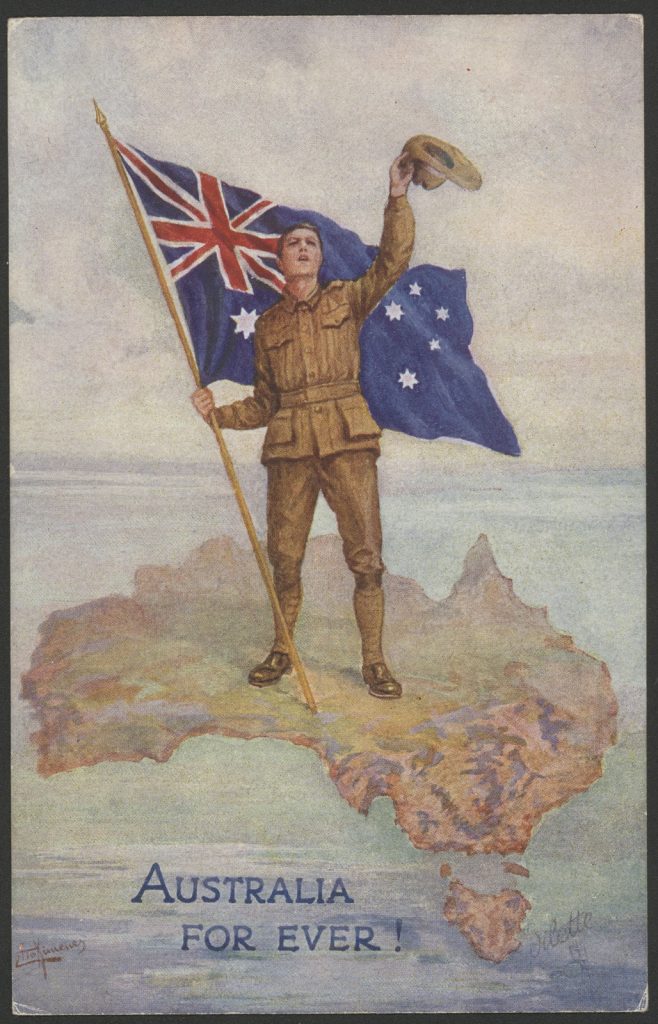

Left: Australia for ever! [ca. 1900 – ca. 1920]. Artwork by Kimeney; H99.166/14. Right: Will you fight now or wait for This [between 1915 and 1918]. Artwork by Norman Lindsay; H141838

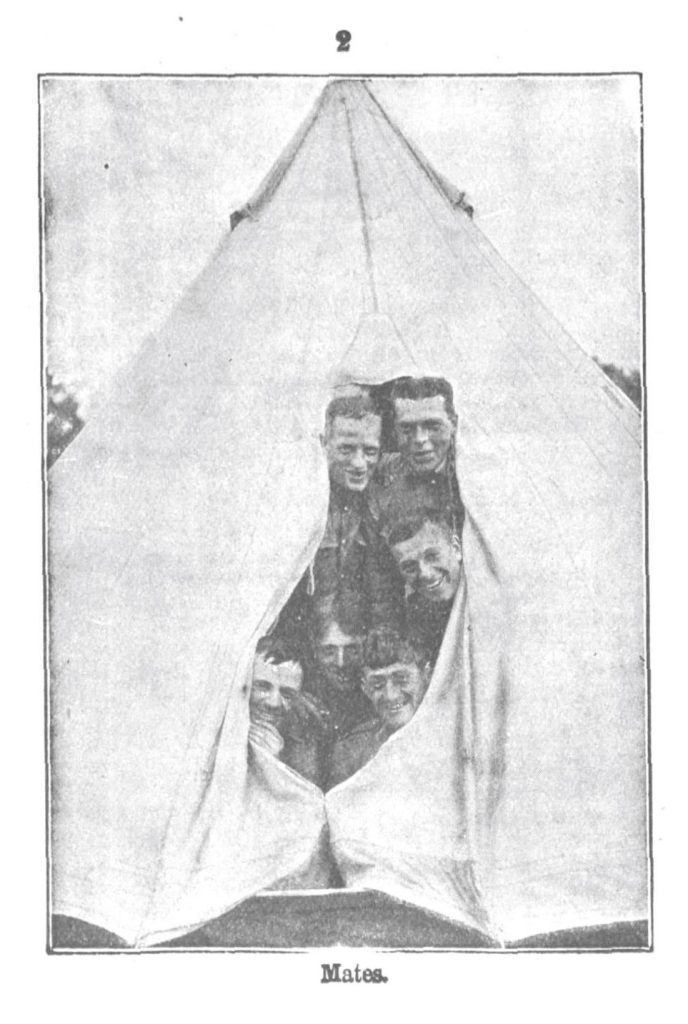
The Recruit’s Companion pamphlet from 1917 reminds possible recruits that “The Australian army is the best paid force in the world and the best looked after, apart altogether from the lifelong honour which is attached to the position”6. Pictures of young soldiers hugging wallabies, socialising in club houses, and crowded into an army tent with the caption ‘Mates’ are scattered through the booklet in an attempt to make enlistment look like an attractive life decision. A detailed list of pay and allowances further seals the deal7. It’s worth noting that allowances may also be paid to family members if they are dependent on the recruit for support, including a young man’s mother, widowed sister, or invalid widower father, and in some cases even the the children of these relatives8. It’s not hard to see how a boy of seventeen or younger could have been persuaded that joining the armed forces was the best thing that they could do for themselves, their family, and their country.
Women and girls may also want to make tweaks to their age, perhaps to make them seem like better prospects for work or marriage9. Take the below proclamation from 1836 announcing free passage from England to Tasmania for single or widowed women aged 15-30. These women
…may look forward, in a country where the disparity between the sexes is so great, to marry under circumstances of provision and comfort, far beyond what they can hope for in the crowded population of Great Britain10
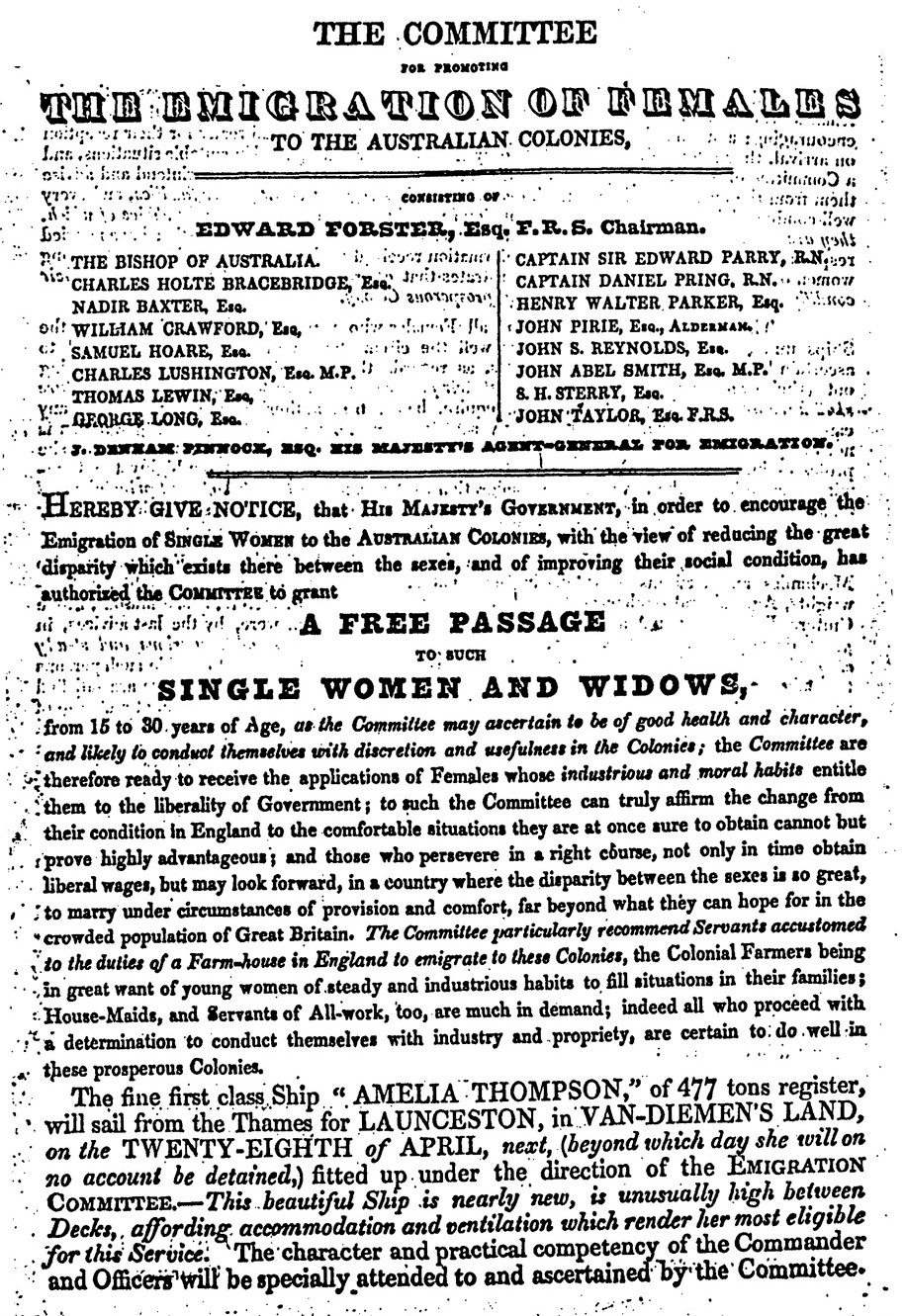
The benefits of a life in Tasmania having been sold, it’s possible that many young girls (or ‘older’ women beyond 30) may have hustled their way onto the Amelia Thompson:
This beautiful ship is nearly new, is unusually high between Decks, affording accommodation and ventilation which render her most eligible for this Service11.
Of course the reason for an age discrepancy might not be so clear. My grandmother meticulously typed up a family tree many years ago, only to get the birth year of her husband wrong by several years.
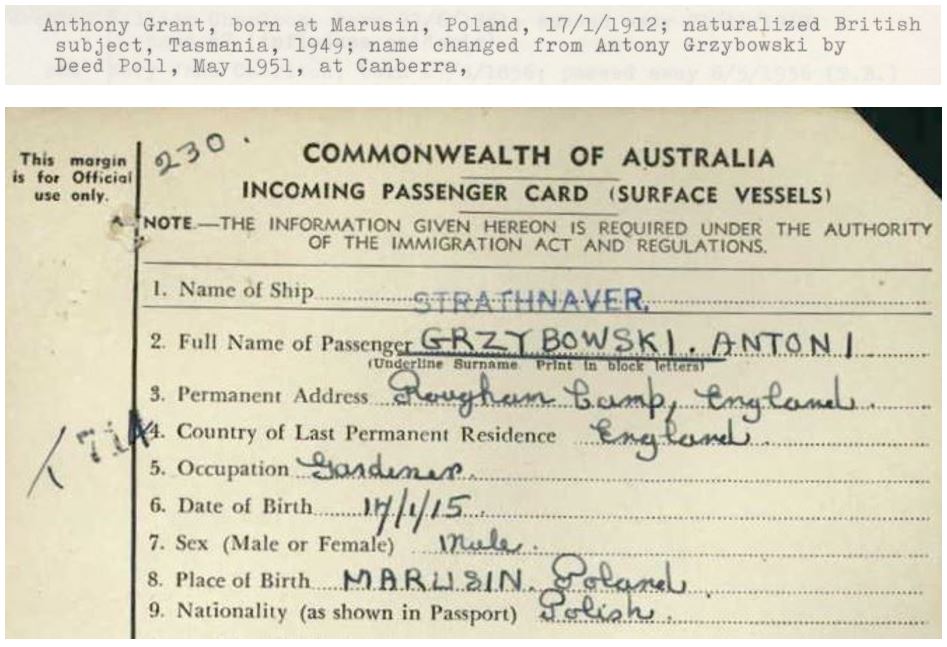
Below: detail from incoming passenger card for Antoni Grzybowski. Image courtesy of the National Archives of Australia. NAA: P1185
Had he adjusted his age down when entering Australia to make himself a more appealing immigrant? Had he added a few years when meeting his Australian wife to make himself seem older, a more stable future husband? Had my grandmother simply chosen to misremember her former partner’s birthday when writing this document several years after their divorce? Unfortunately the motivations will probably remain with my grandparents, now long passed.
If you find that you’re just not locating records for an ancestor, consider broadening the parameters of your age or date of birth parameters, or keeping them ‘fuzzy’. Most family history databases will allow you to set a birth date ‘range’ so you can account for the differences in age that have been mentioned above.
And remember that your family might not be the best sources of information in all cases. Just because someone was there doesn’t mean their memory is objectively correct.
Family lore has it…
The story goes like this: my family, fleeing Eastern Europe at the end of World War II, end up in a ship to Australia, where they are placed at a migrant camp, before settling more permanently in Victoria. I remember vividly the descriptions of the Nissan Huts by my Nanna; how much she hated them, how hot they got in the summer, the possum who bit her after she tried to domesticate it. Learning about the Bonegilla migrant camp later in life, I saw the pictures of the huts, just as Nanna had described. My family agreed – yes, that was where they were. There was no reason to doubt the story.
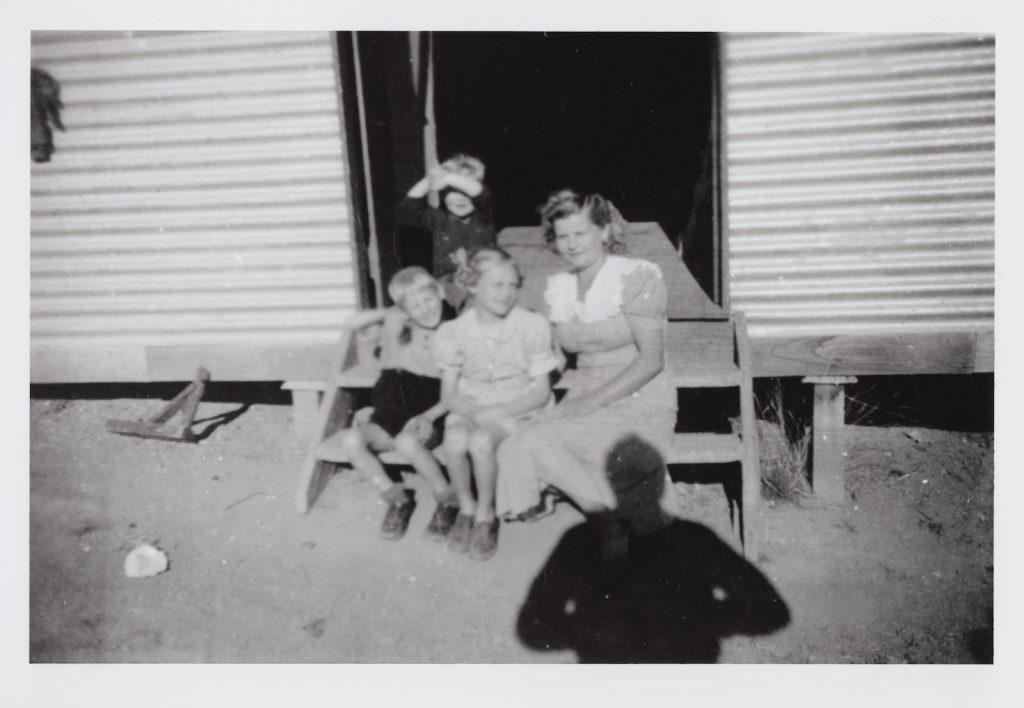
On my first trip to Bonegilla (which now functions as a living museum) I looked for the familiar Polish name in the displays, but it wasn’t forthcoming. Luckily, the surviving identity cards given to migrants processed at Bonegilla are now searchable on the Bonegilla Migrant Experience’s website. But still, my family remained elusive. How unfortunate that my family would be amongst some of the missing records, I thought.
I had found my family’s migration records at the National Archives of Australia earlier in my family history journey, but I clearly hadn’t read the series description in its fullest. I expanded all of the series notes, including those detailing the voyage of the ship my family were registered on – the ‘General Stewart’ – in the hope that I had missed something. And it turns out that I had:
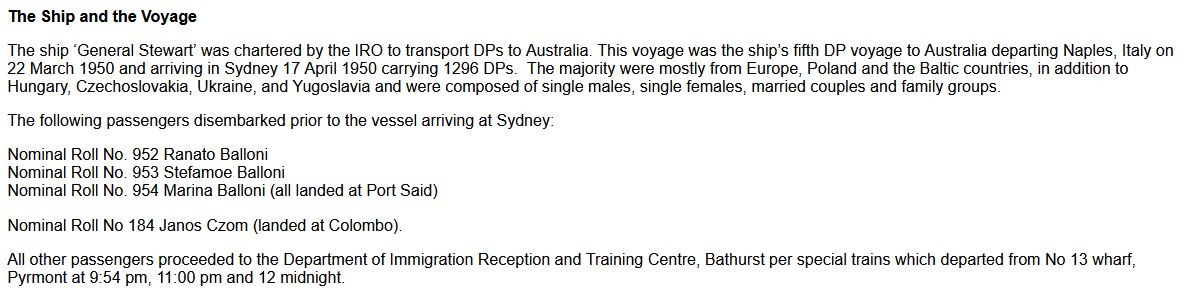
All other passengers proceeded to the Department of Immigration Reception and Training Centre, Bathurst.
My family was never in Bonegilla, they were sent directly to a lesser-known camp at Bathurst, NSW. My Victorian identity now in tatters, I realised how easy it had been for the misinformation to accidentally infiltrate my family story. My family’s muddled memories of a land they didn’t understand – partnered with well-known Australian stories and images that were learned later in life – lead to assumptions that were dutifully passed down with each retelling, until it was just part of the accepted version of the story.
This wasn’t intentional, and it wasn’t that far from the truth, either. But it’s a good reminder that memory is not infallible, and no one’s family is immune.
This blog isn’t intended to sow the seeds of doubt in the stories your family tells you, but if you are on your Family History journey I hope that these stories encourage you to approach your research from a place of curiosity instead of assumption.
If you find you’re hyper-focusing on a fact that is proving hard to corroborate, take a step back and think about whether there’s another explanation. Broaden the date range of your search, check every alternate spelling you can think of. If an article isn’t in the newspaper you thought it would be in, try another paper or a different year entirely. Memory is a great starting point, but don’t take it as fact. And please, please – check your references.
More to explore
Misinformation
- Read our research guide on Misinformation, written by our Librarians
- Visit our exhibition Make Believe: encounters with Misinformation (until 26 January 2026)
- Read our blog: Make believe and misinformation: a guide for cutting through information overload
Family History
Read our Family Matters blog posts:
- Researching births, deaths and marriages in Victoria
- How to trace your ancestor’s criminal past
- Five things to keep in mind when researching your family history
- I know their name, so why can’t I find them?
References
- Unfortunately due to vendor specifications we are not able to provide remote access to Ancestry Library Edition from home, but you can use it onsite at SLV, or at your local public library
- Research on Elsie May Cameron was being performed as part of an ongoing project to identify people featured in the Rosenberg collection of Vincent Kelly portraits. You can read more in our blog Mysteries from the Rosenberg Collection of Vincent Kelly’s Bendigonian portraits.
- If you are starting out with family history research, we recommend reading our research guide on Researching your Victorian Ancestors, particularly the page on Research Steps
- Buchanan J, Hill S, Shapoval O (2023) ‘ChatGPT Hallucinates Non-existent Citations: Evidence from Economics‘, The American Economist, 69(1), 80-87, viewed 28 July 2025
- Hillier M (2023) ‘Why does ChatGPT generate fake references?’, Teche, Macquarie University [website], accessed 28 July 2029.
- Australia. Department of Defence. Directorate of Recruiting (1905), Military forces of the Commonwealth: notice to candidates for enlistment in the volunteer forces, Melbourne: Director-General of Recruiting, p 8
- ibid. p 14
- ibid. p 18
- Ménard H (2023) ‘Janet Johnston‘, Female Convicts Research Centre Inc [website], accessed 28 July 2025
- Committee for Promoting the Emigration of Females to the Australian Colonies (1836) Notice of a grant of a free passage to single women and widows from 15 to 30 years of age, to be made by the Committee / Edward Forster: Chairman. p1
- ibid.


Great information, thanks for your detailed work. Lots to think about here.
Excellent blog. It raises many of the main errors in family history research, and how they are made and/or perpetuated. Definitely a great ‘heads up’ to researchers.
I am after my Russian heritage which you don’t cover,who immigrated to Adelaide Australia in1948.i have been to the immigration museum who provided me with their ship but not their birth place.how do I find this.my Polish father was john jaroszonek and my Ukraine mother was Anna Kurylenko. Peter Oliver.
Hi Peter, thanks for the question. Eastern European family history can be particularly challenging due to the war, and I must confess I have struggled to trace my own back further than my great grandparents’ names (and even then know virtually nothing about them). I’d recommend reading our Researching your overseas ancestors research guide for some more general tips, and the FamilySearch Research Wiki pages on the countries are a real help too. If you would still like some additional assistance feel free to contact us via Ask a Librarian with as much information as you have and we can spend about an hour of research time seeing if we can find anything else.
Hi Peter,
Your parents are listed on the National Archives of Australia. Their migration cards are loaded up, but not their naturalisation certificates (typically these detail birthplace). Alternatively, the full death certificate should also.
As they went through Bongegilla near Albury-Wodonga, they should have their records included there. Many Poles were ‘processed’ through Bonegilla and to a lesser extent, Ukrainian migrants. Unfortunately, these nationalities are quite a task, especially given the changes in borders and ‘governance’ over time on multiple fronts.
https://idcards.bonegilla.org.au/
So useful to have this information so thank you.I’m in another State but have Victorian Ancestors.
Thanks Narelle! All of the concepts that I’ve talked about are of course relevant to all other states. If you do have any questions about your Victorian ancestors I would recommend reading our research guide on Researching your Victorian Ancestors, and if there are any physical resources that you wanted us to check on your behalf you can contact us via Ask a Librarian.
Thank you so much. There is so much good information here.
I enjoyed reading all the information here. I have been doing family history research for 45 years and love it. Grew up with many stories of how things were and who did what etc. Some of them were fact, the others well, we all know about misinformation.
I still have some dead ends and brick walls to get through, but I do agree to the stepping back and trying a new way of looking at a problem. My 2x gr grand father was one of those from the day he was born. There were two babies born with in 6 months of each other given the same name from parents with the same names. Which one was mine.
Anyway long story short I picked the wrong one, Family in UK contacted me through Ancestry we sorted it out. Turned out the two boys were cousins. So now we have the right one in the right tree we hope. Time will tell.
I never take for granted what is put in public trees on any platform. Always do the verification for myself and pass it on to the ones who need to know.
Great blog gave we some ideas.
Thank you
I’m really happy you got something out of the blog, Julie! Yes it’s always good to take a step back if you’re getting stuck. Most organisations are constantly digitising more records, so if you give one ancestor a bit of a break for a while you might come back and find something new that wasn’t there before!
Thank you, Ms. Grant. Where might I find a list of geneologists? I wish to hire someone to assist me with a search of records for my grandfather.
Hi Kevin,
At SLV we can provide around one hour of research help time to you, which might be good if you have a specific question or roadblock that you are wanting assistance with. You can contact us via the Ask a Librarian service. If you are wanting to engage the services of a professional geneaologist for more detailed assistance, I would recommend looking at the website of AAGRA – Australasian Association of Genealogists and Record Agents Inc. They have a directory of researchers who may be able to assist.
Great article and one I can relate to. I started my family research in 1982 and struggled to find one ancestor. The family story was an abandoned or illegitimate child. I recently found out that he was French and prisoner of war in England late in the Napoleonic wars. He stayed in UK and married an Englishwoman. So all the stories that my father believed were to hide that origin.
Oh that’s fascinating, thanks for sharing that story, Kenneth!
Fantastic stuff. If only I had time and you had the space for me to post you all the intricacies that make/made up my family that that of my partner’s and his going back through the nineteenth century. And mine. Still intend to. Wasn’t just the lies and the editing and the interpretations I had to plough through there are lots even up to today that are going to be lost because of the editing and acquiring disorders or embedded traumas I have to deal with and I don’t know how much longer I too will lose my abilities of accurate flashbacks and triggers. Much is written down waiting to be sent to the appropriate department but there is still so much within my knowledge (I haven’t got the disorders) that needs to be recorded because I was there. Already it has been edited, twisted, distorted or and denied as I tell the whole story, warts and accolades both and all inbetween. But is anyone interested until all they have is to look back.
But you have such a great project here. Thank you for preserving it.
Excellent in that it demonstrates the need to check family stories are supported by documentation and that documentation can also be wrong ie names and ages on marriage and death certificates. As the blog points out some are honest mistakes but others are deliberate lies. Well done!
Thanks Claire, I’m glad that you enjoyed it. Yes it’s good to keep in mind that sometimes these are deliberate falsifications, but other times they are just mistakes. There’s a lot of room for human error in family history research!
I wish I had this information at my fingertips when I bagan researching in the 1990s. User input trees publicly available on line have led to an enormous overload of misinformation. I have the UK birth certificate of my GGrandfather b 1851 which provides the names if his parents and grandparents all in the incorrect fields. His mother was 16 when he was born, banns had been called for a wedding which happened 14 years later. In 1851 I can imagine the unwed illiterate mother telling the clerk the details and trying to hide the cold hard truth.
I’m glad you enjoyed the blog, Sandra! yes there’s a number of reasons why information may have been incorrect in this case, what an interesting story!
An excellent guide for family history researchers!
Glad you enjoyed the blog, Di!
Thank you for your article and associated references. I can empathise with you regarding your family connections. I have a Ms Brown marry a Mr Brown, and in the same sibling set, a Mr Brown marry a Ms Smith. I have laid that burden down and am avoiding it. The other common error I see with Ancestry is taking a birth date and place from a person with the same name in the US and applying it to a person who only ever lived in the UK.
Hi John, yes that’s another mistake that I’ve seen also! Ancestry is of course extremely strong with American records, which can sometimes flood results. I often recommend that people make use of the filters to ensure that they’re seeing results from relevant areas of the world.
Great article Caitlyn. One of the things I love about family history research is that moment when you discover something you didn’t expect. Researching my great grandfather, I found the record of his baptism in London in 1853. Months later researching his father’s siblings I found the record of the baptism of his Aunt’s child around the same time. Something looked familiar – the baptism was the same day (Christmas Day, I think) and the next record was his. He had been baptised on the same day as his cousin, but I hadn’t realised, as his Aunt, of course, had a different surname. This also provided some confidence that I had the right sibling.
Oh Yes!, the stories, and then the truth. So many changes to the spelling of a name, and then someone telling you that you are wrong and that they have the right person, even though common sense tells you otherwise. Family History can be so frustrating. Great Article, thank you.