
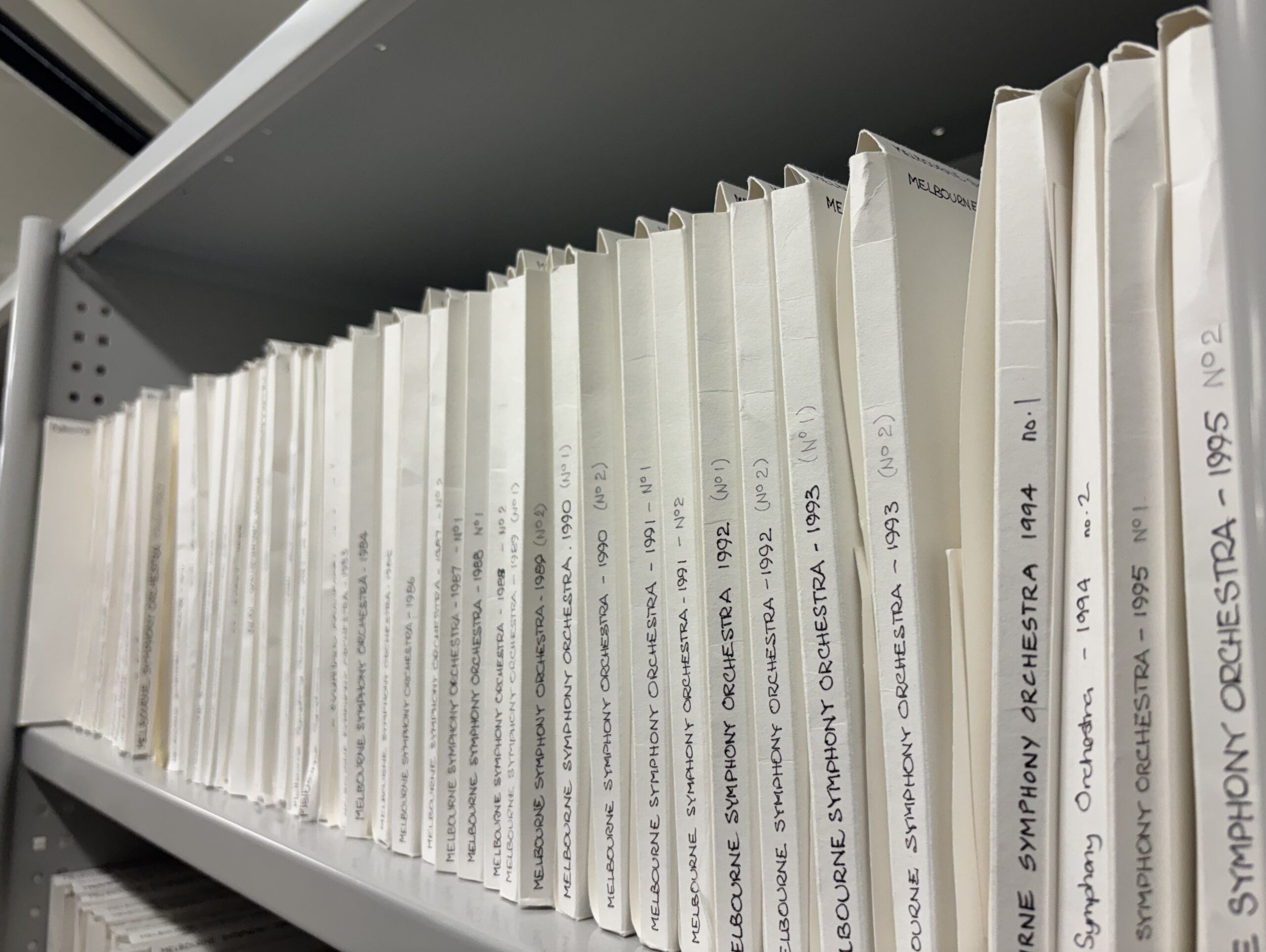
The State Library’s Theatre Programmes Collection consists of some 48,000 items, 1 each a gem, and each one containing details that might otherwise prove elusive, such as precise dates of performances, venues and names of performers. Taken together they give an invaluable pointer to an ever-evolving theatre tradition.
Orchestral music is also included in the collection, a reminder that Victoria boasts ‘Australia’s oldest symphony orchestra’, 2 and much more.
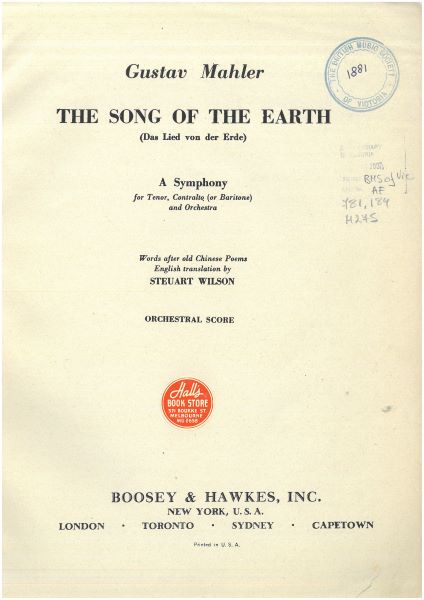
A query about a 1973 Melbourne performance of Gustav Mahler’s The Song of the Earth (Das Lied von der Erde), the composer’s late ‘Symphony for Tenor, Contralto (or Baritone) and Orchestra’, 3 offered a welcome opportunity to delve into the Theatre Programmes Collection, and to consider the role this strangely haunting work — ‘arguably Mahler’s greatest masterpiece’, 4 seen by some as his Requiem 5 — has played in Australia.
Mahler had deep concerns about the work and shared them with his friend, the conductor Bruno Walter. ‘Is this to be endured at all?’ he asked. ‘Will not people make away with themselves after hearing it?’ Mahler was referring in particular to the long final movement, ‘Der Abschied’ (‘The Farewell’). 6
Mahler wrote to Walter, ‘Mein Lieber Freund’, 7 in September 1908, naming the Song of the Earth as possibly his most personal work to date. 8 Tragically, Mahler was not to hear it performed; it was Walter who conducted the first performance — in November 1911, in Munich — six months after Mahler’s death. ‘I was deeply conscious of my responsibility,’ Walter recalled, 9 and he remained a determined champion of this work for the rest of his life.
When, for example, Walter was invited to conduct the Vienna Philharmonic Orchestra at the inaugural Edinburgh Festival, held in 1947, he insisted that The Song of the Earth be performed, an insistence that ‘had thrown the organisers into conflict’, 10 although it proved to be a highlight of the Festival. ‘To many people present,’ the festival’s historian wrote some forty years later, ‘this concert remains the most memorable of any Edinburgh Festival.’ 11
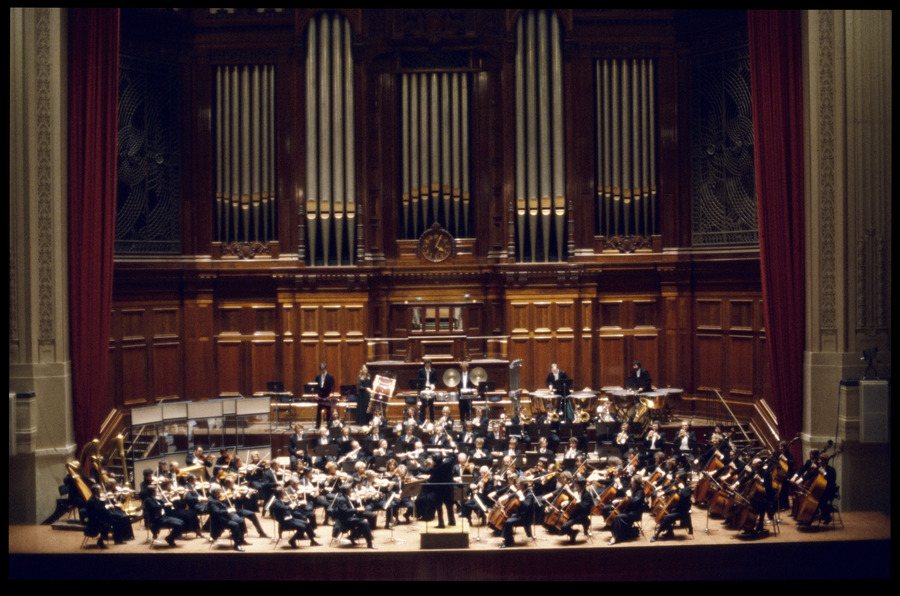
Of interest to us is that the influence of Bruno Walter, who had died in February 1962, was still present in the Melbourne Town Hall on that Thursday evening in July 1973 when The Song of the Earth was performed by the Melbourne Symphony Orchestra. 12 His influence was present in the person of the contralto soloist, Maureen Forrester, who had worked closely with Walter and had recorded Mahler’s Second Symphony with him. ‘He had given me the gift of Mahler,’ she stated.
‘Even now, all these years later,’ Forrester wrote in memoirs published in 1986, ‘every time I sing Lied von der Erde, no matter where I am, something strange comes over me.’ Towards the end of the final movement, ‘Der Abschied’ (‘The Farewell’), she looked up to the balcony of whichever auditorium she was performing in, and imagined Walter sitting there, giving his approval. ‘Ja, ja, mein Kind,’ he was still telling her. 13
Walter had described the final moments of The Song of the Earth as ‘the melting of a cloud in the ethereal blue.’ 14 He knew — as Mahler had known — that a singer could be overwhelmed at this point, and simply weep; Walter knew, also, that ‘in those tears spoke strength of feeling, not weakness.’ He wrote this in a tribute to the English contralto, Kathleen Ferrier, who had sung the work with him in Edinburgh. 15
Indeed, Ferrier had broken into tears and left the stage as the work came to an end. Neville Cardus, the English music critic and cricket writer who had recently returned from seven years in Australia, was present and immediately sought out Ferrier in the artists’ room. ‘What an idiot I have made of myself,’ she said to him, and then, when Walter entered the room, began to apologise to him. Walter’s response was extraordinary. ‘My dear Miss Ferrier,’ he said, ‘if we had been all as great artists as you, we should all have wept — orchestra, audience, myself — we should all have wept.’ 16
It is thanks to Cardus that we have this anecdote, and it is thanks to Cardus, also, that many Australians heard — in April 1941 — Walter’s first recording of The Song of the Earth. Cardus was living in Sydney and had been presenting a weekly ‘Enjoyment of Music’ radio programme for the ABC. Every Sunday evening it was beamed across the Australian continent.
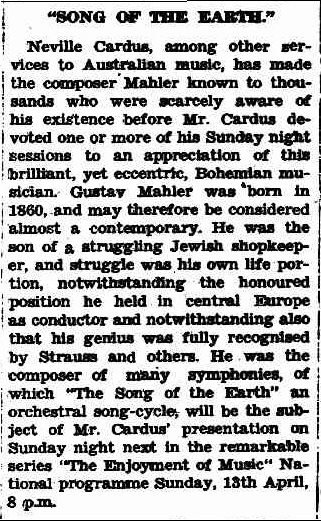
Against advice, Cardus — ‘that notorious “N.C.”’ as he was referred to — decided to risk ‘at my third or fourth session’, broadcasting Mahler’s work. The response from listeners astonished all. Letters of appreciation from across Australia came during the following week, not just from the cities, ‘but from remote places with, for me, curious and unpronounceable names,’ Cardus reported. 17
One youngster who heard the broadcast from his home in Tasmania was Peter Sculthorpe. ‘I was in my early teens,’ the distinguished composer recalled years later, ‘and if any work helped me decide to commit my life to musical composition, it was this.’ 18 Had he, too, written to Cardus? We do know that he took note of what Cardus said, and had read what Cardus wrote on Mahler, thoughts captured in the book, Ten Composers, published in Sydney in 1945. Sculthorpe, indeed, quoted a line from this book, a description of Mahler as ‘a shell in which we can hear the sound of a withdrawing sea.’ 19
Sculthorpe wrote his recollection at a time when his mother, Edna (1901–1994), was at the end of her life. She had encouraged him from the start and had, in 1942, taken her sons, Peter and Roger, to Melbourne, where they made for Hall’s Book Store in Bourke Street and bought the vocal score of The Song of the Earth. It was the ‘Farewell’ movement that ‘became more and more important to me,’ Peter Sculthorpe remembered; hardly a day went by, he added, when he did not play this movement on piano.

Sculthorpe’s recollection ended with a note of thanks to Edna, and with the final words from Mahler’s Song of the Earth, in English translation from his 1942 vocal score. (These final words were, in fact, additions by Mahler himself to the texts he had taken from German renderings of Chinese poems.)
I have strayed from my initial aim to simply highlight the State Library’s Theatre Programmes Collection, and have not even done justice to the 1973 Melbourne performance of The Song of the Earth. The tenor soloist alone would surely require a blog piece in his own right, as according to the programme, it was Gerald English ‘making his first ABC tour of Australia.’ 20
So too, the pianist, Jean-Rodolphe Kars. Born in Calcutta in 1947 of Austrian parents who settled in France soon after his birth, Kars, too, was ‘making his first ABC concert tour of Australia,’ and it was he who opened the concert of February 1973 with Franz Liszt’s mighty Piano Sonata in B. 21 His future course is also one to note.
Perhaps, however, in this year which marks the 165th anniversary of Mahler’s birth, it is worthwhile to mention ways in which his Song of the Earth touched Australians; and, at the same time, to remind ourselves of this incredible resource of 48,000 (or so) gems that make up the State Library’s Theatre Programmes Collection. It is there for us and for future generations to explore.
Postscript
This blog is dedicated to the memory of Roger Smith (1951-2025), former State Library colleague and musician extraordinary. He would, I can imagine, have turned to the Library’s copy of the score of The Song of the Earth (would he have noticed its ‘Hall’s Book Store, 371 Bourke St Melbourne’ sticker?), and may have been gently puzzled, also, by Arnold Schoenberg’s assertion: ‘Gustav Mahler was a saint.’ 22
References
- Theatre programmes | State Library Victoria
- Barber, Stella M (2007) Crescendo: Melbourne Symphony Orchestra, Celebrating 100 Years, Melbourne Symphony Orchestra, Melbourne, p vii.
- Mahler, Gustav (1942) The Song of the Earth (Das Lied von der Erde): A Symphony for Tenor, Contralto (or Baritone) and Orchestra, Boosey & Hawkes, New York.
- Hefling, Stephen E (1992) ‘Das Lied von der Erde: Mahler’s Symphony for Voices and Orchestra – or Piano’, Journal of Musicology, vol 10, no 3, p 293.
- Schumann, Karl (1972) Das kleine Mahler Buch, Residenz, Salzburg, p 93.
- Walter, Bruno (1937) Gustav Mahler, translated by James Galston, Kegan Paul, Trench, Trubner & Co, London, p 60.
- ‘My dear friend’
- Walter, Bruno (1946) Theme and Variations: an Autobiography, translated by James A Galston, Alfred A Knopf, New York, p 191.
- Blaukopf, Herta (ed) (1996) Gustav Mahler: Briefe, rev edn, Paul Zsolnay, Vienna, p 371.
- Leonard, Maurice (1988) Kathleen: The Life of Kathleen Ferrier, 1912-1953, Hutchinson, London, p 97.
- Miller, Eileen (1996) The Edinburgh International Festival, 1947-1996, Scolar Press, Aldershot, p 10.
- The Australian Broadcasting Commission presents the Melbourne Symphony Orchestra with Jean-Rodolphe Kars, Yuval Zaliouk, Gerald English [and] Maureen Forrester in the Fourth Concert of the 1973 Series, Melbourne Town Hall, Gold Series, Thursday, 26th July, 8.00 p.m. (1973) Australian Broadcasting Commission, [Sydney].
- Forrester, Maureen (1986) Out of Character: A Memoir, with Marci McDonald, McClelland and Stewart, Toronto, p 155.
- Walter, Bruno (1937) Gustav Mahler, translated by James Galston, Kegan Paul, Trench, Trubner & Co, London, p 127.
- Walter, Bruno (1954) ‘Farewell’, in Cardus, Neville (ed), Kathleen Ferrier, 1912-1953: A Memoir, Hamish Hamilton, London, p 113.
- Cardus, Neville (9 October 1953) ‘Obituary: Kathleen Ferrier’, Manchester Guardian, p 7.
- Cardus, Neville (1947) ‘Neville Cardus bids Adieu’, ABC Weekly, 7 June, p 22.
- Sculthorpe, Peter (1995) ‘The Song of the Earth: Some Personal Thoughts’, in Reed, Philip (ed), On Mahler and Britten: Essays in Honour of Donald Mitchell on his Seventieth Birthday, Boydell Press, Woodbridge, p 110; and Sculthorpe, Peter (1999) Sun Music: Journeys and Reflections from a Composer’s Life, ABC Books, Sydney, p 299.
- Cardus, Neville (1945) Ten composers, Collins, Sydney, p 88.
- The Australian Broadcasting Commission presents the Melbourne Symphony Orchestra with Jean-Rodolphe Kars; Yuval Zaliouk; Gerald English; Maureen Forrester. (1973) Australian Broadcasting Commission, [Sydney].
- As above.
- Schoenberg, Arnold (1912) ‘Gustav Mahler: In Memoriam’, in Stein, Leonard (ed) (1984) Style and Idea: Selected Writings of Arnold Schoenberg, 60th anniversary edn, University of California Press, Berkeley, p 447.


Another well-rounded, brilliant, historical commentary on a great piece of music by a great composer and the change it had on artists’ lives – and all this from a simple concert program – one of 48000.
Well done Walter
Really interesting piece, and thanks for sharing. I just wanted to add one detail: The Royal Melbourne Philharmonic Choir and Orchestra was founded in the 1850s so is older than the MSO by quite some time (although you could argue about whether they are considered purely a symphony orchestra or a musical organisation more broadly).
Dear Renata,
Thank you for this. Your clarification spurred me turn to W.A. Carne’s ‘A Century of Harmony: The Official Centenary History of the Royal Melbourne Philharmonic Society’, published in Melbourne in 1954.
It seems that its first choral performance was given in 1856, and its first orchestral performance in 1867.
In his foreword to this book, Sir Bernard Heinze (‘Conductor of the Society for the last 27 years’), wrote that ‘the “Phil” was, in fact, Melbourne’s music’, and closed with a ‘wish that the next 100 years may prove as fruitful as the first 100’.
Wonderful!
Thanks again,
Walter
A really good piece of writing. I didn’t mind the topic change as I learnt more about both Mahler and the collection. Sad to see the tribute for a fomer colleague who was in my mind a ‘perfect gentleman’. A quiet man who knew his stuff too. Thank you.
Fascinating article arising from a reference inquiry. Thank you
Thank you for this article. It’s fascinating and demonstrates the importance of collecting material like theatre and concert programs, which contain details often not preserved elsewhere. I also particularly enjoyed the discussion of the radio broadcast’s reception. Thanks so much again!
A wonderful essay, Walter, and thank you for highlighting the significance of the SLV’s Theatre Programmes Collection.
I’ve just read your Mahler essay (and it is an essay…much more than a mere blog piece). It’s wonderful, you really understand the art of research and the challenging but wondrous art of short biography. The set of references are themselves an important archive. I like all the interconnections and I especially coming across Sculthorpe in that context. And such a dignified tribute to your friend and colleague Roger Smith.
A moving and beautifully written & researched article, Walter, about one of my favourite composers and favourite SLV collections. Thank you.