
After recently discovering a connection with my local area through the photograph albums of World War I nurse Kathleen Gawler, my research led me to the equally interesting and intriguing story of her husband, Reverend Herbert Edward Elton Hayes (known as Padre Hayes).
The library holds copies of his poetry and verse, religious and biographical writings, including the controversial God’s priceless mountebank : An allegory and tale of heresy during Melbourne’s first centenary celebrations, providing insight and commentary into Hayes’ heresy trial, where he was found guilty of ‘false doctrine and conduct disgraceful by a clergyman’ by the Ecclesiastical Commission of the Anglican Church.1 This sensational period is how Hayes has become defined by history and widely reported in the news. While the trial was significant and cannot be overlooked, I’ve learnt that Hayes was a complex, complicated individual; benevolent, Christian, community-minded, principled, passionate, rebellious, unreasonable, unpredictable, and eccentric. Someone deeply impacted by his experiences, and the strain of a process that he felt sought to make an example of him because of his unconventional views.
Born in 1882 in Kent, England, Hayes was educated at a local Church of England School and a Nonconformist academy, later spending five years in the volunteer militia, before transferring to the army. 2 He writes about this in Two years in the army (1904-6) by a private of the Army ordnance corps. We are introduced to someone with leadership ambitions, but who was very different to his comrades and found military discipline a challenge.
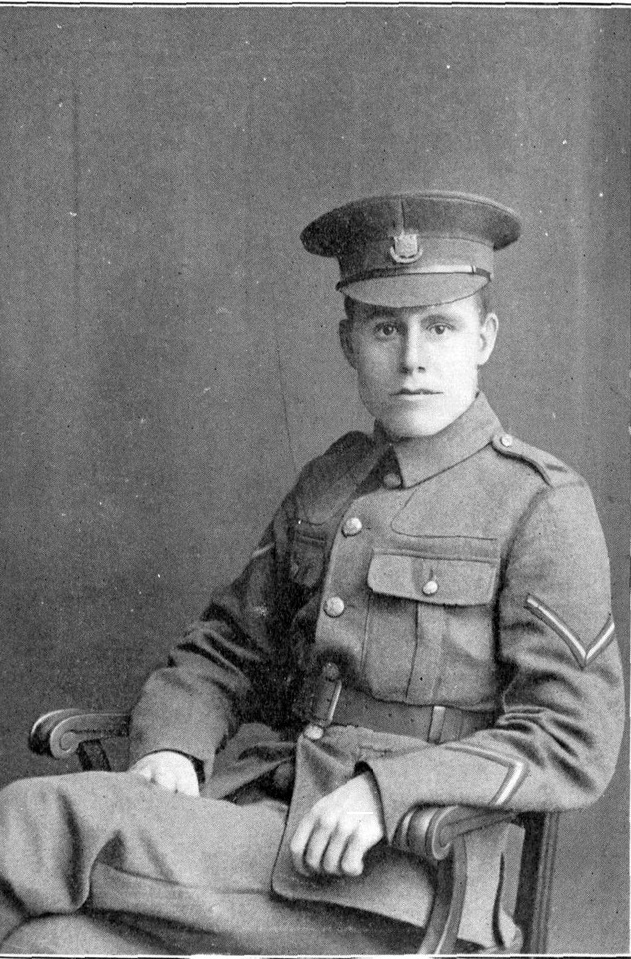
H. E .E. Hayes in his army uniform, from Two years in the army (1904-6) by a private of the Army ordnance corps.
Eventually charged with insubordination, Hayes was sent to Dublin, where he met an enthusiastic Christian who he credits with changing the course of his life.3 It was not until after a critical injury to his leg that his ideals truly changed.4 In early 1906, he left the Army to begin Baptist theological training, but left within a year, joining the Foreign Missionary Service.5 While serving in Egypt in 1910, he also acted as an observer for British military intelligence.6 As World War I began he was called up to serve on the Western Front.7
After the war, Hayes’ religious allegiances changed to the Church of England, and he returned to Egypt for the Church Missionary Society, in charge of the church and school in Menouf.8 In 1923, an Australian nurse, Sister Kathleen Gawler was sent to the mission and love blossomed between the pair.9 Following their marriage, the couple departed Egypt and spent 6 months in England, where they met Toc H founder, Reverend P.B. “Tubby” Clayton.
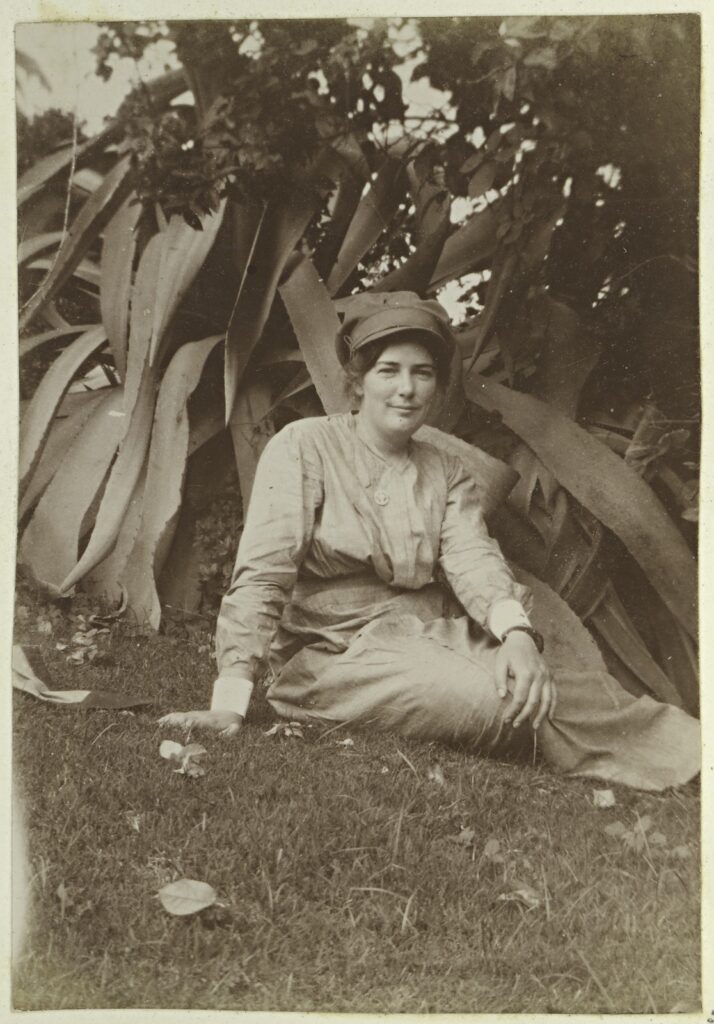
The origins of Toc H began in December 1915 in Belgium with the establishment of Talbot House,10 a place of rest and relaxation where battle-weary soldiers from World War I were met with friendship and camaraderie, and could seek counsel and guidance to deal with the challenging environment around them.11 Grounded in Christian values, the movement’s ideology grew post-war to foster a broader sense of service to community, helping the disadvantaged and marginalised.12
Upon hearing of the couple’s move to Australia, Clayton tasked Hayes with establishing the movement locally.13 Hayes arrived in Australia in September 1924 and immediately began setting the foundation, travelling the country as national padre.14 A tireless promoter of the cause, Hayes was outspoken, and some of his views were considered too liberal for the establishment, going beyond what was considered acceptable.15
Hayes also caused disquiet in 1926 when he spoke out against the Returned Sailors and Soldiers Imperial League’s treatment of unemployed returned soldiers.16 As a result, he was asked to vacate his office space at Anzac House by the RSL17 forcing Toc H to try and distance itself from his views.18 By the end of that year, he had stepped down from formal duties,19 but continued to be a supporter of the movement.20
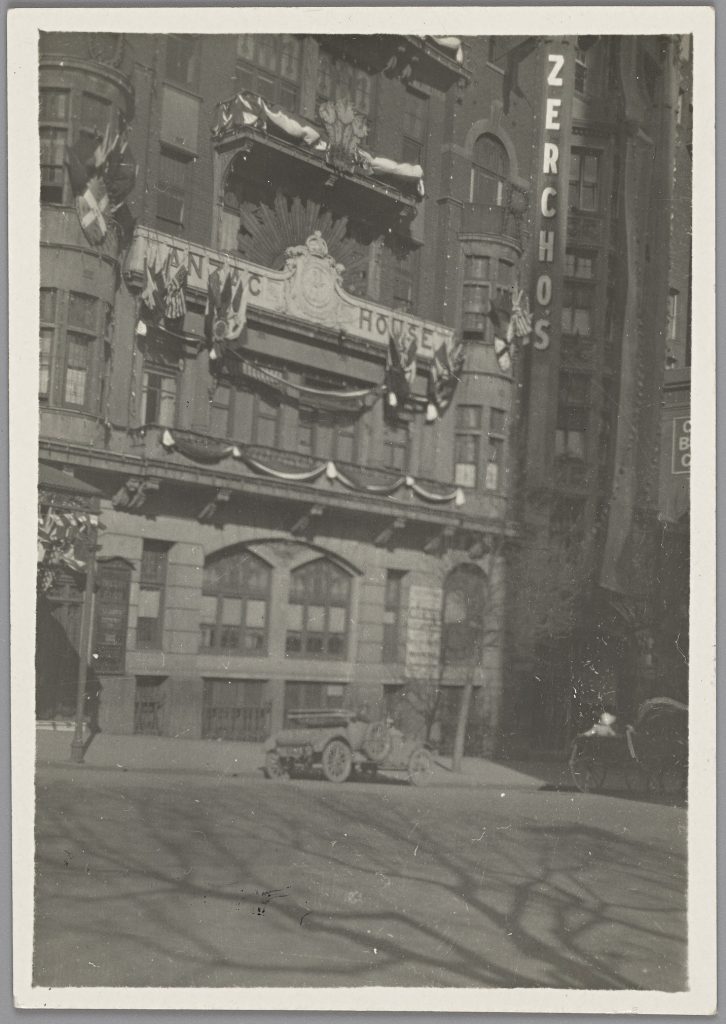
Anzac House, decorated for Royal visit, 1920; H37808
In 1927, he was offered the Church of England ministry at Mernda.21 Alongside his religious commitments, he involved himself in community activities, including the Progress Association, where he pushed for Mernda to be declared a township22 and fought for the installation of drainage in an area prone to flooding.23 He acted as local scout leader24, and encouraged support of charitable events.
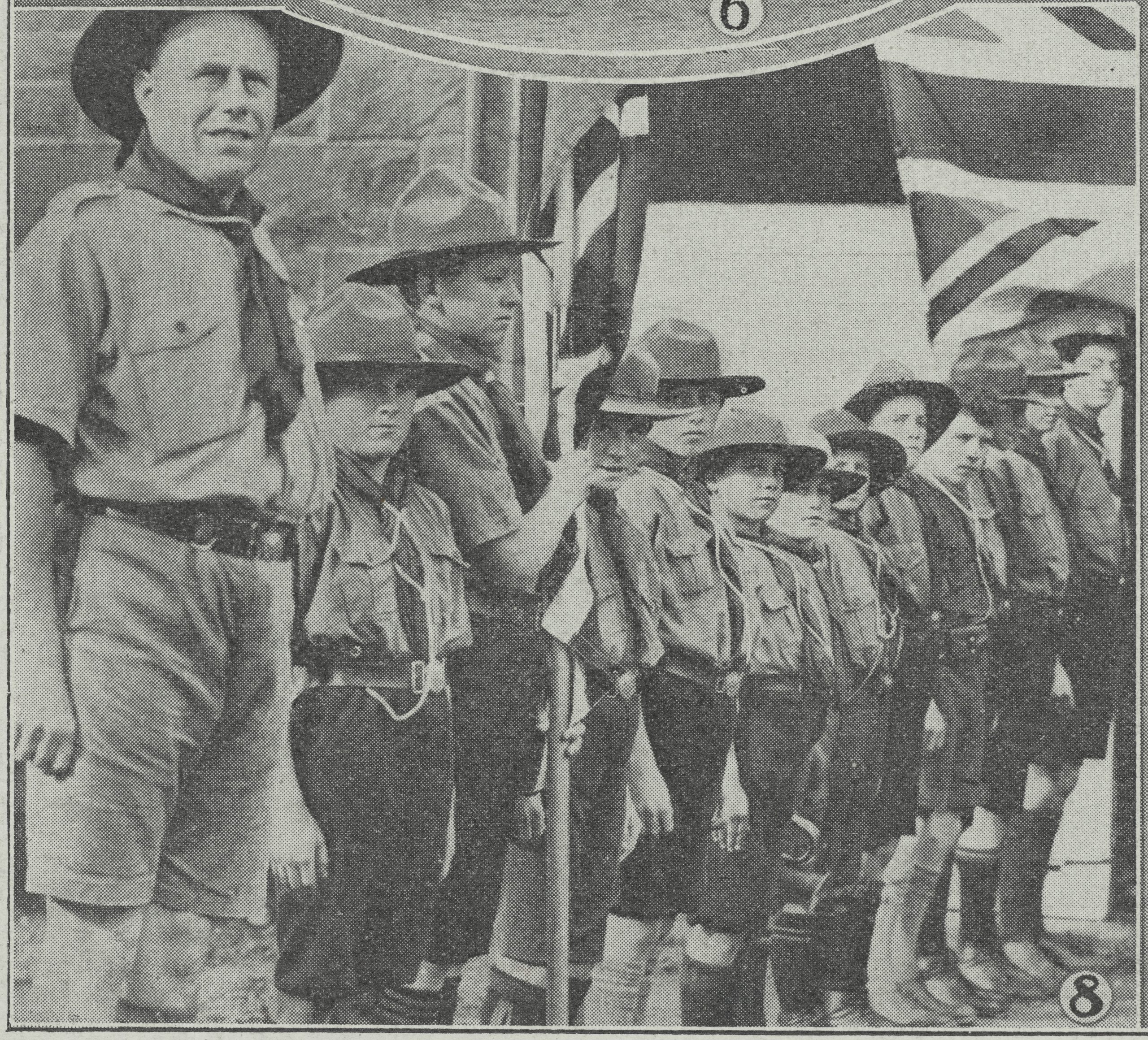
Hayes and scouts at Mernda Township proclamation, Weekly Times, 5 May 1928, p 40
Hayes was extremely loyal to his parish, but his was not a conventional ministry. He practiced alongside other religions, and so had good relationships with people of other faiths, not afraid to challenge the institution and call for change.25 While this may be more accepted today, it rankled officials of the time. His passion for writing meant that he had an additional platform to express himself, and he wrote as himself and under pseudonyms for Smith’s Weekly, The Bulletin, Argus, and Herald, and Labor Call on Christian values and faith. His books of poetry and verse showed his lighthearted and humorous side, on topics such as beauty, childhood and nature, alongside religion. It was his piece in the Christmas 1934 issue of Labor Call that signalled his eventual undoing.
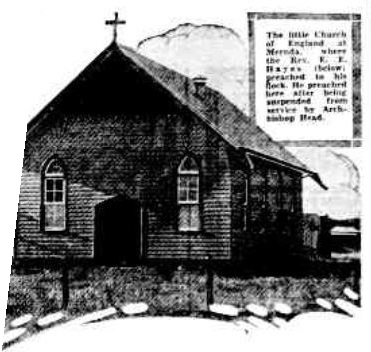
St. Stephen’s Anglican Church in Mernda, where Hayes ministered, Brisbane Truth, 5 June 1935, p 27
In ‘Peace Goodwill’, Hayes wrote of the importance of bringing extra Christmas joy to all children, even those who were ‘illegitimate’, citing that Jesus himself was an illegitimate child 26. This seeming challenge to the concept of divine birth was to form the basis of his June 1935 heresy trial.27 Hayes was initially asked to resign his position but would not oblige until he had the chance to defend himself. He sought and gained the support of many parishioners and continued to preach.28
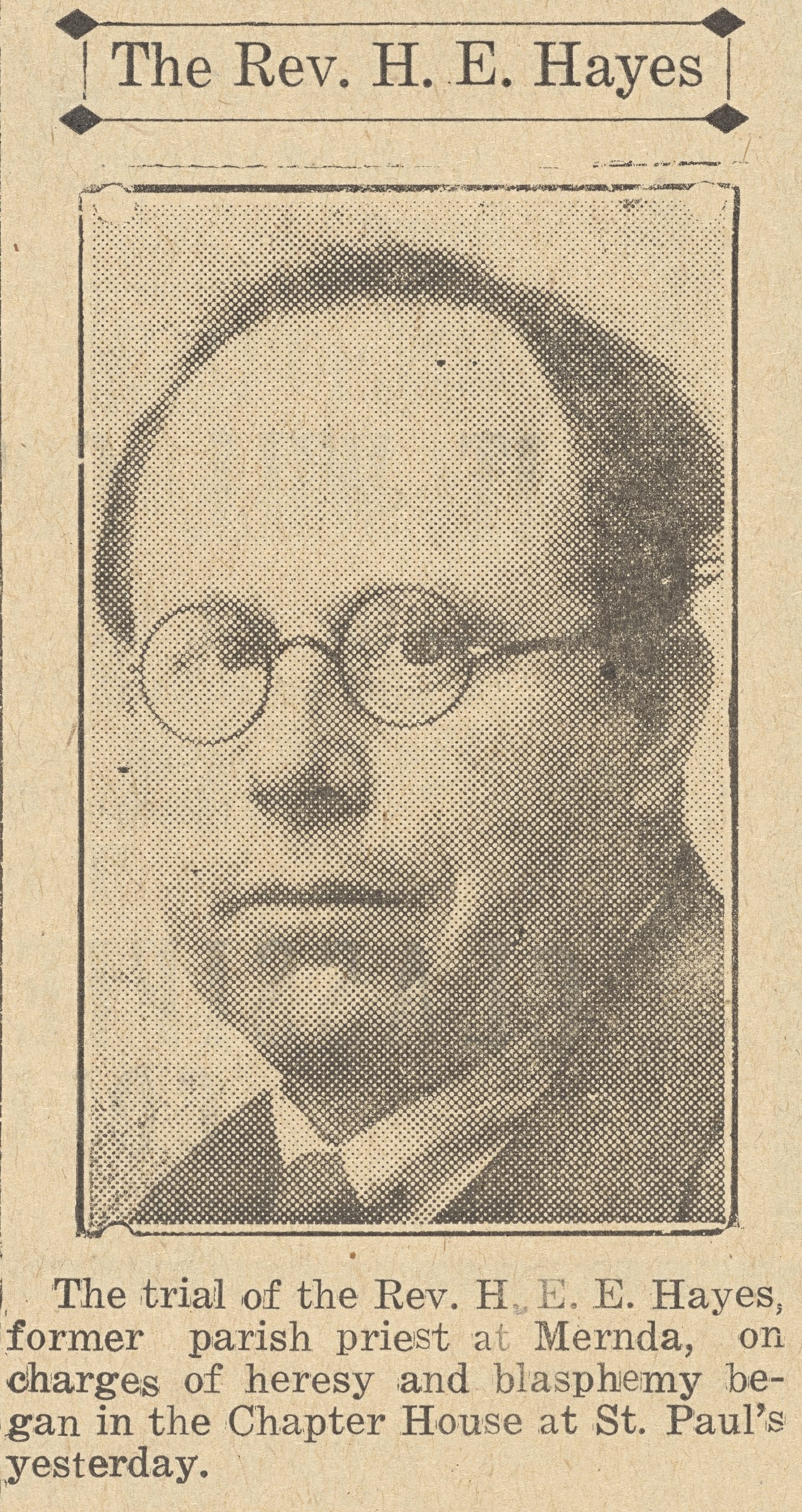
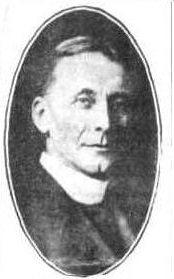
Left to Right: Hayes (Shepparton Advertiser, 6 June 1935, p 10) and Archbishop Frederick Waldegrave Head (Townsville Daily Bulletin, 6 January 1930, p 7)
As the case played out, relations between Hayes and Archbishop Head, the Anglican Archbishop of Melbourne became more central. Hayes alleged there was a conspiracy against him, and the toll on his mental health was evident. A number of adjournments took place, particularly when he was ordered to rest following a nervous breakdown.29 When the trial resumed, Hayes was again given the opportunity to voluntarily resign from the parish. An appeal was sought and parishioners petitioned but this failed in the early months of 1936.30 The parish was dissolved and the vicarage was offered for sale.31 Hayes continued offering sermons, fighting to reinstate his position and seek restitution.32
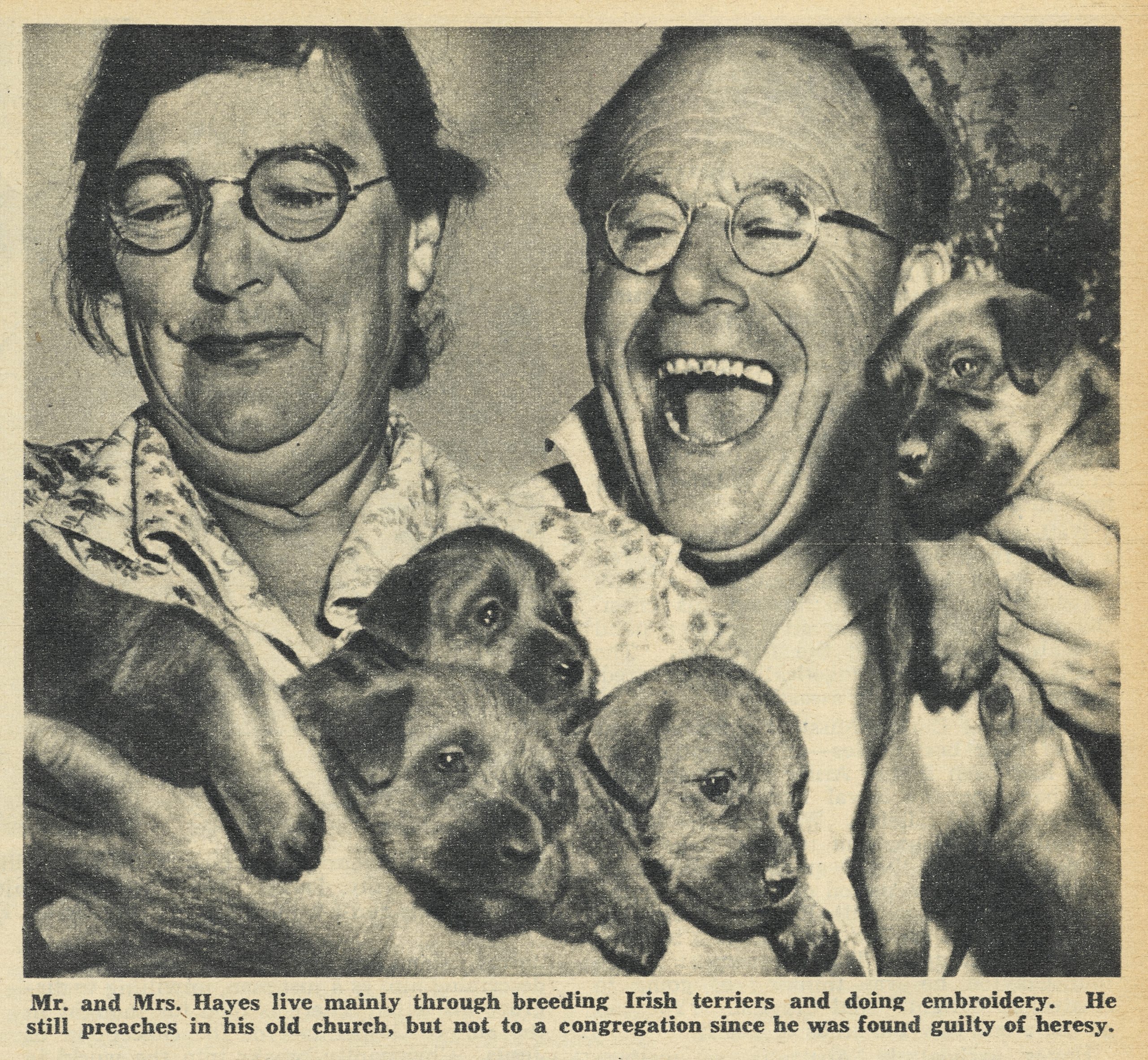
People (Sydney), July 2 1952, p 15
In October 1960 Hayes passed away in Fairfield aged 77.33 His is a rich story of many shades. There is no doubt he was controversial and challenging, but he was also strong and principled, and stood up for what he believed in. Before writing this blog, I knew a little of his story. While my views took a few turns as I researched, I discovered that there is much more to Hayes than one particular point in history.
Note: While State Library Victoria has a number of collection items relating to Hayes, his personal papers are held by the National Library of Australia.
More to explore
Giddens Daniel (10 May 2024) ‘Kathleen Gawler: Uncovering a local connection‘, State Library Victoria blog
Works by Hayes held by State Library Victoria
Link magazine (TOC H Australia)
Articles on Hayes and TOC H on Trove
Articles about Hayes and Mernda
Reporting of Hayes’ trial in Victorian newspapers
References
- ‘Removed from office‘, (8 February 1936), The Argus.
- Lewis DC (2006) ‘Herbert Edward Elton Hayes (1882–1960)‘, Australian Dictionary of Biography [website], accessed 30 June 2025.
- However, he recounts that he didn’t feel a ‘sudden change’ (or religious awakening) that others often speak of, Hayes, H (1914) Two years in the army (1904-6) by a private of the Army ordnance corps ordnance corps, Standard, Gravesend, p 49.
- He spent fourteen days unconscious in the military hospital. As above, pp 49-53.
- ‘Self-confessed heretic’ (1952, July 2), People, p 15.
- Lewis DC (2006) ‘Herbert Edward Elton Hayes (1882–1960)‘, Australian Dictionary of Biography [website], accessed 30 June 2025.
- As above. He rose to the rank of acting lance sergeant.
- ‘Self-confessed heretic’ (1952, July 2), People, pp 15-16.
- Within weeks they married at the British Consulate, on 15 June 1923.
- ToC H being the abbreviation for Talbot House, named for one of the founder’s brothers, Lieutenant Gilbert Talbot, who was killed in action in July 1915, referred to as T.H., or in Signallers’ language, Toc H.
- ToC H Australia (n.d.) ‘The Fascinating Story of TOC H‘, ToC H Australia [website], accessed 1 July 2025.
- Altschwager L (1985) The first sixty years: A history of Toc H in Australia from 1925 to 1985, Toc H Australia, Adelaide; ToC H Australia (n.d) ‘The Mission and Vision‘, ToC H Australia [website], accessed 1 July 2025.
- Governor General, Sir Henry William Forster, expressed an interest in establishing the movement in Australia in memory of two sons killed during WWI and invited Clayton to visit in 1925. Altschwager, as above, pp 6-7.
- ‘Self-confessed heretic’ (1952, July 2), People, p 16.
- In response to views expressed at an Anglican Convention about ToC H and its connection to the Church, he wrote of errors on his part when trying to foster support. He reflected on what he felt was ToC H’s interdenominational nature, as a progressive group serving everyone regardless of need, their beliefs or character: ‘It will augment all that stands for good as expressed in the simple life and teaching of Christ’, ‘Letter to the Editor‘, (18 October 1927), The Argus, p 18.
- ‘Unemployed soldiers‘, (23 April 1926), The Age, and ‘ToH H must go‘, (4 June 1926), The Sun News-Pictorial.
- Lewis DC (2006) ‘Herbert Edward Elton Hayes (1882–1960)‘, Australian Dictionary of Biography [website], accessed 30 June 2025.
- ‘Soldiers’ league and ToH H‘, (13 July 1926); The Age, and ‘R.S.L. and Toc H‘, (21 June 1926), The West Australian.
- ‘Founders of ToH H Intend Taking Long Holiday‘, (10 November 1926); The Herald, and ‘Personal‘, (2 December 1926), The Argus.
- For example, ‘ToC H endowment fund‘, (29 January 1929), The Argus.
- ‘Personal‘, (11 January 1927), The Argus.
- ‘Whittlesea council‘, (16 September 1927), Advertiser (Hurstbridge); ‘Mernda a township‘, (17 February 1928), Advertiser (Hurstbridge); ‘Proclaiming Mernda a township‘, (20 April 1928), Advertiser (Hurstbridge), and ‘Mernda Proclaimed a Township‘, (27 April 1928), Advertiser (Hurstbridge).
- ‘Separation drain‘, (10 March 1933), Advertiser (Hurstbridge). He penned the cheeky ‘The Waters of Separation: A Ballad’ ‘…to stimulate a lethargic municipality to action’, published in his work, (1934) Centenary songs and a parson’s nonsense, Ruskin Press, Hawthorn, pp 82-83.
- ‘Mernda‘, (5 August 1927), Advertiser (Hurstbridge).
- ‘Mernda news‘, (2 September 1927), Advertiser (Hurstbridge); ‘Mernda‘, (25 November 1927), Advertiser (Hurstbridge).
- Mary’s ‘honour was saved by the love and grace of her husband’, a dignified and just man unwilling to disgrace his wife, Labor Call, 20 October 1934, p 19.
- His poetry and verse was also cited as evidence of disgraceful conduct for its attacks on the church.
- See for example ‘Faith of Rev. H. Hayes prepared to face trial‘, (25 February 1935), The Herald, and ‘False doctrine alleged in ecclesiastical trial‘, (5 June 1935), The Age.
- ‘Rev. H.E. Hayes has nervous breakdown‘, (6 March 1935), Sunraysia Daily.
- ‘Rev. H.E. Hayes action withheld‘, (28 December 1935), The Argus; ‘Future of Rev. H.E. Hayes‘, (1 February 1936), Shepparton Advertiser; ‘Rev. H.E.E. Hayes removed from office‘, (8 February 1936), The Age.
- His wife would purchase it, ‘Wife’s Vicarage Buy‘, (25 February 1935), The Daily Telegraph (Sydney); ‘Padre Hayes leaves for England‘, (13 July 1935) The Herald.
- In late 1938-early 1939, he made a failed attempt to seek £5,000 in damages from Archbishop Head.
- Lewis DC (2006) ‘Herbert Edward Elton Hayes (1882–1960)‘, Australian Dictionary of Biography [website], accessed 30 June 2025.


As the author of a major book on the Lemnos connection to Australia’s Gallipoli story (Lemnos & Gallipoli Revealed), I found your article very illuminating. Years ago I accessed Nurse Kathleen’s photographic archive of Lemnos and reproduced some of them in my book (see a brief blog post link below). Congratulations on your article, a reminder of the importance of the SLV collections and their accessibility to researchers.
http://lemnosgallipolicc.blogspot.com/2015/03/lemnos-discovery-photographs-held-at.html
Thank you for your comment, Jim, and sharing your connection to Kathleen Gawler’s albums.
A most interesting review of a very interesting person. I really enjoyed the read which promoted a wide variety of thoughts and ideas from this historical period.
Thanks Brendon. It’s illuminating for us as librarians to uncover the stories beneath the surface and share them with the public.