
On 3 August 1914 British Foreign Secretary Sir Edward Grey presciently remarked, ‘The lamps are going out all over Europe, we shall not see them lit again in our life-time’.1
The following day Britain declared war, and when Britain was at war, the British Empire (including Australia) was at war too.
For many young men war seemed a rousing adventure and they flocked to sign up.2 This initial romantic view was quickly vanquished under the crushing weight of casualties. The adventure became a descent into hell.
The First World War ushered in industrial and mechanised warfare. The technology had advanced only enough to cause stalemate with thousands dying for a few metres of muddy ground.
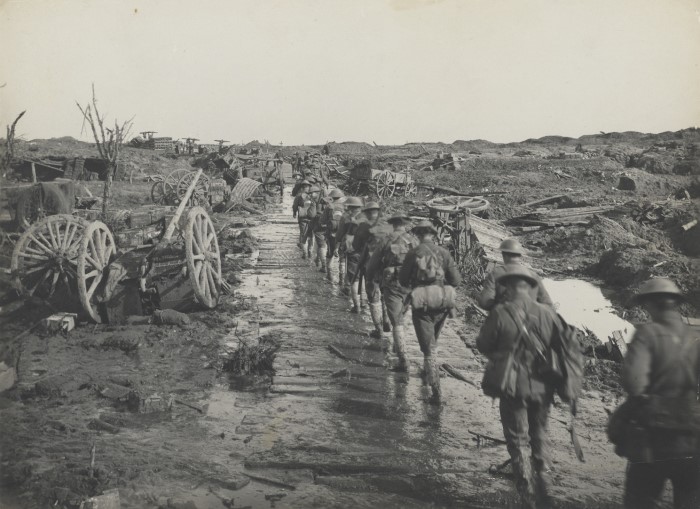
Australian troops making their way to the trenches, on October 28th 1917, along the wreckage strewn ridge of Westhoek, in the Ypres sector, in Belgium, 1917; H37630/18
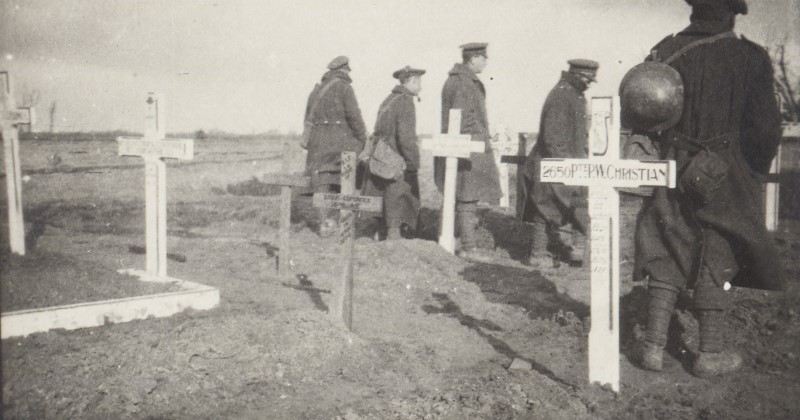
Soldiers standing among graves, Belgium, 1918; H36439/255
One respite from the horror for Australian soldiers was football. A number of VFL (now AFL) players enlisted, a number died.
One of the first to volunteer in August 1914 was Melbourne champion Arthur Mueller ‘Joe’ Pearce, a veteran of 152 games. He was in the initial wave of the Australian Infantry Force (AIF) to approach Gallipoli on 25 April 1915. He was shot dead before his landing craft even made it to the beach.
When Carlton player George Challis starred in the Blues 1915 premiership victory over their arch rival Collingwood, he had already volunteered for the AIF. In March 1916 he wrote from Cairo referring to a handful of former VFL players in his 6th Training Battalion in Egypt. Of eight mentioned, Bill Nolan, Hugh Plowman and Jim Morrison died, while Herbert “Boxer” Milne was severely wounded and returned a different man, dying young in 1930.
Three months after he wrote the letter, George Challis was killed by an enemy shell in Armentieres, France.3
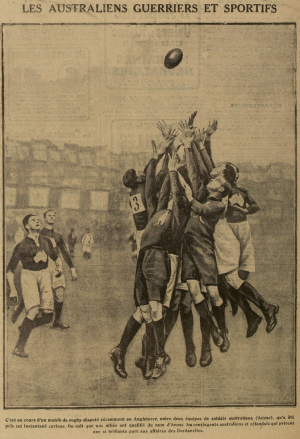
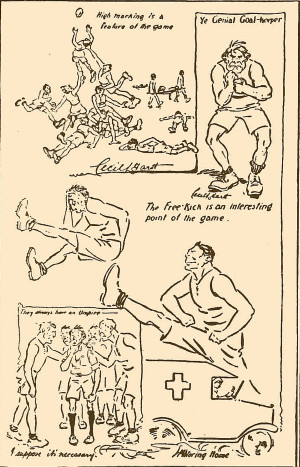
Left: Les Australiens guerriers et sportif [Australian warriors and sportsmen], (20 Nov 1916), Excelsior : journal illustré quotidien : informations, littérature, sciences, arts, sports, théâtre, élégances, p 12. Right: Winner, 20 December 1916, p 7
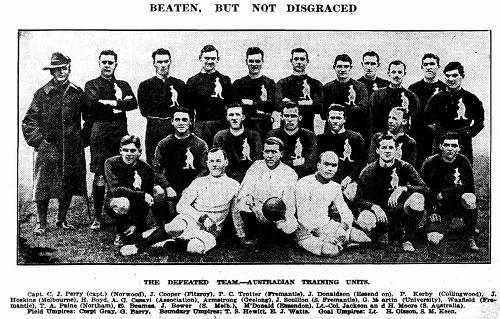
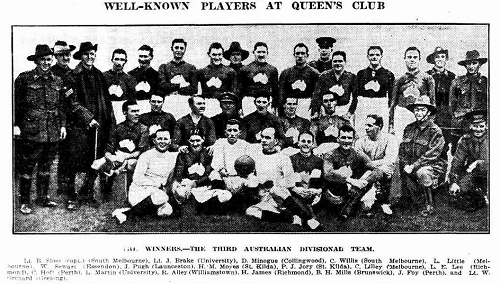
The two exhibition teams: Winner, 20 December 1916, p 7
In 1916 an Australian rules exhibition match was played in London. It was reported in the English newspapers. News of the game even made its way to France (above) and to New York. Six of the players competing later died in the war.4
Most games were played much closer to the front.
Ardy Muller, a young soldier from Kinimakatka (a tiny hamlet near Nhill), wrote home blithely detailing a very close call when a shell hit his trench. On a break from the front line he played in a football match.
The ground was very wet, but we had a grand lot of fun. I ran two quarters in the ruck, but was not in such good form as I used to be. Our company got beaten by a few points. (Nhill Free Press, 14 September 1917)5
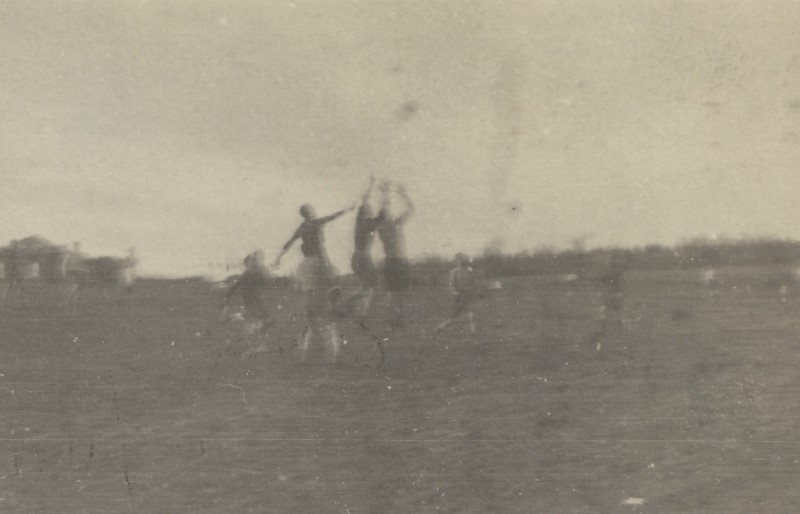
Active service after the Armistice [Gourdinne, Belgium], 1919; H85.55/160/85
Soon after arriving in Egypt, Victor Laidlaw, wrote home:
18/1/15….We had a great football [game] yesterday (Aust. rules) it was between 2nd Field Ambulance and 4th L. Horse, it was a great game, it was played in Cairo and after an exciting game the Light Horse won by 3 points, we were leading up till a few minutes to go when a L.H. received a free kick which ended it. Needless to say all players were pretty stiff, I would have been playing but for a badly cut finger which wasn’t quite well. We got back to camp about 11 o’clock.6
A few months later he was amongst the first landing at Gallipoli. He survived.
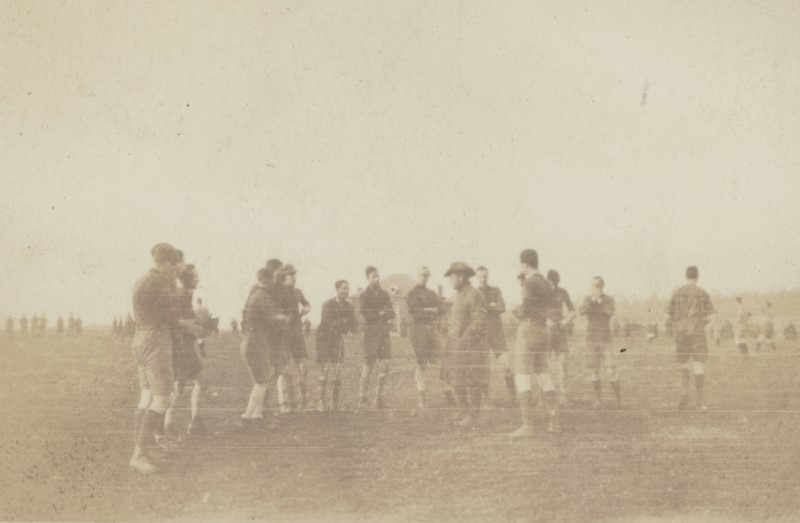
Lt Lionel Short, a journalist with the Argus prior to volunteering, wrote about a football match he observed with men just ‘out of the trenches’ playing in snow on rough ground pockmarked with shell craters.
There were some good players involved but in terrible conditions, with teams of battle weary soldiers, the play ‘was … more famous in its spirit than its skill’. But the game
carried their thoughts vividly back to those happy days when football was played in certain Melbourne suburbs they called “home”. And it is in such happy thoughts and memories that we soldiers live. (Argus, 10 May 1917)
Lionel Short was promoted to captain and won a Military Cross. His career as a journalist took him to New York. It is not recorded how many of the players survived the war.
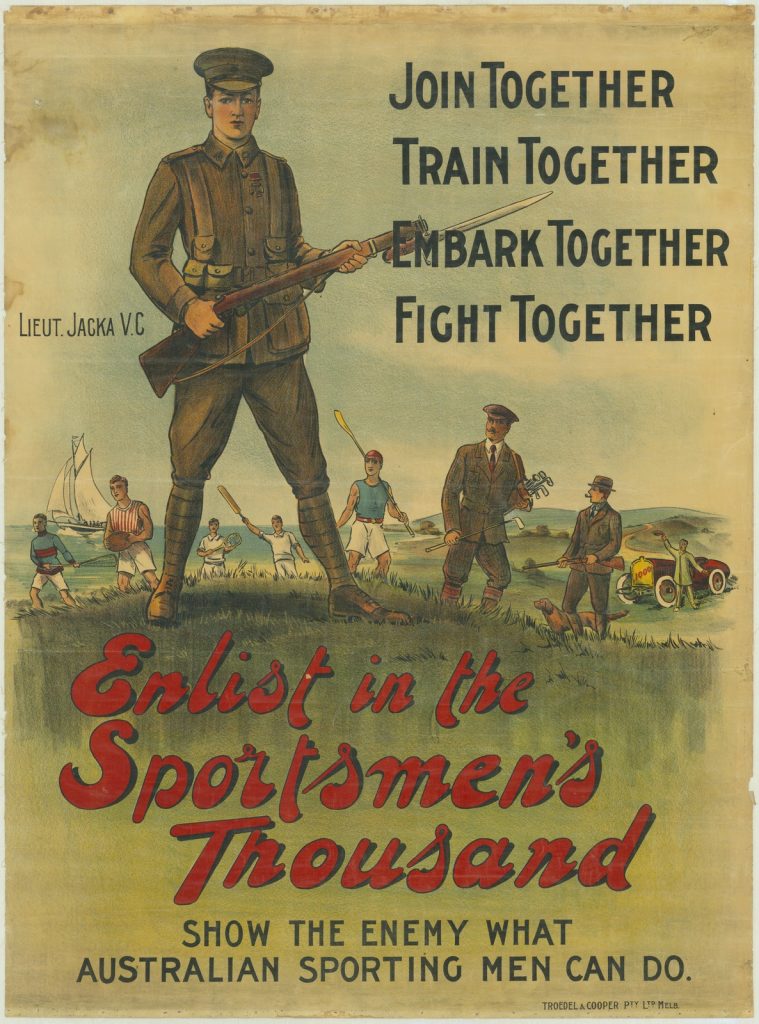
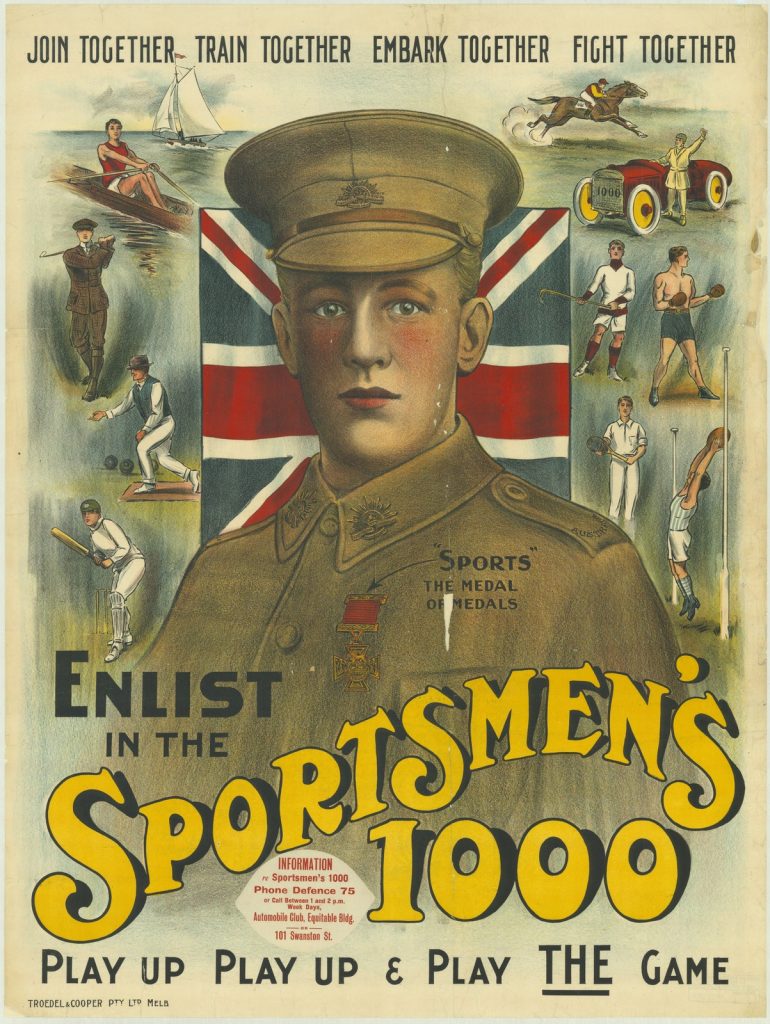
Sport was used as a recruitment hook. Enlist In The Sportsmen’s 1000. Play Up And Play The Game, 1915. Lithograph by Troedel & Cooper Pty Ltd; H2001.34/1a & H2001.34/3b 7
VFL Football did continue in Melbourne, but the pre-war crowds shrunk as the reality of the cost of the conflict hit home.
In the 1913 Grand Final, Fitzroy overcame St Kilda in front of nearly 60,000 fans. The following year, power clubs Carlton and South Melbourne drew only half that number.
The VFL limped on in a much-abbreviated competition. In 1916, with only 4 teams competing, Fitzroy achieved a never to be repeated double, wooden spooners and premiers in the same year. They finished last with only 2 wins in the 12 game season, but last place was fourth, qualifying them for the finals, where they proceeded to win all three finals.
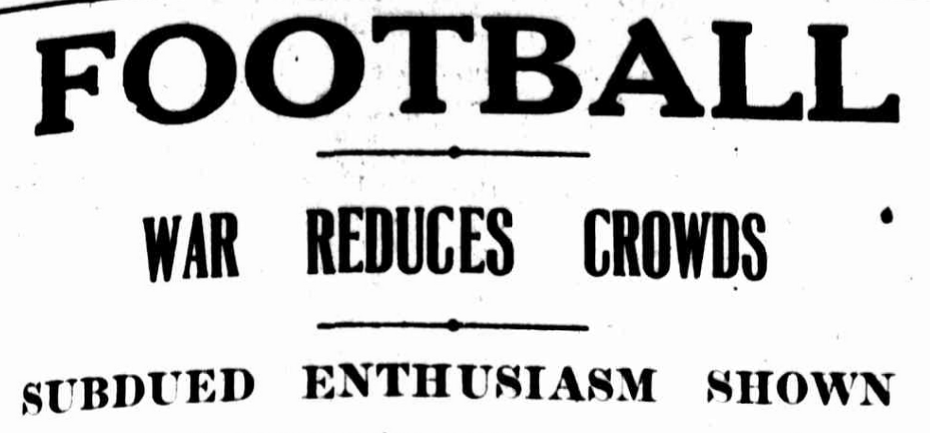
There was a noticeable diminution In the attendances at the principal fixture’s, owing to the gloom which hangs over the people on account of the Australian casualties in the war. Those who witnessed the matches were more subdued In their behaviour, and enthusiasm did not so often reach the noisy stage as in normal times.8
By 1916 Australia was a divided community with bitterly fought plebiscites on conscription and rising sectarian tensions. Football seemed to many to be trivial in the face of extreme loss and sadness. The 1916 grand final drew only 21,000 supporters.
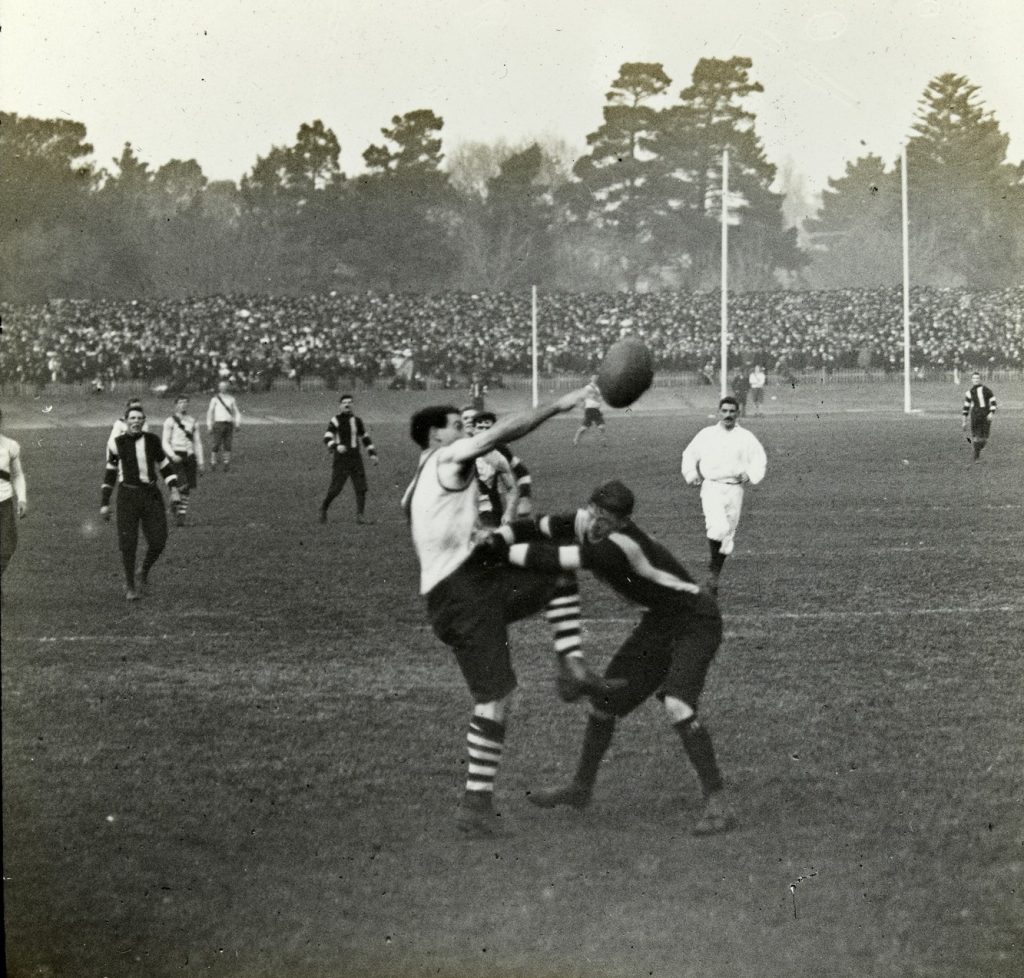
South Melbourne verses St. Kilda before a large crowd, [just prior to the war, c.1911]; H99.218/26
The powerful Victorian Football Association remained a great rival to the VFL until the 1940s. Their competition ceased in 1916 and 1917. Their view being that
Football being abandoned would bring home to the minds of the people more than anything else is …..the fact that recruiting was an absolute necessity. It was not the players they had to consider, but the barrackers -the men outside the fence. They would then realise the seriousness of the position. (Argus, 25 January 1916)
In 1918 the VFA resumed a limited competition despite pleas from Vice President Turner who
pleaded with delegates not to play this winter, saying that he could not see how they could think of football while the dreadful fight was being waged on the Western front. While thousands were fighting for our liberty, how could men go on hipp-hip-hooraying for football? (Argus, 16 April 1918)
In 1924, a decade after the war commenced, the VFL premiers (Essendon) played the VFA premiers (Footscray) in a benefit match for Dame Nellie Melba’s limbless and tubercular servicemen charity – a reminder of the terrible individual cost of the war.
Footscray were victorious amid rumblings of dissent in the Essendon team. 9
Soon after the war football had returned to its’ pre-war popularity. In 1919 nearly 50,000 fans attended each of the four finals. In 1920 the Carlton / Richmond semi final alone drew over 62,000, the record attendance for any game up to that point.
Perhaps football offered an escape from the grim aftermath of the devastating consequences of the war. Football continued but the world would never be the same.
References
- Grey of Fallodon EG (1925) Twenty-five years, 1892-1916, Hodder & Stoughton, London, p 20. Available online from the Internet Archive.
- Philip Larkin’s 1964 poem MCMXIV captures the ebullience of early volunteers.
- De Bolfo T (2015) ‘The Great Fallen: George Challis‘, Carlton Football Club [website], accessed 26 August 2025.
- Collins B (2019) ‘Why soldiers played Australian footy in a time of crisis‘, AFL [website], accessed 26 August 2025.
- Gustav Adolph ‘Ardy’ Muller survived the war.
- Laidlaw VR ‘War diary of Victor Rupert Laidlaw’ : Volume 1, MS 11827, State Library Victoria.
- The posters refer to the famous poem Vitai Lampada, written by Henry Newbolt in 1892, which was often quoted to encourage recruitment and sacrifice.
- Football (13 April 1918) The Australasian p.22, accessed 25 August 2025
- See also our research guide Australian Rules Football – Great games

