
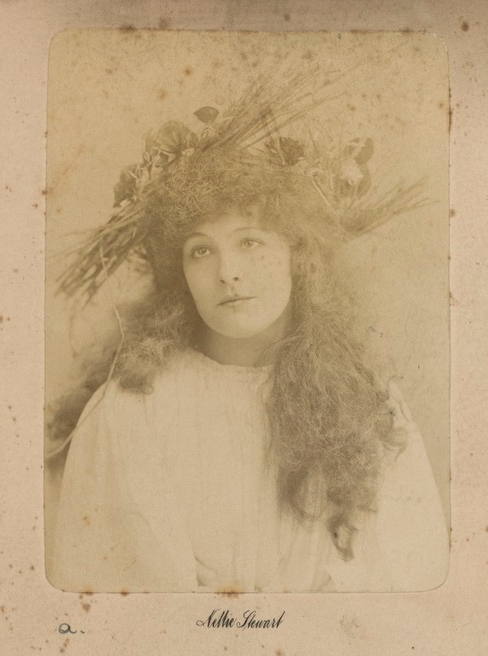
In the years around the turn of the century, in playhouses, theatres and town halls, Australia’s stagecraft roots were growing. Imported plays and actors abounded, along with homegrown talent both on the stage and behind the scenes. A lot of their stories can be found in newspapers and magazines of the day, in biographies and playbills. The stories can also be found in the photographs of the time such as those found in the Photograph album of Australian actors and actresses, circa 1870-1910, compiled by Gordon Ireland 1
The volume itself is a beautiful object and moving from page to page one is drawn in by story after story and character after character. The album offers an insight into the theatre scene in Victoria showcasing actors and actresses, magicians and comedians from Australia, as well as many who were visiting from abroad from 1870 through to the early decades of the twentieth century. Along with the well-known men of the time such as Bland Holt and J.C. Williamson, the album captures moments in the careers of some notable women of the stage, allowing us to delve briefly into the some of the stories behind the images.
Nellie Stewart
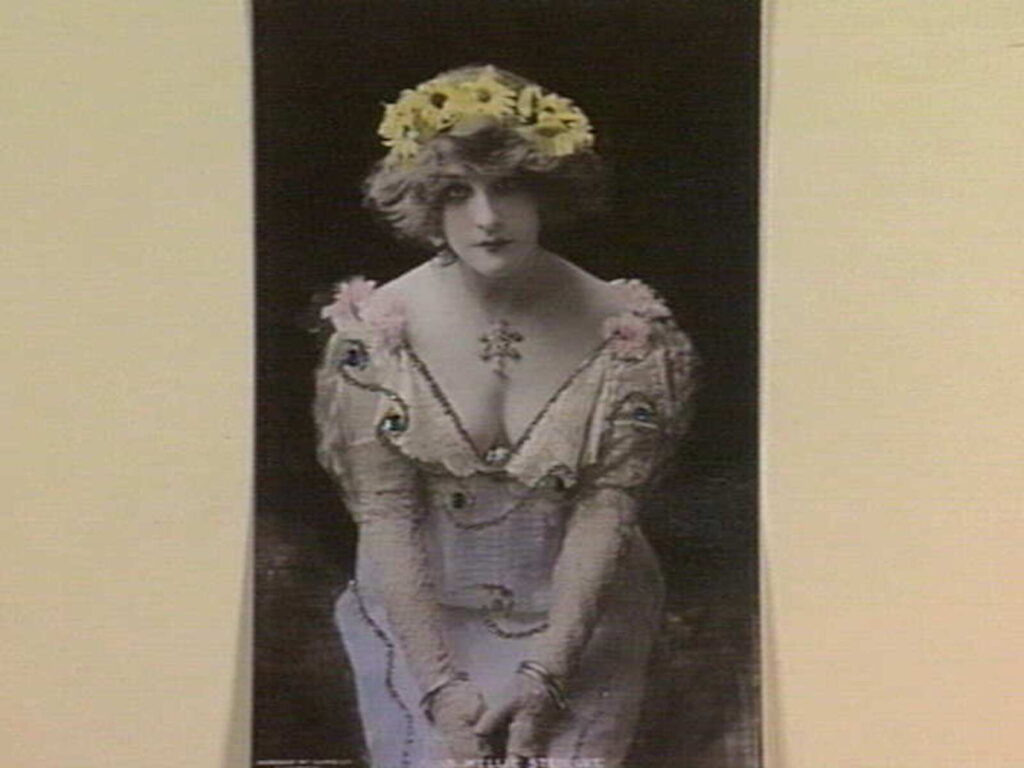
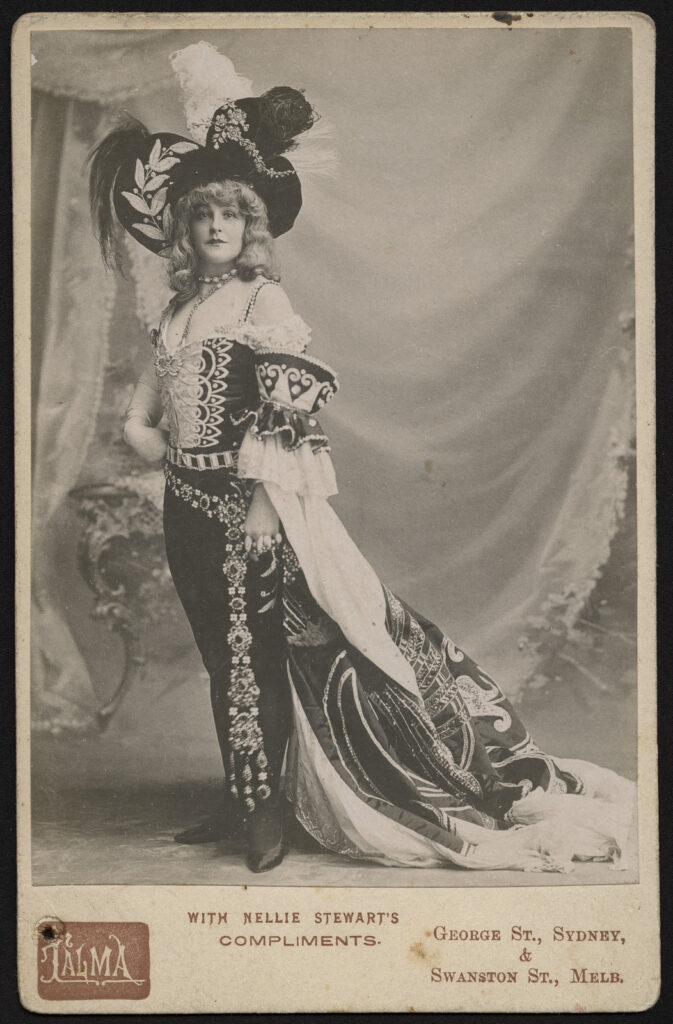
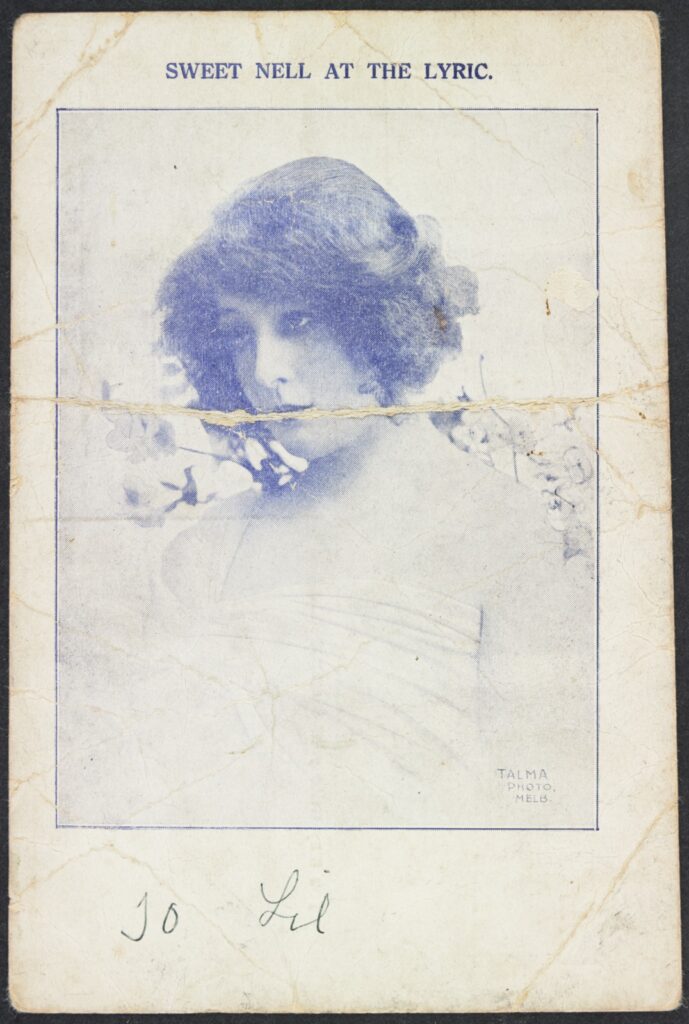
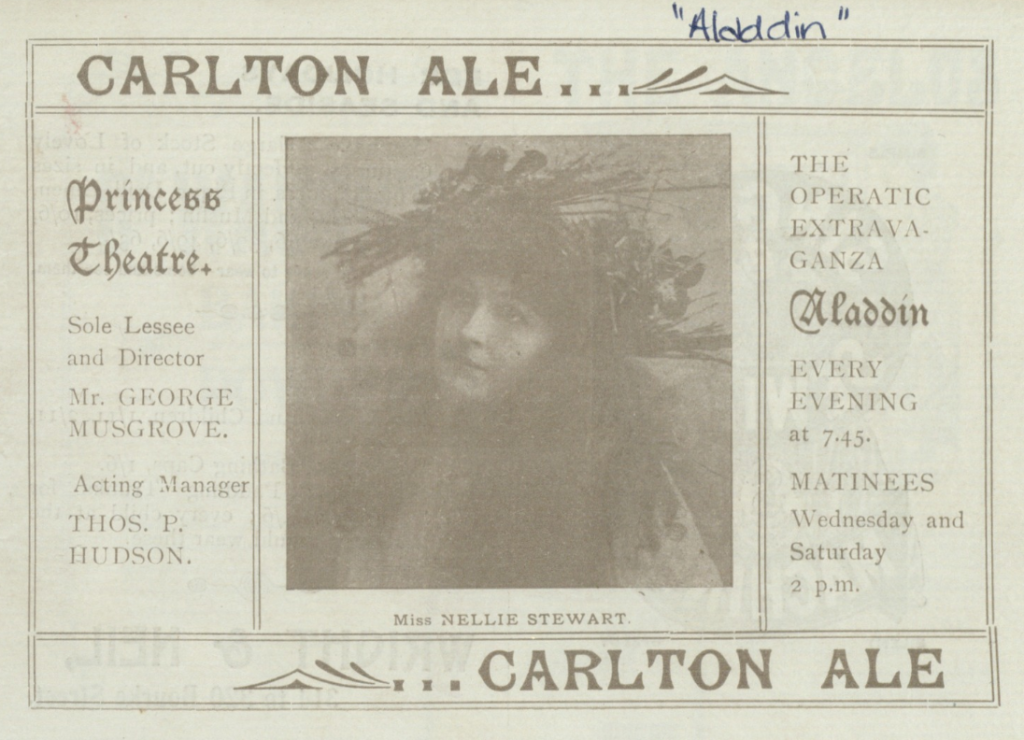
Nellie Stewart (1858 – 1931) was a singer and actress whose name should probably be known by more Australians. Born into a theatrical family in Sydney and moving shortly thereafter to Melbourne, she spent much of her career divided between Victoria and New South Wales, along with tours of the United States and Europe. She was noted for having a voice ‘…of fine quality and imposing power’ (The Daily Telegraph (Sydney), 27 October 1924) but it went into decline later in her career, to the point where she purportedly lost her voice entirely.2 There is a wonderful profile of her in Pets of the public : a book of beauty, containing twenty-five portraits of favourite actresses of the Australian stage, with critical and descriptive notes. This profile speaks of her ‘…hard work, indomitable courage and unremitting industry…’ and describes her as ‘…a genuine specimen of the power of pluck and perseverance, and as such a credit to her country and her profession.’3
Along with her significant stage career she is notable for having appeared in one of Australia’s first moving pictures, a lavish adaptation of her famous role as ‘Sweet Nell of Old Drury’ produced in 1911. The film was wildly popular and screened regularly across Australia for 6 years. Sadly no prints of this film survive.4
She is captured in this album in her costume for the ‘operatic extravaganza’ ‘Aladdin’. She had a varied career where her roles included Camille, Trilby and of course Sweet Nell of Old Drury.
Amy Castles
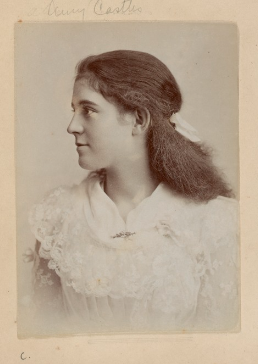
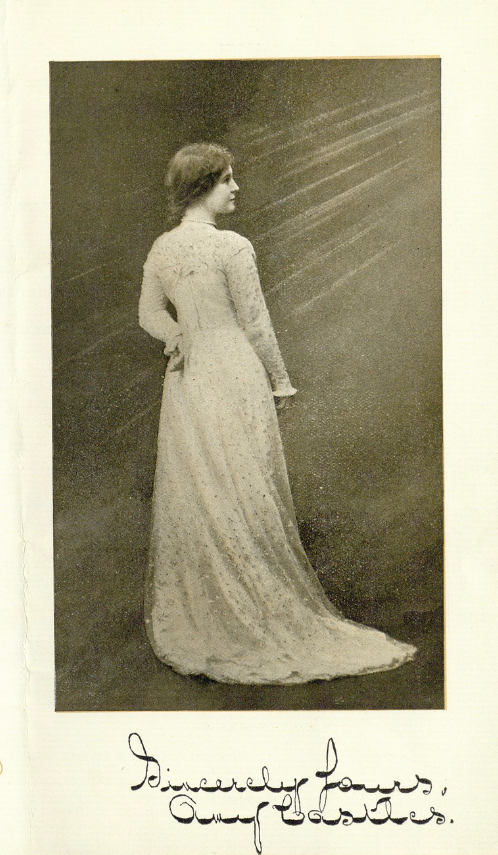
Raised in Melbourne and Bendigo, Amy Castles (1880 – 1951) was hailed as a formidable talent well before she gave her first major concerts. Rumblings of her exceptional voice ran through the Melbourne and regional newspapers, leading to high expectations and an over-sold house for her first show …’at first class prices..’ at the Melbourne Town Hall on April 8 1899 (Examiner (Launceston) 2 July 1902). The event was part of a tour to raise money for Castles to travel to Europe to be trained by the great Nellie Melba‘s coach, Madame Marchesi. Indeed, Castles was hailed by some as a ‘new Melba’ (Punch (Melbourne) 25 July 1901). She was often characterised as an alternative to Melba, many said she had the same raw talent. She was, however, a young ‘slip of a girl’ (Punch (Melbourne) 10 April 1902), educated in a convent in the bush, often appearing in a simple white dress with her hair down (as she appears in the Ireland album). This presentation was in stark contrast to the cosmopolitan image of Melba who many felt, had left Australia behind her. She was rumoured to have had extra-marital affairs, was a Protestant5 and she often wore red dresses to boot! Castles was seen by many as the wholesome choice, virginal and unpretentious, and the sign of a newly flourishing Australian-Irish Catholic identity in the colonies.6
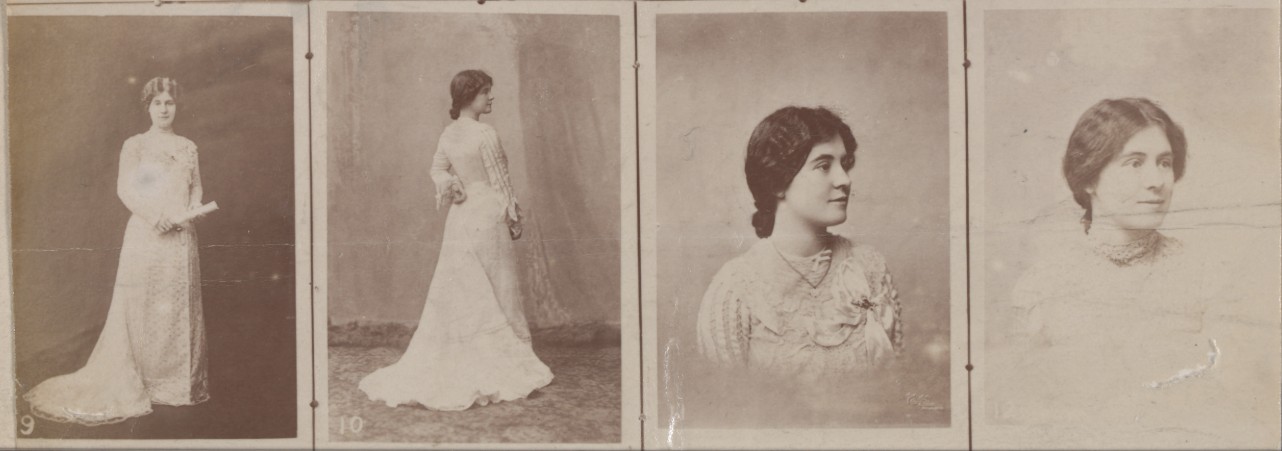
Amy Castles spent some years in Europe and the UK, training and performing, but returned to Australia periodically. Her return home was often greeted with delight by the Australian press who depicted it as a sign of her humility and loyalty to her native land (Table Talk, 19 August 1915).
Edith Crane
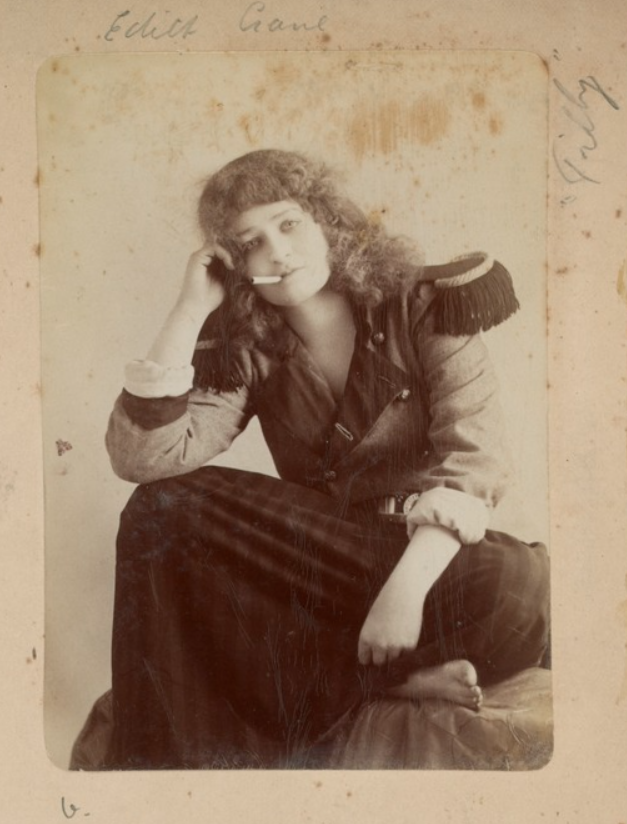
Born in the United States and daughter of a renowned New York merchant, Edith Crane’s star truly rose in Australia. Referred to in newspapers, theatre histories and captions on her photographs as ‘Australia’s Trilby’, she owned the role on these shores. The play Trilby, based on the hit 1894 novel by George du Maurier7, in which our bohemian heroine undergoes a hypnosis-based transformation, was Crane’s most famous role. Seen here in Trilby’s famous oversized military coat with bare feet and a cigarette, the look – and the outlook – became iconic. Despite its tragic storyline of lost loves, class disparity and manipulation, the most notable impacts were the naming of the Trilby hat and the ‘bachelor girl’ vision of female empowerment. These ‘bachelor girls’ modelled aspects of their lives on our heroine, daring to refer to themselves as Artists, to smoke cigarettes and drink liquor. It also spawned a craze for bare feet with one paper noting that ‘…Trilby’s feet were her glory’ (Narracan Shire Advocate, 12 May 1920).
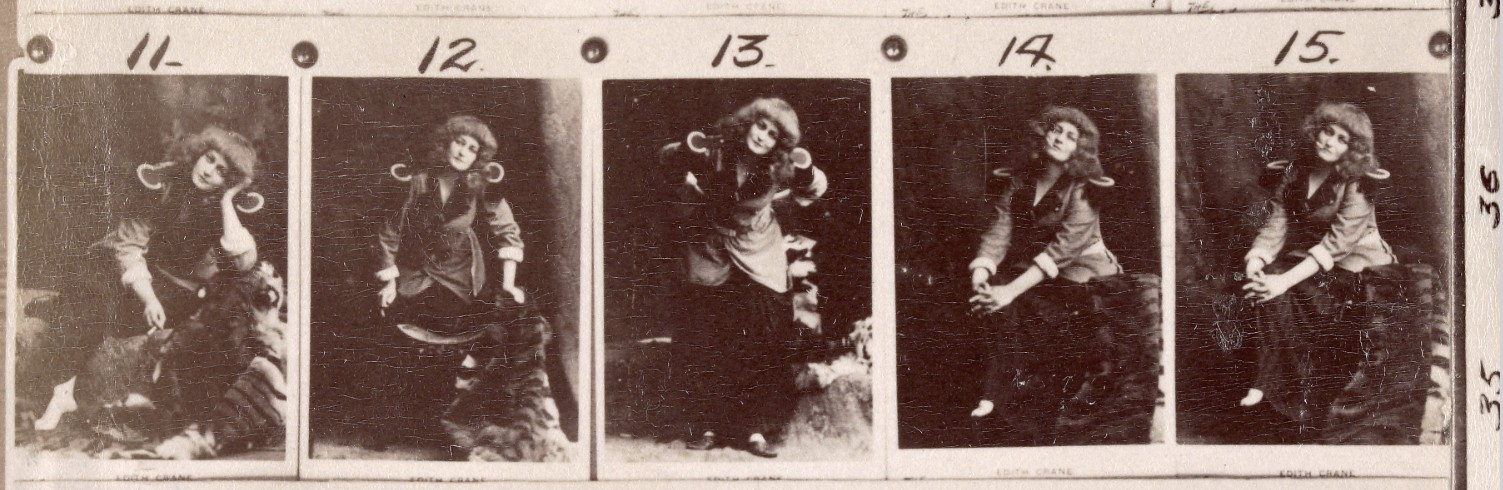
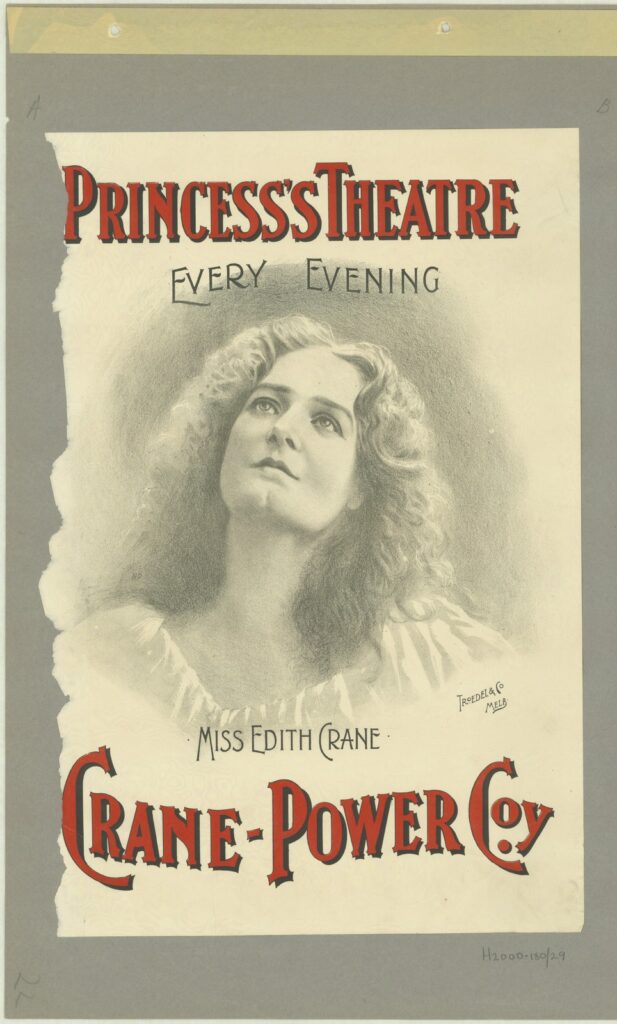
Along with originating the role of Trilby here in Australia, Crane was known as a versatile and powerful talent. She had an 11 year marriage to legendary actor Tyrone Power Sr, with the couple often appearing as co-leads touring Australia as The Power Company and The Crane-Power Company.8 Both performers took their craft extremely seriously; in an interview in 1896 Crane speaks of a deep love of Shakespeare yet does not dismiss the complexity of her most famous role:
Trilby I consider one of the most exciting parts I have ever had to play. Strange to say, I did not feel much interest in the book itself, but as soon as I found I was likely to be called upon to play it, I studied the piece diligently, for I saw that it was full of dramatic possibilities. To give the effect of absolute simplicity and naturalness appears to me to be essential, and my first conception of Trilby is that of a lovable and naturally refined girl, whose high spirits and unconventionality never leader her unto real vulgarity or boisterousness. (Australian Town and Country, 13 June 1896)
Her life was short. She passed away from complications following the removal of a tumour on January 3rd 1912 at the age of just 42, with her husband by her side. They had been planning a tour of co-led works of Shakespeare, Power’s long-held dream. One can only imagine his grief at looking to his leading lady each night and not seeing Edith’s beautiful face.
If you have enjoyed this foray into just a few of the images in the Ireland album, there are a lot more ways to explore the stories of the luminaries of the time and the way their images have been captured and preserved.
More to explore
More pictures:
Portraits of members of Bland Holt’s company
Album of photographs of George Coppin family and friends
Or delve into our copyright-free image pool
The State Library Victoria also holds a large and ever-growing collection of theatre programmes, see our website
See our Theatre and performance in Victoria research guide
More blogs to explore:
State Library Victoria – Beauty spots: from facial flaws to fashion statements
State Library Victoria – Broken glass: accidental beauty in the Library’s photographic collection
State Library Victoria – Snaps and stories: photo albums
State Library Victoria – Who’s that girl? Dating a 19th century photograph
State Library Victoria – Recently digitised: playbills from the Coppin Collection
- In addition to compiling this album, Ireland also compiled the papers of Philip Arthur Darbyshire which are held by the State Library Victoria. He was a prominent theatre and music historian and wrote plays and scores for the ABC, among many other achievements. See this write up from ABC Weekly (vol. 10, No 23, 5 June 1948, p 24) for further insight.
- The beginning of this decline is often attributed to her monumental 24 straight nights’ performance in Gould’s Faustus in Melbourne, Cooper R ‘Stewart, Eleanor Towzey (Nellie) (1858–1931)’ (1990), Australian Dictionary of Biography [website], accessed 22 February 2026
- Ellis E (1888) Pets of the public: a book of beauty, containing twenty-five portraits of favourite actresses of the Australian stage, with critical and descriptive notes, Edward Ellis, Sydney, p 30.
- Shirley G (2020) ‘The lost film of Nellie Stewart‘ [website], State Library of New South Wales, accessed 22 February 2026.
- Brownrigg J (2006) A new Melba, Crossing Press, New South Wales, p 35. This depiction is likely the result of something called ‘Melba bashing’.
- Brownrigg J (2006) A new Melba, Crossing Press, New South Wales, p xvi
- Du Maurier G (2009, first published 1894), Trilby, The Floating Press, Auckland
- ‘Nadjezda / Maurice Barrymore, by the Crane-Power company’; TPC Nadjezda [1901]

