
They just drifted in. As they became caught in the economic landslide which was not of their making, and as they lost their jobs, they drifted into the Flats…1
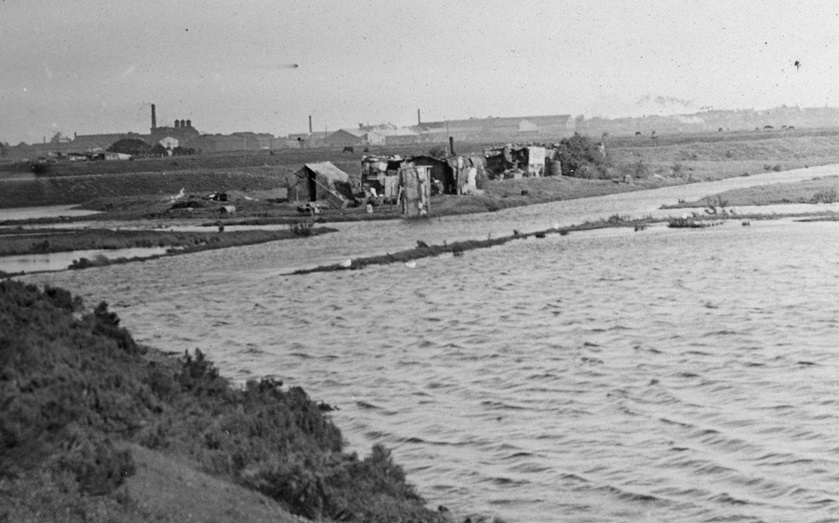
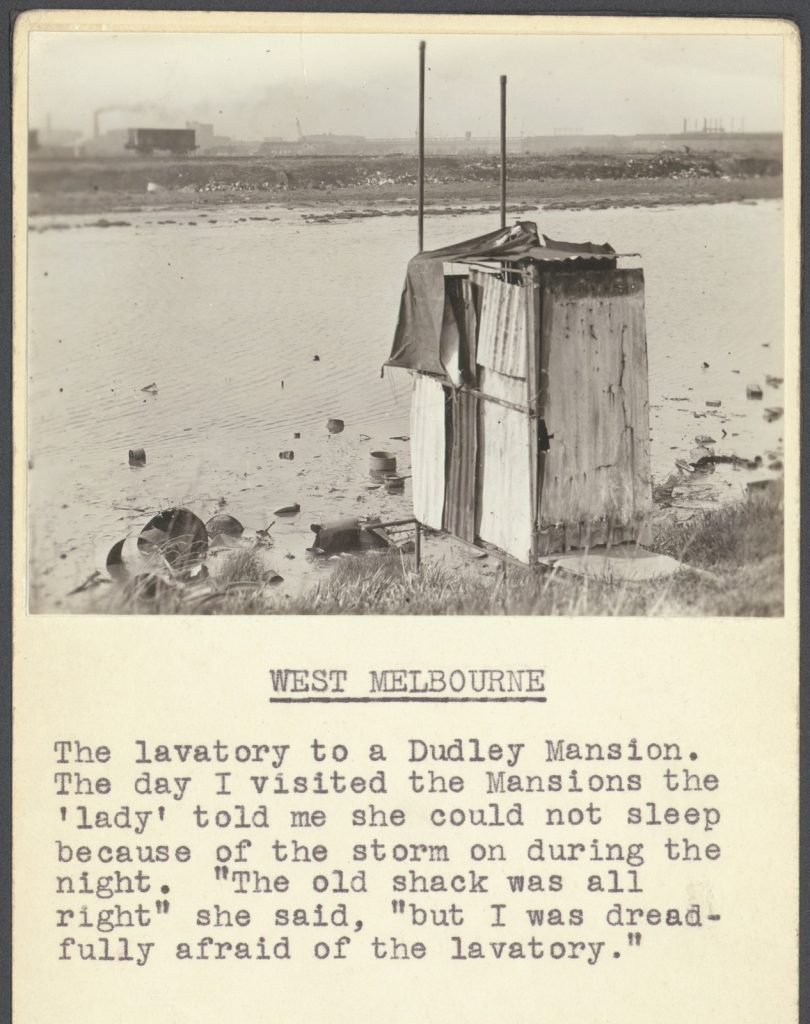
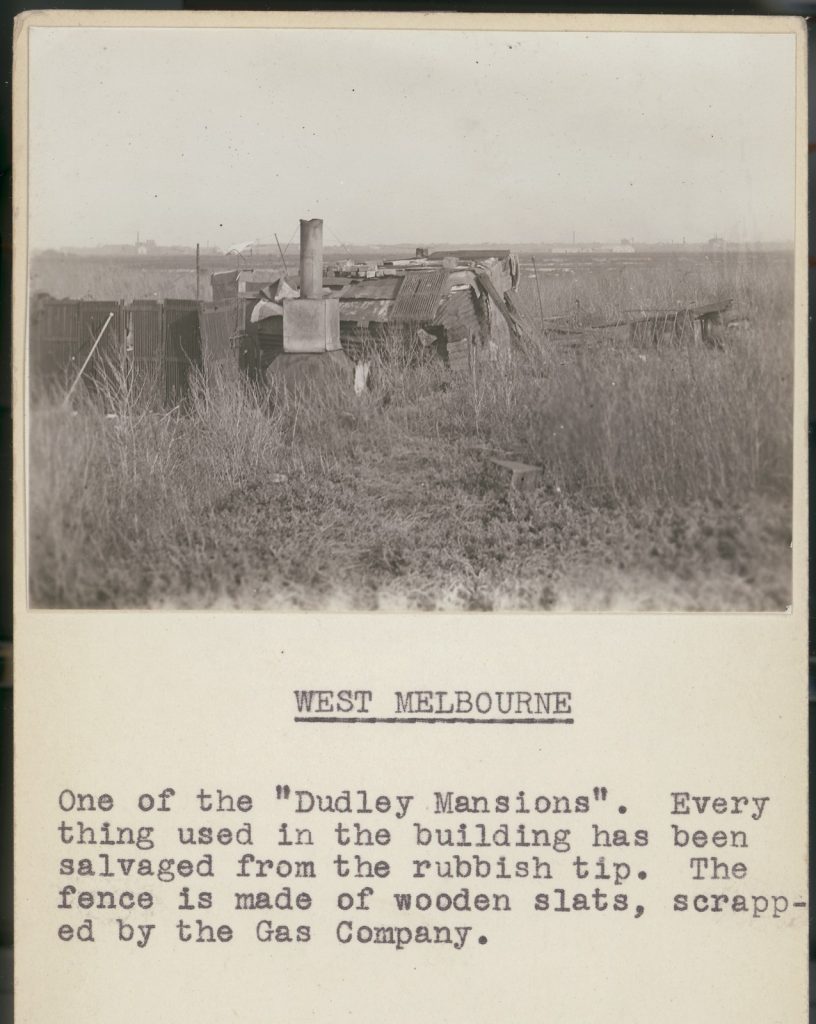
Dudley Flats was a slum that emerged on the West Melbourne swamp during the early years of the Great Depression. Residents fashioned makeshift houses — known colloquially as ‘Dudley Mansions’ — out of refuse scavenged from the nearby tip. No salvaged item went to waste: old steam funnels doubled as chimneys, sheets of corrugated iron formed house exteriors, and paper bills and newspapers lined the walls and the floors.
Drinking water was accessed via run off from the roofs, or from a nearby standpipe ‘a mile and a half’ away.2
Visitors to the slum were struck by the residents’ resourcefulness:
“Dudley Flats” is a city of ingenious and insanitary makeshift. Its mansions are indescribably primitive, fashioned from discarded sheets of rusty galvanised iron, bricks from demolition works, timber from packing-cases, hessian from sacks and packs. Its gardens are miniature rubbish-tips. (Herald, 26 January 1938, p 10)

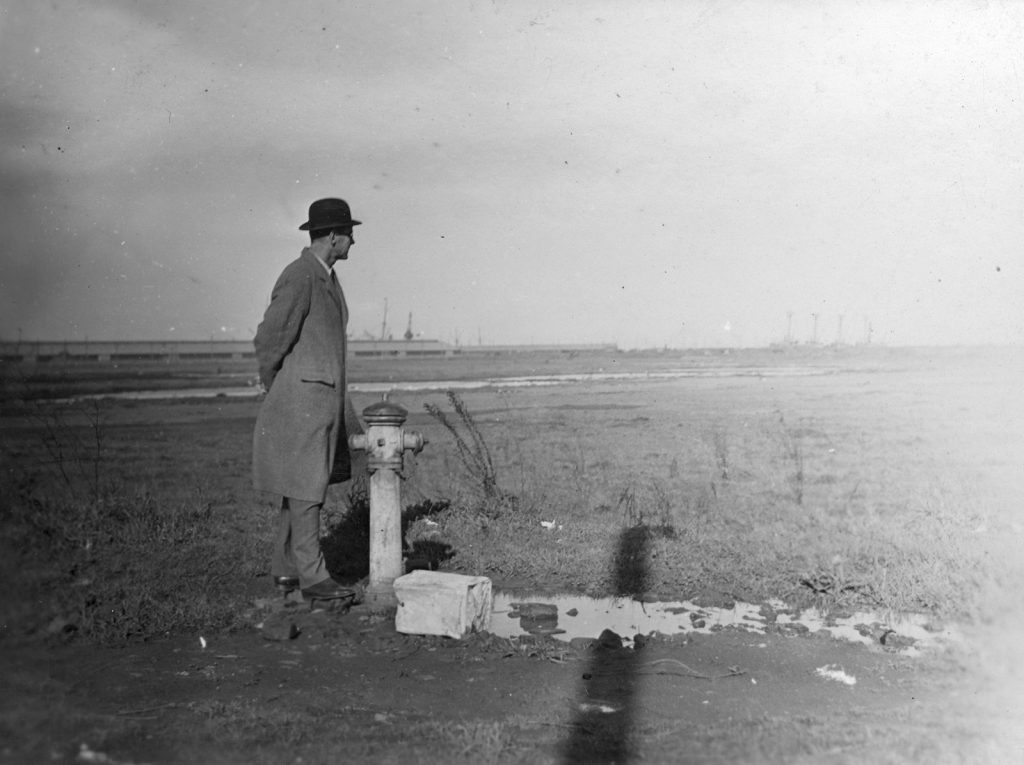
By the mid-1930s, the Flats had evolved into two main ‘suburbs’, delineated by the railway canal. The city side of the canal was known as the ‘Bachelor’s Quarters’ and consisted entirely of single men. On the other side of canal was ‘Happy Valley’ (also known as ‘Tin Town’) which was inhabited by couples and women living alone. (Argus, 15 July 1949, p 2)
There was also a third sub-group who haunted the Flats. These were the ‘bagmen’ — young men aged between 25 and 35 — who’d stay a few nights in one of the lean-to’s before heading off with their swags to look for work or food. (Argus, 15 July 1949, p 2)
The maps below show the whereabouts of Dudley Flats in relation to the surrounding waterways. The little circles represent the locations of the Dudley Mansions:


Left: Details from Melbourne and inner suburbs map, [192-?]; MAPS 821.03 GMFS 192-; Right: Plan of Dudley Flats created by Melbourne City Council’s Health Inspector E T Wood in May, 1939. Courtesy of Public Records Office of Victoria (PROV). 3

Many residents earned a living selling scrap iron from the tip,5 but some had casual jobs on the wharves or worked the streets as professional beggars. (Sun, 5 June 1937, p 40). Others embarked on more imaginative enterprises. The Riddetts — who lived in Happy Valley in the mid-1930s — sold freshly picked mushrooms to city restaurants.6 7 Albert Cornish and his wife peddled tins of ‘magic soap’8, and ‘regular’ Jack Peacock, from the Bachelor’s Quarters, offered ‘Wild West and cross country’ riding lessons on the Flats. 9 10

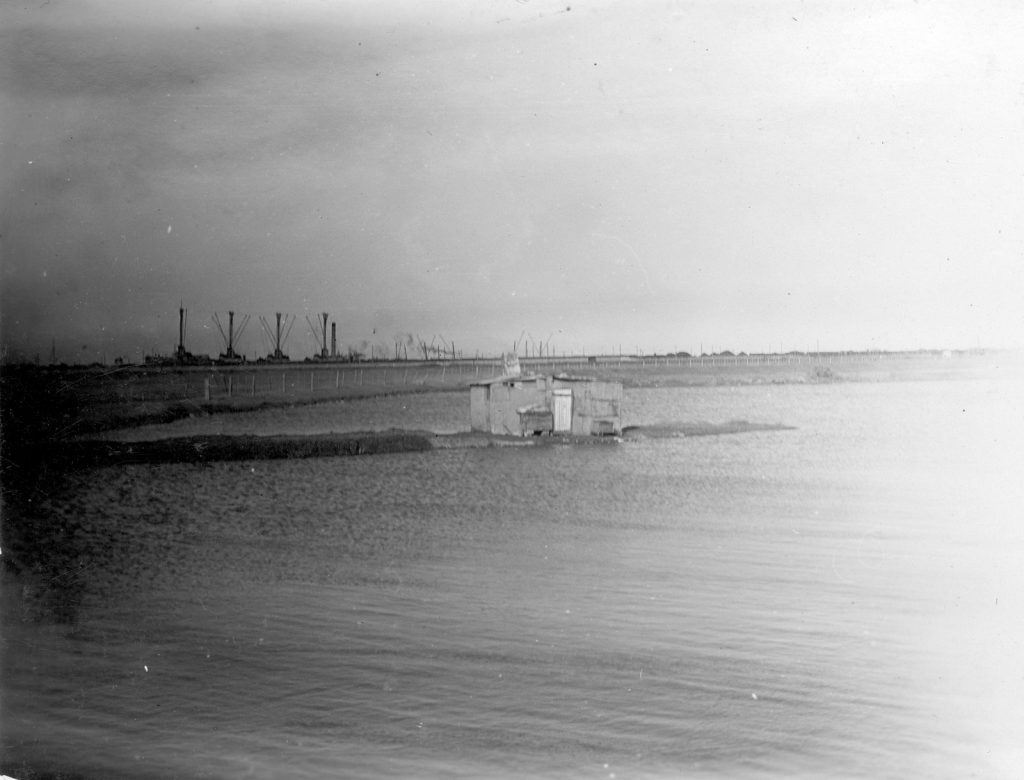
Of course, no town is complete without some inter-suburban rivalry. Residents of the Bachelor’s Quarters looked down on Happy Valley, with one local telling a visiting reporter that the neighbouring suburb was ‘the worst place in Australia’. Having being forewarned, the journalist approached ‘Tin Town’ with caution, but later reported that he ‘needn’t have worried’ because ‘the women’ took ‘a normal housewife’s pride in their homes’:
… I was conducted over “Tin Town’s” show place. It had a “garden”, two feet square; a “marine yard”, thriftily stocked from the rubbish tips; a stuffy, smelly living room; a kitchen of sorts. Built entirely from rubbish scraps, this house was a lesson in makeshift. Its path was made with old bricks, and its garden gate was nothing more or less than a bedstead head, running to and fro on castors. (Herald, 27 January 1938, p 16)

One man who knew more about the residents than most was the City of Melbourne’s Health Inspector, Edgar Thomas Wood, who spent some 19 years monitoring their health and living conditions. In a lengthy interview after his retirement, he mentioned a number of inhabitants by name, singling out Happy Valley’s ‘Joan’ as being the tidiest:
Joan owned two “humpies” — renting one out to neighbours. The floor of her abode was lined with newspaper and decorated with “primitive furniture”. She had managed to scavenge a mantelpiece from somewhere, upon which was propped a photo of King George V and the Queen Mary alongside “odd pieces of china”. (Argus, 15 July 1949, p 2)
But while all agreed on the residents’ ingenuity, concern about their living conditions was mounting. The proximity of the Flats to the council tip meant that the area was infested with rats and flies in summer. (Age, 15 August 1935, p 9) The dirty swamp water was a perfect breeding ground for mosquitoes (Age, 12 January 1935, p 21), and packs of stray dogs were a constant presence — roaming the area in search of food.12

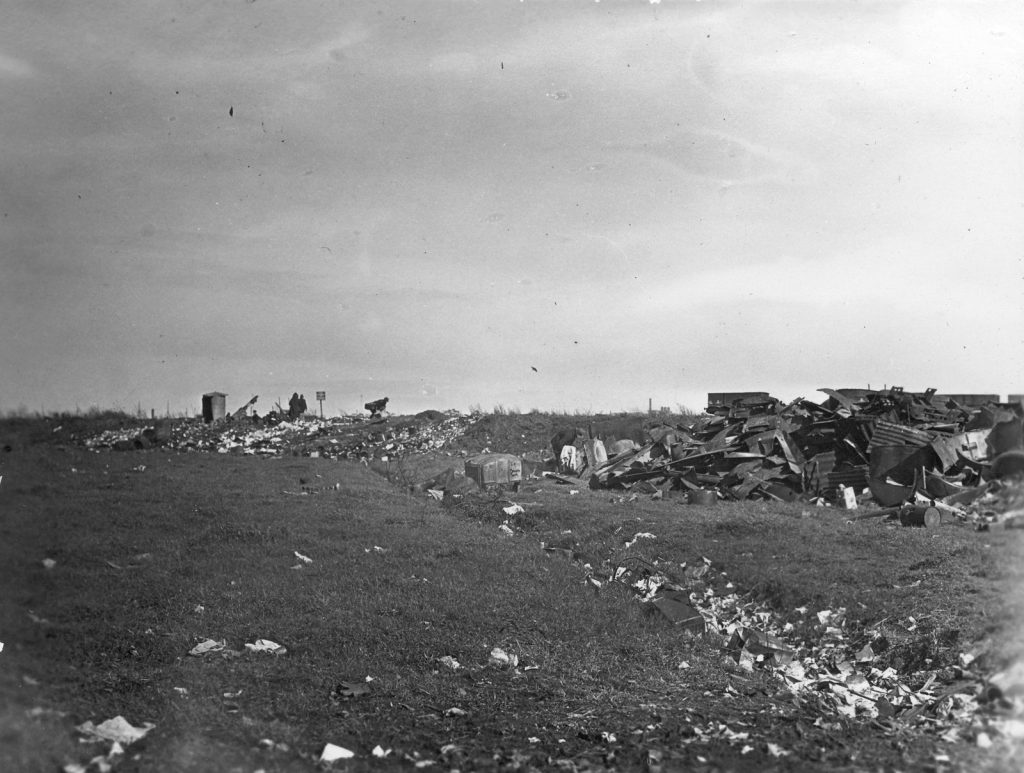
On 15 August 1935, social reformer Frederick Oswald Barnett toured Melbourne’s slums with the Victorian Premier, Albert Dunstan. 13 They took in Richmond, Collingwood, Fitzroy and Carlton, but Barnett found the Flats to be ‘the most squalid slum in the whole of Melbourne.’ 14 15
‘It is shocking,’ the Premier told the media after the tour. ‘I don’t know how people can exist in such conditions…’ (Herald, 14 August 1935, p 1)
Despite widespread concerns and increasing agitation by Melbourne’s newspapers, it would take years for the authorities to act. The Herald summarised the issue succinctly:
The Government thinks this is a matter for the Melbourne City Council; the City Council says it is a Harbor Trust affair; and the Harbor Trust says it does not own the land, and has no control over what happens there. (Herald, 9 December 1936, p 8)
Incredibly, the impasse continued until 1942.16 By this time, the population at the Flats had decreased dramatically. In its heyday, the Flats had boasted more than fifty residents; but by 1942, only nine remained.17
After the tragic death of long-time resident Elsie Williams (Herald, 11 November 1942, p 3),18 authorities finally agreed that it was time to act. Inhabitants were issued eviction notices, and the Harbor Trust issued an order for demolition.19

On the 18th of November, the Herald reported ‘clouds of black smoke… sweeping over Dudley Flats’ as the last of the uninhabited mansions were destroyed.20 Old iron and junk from the ruins were removed, and the stray dogs were shot or taken away. (Herald, 18 November 1942, p 3)
Postscript
Author and former State Library creative fellow, Dr David Sornig, has written extensively about the people who lived on Dudley Flats. You can read more about them in his works below:
Blue lake: Finding Dudley Flats and the West Melbourne swamp
‘Jubilee: A hymn for Elsie Williams on Dudley Flats’, Writers Prize 2015. Finalist Essays
You may also like…
References
- ‘Drab memories of Dudley Flats’, Argus, 15 July 1949, p 2.
- Housing Investigation and Slum Abolition Board (October 1937), First (progress) report, with appendices and supplements [microform] : slum reclamation : housing for the lower-paid worker; short term programme, Premier’s Department, Melbourne, p 15.
- Melbourne City Council Dudley Flats Melbourne North, Public Records Office of Victoria, VPRS 5357/P0000, G57040, p 37. A list of residents, including names, ages, income source and living conditions also accompanies the plan on pages 39-43.
- Melbourne City Council Dudley Flats Melbourne North, Public Records Office of Victoria, VPRS 5357/P0000, G57040, p 37.
- Sornig, D (2018) Blue lake: Finding Dudley Flats and the West Melbourne swamp, Scribe Publications, Melbourne, p 171.
- As above, p 175.
- Barnett, F O, ‘ “I Remember”: Reminiscences written for the family of Oswald Barnett 1964-5’, Memoir and travel diaries of Oswald Barnett: also related material: 1940-1992, MS 15276, BOX 5200/1, p 85.
- ‘Group “A”. Dudley Flats, between Melbourne and Footscray Road and Moonee Ponds Creek’, 9 May 1939. Melbourne City Council Dudley Flats Melbourne North, Public Records Office of Victoria, VPRS 5357/P0000, G57040, p 40.
- Sornig, D (2018) Blue lake: Finding Dudley Flats and the West Melbourne swamp, Scribe Publications, Melbourne, pp 184-5.
- ‘Dudley Flats scandal’, Herald, 26 January 1938, p 10.
- Sornig, D (2018) Blue lake. Finding Dudley Flats and the West Melbourne swamp, Scribe Publications, Melbourne, p 185.
- As above, p 163.
- As above, p 159.
- As above.
- Barnett, F O,‘ “I Remember”: Reminiscences written for the family of Oswald Barnett 1964-5,’ Memoir and travel diaries of Oswald Barnett: also related material: 1940-1992, MS 15276, BOX 5200/1, p 85.
- There was a brief breakthrough in 1938 in which authorities agreed to work together to remove the Flats, but the State government intervened, and the plan was abandoned. From Sornig, D (2018) Blue lake: Finding Dudley Flats and the West Melbourne swamp, Scribe Publications, Melbourne, pp 230-242.
- As above, p 280.
- As above.
- As above.
- The remaining six shacks followed once the residents had vacated.

