
Today’s blog marks International Day of People With Disability. First proclaimed in 1992 by the United Nations, it ‘…aims to promote community awareness, understanding and acceptance of people with disability’.1
According to statistics from 2022, 5.5 million Australians reported having a disability.2 A disability may be short-term, long-term or lifelong, reducing a person’s capacity in some way. When thinking of disability, most people’s immediate association would be a person with a physical, vision or hearing impairment, often visibly recognised by the aids or supports they use, however in addition there are a number of conditions that have been termed invisible, or hidden disabilities. These include mental health conditions, cognitive impairments, sensory challenges and chronic pain for example.
In keeping with the visibility theme, I have chosen to showcase some representative images from our Pictures collection, beginning in the 19th century through to today.
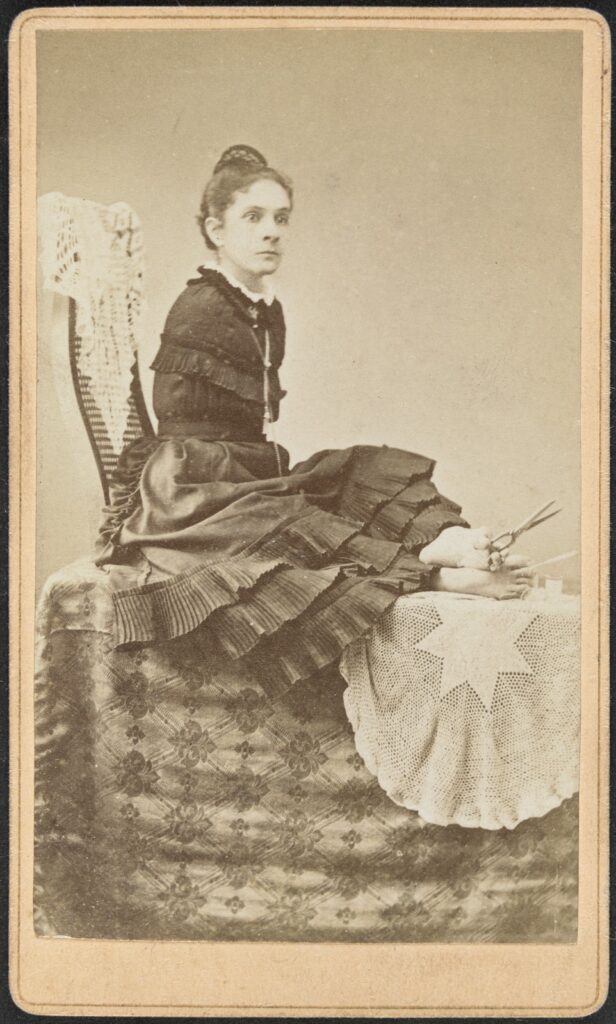
Previously we did not know a lot about ‘Aunt Leah’s’ portrait apart from what the catalogue record provided and what we can see. The photograph, taken in 1877, shows us a woman without arms in a seated position holding scissors and thread with her feet. It suggests that she has sewed the decorative cloth or piece of clothing on which her feet are resting. Her eyes do not catch the camera lens, appearing to gaze into the distance, with a sense of sadness about them, possibly weighed down by the challenges of the time compounded by living with a disability. Equally, we could draw the conclusion from the representation of her, that she did not let her disability limit her, finding a way to use the capability she did have.
From some further detective work, we have identified that ‘Aunt Leah’ is in fact Ann E. Leak and we have her autobiography in our collection. Known for her skills braiding hair and crocheting, she would eventually use these abilities beginning as a performer with with Barnum’s Museum in New York. 3 Initially uncomfortable with the idea, having begun work as a teacher and governess, her convictions for changing direction were strong. 4 Carte-de-viste photographs such as the one above were souvenirs from her shows, with foot-written messages written on the back. 5
Today’s Vision Australia began in Melbourne in 1866 as the Victorian Asylum and School for the Blind.6 A series of RVIB glass plate negatives from the late 19th-early 20th century have been digitised.7
The three showcased images below help to illustrate the different roles of the organisation in its early years, school, factory and benevolent asylum, also recognising that conditions were tougher than perhaps depicted.8 Those within its care had ‘… to be looked after, sheltered, fed, doctored, and educated, but were also required to do everything possible to support themselves’.9

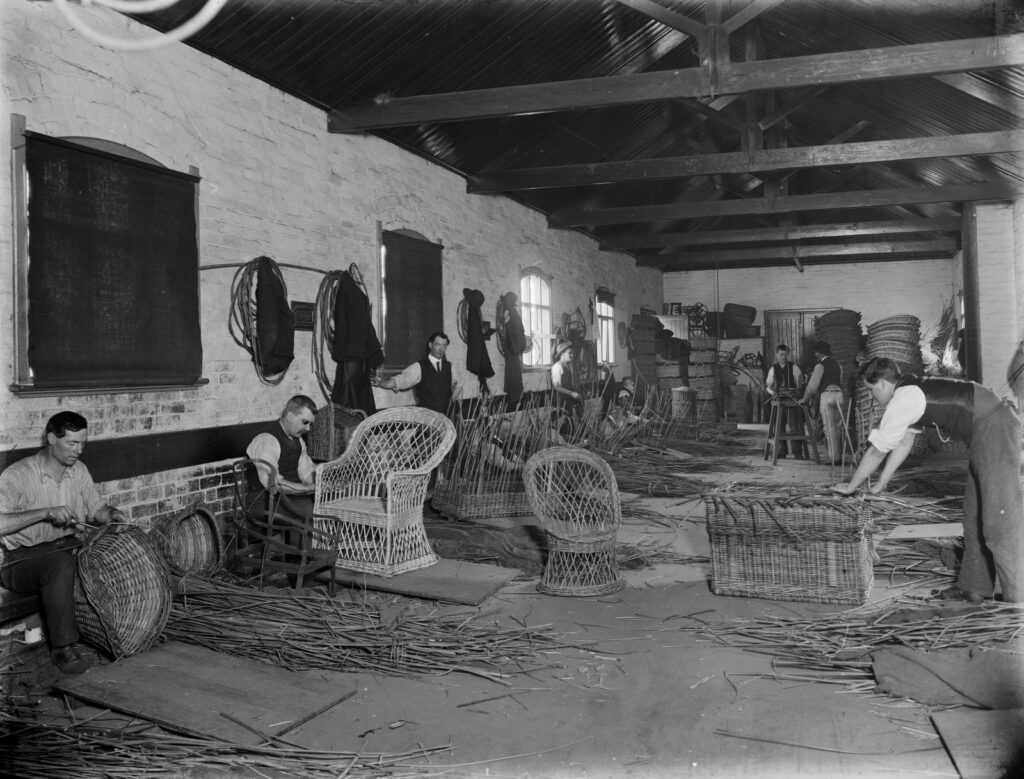
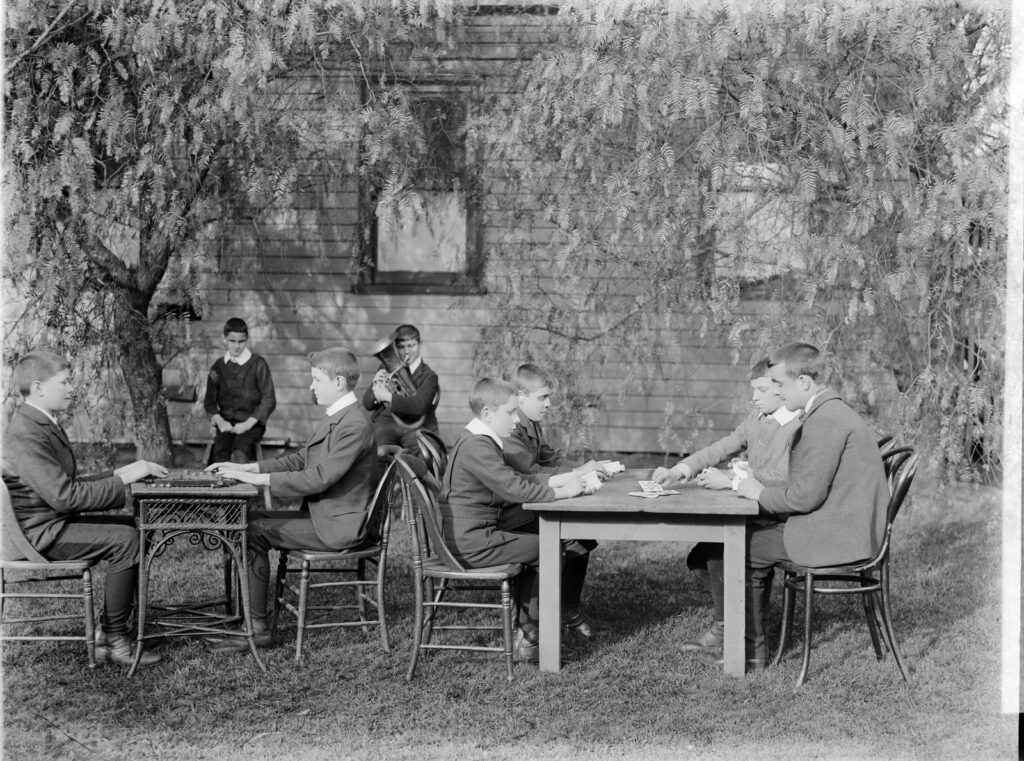
Left to Right: Blind children in a schoolroom reading braille. H94.107/83, Workshop with men making cane chairs and baskets […]. H94.107/79, Blind boys seated at tables in a garden playing cards, another boy playing the tuba in background. H94.107/86
The schoolroom could be like any other from the time, large wooden desks in rows with students in uniform, however you can see in the movement of some student’s hands that they are working with braille tablets. While there are many new forms of assistive technology today, the invention of braille or reading by touch fundamentally remains the same, continuing to improve the lives of those with blindness or low vision. Because of their keener sense of touch, trades were also taught; basket-making and mat-making for boys, and netting and knitting for boys and girls. Some of the finished products were then sold.10 The final image is a reminder that those with disabilities enjoy many of the same recreational activities as those without disabilities, regardless of the time period; the experience may be different, but the result is the same.
Finding a 1969 newspaper photograph taken by American-born Melbourne photographer Maggie Diaz of a vision-impaired man and his guide dog, I was reminded of our extensive collection of her work. Born in 1925, she took up photography at 21. Arriving in Melbourne in 1961, she established herself as a successful commercial photographer.11 However, knowing that she also used her camera to capture the broader community, I was keen to see if she had photographed others with a disability. I found the John Shome (or Shone) and others people in wheelchairs images. These were taken for a friend and depict those with disabilities primarily working in an office environment in late 1986.
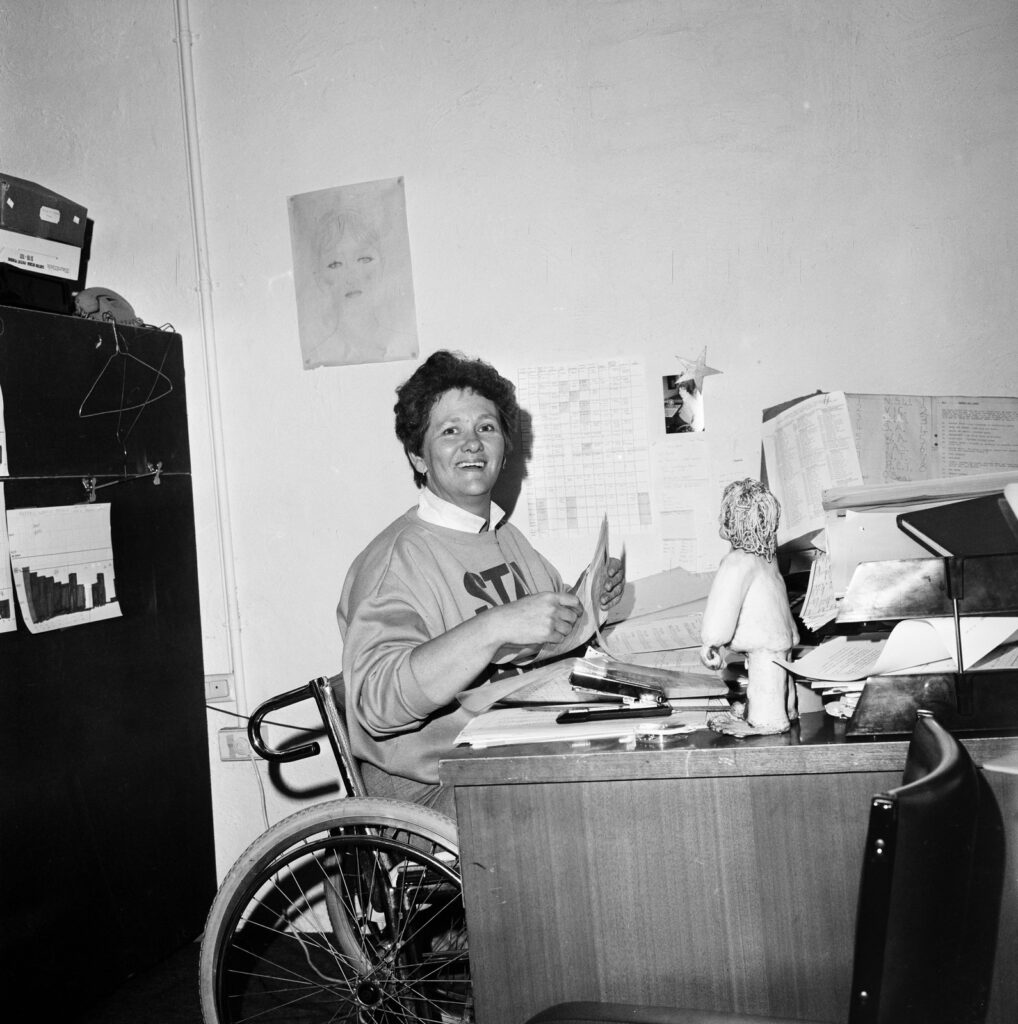
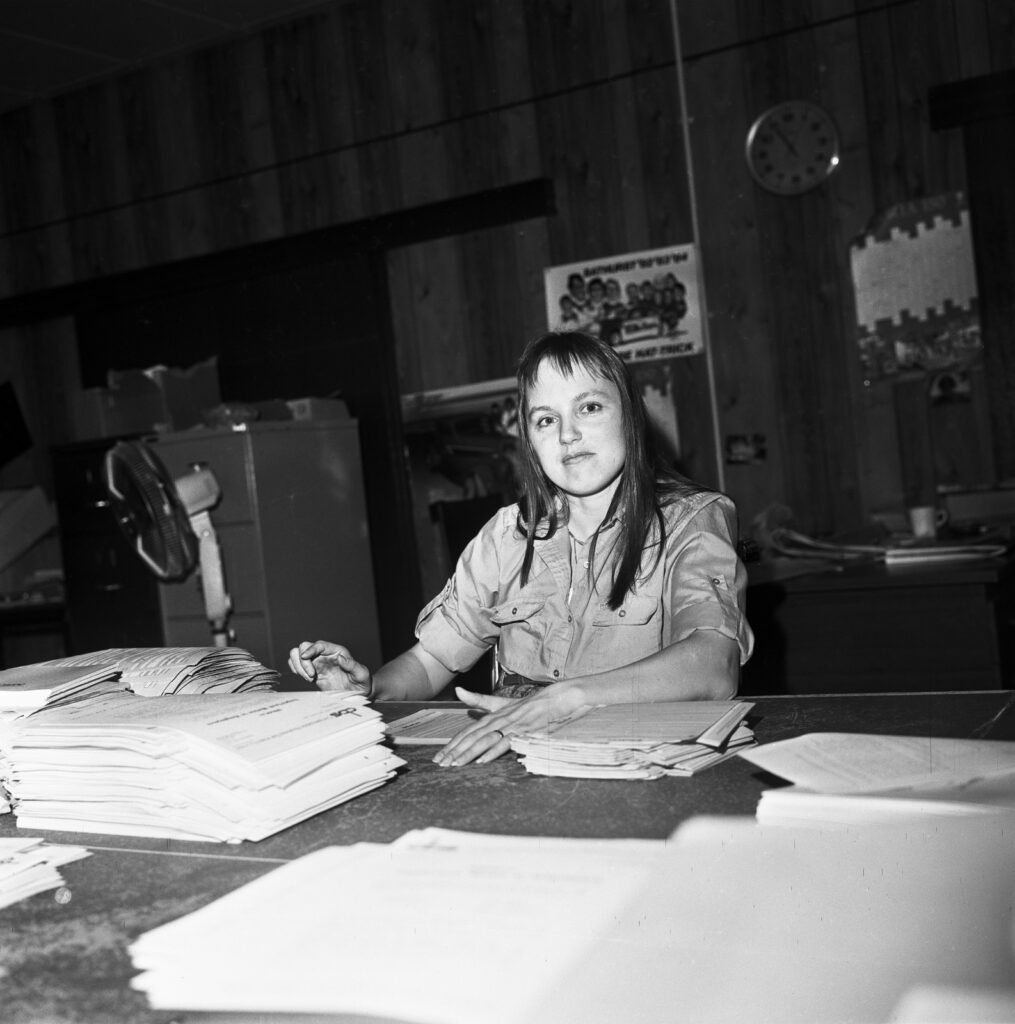
Portrait photographs of two women in a work environment seated at desks, in the image at left the woman is sitting in a wheelchair. John Shome (or Shone) and others people in wheelchairs, December 1986, Maggie Diaz collection of film negatives. These works are in copyright; H2014.1122/31b, H2014.1122/29d
The Variety Children’s Charity has supported sick, disadvantaged and disabled children globally since 1927.12 There are lots of ways the organisation has fundraised including art auctions, cookbooks and masquerade balls, usually involving well-known identities from the community, radio and television. However perhaps the most well-known is the annual Variety Kids Xmas Party, which began in 1986.13 Given the time of year, when I came across photographs from a party, taken by renowned Melbourne photographer, Rennie Ellis, this was another reason to include them.
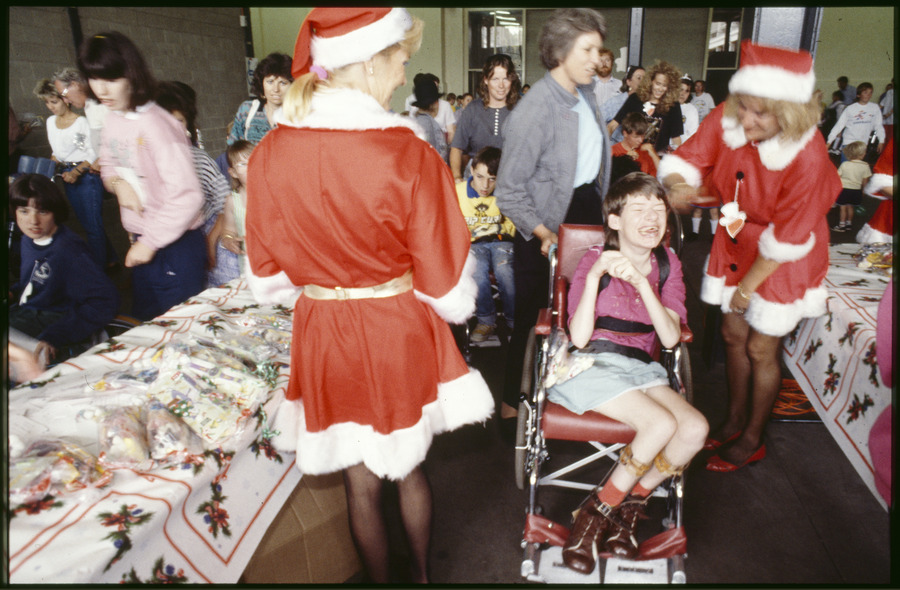

Left: Two ladies dressed in Santa suit dresses and hats happily engage with a smiling young girl in a manual wheelchair. Right: Children are transfixed by a clown making balloon animals. Variety Club Christmas Party, [between 1980 and 2000]. Photos by Rennie Ellis. These works are in copyright; H2012.140/2351, H2012.140/982
I was lucky enough to attend a party as a seven-year-old in 1989 with my disability sporting group at the time. So, these images stirred up some nostalgia. I remember meeting Santa and feeling a combination of excitement and anxiousness because of the crowd, as well as meeting actors from Neighbours, Tony Barber from Sale of the Century and well-known car dealer and businessman, Ken Morgan.
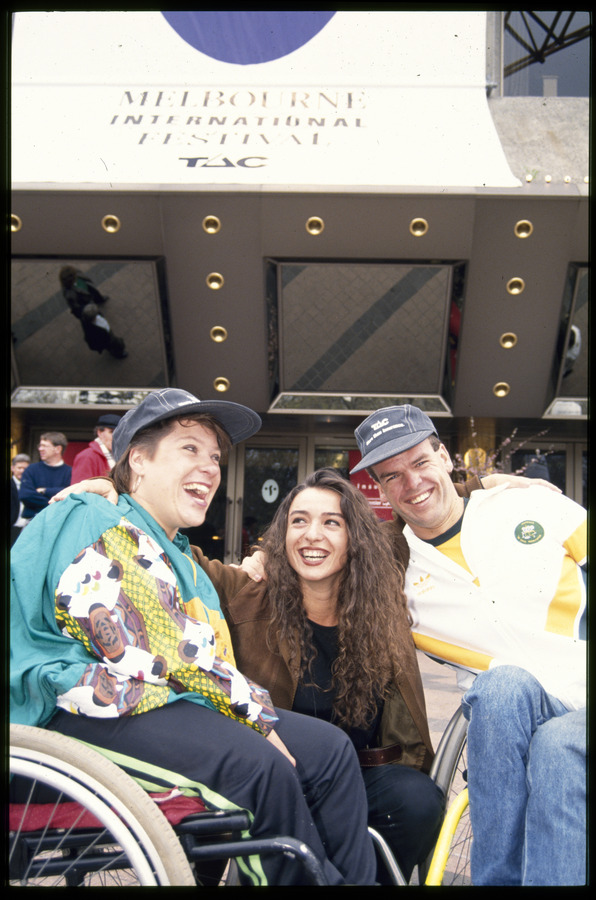
Man and woman in wheelchairs with unknown woman centre, outside the Arts Centre Melbourne, 1992, Rennie Ellis collection. Melbourne. This work is in copyright H2011.150/253
Another photograph by Rennie Ellis, part of a collection he took of the Melbourne International Festival [of the Arts] in the 1990s, shows the beaming smiles of a young man and woman both in wheelchairs outside the Arts Centre, another young woman kneels between them. The Festival was a forerunner of today’s RISING festival.
Through these later collections, I’d like to think that representations of disability were being recognised as a mainstream part of society.
A more recent acquisition is the Opening Doors project collection of images. A blog post was written about this in 2021. The photographer sought to capture people with disabilities sharing their interests and the comforts of living in their own home. For the purposes of this blog, I am highlighting it for its representation of hidden disabilities, but also to equally recognise that without context, these could represent anyone within our community.

Danny Lyons, 2019. Photo by Paul Dunn, Opening doors – renting for all collection. This work is in copyright H2022.181/7
Days like today allow us to acknowledge the diversity of disability, visible or invisible, to challenge our assumptions, to see the person before the disability, and champion accessibility and inclusivity within our community, because this ultimately benefits us all.
More to explore
Assistive technology at State Library Victoria
Online Collection Spotlight: Disability in the Modern World: History of a Social Movement
References
- International Day of People with Disability (2023) About IDPwD, International Day of People with Disability [website], accessed 11 November 2025.
- Australian Bureau of Statistics (2024) Disability, ageing and carers, Australia: Summary of findings [2022], Australian Bureau of Statistics [website], accessed 11 November 2025.
- Josef Lebovic Gallery (n.d.) Ann E. Leak [“Armless Wonder”, USA], Josef Lebovic Gallery [website], accessed 17 December 2025.
- The impacts of the civil war had a profound impact on her family; her parents declining health, the loss of property and her two brothers dying on the battlefields, meant that she saw herself as their only hope for stability moving forward.
- For more insight into her life, see Ann’s autobiography published in 1871, The autobiography of Miss Ann E. Leak, born without arms: Containing an interesting account of her early life and subsequent travels in these United States, Barclay & Co., Philadelphia.
- Buckrich, JR (2004) Lighthouse on the boulevard: A history of the Royal Victorian Institute for the Blind, Australian Scholarly Publishing, Melbourne, p 1.
- The organisation became the Royal Victorian Institute for the Blind in 1891. As above, p 52.
- As above, p 35.
- As above, p 33.
- As above, p 19.
- Oliver J (10 April 2015), ‘Maggie Diaz: Not sour, but definitely not sweet‘, The Sydney Morning Herald, accessed 12 November 2025.
- Variety the Children’s Charity (n.d.) About Us, Variety the Children’s Charity [website], accessed 17 November 2025.
- Variety the Children’s Charity (2022, December 15) ‘Christmas comes early for over 4,000 Victorian kids in need‘, Variety the Children’s Charity [website], accessed 12 November 2025.


Wonderful article congratulations State Library and Daniel.
Thank you Cheryl. Such an important day to acknowledge.