
A moving first
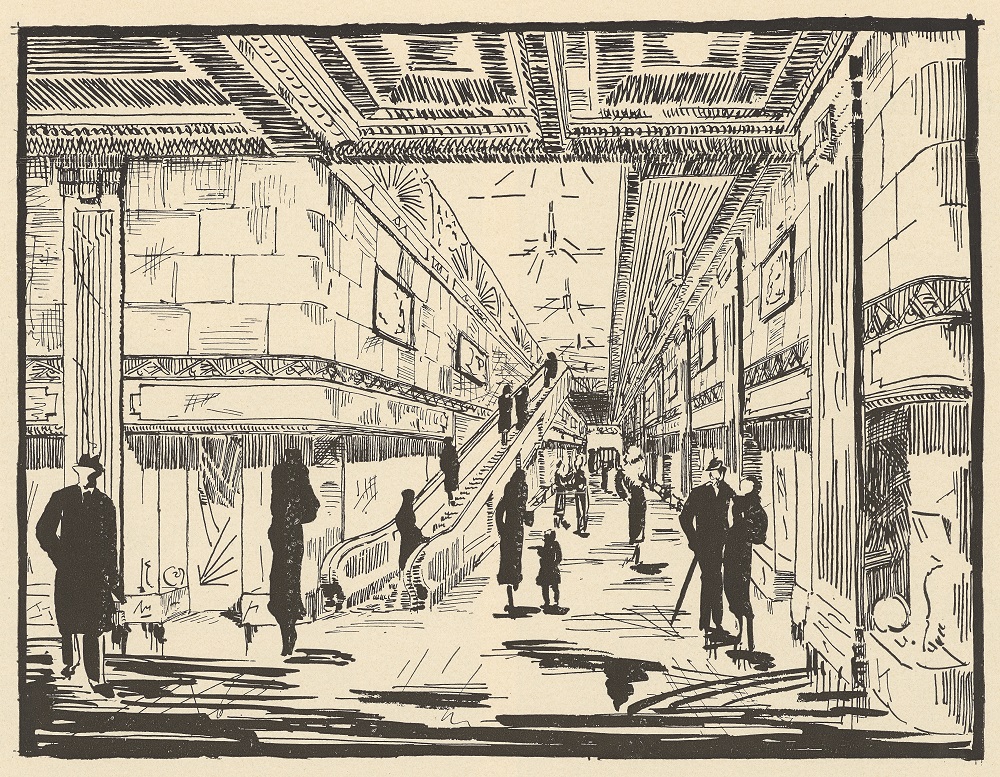
The place was Melbourne, the corner of Collins and Swanston Streets (also known as ‘Stewart Dawson’s corner’)2, and the month was September 1932: ‘For days, hundreds of people congregated in and around the building…’ reported journal, Building: the magazine for the architect, builder, property owner and merchant.3 So, what was the reason for this depression-era gathering?
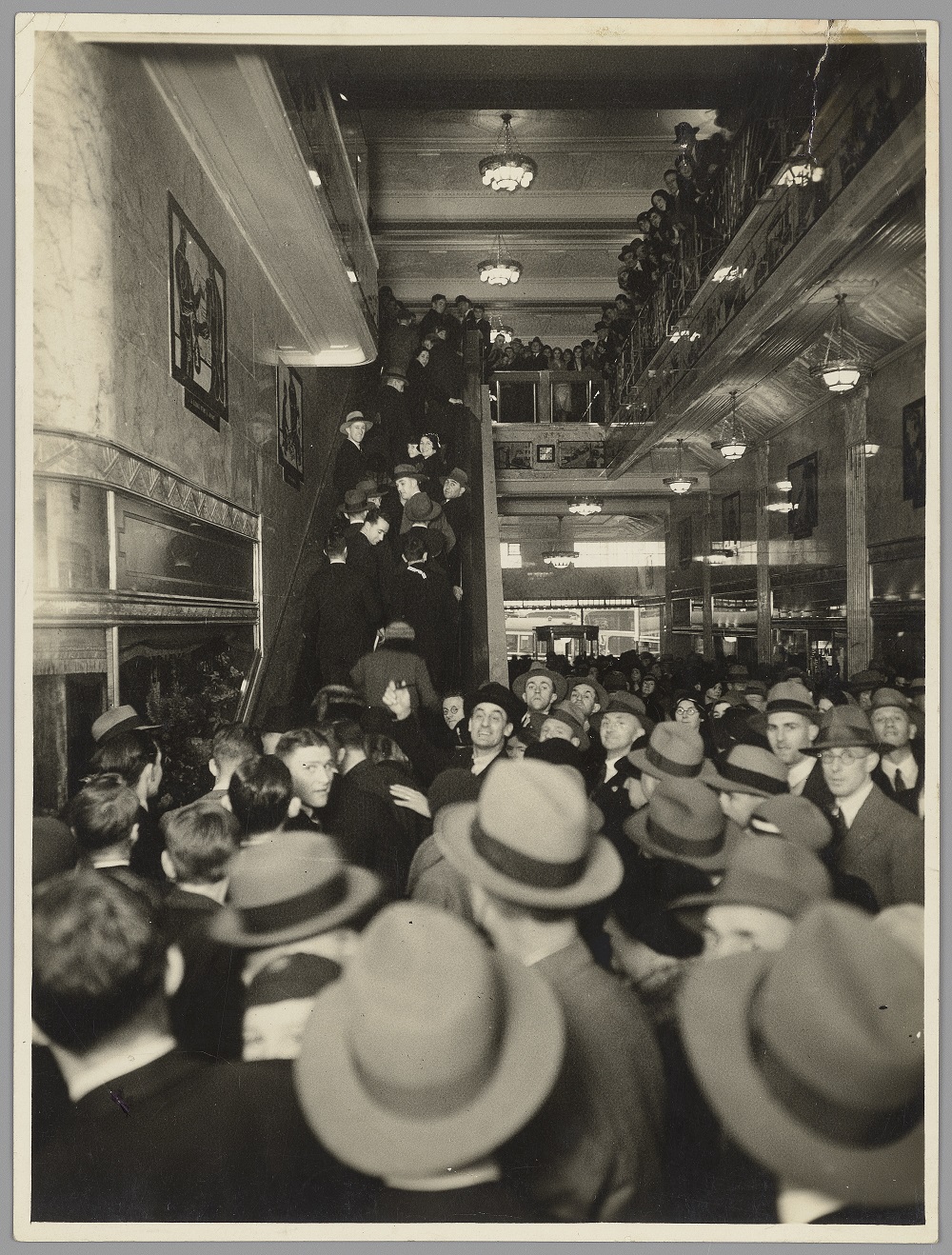
In 2025, if you see a long, snaking queue of people congregating outside a Melbourne CBD building, you suspect a limited-edition sneaker release, a new mobile phone event or a concert ticket sale. In 1932, hundreds of people gathered outside Melbourne’s M.U. – I.O.O.F. (Manchester Unity – Independent Order of Odd Fellows) Building on a prominent city corner for the express privilege of riding on Melbourne’s first escalators!4
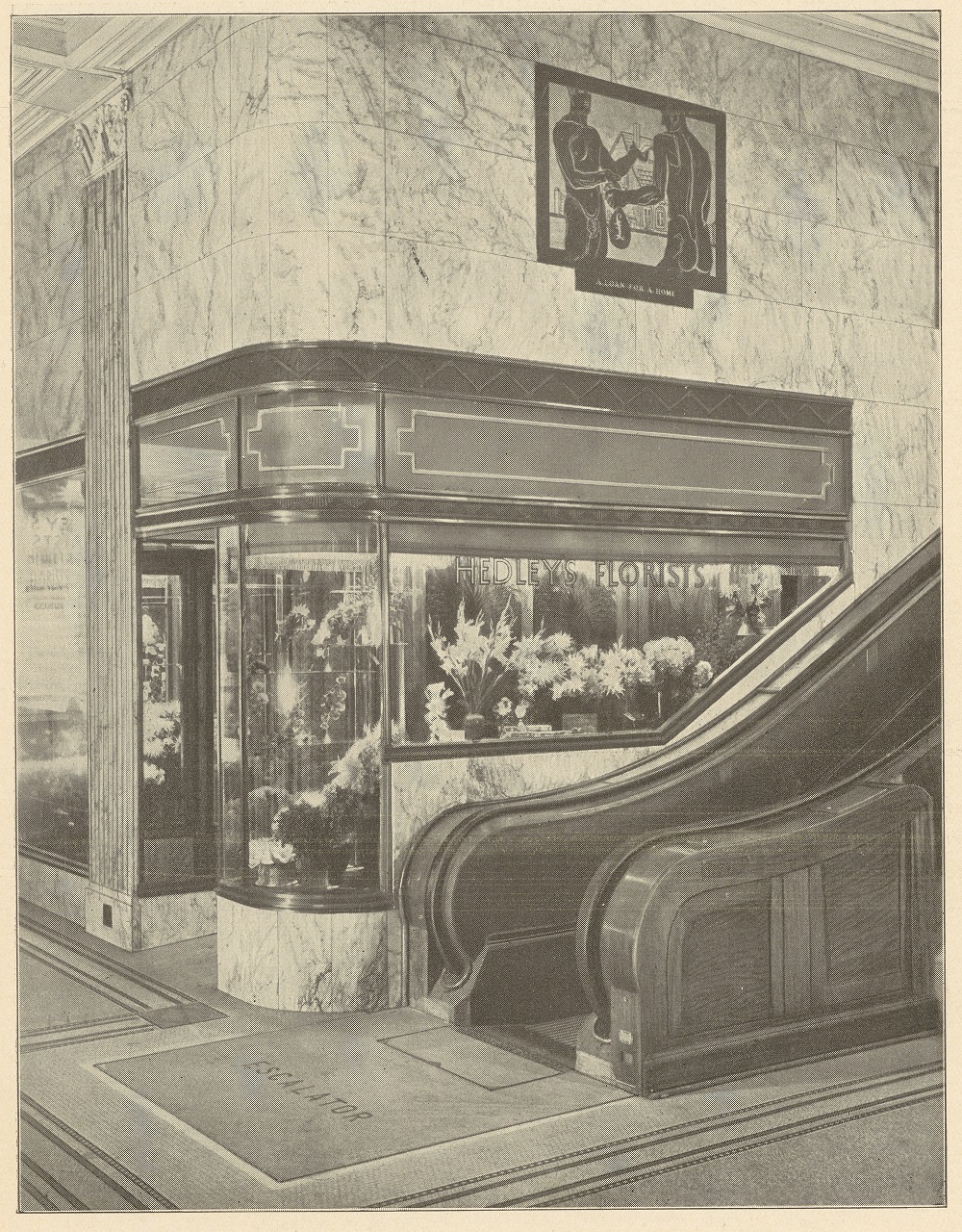
Opened at the height of the ‘Great Depression’, in the year that Australian unemployment reached 32 percent6, a new free entertainment enthralled Melbourne. Melbourne’s Herald waxed lyrical in an article entitled ‘City has a magic stair’, asserting that, ‘If the pages of the Arabian Nights opened, and the magic carpet floated down into Collins Street, Melbourne could not watch with greater awe. For Melbourne is learning to escalate!’ (The Herald, 2 September 1932, p 1).
‘Escalating’ was seen as an attraction for all ages and stages:
‘the oldsters and youngsters, the urchins and stray dogs have found it out. Today they all rode on it. Grave men with lawyer’s satchels, young men with self-conscious smirks, typists with high heels, carpenters with hammers in their belts…’.
The article went on to describe ‘four stages of escalating’: shy, venturesome, confident and seasoned.7 In 1941, a different four types were identified as ‘the do or die’, ‘the shuffler’, ‘the standing jump’ and ‘the splits’.8
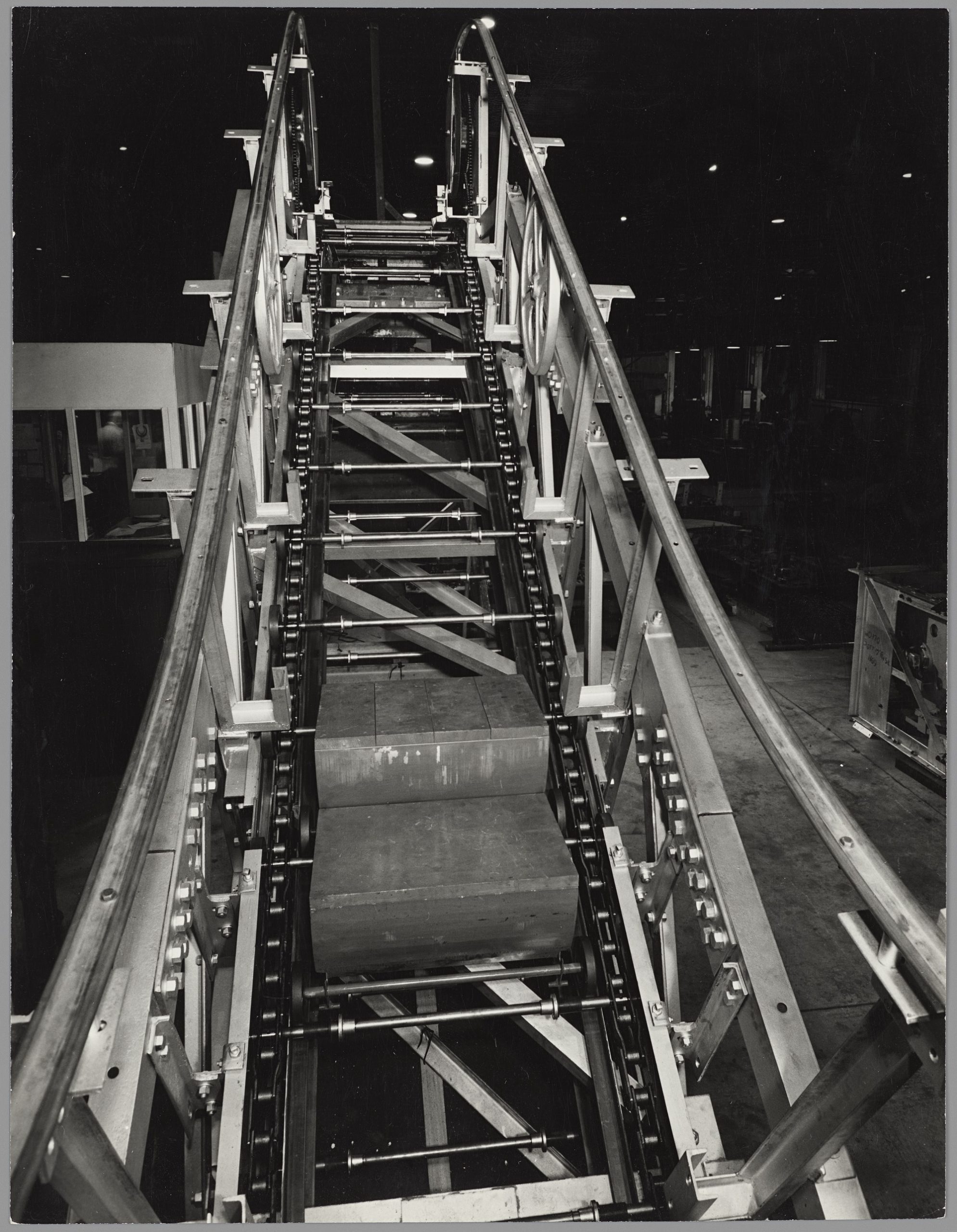
Marcus Barlow, a devotee of skyscraper-style modernism, later responsible for Melbourne’s Century Building (late 1930s),10 was the architect of the new building with Waygood-Otis (Australia) Pty Ltd responsible for the fit-out.11 The engineer involved with the escalator’s installation was a Mr D.E. Coles12 and a detailed description of the escalators’ mechanism was provided in Building.13 The Herald reported at the time that the new escalators ‘can bear 6000 people upwards at the rate of 90 ft [27.432 m] per minute!’ (The Herald, 2 September 1932, p 1). In the wake of the first escalator success, other escalators were soon planned in Melbourne.14 15
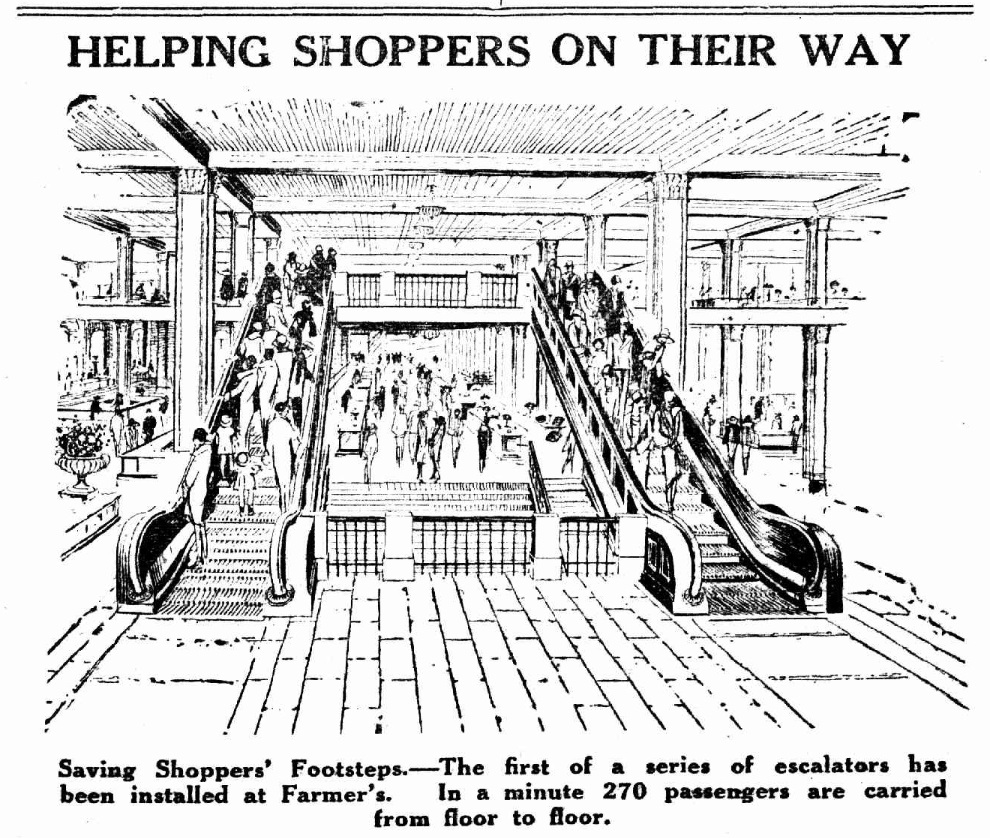
Early Australian escalation
The desire to ‘streamline customer experience and movement’17 was a strong driver for the introduction of escalators, which were largely rolled out in expansive railway station and shopping department store contexts. Escalators were used to regulate speed, leading to consistent movement (effectively controlling the varied paces of people of different ages, stages and abilities). Escalators found their place in retail theory too, directing travelers to the wares a shop particularly wanted to promote.18 19
At one stage it was even envisaged by some that escalators might be the future of footpaths, in a time ‘when all the streets of our large towns will consist of huge moving tracks on the escalator principle…’ with ‘junctions at the crossings, where you will simply step from one moving track to the other’ (Werribee Shire Banner, 13 Aug 1925, p 4).
England’s first escalator, an inclined conveyor (at London’s Harrods) was installed in 1898, where smelling salts and alcohol were offered gratis to revive those disturbed by their transportation experience.20 By the time the first escalators were realised in Victoria, apparently 16 were already operating in Sydney, including an installation at Milson’s Point Railway Station21 and at Mark Foy’s department store, of a travelling staircase or escalier hoquart.22
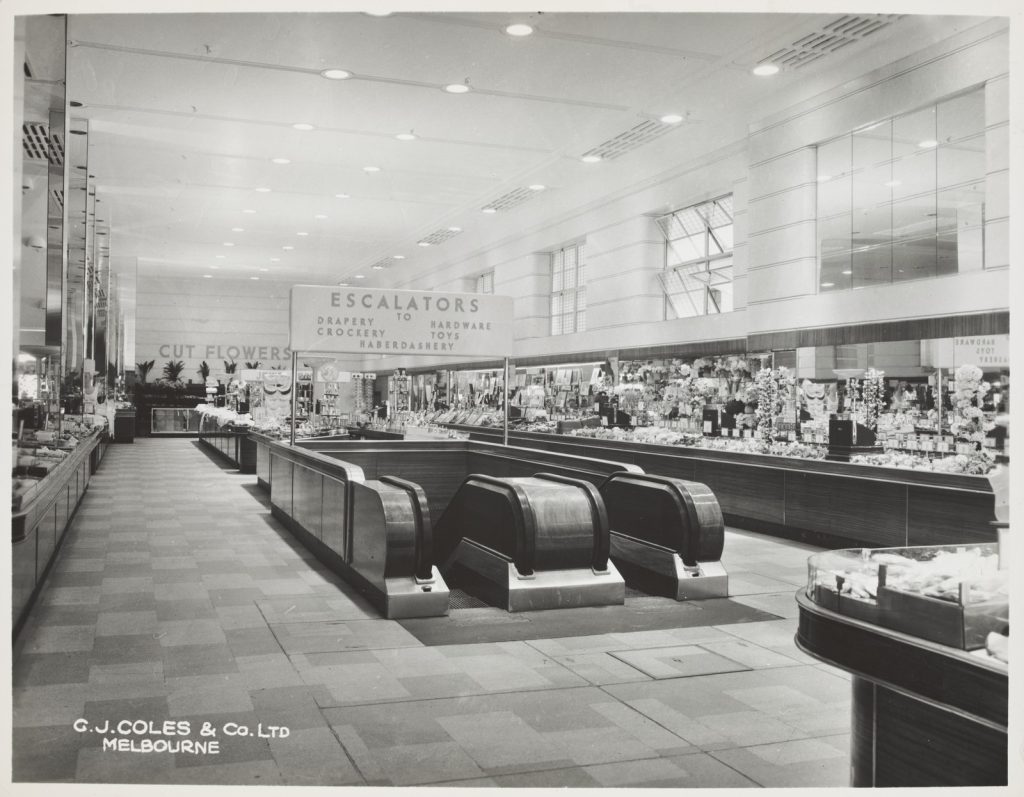
The harbour city’s most popular moving staircases were the 1932 Wynyard and Town Hall station wooden escalators, decommissioned in 2017.23 Parts of Wynyard’s York St escalators were then reconstituted as the Interloop sculpture by artist Chris Fox.24
Western Australia stole a march on Melbourne in 1928, when drapery store Charles Moore and Co. installed Perth’s first escalator (Truth, 11 November 1928, p 13).
Then, not long after Melbourne’s first experience, it’s been reported that South Australians first discovered the joys of the moving staircase in 1933 at John Martin’s store in Rundle Mall (News, 22 February 1933, p 6). Then, apparently Queensland’s Penney store in Brisbane boasted that state’s first escalators from late 1936 (Telegraph, 12 November 1936, p 7).
Later in WA, much was claimed on behalf of escalators that were ‘entirely doing away with the fatigue of mounting steps’ (The West Australian, 4 December 1948, p 18) at Boans department store in Perth in 1949, where the opening also led to a flurry of escalator travel and travellers received a badge in memory of their trip. A rumour (which apparently turned out to be false) even started that a woman had given birth to twins on the moving stairway (Worker, 23 May 1949, p 7).
Tasmanians are said to have first enjoyed escalators this same year, 1949, in Hobart’s Charles Davis department store (Advocate, 7 December 1949, p 18).
Apparently, the ACT had to wait until the 1950s and 60s for Canberra to enjoy its first escalators, when the J.B. Young store in Kingston was renovated25 (The Canberra Times, 18 March, 1961), and later the the Rogers’ Civic store also gained escalators (1961), said then to be ‘the first installed in a retail store in Canberra’ (Canberra Times, 24 March 1961). Some debate has also existed around the date and place of the Northern Territory’s first escalators. A contender is apparently Woolworths, corner of Knuckey and Smith Streets in 1968.26
Escalating popularity and etiquette
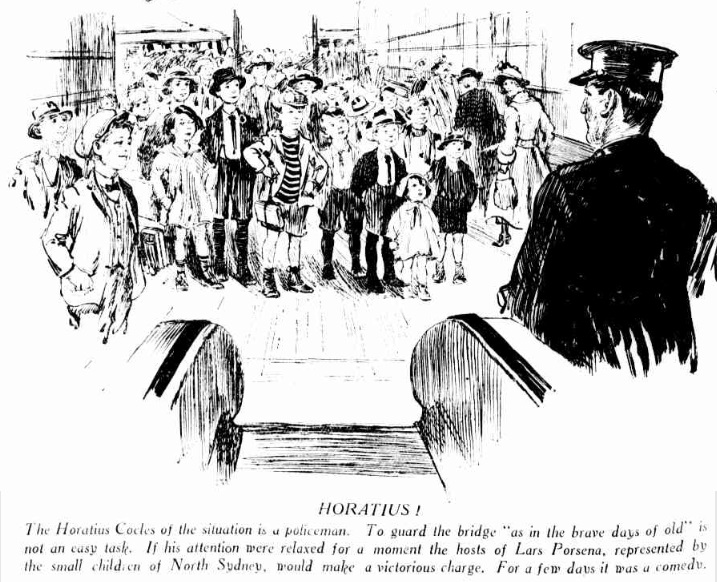
Forget playgrounds, in 1924, it was reported that ‘…all the kiddies of North Sydney went for an escalator joy ride. They went round and round down one up the other. The police and other authorities tried to stop them, but it was a hopeless task.’ (Evening News, 29 July 1924, p 1). In Queensland, young visitors to Penney’s in 1936 were expected to amuse themselves on the escalators while parents shopped: ‘until the novelty wears off, the youngster will do the round trip time and again’ (The Telegraph, 25 November 1936 p 21).
In a similar vein, in 1949 in Perth, children considered escalators the height of school holiday entertainment – and their parents took the opportunity to use the escalator as a babysitter and go about their own errands (West Australian, 2 September 1950, p 9). Why were escalators so popular? According to Building, ‘the escalator owes its popularity to the continuity of movement’.27
While many children and adults travelled the moving stairways with glee, there have always been the timid and beyond that sadly some who have come to grief around escalators. Among various minor through to fatal incidents over the years, in 1941, a claim for £249 in damages was made by a grandmother whose 3-year-old grandson lost a finger after it was caught in the Melbourne Myer Emporium escalator and later amputated. The child had been allowed to sit on the escalator and so a jury found in favour of Myer Emporium (Sun News-Pictorial, 23 October 1941, p 9).
The author of a 1933 newspaper article confessed to an enduring nervousness about escalators, which they traced back to Charlie Chaplin’s bumbling cinematic efforts in The Floorwalker (The Pioneer, 14 July 1933, p 4). The 1916 film contains a moving staircase sequence in which Charlie’s character attempts to walk down the up-escalator to comedic effect.28
In her decluttering memoir, Lessons in letting go, comedian Corinne Grant details her first escalator trauma as a country girl in Melbourne, where she trips over her culottes and falls down the escalator on her first day of work experience.29
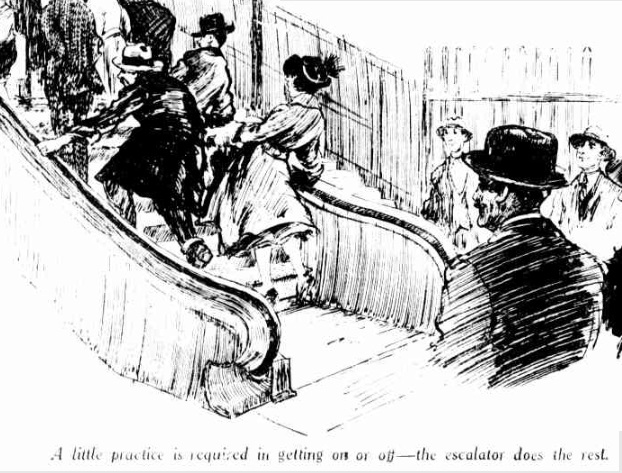
To the present day, despite early assertions that ‘the safety arrangements are foolproof’ (The Herald, 31 Aug 1932, p 27), there are still accidents around escalators. Melbourne’s long, steep Parliament Station escalators have seen frequent falls, leading Metro Trains to design a 2018 safety campaign.30
In terms of escalator etiquette, in her irreverent 2015 book, Things I want to punch in the face, Jennifer Worick cites ‘People who stop at the top of escalators’ as a particularly frustrating group of people and comments, ‘the first working escalator was built alongside a pier at Coney Island in 1896. You’d think people would have learned how to use them by now’.31 In her book, Amy’s guide to best behavior in Japan: Do it right and be polite! (2018), Amy Chavez also has ‘a word about escalators’, noting that traveling one side of the escalator to allow others to pass has been a widely understood norm that is now changing.32 Anyone traveling by train into Melbourne will certainly have witnessed the ire of commuters when unknowing tourists or novice city-goers try to travel two-abreast or stop and attempt to travel on the right-hand side of the escalator.
City commuters use them every day and most likely if you travel by train to State Library Victoria, you’ll use one too. These days we take them for granted, but next time you see one, spare a thought for the escalator.
Further reading
Abdullah R & Hübner R (2006) Pictograms, icons & signs : a guide to information graphics [translated from the German by David H. Wilson] Thames & Hudson, London, New York
Adler R R (1970) Vertical transportation for buildings, American Elsevier Pub. Co., New York
Baker N (1989) The mezzanine, Penguin/Granta, Cambridge, Eng [novel]
Carpenter M M (2019) ‘Escalator’ in C. Op den Kamp (ed) A history of intellectual property in 50 objects, Cambridge University Press, Cambridge, United Kingdom ; New York, NY, USA
Goetz A (ed) (2003) Up, down, across : elevators, escalators and moving sidewalks, Merrell, London
Gronert S (1994) ‘The exact course of an escalator’ in V M Lampugnani & L Hartwig (gen eds) and J Simmen & J Imorde (eds) Vertical: lift escalator paternoster: a cultural history of vertical transport, Benson R and Kerkhoff-Saxon C (trans), Ernst & Sohn, Berlin
Strakosch G R (1967) Vertical transportation: Elevators and escalators, Wiley, New York
Williams A (n.d.) The Romance of Modern Mechanism : With Interesting Descriptions in Non-technical Language of Wonderful Machinery and Mechanical Devices and Marvellously Delicate Scientific Instruments, Project Gutenberg, Salt Lake City, UT
For children
BMX Bandits: ‘That’s life, pal’ (1983) NFSA , accessed 31 July 2025. Note: an escalator action sequence begins at 1.36 in the video.
Smith Dinbergs H (2006) Escalator escapade, Macmillan Education, South Yarra, Victoria
- Centenary souvenir Manchester Unity I.O.O.F in Victoria (1934) p 33. Records of Manchester Unity Independent Order of Odd Fellows, 1840-1982, YMS 16496, BOX 3
- Prior to 1932, this corner was known as Stewart Dawson’s Corner, after the jeweller whose building had previously occupied the site (The Argus, 28 November 1928, p 7)
- Federated Builders’ Association of Australia & Master Builders’ Federation of Australia (1923) ‘The Manchester Unity Building, Melbourne AN EPOCH-MAKING ACHIEVEMENT. Marcus R. Barlow, Architect; W. C. Cooper Pty., Ltd., Master Builders.’ Building: the magazine for the architect, builder, property owner and merchant, vol 51, no 301, p 64b
- As above, pp 54-64e
- Centenary souvenir Manchester Unity I.O.O.F in Victoria, 1934, p 37. Records of Manchester Unity Independent Order of Odd Fellows, 1840-1982, YMS 16496, BOX 3
- National Museum of Australia (n.d.) Defining Moments: Great Depression, National Museum of Australia [website], accessed 3 July 2025
- ‘City has a magic stair’ (2 September 1932) The Herald, p 1
- Smith’s Weekly, 6 December 1941, p 19
- Loose photographs of Manchester Unity Building and city surrounds [photographs], 1930-1970?. Records of Manchester Unity Independent Order of Odd Fellows, 1840-1982, YMS 16496, BOX 2/2. It is likely the photograph was taken in September 1932 during the first weeks after the building opened as this photo appears in newspaper The Advertiser, 28 September 1932, p 20
- Manchester Unity Building (n.d.) History, Manchester Unity Building [website], accessed 3 July 2025
- Federated Builders’ Association of Australia & Master Builders’ Federation of Australia, (1923) p 64b
- The Herald, 31 August 1932, p 27
- Federated Builders’ Association of Australia & Master Builders’ Federation of Australia, (1923) p 64b
- The Herald, 5 January 1933, p 17
- The Sun News-Pictorial, 4 January 1933k p 5
- Johns & Waygood Collection, PCLTA 2373 Box 5
- Transport for NSW (n.d.) Escalation sensation, Transport for NSW [website], p 4, accessed 5 July 2025
- Strakosch G R (1967) Vertical transportation: Elevators and escalators Wiley, New York
- ‘The vogue of the escalator’ (1 January 1930), Construction and local government journal, p 6
- Noble W (2024) Everything you need to know about London’s escalators, Londonist [website], accessed 3 July 2025
- Federated Builders’ Association of Australia & Master Builders’ Federation of Australia (1932) p 64b
- The Sydney Morning Herald, 15 September 1909, p 4
- Transport for NSW (n.d.) Escalation sensation, Transport for NSW [PDF], accessed 5 July 2025
- Transport for NSW (2021) Interloop, Transport for NSW [website], accessed 5 July 2025
- ACT Heritage Council (2024) Background Information: Kingston Shopping Precinct, May 24 Appendix – Brief History, Integrity and description of each block, ACT Government [PDF], accessed 5 July 2025
- Manicaros A (2015) MYSTERY SOLVED: The Woolies escalator DID exist! NT News [website], accessed 5 July 2025
- Federated Builders’ Association of Australia & Master Builders’ Federation of Australia (1932), p 64b
- McDonald G D, Conway M and Ricci M (1965) The films of Charlie Chaplin, Citadel Press, New York
- Grant C (2010) Lessons in letting go : Confessions of a hoarder, Allen and Unwin, Crows Nest, NSW
- Mills N (10 December 2018) Frequent falls on Parliament Station escalators prompts Metro Trains safety campaign, ABC News [website], accessed 10 July 2025
- Worick J (2015) Things I want to punch in the face, Prospect Park Books, Altadena, California, p 164
- Chavez A (2018) Amy’s guide to best behavior in Japan: Do it right and be polite! Stone Bridge Press, La Vergne


“Every frame silently narrates a world… Thanks for your interest.”
Fantastic story.
Fantastic story.
I recall that when I noticed the escalator in th MU building in about the mid 60’s, it had wooden treads.
Regards.
Wonderful post, so interesting! Hope to see more like this.
Fascinating to read. I did not know it was that early in Melbourne. Thank you for enlightenment – one assumes it might need to be updated with one of the new train stations having the longest escalators?
Very interesting. What make of chain is used overseas and in Australia?
Is it Renold?
As a country raised chid from a village in South West NSW but with Melbourne roots I found this evocative of my childhood fear of escalators on those infrequent times I found myself in Sydney or Melbourne. Now in my 80s I find escalators reprising my childhood fears.