
Christmas is a time that is often dedicated to religious festivities, family and friends, gift giving and holidays. However, for many, it’s really all about…the food.
Whether it be an elegant cocktail party with dainty canapés on Christmas Eve, a Christmas Day champagne breakfast, beachside picnic lunch, hotel buffet dinner or all-day grazing board at home, the Christmas feast acts as the enticing hub that brings people together to celebrate.
The State Library’s collections of historic menus, cookbooks, photographs, newspapers and magazines document everything from the Christmas colonial fare of the first British settlers, through the festive food fads of the 20th century, to the traditional Christmas dishes celebrated by our diverse migrant communities. Perhaps the following gems from our Library collection will reignite fond memories of your favourite Christmas foods or offer you some new ideas to cook for your celebration this year. Now, who’s hungry? Well then, your Christmas feast is served — so come and get it!
Christmas feasts in the great outdoors
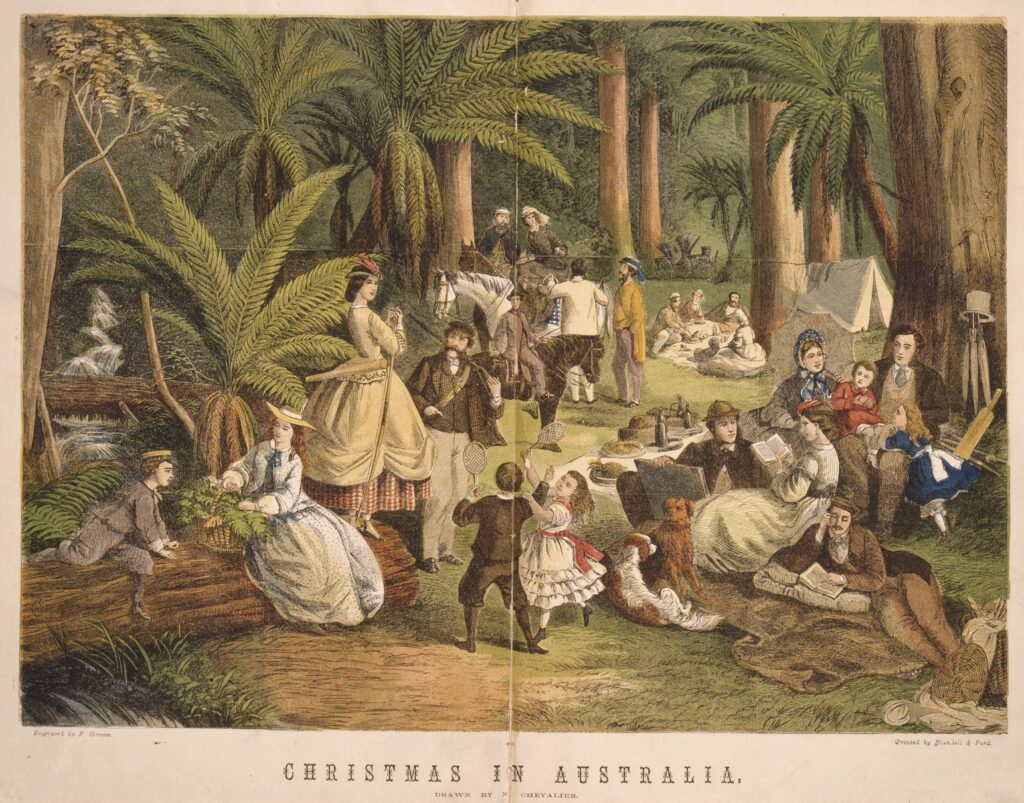
Although most of us are used to celebrating Christmas in the comfort of our homes, many Victorians have traditionally enjoyed their feasts relaxing outdoors. The healing power of nature was often the perfect setting for an al fresco Christmas Day:
A Christmas dinner in Australia necessarily takes the shape of an al fresco meal and as Melbourne abounds in public parks and pleasantly situated reserves, pleasure seekers enjoy a wide range of choice. (Illustrated Melbourne Post, 22 December 1864, p 3)
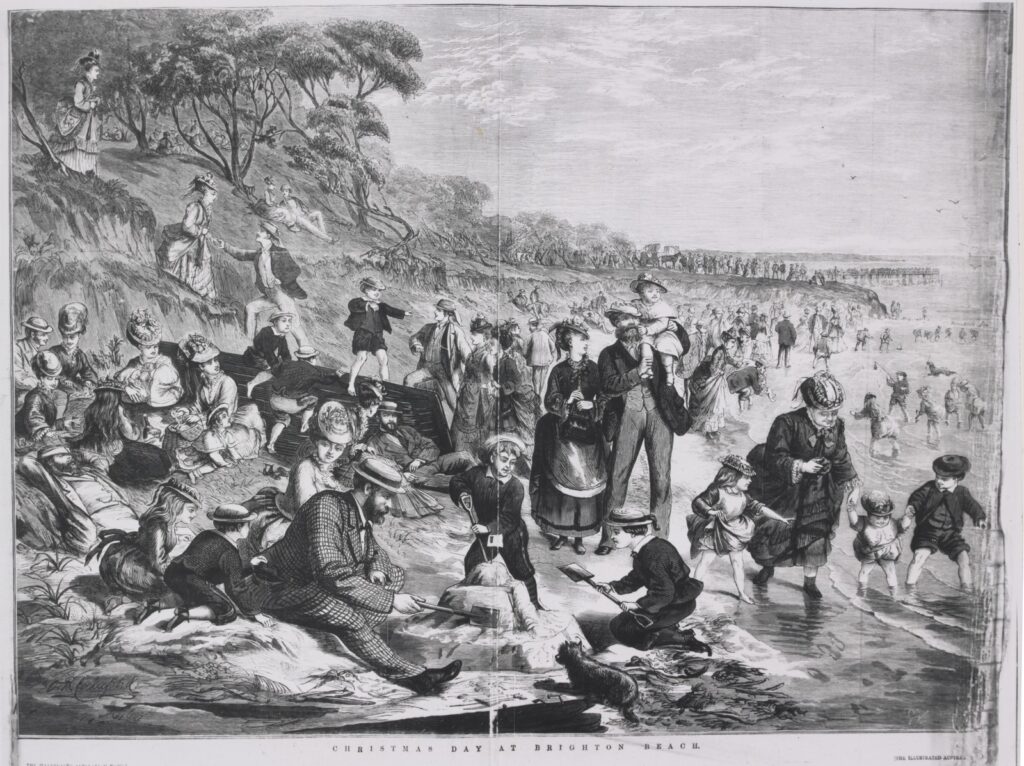
Lunch at the beach was a refreshing option, making the most of the Aussie summer with a Christmas Day dip in the sea:
One of the most popular places of resort at such time, the beach at Brighton is visited by thousands of persons on Christmas Day. Fires are lit, hampers of provisions unpacked, tablecloths are spread upon the sand, and temporary awnings wreaked overhead. The clatter of plates, the popping of corks, the jingling of glasses, and the rattle of knives and forks mingle with peals of merry laughter, with the buzz of conversation, and the splash of the waves upon the beach. (Illustrated Melbourne Post, 22 December 1864, p 3)
Keeping Christmas waterside, others chose to recline along the bank of a river whilst grazing on picnic fare:
Another favourite camping ground for Christmas revellers is Studley Park… forming a kind of peninsula round two sides of which creeps the sinuous Yarra. It is much resorted to by boating parties throughout the summer and especially by picnic parties on Christmas Day. (Illustrated Melbourne Post, 22 December 1864, p 3)

From river deep to mountain high, where hikers in the 1930s cobbled together a Christmas stew in the Victorian Alps:
A Christmas meal remembered gratefully was marked by an extravagant stew. Some fresh meat had been secured that day in passing through a tiny township. It was sliced into fair sized pieces and supplemented with the final fragments of corned beef which had lasted the party for about a week. Some onions and potatoes a bag full of broken biscuits, half a pound of stale bread, a bottle of Bovril, a lump of bacon, salt, pepper, and several scraps of other food, a little oatmeal, and half a cup of rice, all these went into the big billy. It was a good stew: a bush bouillabaisse. — Robert Henderson Croll (Along the Track, 1930, p 74)
Other southern cold-climate Christmas meals documented include explorer Douglas Mawson’s 1911–1915 Antarctic expedition:
Christmas Day was gloriously fine, with just sufficient wind to counteract the heat of the sun. At midday the Christmas ‘hamper’ was opened, and it was not long before the only sign of the plum-pudding was the tin. — Douglas Mawson (The Home of the Blizzard, 1938, p 310)
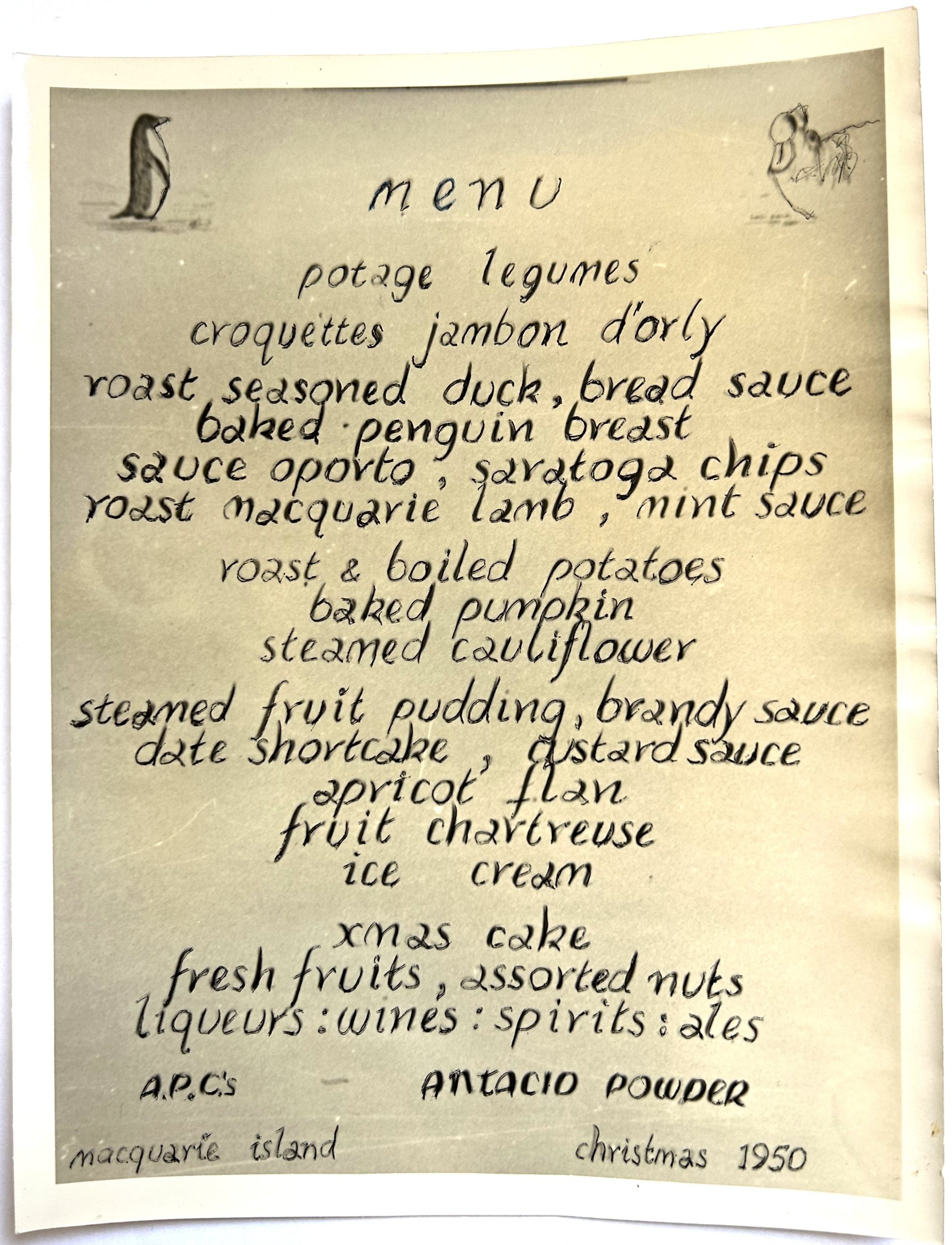
The State Library manuscripts collection includes this 1950 postcard and handwritten menu for the crew spending their Christmas Day on the subantarctic Macquarie Island:

The no-cook, no-fuss, catered Christmas
For those who preferred to outsource their catering, the prospect of having food platters delivered to their table was a splendid way to enjoy Christmas:
Carefully curated Christmas hotel menus provided an ideal way to relax in style. Boasting its status as ‘Australia’s largest hotel’ on its 1956 Melbourne Olympics Christmas menu, the Victoria Hotel on Little Collins Street offered six choices of Christmas roast — pork, lamb, beef, chicken, turkey and… ‘drakeling’:


Christmas Greetings from The Victoria Hotel Melbourne, 1956.
Some Christmas revellers even opted to share their good tidings on high tides by boarding ships that offered fine-dining festive menus:


SS Orsova Christmas Day menu 1954, from Collection of Orient Line ships’ menus from SS Orsova, voyage from Australia to Europe via Africa; H2001.87/9-13.
Feasts of Christmas past
The tradition of Christmas was brought to Australian shores with the arrival of the first British migrants, who faced many hardships in this new land, including having limited food options:
The Europeans who, willingly or not, began to arrive in Australia from 1788 did not have rigid expectations about how they would celebrate Christmas or what would make their Christmas feast…The early Australian settlers were probably less concerned about what they ate than about whether they ate. Food supplies often ran short. — Colin Bannerman (The Upside-Down Pudding: A Small Book of Christmas Feasts, 1999, p 10)
and struggling with being unaccustomed to southern Christmas Day temperatures around 30 degrees in the shade:
Sunday 25 December 1803, Xms. Day: At 1 P.M. the thermomiter in the shade 82, I dind with the gentlemen of the mess at Port Phillip. — Reverend Robert Knopwood (Historical Records of Port Phillip: the first annals of the colony of Victoria, 1879, p 152)
Watching Christmas bushfires surround the Victorian goldfields in the mid-1850s, miners sought the comfort of familiar festive foods:
Few of the miners would be likely to forget the Christmas of 1857 — their first in Ararat. Bushfires were all around them. The Pyrenees and the ranges between Ararat and Pleasant Creek were in flames… Frank’s Restaurant advertised a dinner of roast beef and plum pudding ‘such as you used to get at home before this gold fever was thought of’. — Lorna Lamont Banfield (Like the Ark: the story of Ararat, 1955, p 90)
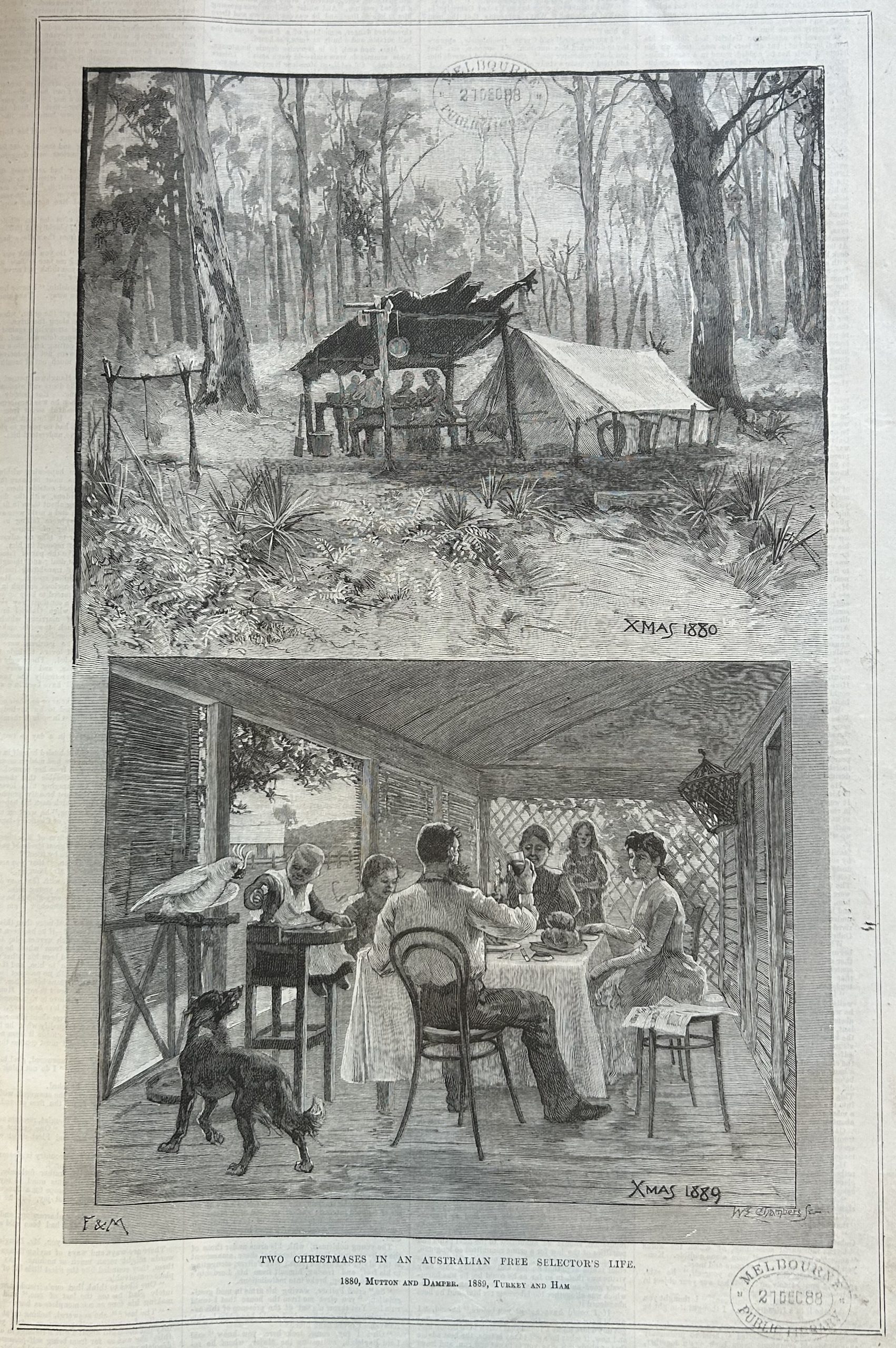
Although specialty festive foods were imported, they were too costly for common people. Apart from the traditional English roast beef, inspiration was also found in America’s Thanksgiving turkey, which had become fashionable in England.1 However, these sumptuous Christmas meats were not as obtainable as a leg of mutton, which would often be enjoyed as the settlers’ main Christmas dish:
The early 1900s saw a proliferation of popular women’s magazines, which were filled with suggestions of what to cook when hosting guests for Christmas. Perhaps some savoury nibbles to enjoy with drinks, followed by some poultry generously filled with stuffing, accompanied by various sauces and roast vegetables:
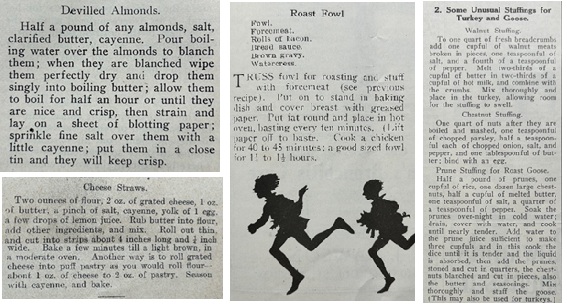
Early 1900s Christmas recipes
Top left: Devilled almonds, Everylady’s Journal, 6 December 1913, p 746.
Bottom left: Cheese straws, New Idea, 6 December 1907, p 857.
Centre: Roast fowl, Woman’s World, 1 December 1922, p 37.
Right: Walnut, chestnut and prune stuffings for turkey and goose, Everylady’s Journal, 6 December 1915, p 739.
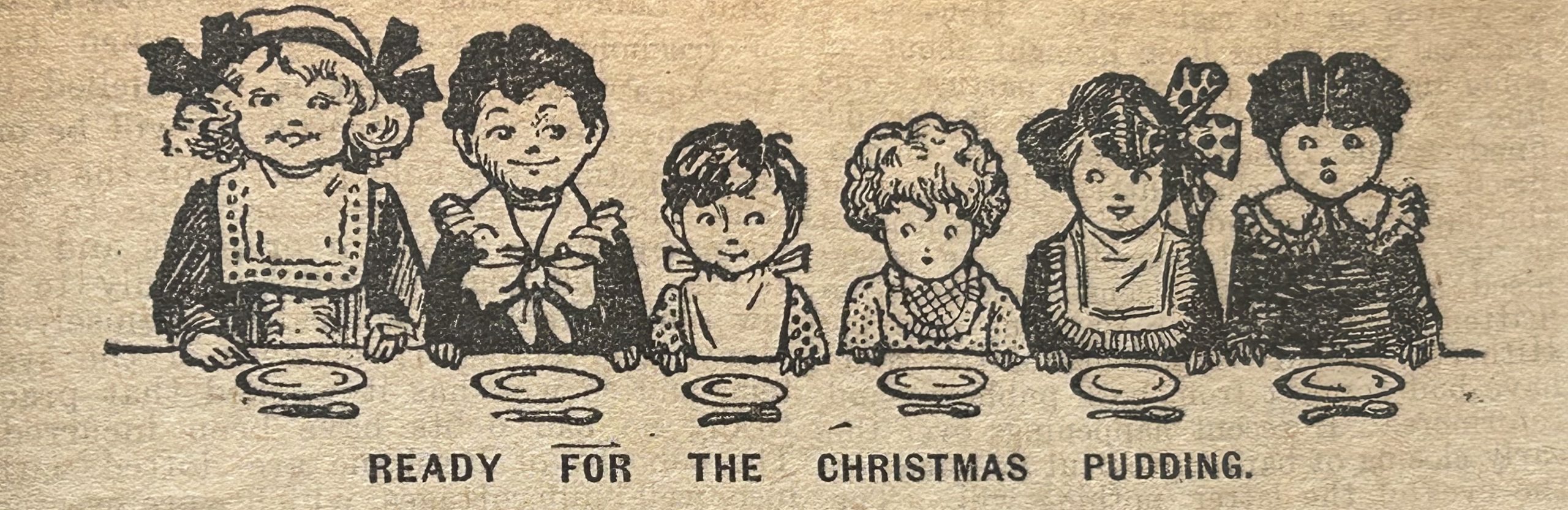
Then, to finish, of course there was the pudding, with fruit mince prepared using beef suet and often beef sirloin steak as well — hence the term ‘mince pies’.2
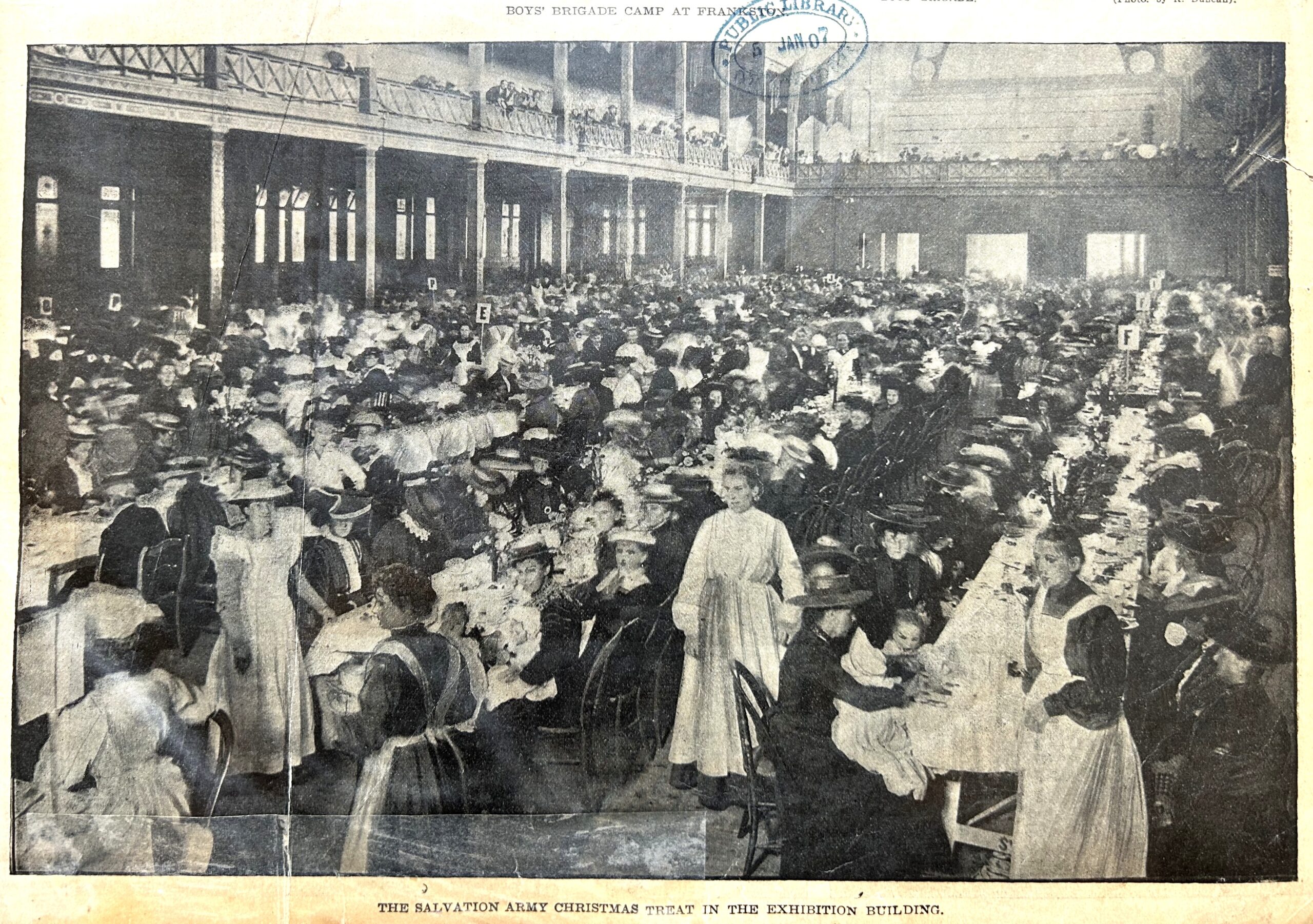
Around the turn of the century, the Salvation Army held its annual Christmas banquet for 2500 people, kindly treating those in need to a special ‘dinner and biograph entertainment in the Royal Exhibition Building, as is the army’s usual custom at Christmastide’:3
During the Great Depression of the 1930s, Victorians rallied together to send Christmas parcels of food to help citizens in their time of need. Collection baskets were placed at Flinders Street, Princes Bridge and Spencer Street train stations:

Community groups packed hampers of Christmas provisions to brighten up the festive season for World War II troops:
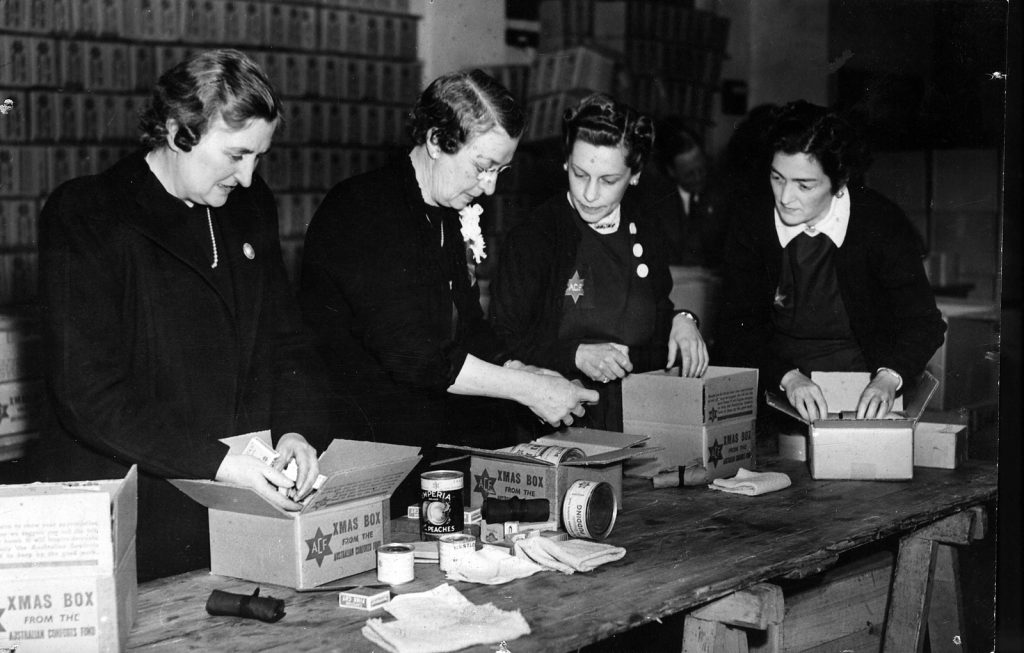
Christmas dinners were organised as celebrations for Australian and American service men and service women:
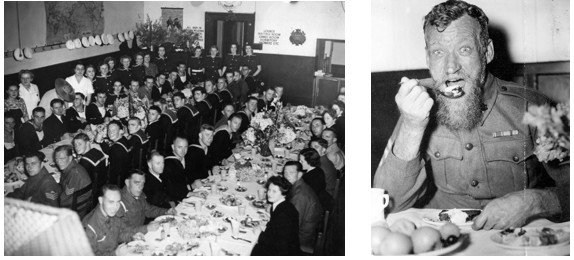
Left: Servicemen and women pause for photograph while eating Christmas dinner at Navy House Collins Street, Argus newspaper collection of war photographs, World War II, 1941/1947; H99.201/5285.
Right: Sgt G Spedding enjoying Christmas dinner at Caulfield Military Hospital, Argus newspaper collection of war photographs, World War II, c 1940-1941; H98.100/3885.
Colourful Christmas entertaining guides in the 1950s and 1960s showcased a modern smorgasbord of festive foods, such as: creamy turkey hash; salad with tinned asparagus; and ham mousse crowned with peaches and gherkins.4
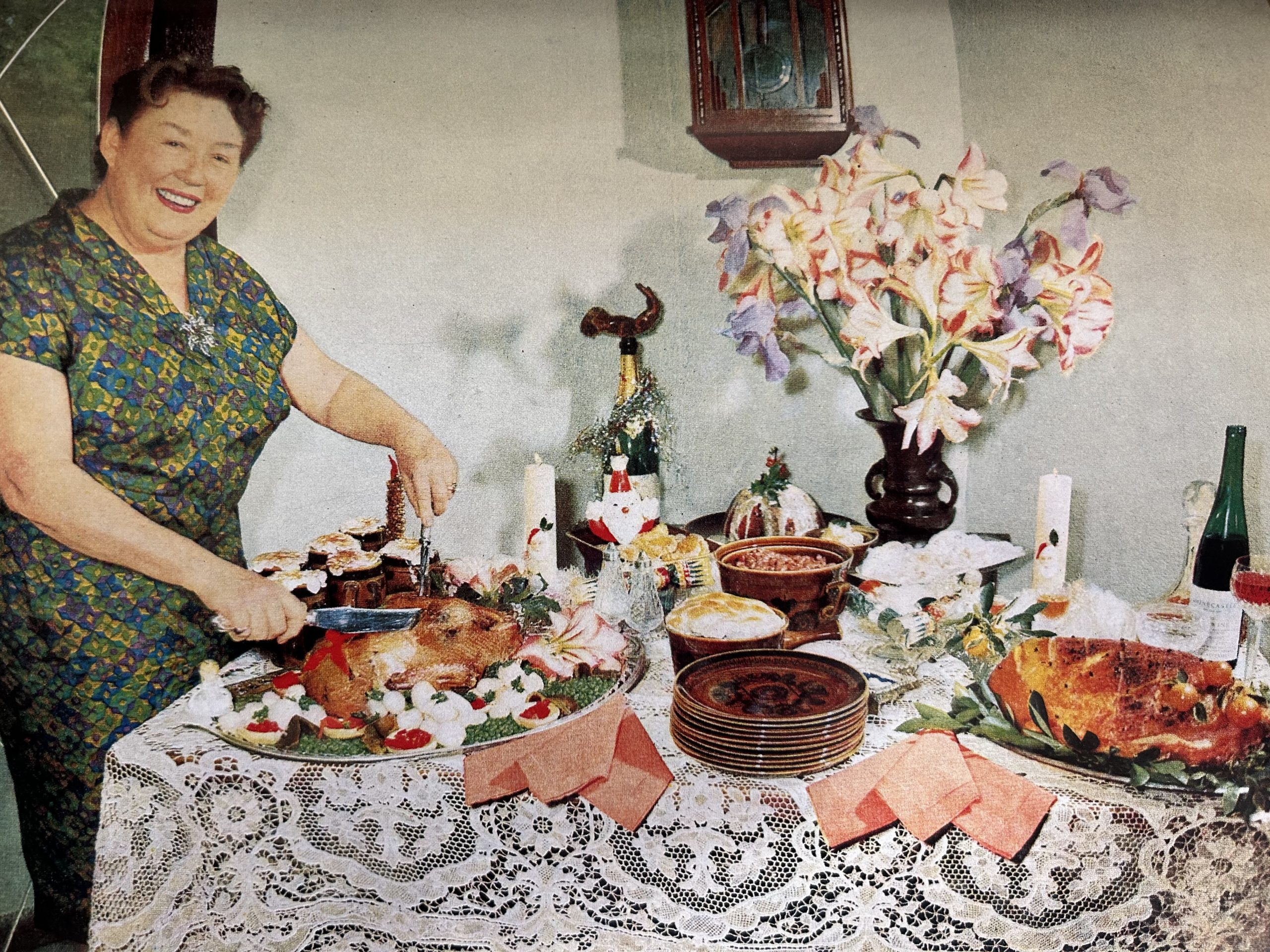

1970s magazines offered a choice of Christmas Day menus, complete with ‘work plans’ scheduling a checklist of hourly tasks. Summer Christmas chilled menus recommended prawn paté and minted iced pea soup.5
The addition of pineapple also featured heavily in 1970s Christmas dishes:
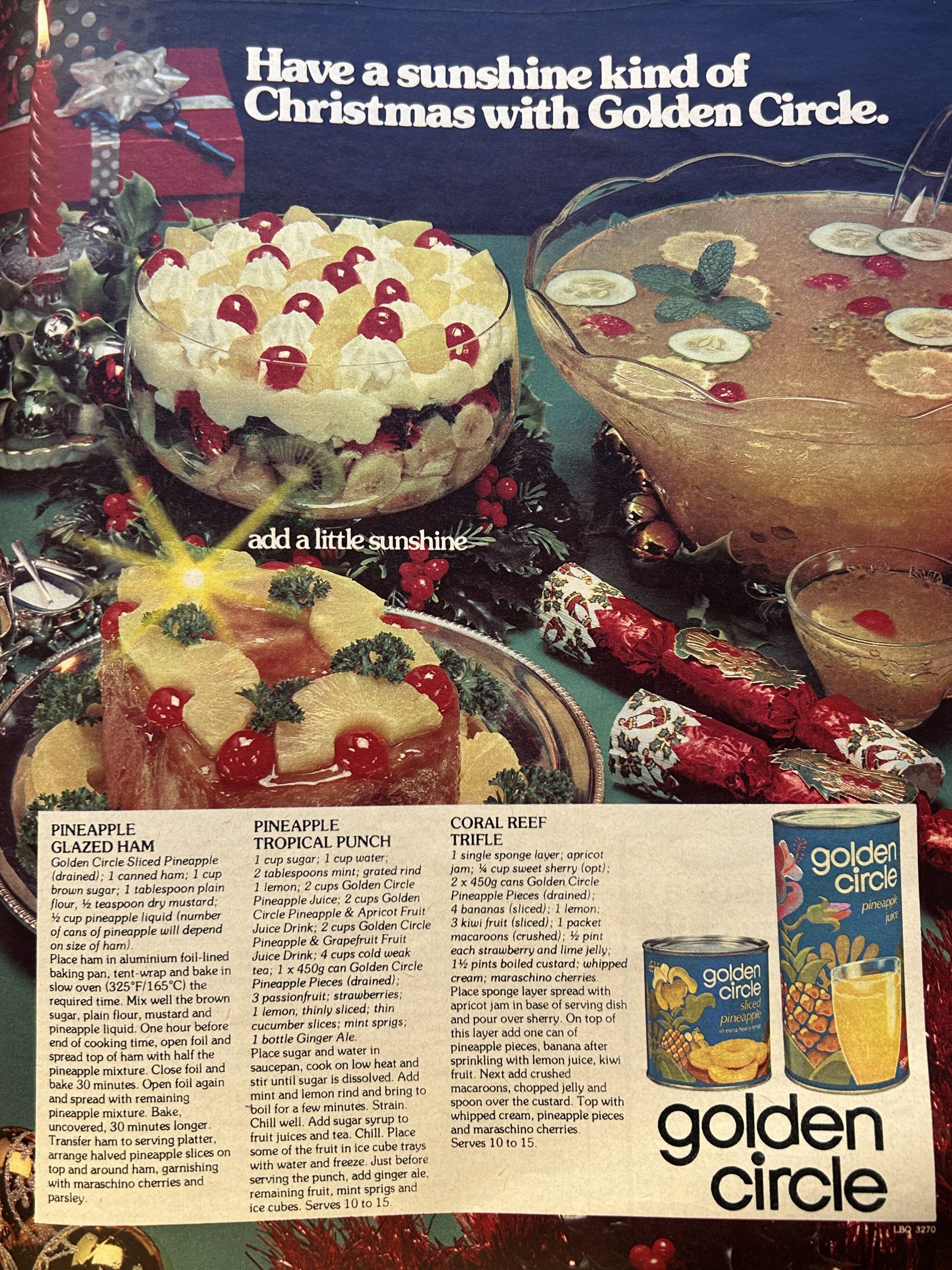
Christmas dinners in the 1980s tended to be more casual gatherings at home:

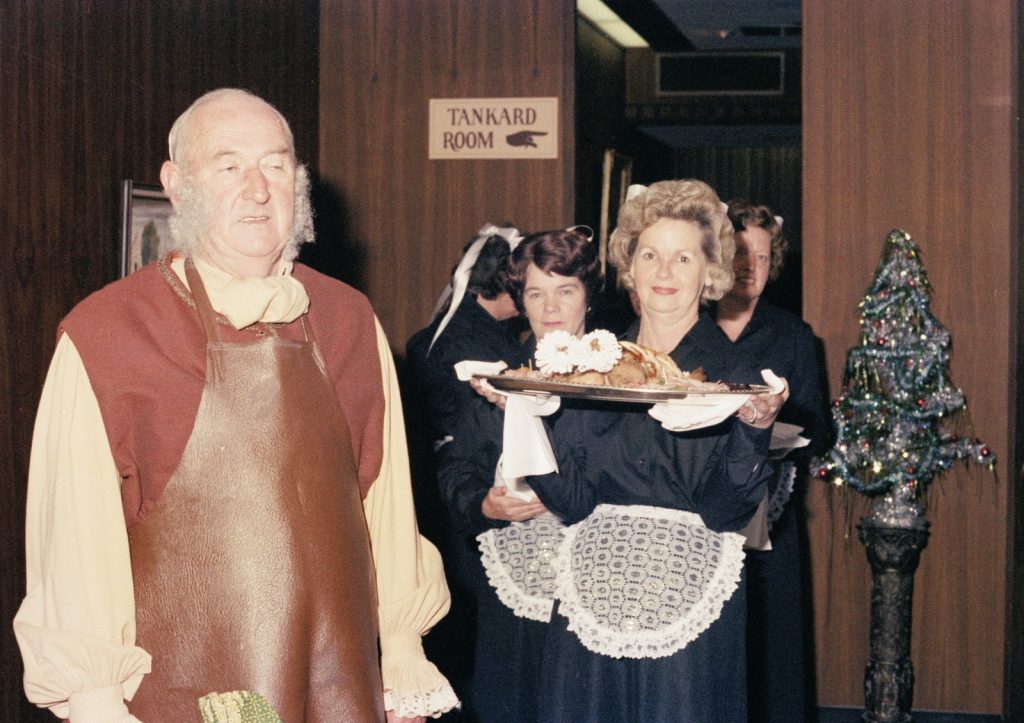
or out celebrating with your workmates at the annual Christmas office party, a chance to blow off some steam after a year of hard slog:
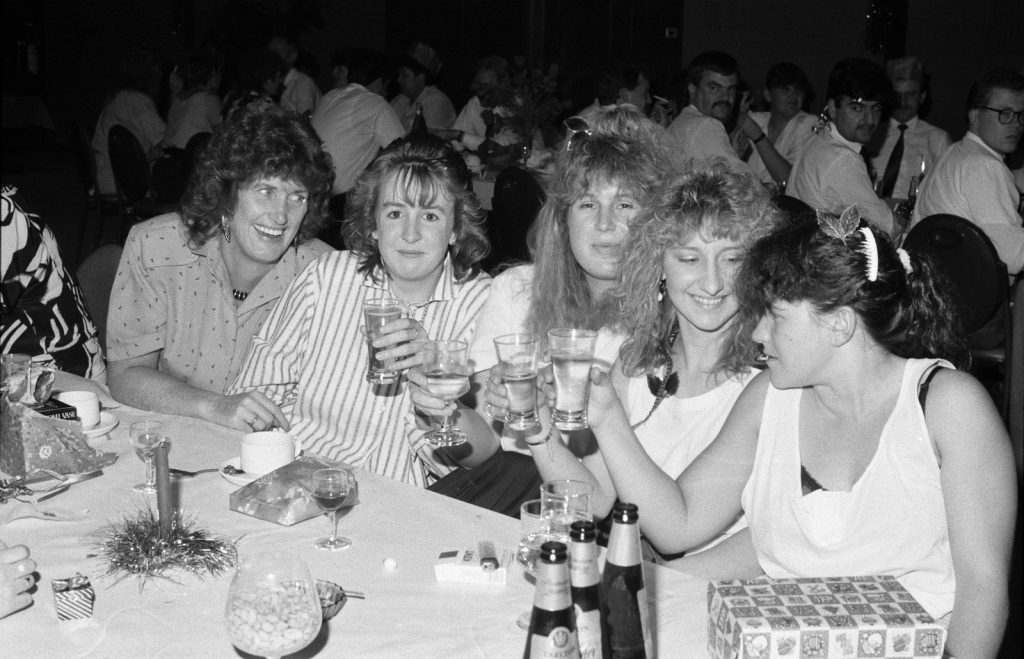
Festive foods of the ’80s included Kahlua choc prunes, turkey with raspberry sauce and the very fancy Vienetta ‘frozen dessert’ log.
The 1990s saw the rise in Christmas convenience foods — with supermarkets offering pre-packaged goods such as pre-baked hams, stuffed poultry, boxed pavlovas and pre-cooked puddings with custard poured from a carton.
‘Oh, bring us some figgy pudding!’
Then there were the modern reinventions of the Christmas pudding. You had the healthier wholemeal Christmas pudding, the elegant Christmas pudding terrine with coulis, the Christmas frozen fruit ‘pudding’ and BBQ Christmas pudding wedges:
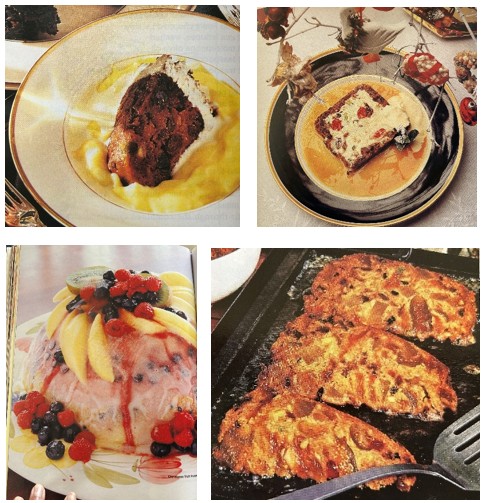
Modern reinventions of the Christmas pudding, from The Epicurean:
Top Left: Wholemeal pudding (December 1994, p 42).
Top Right: Ice-cream pudding terrine with orange and grenadine coulis (November-December 1987, p 26).
Bottom Left: Frozen fruit ‘pudding’ (December 1995, p 30).
Bottom Right: BBQ Christmas pudding wedges (December 1994, p 21).
Embracing our diversity through festive foods
Modern Australian Christmas feasts have evolved into a blend of the festive fare brought to this country by the first British settlers and the traditional Christmas foods that other migrant communities have brought with them from across the globe. These Christmas traditions include everything from Italian panettone (sweet bread)6 and Filipino flame-roasted suckling pig 7 to Greek kourabiethes (shortbreads dusted in icing sugar),8 Lebanese djaj a riz (chicken and rice)9 and the Christian Orthodox Ethiopian Christmas dish of doro wat (chicken stew), mopped up with spongy injera bread.10
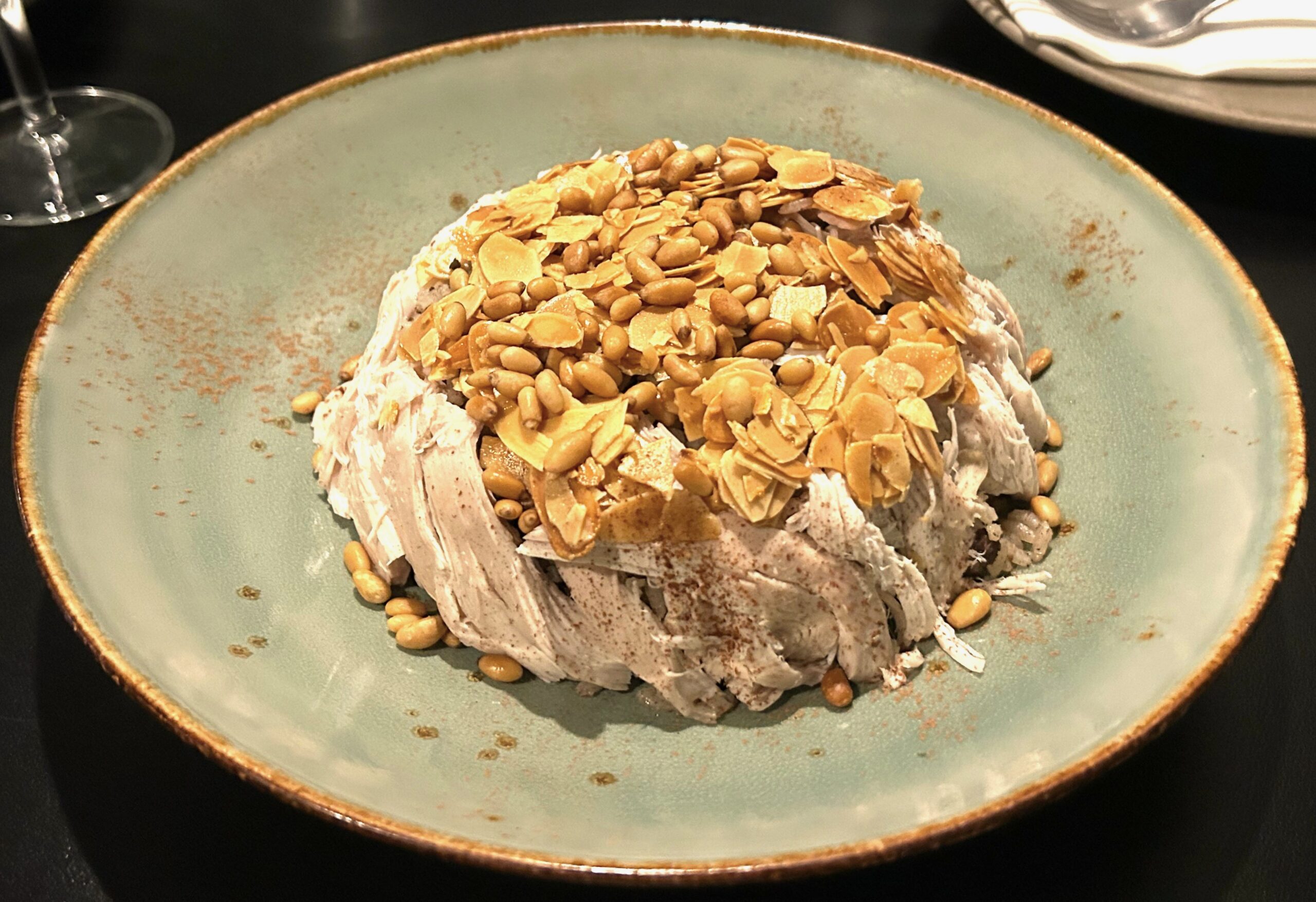
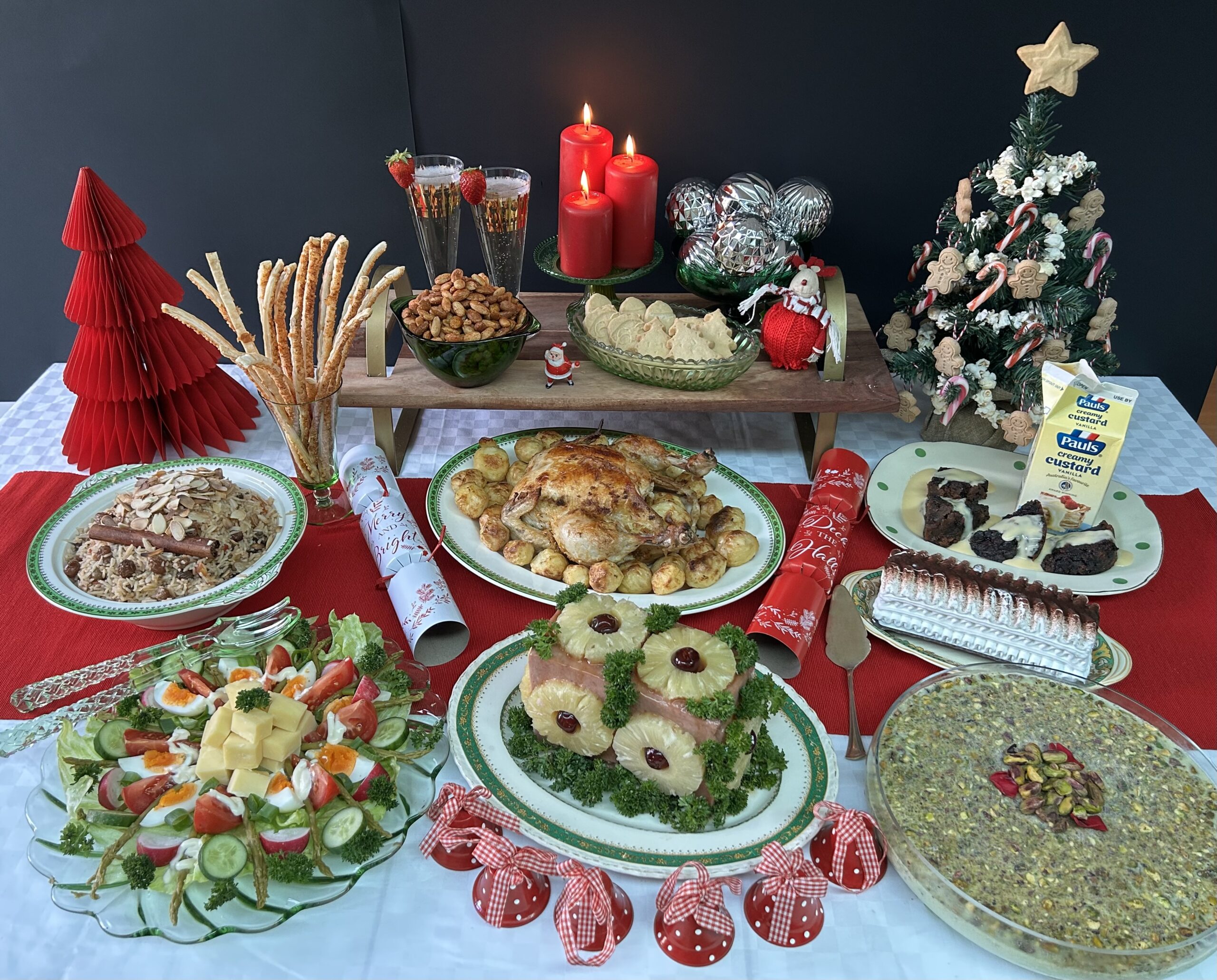
But what Christmas lunch will always mean to me is my mum’s Indian Christmas cooking. Although I was born here in Melbourne, my ancestry originates from the Indian beach region of Goa, a Portuguese colony with a large Catholic population. Therefore, Goan Christmas foods were influenced by Portuguese cuisine, such as the festive pilau rice covered in sultanas and toasted almonds, and sweet treats like bibica (a layered coconut pastry incorporating a mere 40 egg yolks). At home here in Melbourne, our family Christmas table would always be heavily laden with traditional Goan Christmas dishes such as pilau (our ‘party rice’) and masala roast chicken (marinated in a spice rub of freshly ground cinnamon sticks, cardamom pods, coriander seeds, cumin seeds, peppercorns, turmeric and chilli powder mixed with lemon juice). And the Christmas dessert spread would always feature my mum’s Christmas cake (which I have never been confident enough to make but is the only fruit cake I truly enjoyed eating) and a large tray of our Indian Christmas pistachio ice cream called kulfi, fragrant with splashes of rosewater — a refreshingly cool way to round off a warm Christmas Day in India or Australia.
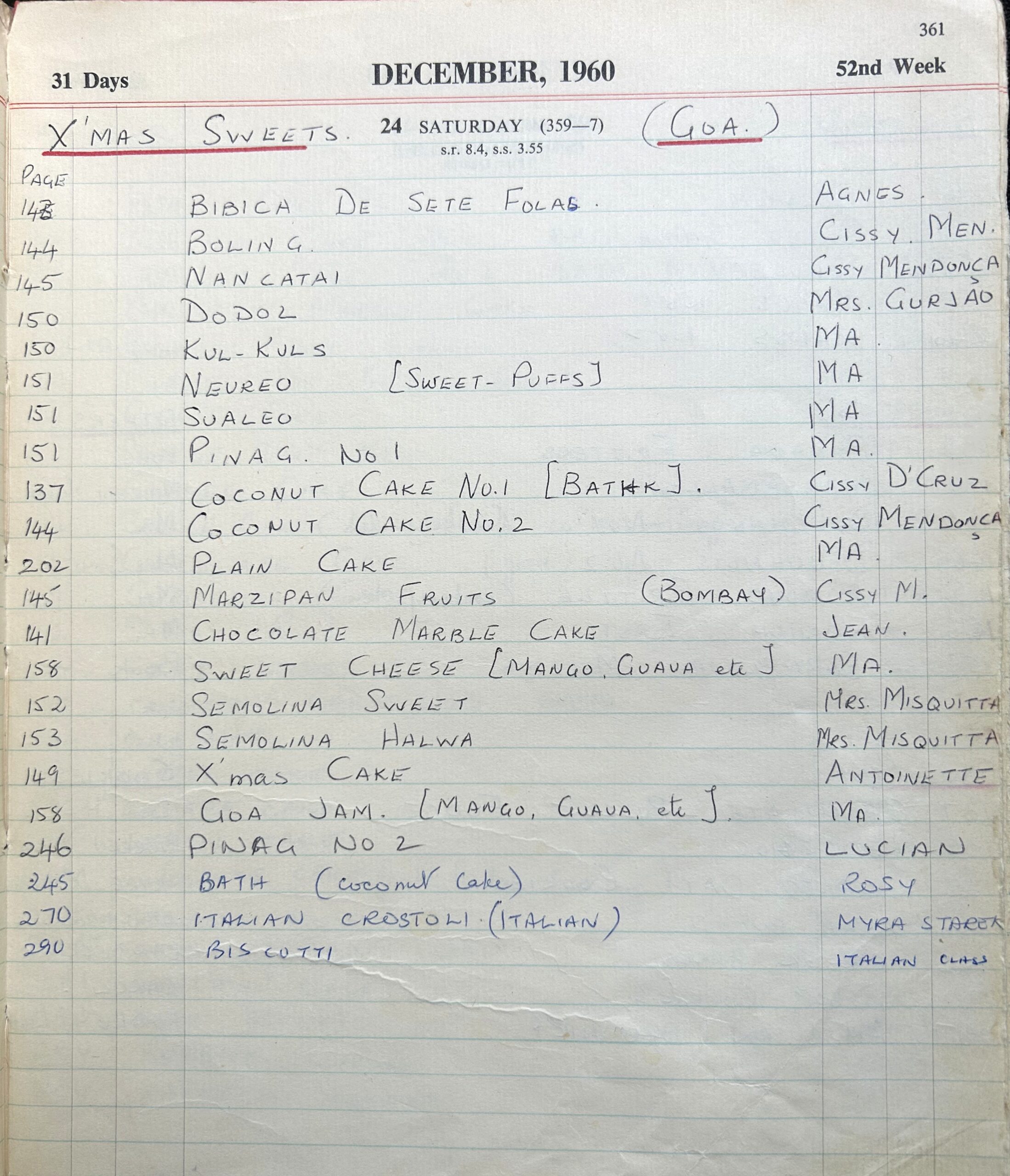
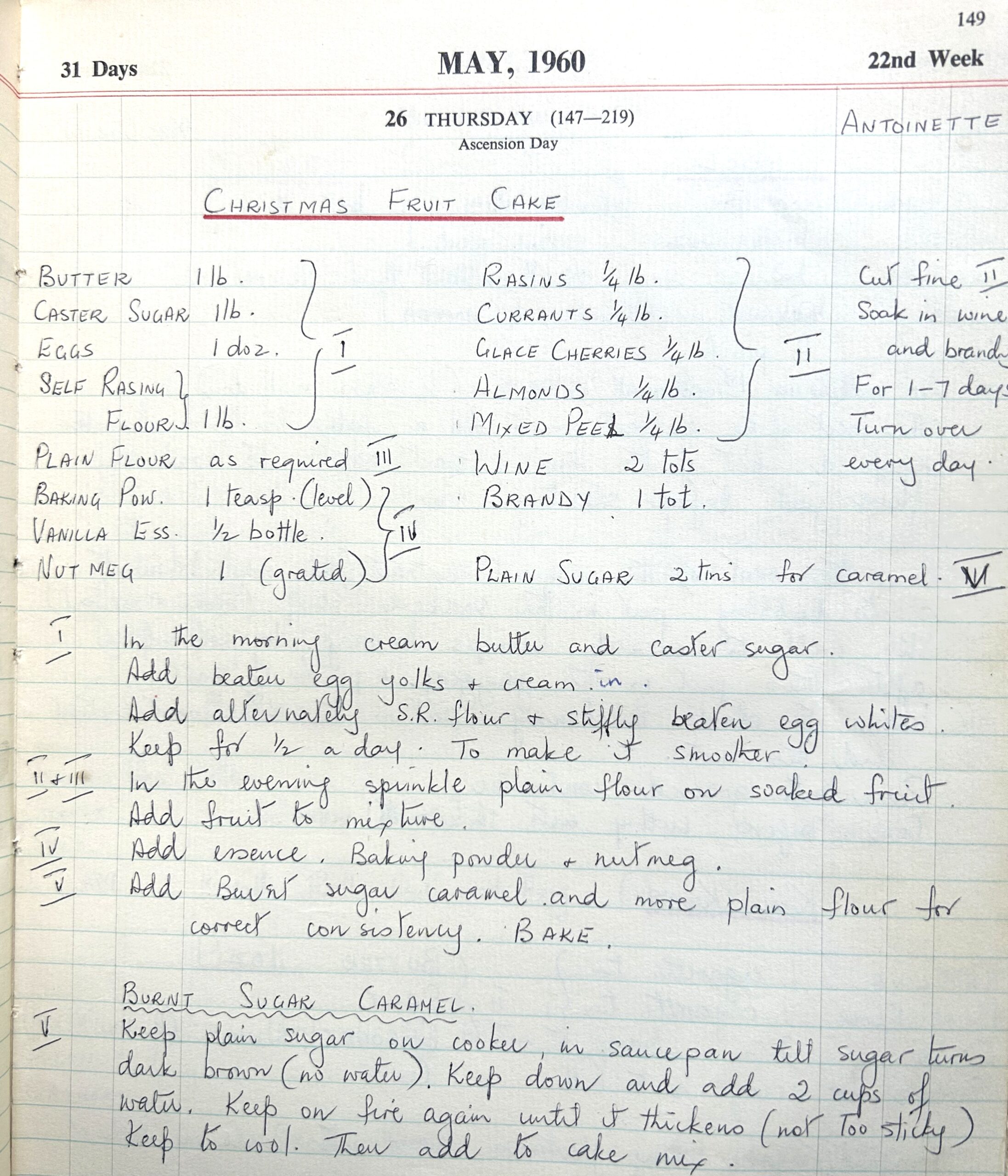
Goan-Indian Christmas sweets index and Christmas cake recipe pages from my mother’s handwritten recipe book.
I hope you have enjoyed this appetising journey through the evolution of Australian Christmas feasts. This year, my Christmas table will be filled with foods ranging from festive fare of the early 1900s to Mod-Oz 1990s Christmas cuisine, perfectly complemented with my family’s traditional migrant Christmas dishes, symbolising the time and place we live in now and also the historic cultural narrative of where we have come from.
Whatever your festive foods may be, enjoy your day — Merry Christmas, Buon Natale (in Italian), Kalá Christoúgenna (in Greek), Milad Majid (in the Lebanese language of Levantine Arabic), Maligayang Pasko (in Filipino), Melkam Gena (in the Ethiopian language of Amharic), Kushal Natalam (in the Goan-Indian dialect of Konkani) and ‘Happy Holidays!’ from us all at State Library Victoria.
‘As far as I am concerned, for Christmas there is no greater gift than the gift of food, and regardless of who we are or where we come from, when you sit at my table we are all one people.’ — Abla Amad (Abla’s Lebanese Kitchen, 2012, p 123)
References
- Bannerman, C (1999) The Upside-Down Pudding: A Small Book of Christmas Feasts, Canberra, National Library of Australia, p 25.
- Rawson, Mrs L (1895) The Australian Enquiry Book of Household and General Information: Recipes and information upon everything and for everybody, Pater & Knapton, Melbourne, p 67.
- ‘A Salvation Army distribution’, The Age, 22 December 1906, p 13.
- ‘Tony’s Christmas fare’, The Australian Women’s Weekly, 22 December 1954, p 49.
- ‘Three great Christmas dinners: we’ve done the planning for you — with Margaret Fulton’, Woman’s Day, 13 December 1976, p 61.
- Montanari, M (2009) Let the meatballs rest and other stories about food and culture, Columbia University Press, New York, p 5.
- Maxabella B (2021) A very Filipino Christmas: Early starts, pigs and plenty of flan, SBS Food, 21 December 2021, viewed 19 November 2025.
- Rennick, L (2023) Melbourne’s sweet Greek dishes out tips for Christmas dinner (and dessert), SBS Food, 4 December 2023, viewed 19 November 2025.
- Amad, A (2012) Abla’s Lebanese Kitchen, Lantern, Penguin Books, Australia, p 84.
- Africa News Service (1987) The Africa News Cookbook: African cooking for Western kitchens, Penguin Books, Ringwood, p 40.


Brilliant blog, Alison! So much interesting history shared here as well as lots of yummy (and maybe not so yummy) food.
This is like the blog equivalent of an Anthony Bourdain episode. Thank you for bringing these recipes to life Alison!
Wonderful, expansive, drawing on the range of material collected by the SLV team
Alison thank you for this great blog. I hope you’ve managed to look at Rosemary Norman’s family collection of Christmas cakes and pudding recipes at SLV. I had no idea there were so many ways to make a Christmas fruit cake or a pudding.
The Norman family was well off by most standards, but they still didn’t waste a thing, particularly paper. Rosemary’s mother, Nerelle Norman, pasted cake and pudding recipes into BHP prospectuses. Rosemary’s dad Reginald Havill Norman, known as Babe Norman, was Manager of the Melbourne office of the Orient Line of shipping. The family entertained a lot to attract and maintain business. And Christmas was a food milestone for that family.
What an evocative spread. All manner of Christmas feasts past! And nice referencing. ThankYOU Alison
I love how this article captures the essence of Christmas feasting, emphasizing how food brings us together during the holidays. Exploring historical Christmas menus and traditions is fascinating! It’s interesting to see how outdoor feasts were a Victorian tradition, adding a unique twist to festive celebrations.
A delightful and timely blog. This very well-researched piece yet again demonstrates the scope of the SLV’s resources and the skills of its librarians.
This lovely piece reminds us that authentic history may be found, not only in dry technical tomes, but also in cookery books, menus and recipes from our diverse community, through the years. The writer’s careful selection of illustrations, and generous sharing of her own mother’s recipes, make for delightful Christmas reading.
Lovely Christmas post. Merry Christmas to you and your family. Enjoy the feast!
Ahhh, A2, excellent work!! Really enjoyed the historic examples of how how the early settlers celebrated in and around Melbourne, and your Christmas heritage too.