
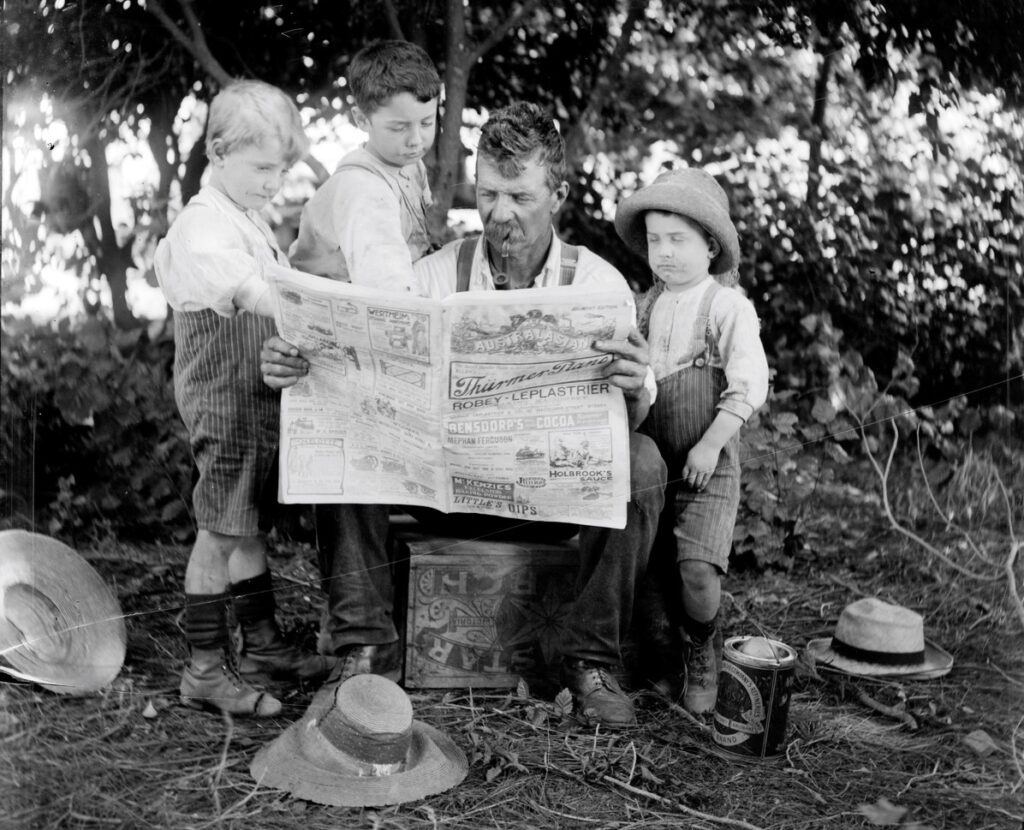
Newspapers can be complex to research. Frequent title changes, mergers, and multiple editions can all make it difficult to find what you’re looking for.
The concept of family trees for newspapers was first conceived of by librarian Zoe Velonis in 2005, after she tired of her newspaper orders coming back as ‘Not Founds’:
If I tried to order the Ringwood Croydon Mail from 1927, for example, it would come back the next day as “Not Found”, because the paper had by that point split into the Ringwood Mail and the Croydon Mail. So, I started making little diagrams for myself to keep track of the title changes… The diagrams looked a lot like family trees so that’s how I started referring to them.
Zoe soon realised that her diagrams could also help others with their newspapers research. After receiving backing for her idea from the Library in the form of a staff fellowship, Zoe created a series of trees tracing the genealogy of Victoria’s newspapers. More than twenty years later, Zoe’s family trees remain an indispensable finding aid for librarians.
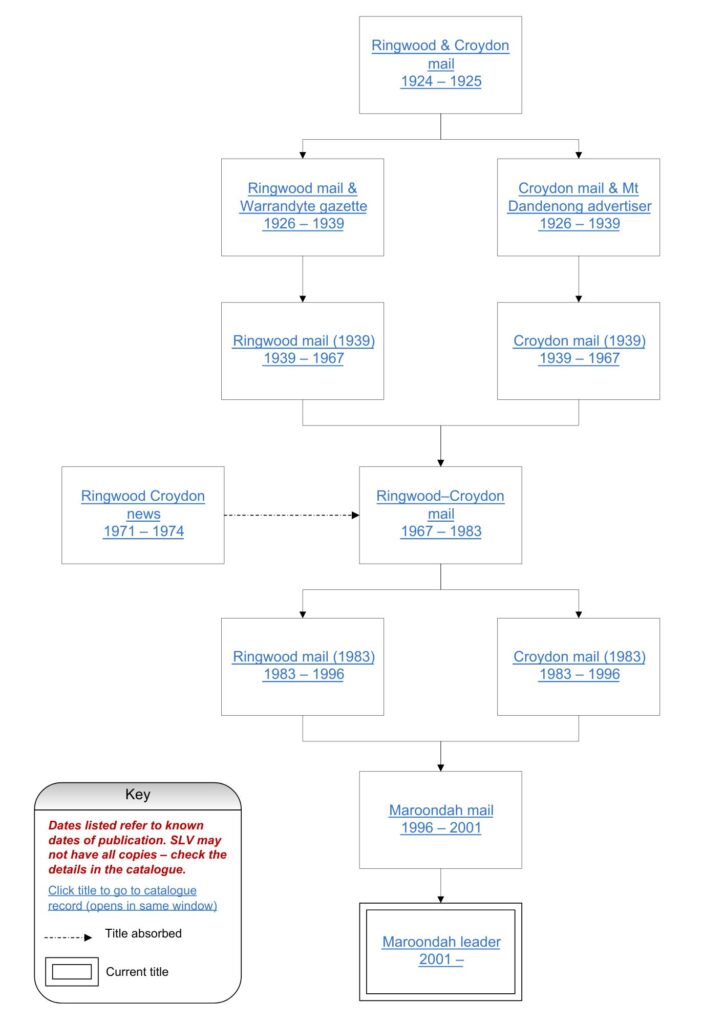
So, how can newspaper family trees help your research, and where do you find them? Let’s look at a few examples.
Mergers, acquisitions & takeovers
Those familiar with researching newspapers will know that mergers, acquisitions and takeovers can all make it tricky to locate a title. Melbourne’s Herald Sun is a good example. While most Melburnians are familiar with this publication, many are unaware that prior to 1990, it did not exist in its current form, but was in fact two separate newspapers: The Herald and The Sun news-pictorial.
A quick check of the Herald Sun‘s family tree shows us when the merger took place. It also offers a bird’s eye view of the genesis of one of Victoria’s oldest newspapers:
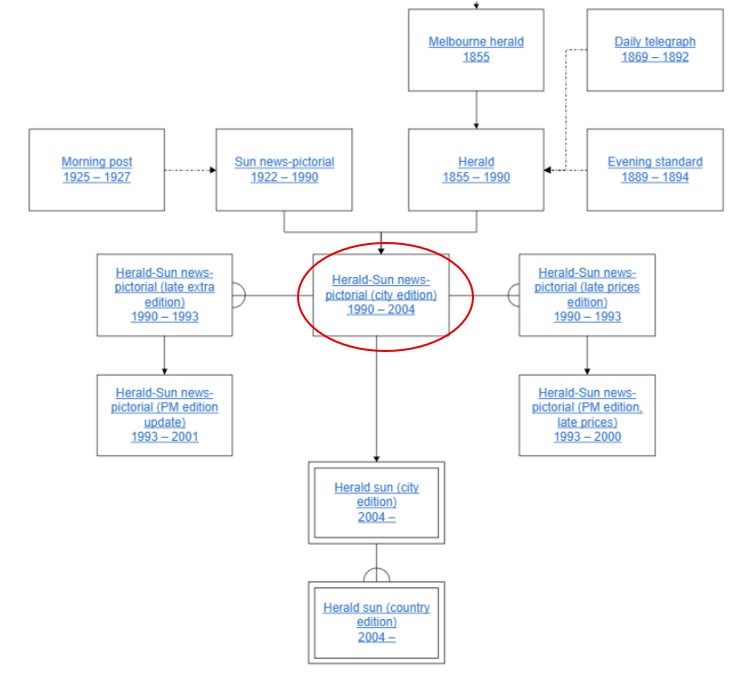
You can see where the two newspapers merged in the centre of the diagram, while the branches on either side show us the different editions that have existed over time (PM edition, ‘late extra’ edition, ‘late prices edition’ and so on).
The branches of the tree represented by dotted lines represent instances where titles were absorbed by another newspaper. We can see that Melbourne’s former newspapers, the Daily Telegraph and the Evening Standard, were absorbed by the Herald in the late 19th century. Another short-lived title, the Morning Post, was subsumed by the Sun news-pictorial in 1927.
The boxes at the bottom of the tree (with the double lines) depict the Herald Sun as it exists today. We can see it has two editions: a City and a Country version.
Spelling variations
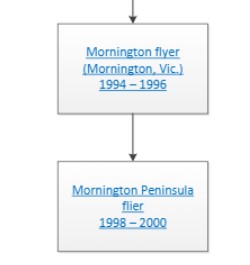
It’s not just mergers that can cause headaches for researchers. This excerpt from a Mornington newspaper’s family tree illustrates how even spelling can create unforeseen problems:
Place names
Towns can also change names over time, leading to changes in the names of its newspapers:
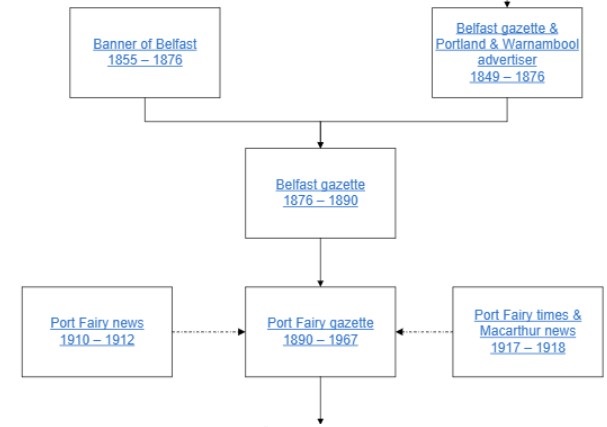
Changes to local councils
Just as newspapers can merge, or be absorbed, so too, can they multiply:
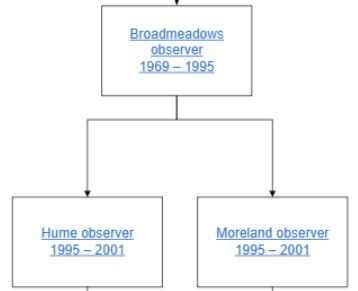
This example followed the abolition of the City of Broadmeadows in 1994, when suburbs north of the Western Ring Road became part of the City of Hume, 1 while suburbs south of the road were transferred into the City of Moreland (now Merri-Bek). 2
Rebranding
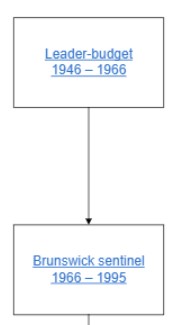
Newspapers can also change names altogether, as in the case of Brunswick’s Leader Budget, who explained to its readers in 1966: ‘The change is made for the sake of brevity and to avoid confusion with an associate publication…’ (Brunswick Sentinel, 21 September 1966, p. 1)
Some newspapers, like Melbourne’s Age, have relatively straight-forward histories, so not every newspaper will have a family tree. But if you are having trouble finding a title, this simple research tool can be very helpful.
So where can I find them?
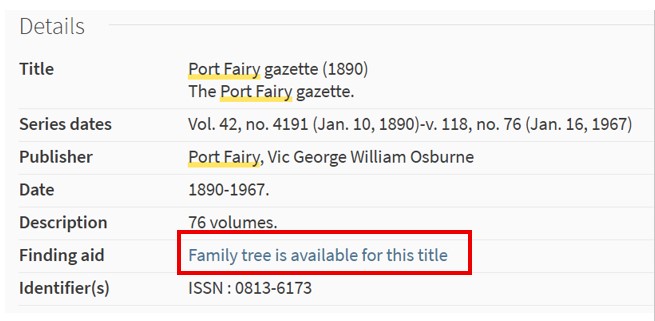
To see if a newspaper has a family tree, go into the item’s catalogue record and scroll down the page. If a tree is available, you will see it listed in the ‘Finding Aid’ field:
You can find further tips and tricks for researching newspapers in our guides: How to find newspapers and How to find items in newspapers.
Postscript
Zoe’s newspaper family trees were so useful that she decided to expand her project to include other serials with a history of name changes, such as telephone directories and government departmental annual reports. Check the catalogue record details of any serial to see if there is an accompanying family tree.
References
- Office of Local Government, Victoria (1995) New patterns in local government: 1995, The Office, Melbourne, Vic, pp 82-3.
- Office of Local Government, Victoria (1995) New patterns in local government: 1995, The Office, Melbourne, Vic, pp 120-121.


Nice to see Zoe’s work remembered and explained. I remember when the newspaper family trees came in. They provided such a valuable tool for researchers and staff. Great piece Sarah.
Thanks Tim. I’m glad you enjoyed it.
Brilliant!!!!!!
Thank you.
Thank you Sarah, for thinking of this good idea, to aid our searches.
A really useful finding aid. Great work Zoe.
Awesome Sarah! Research is like peeling off layers of skins on an onion, and your article reveals some critical layers, and then for me – Bam – Port Fairy was Belfast! I had no idea but now I’m hungry to know that story too.
Thank you. Zoe
Thank is a very useful and interesting guide
Nice to see the awesome work of our Librarians and their amazing research skills.