
To celebrate Trans Awareness Month 2025, we turn our attention to one of the fascinating volumes in State Library Victoria’s Rare Books Collection: Leslie Feinberg’s Stone butch blues. Purchased as part of the Women Writers Fund — an initiative that seeks to redress historical bias in the Library’s collecting practices — this recent acquisition is a rather unassuming looking book; the kind of novel you might find in a second-hand bookshop or on an old friend’s bookshelf. Despite its humble appearance, the book brings with it stories of struggle — both within and beyond it’s pages — along with questions about control, artistic ethics and the ways we find (and too often don’t find) the stories we seek: stories of people like us.

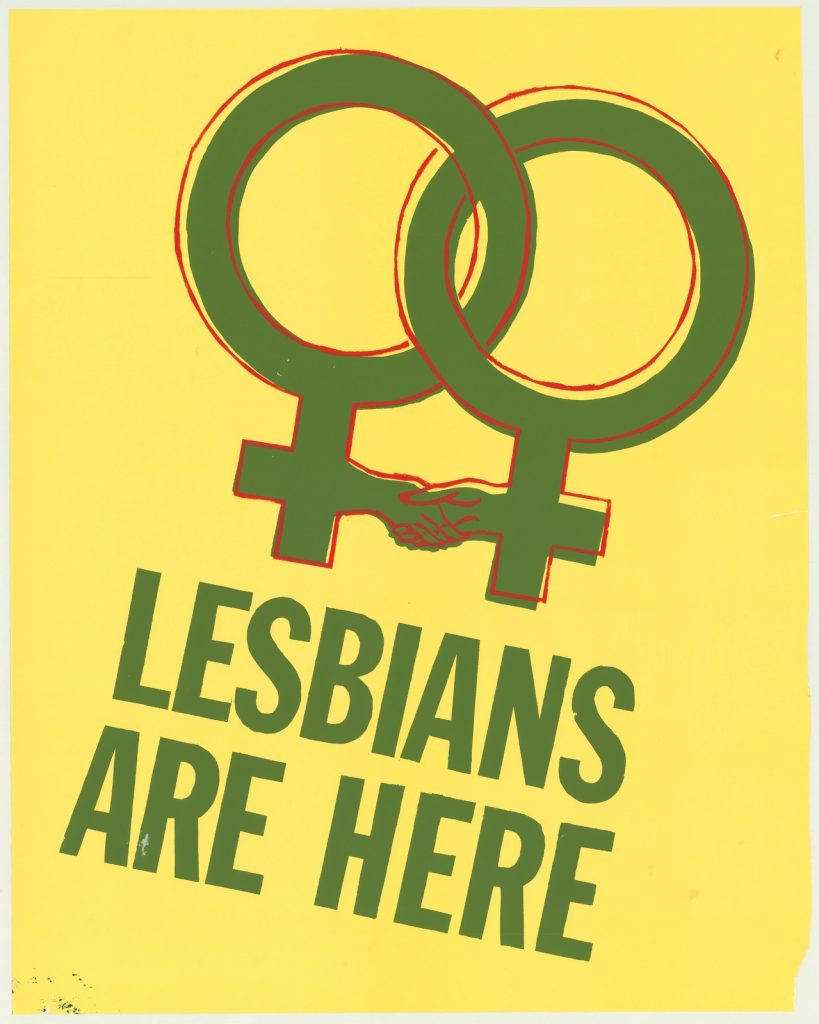
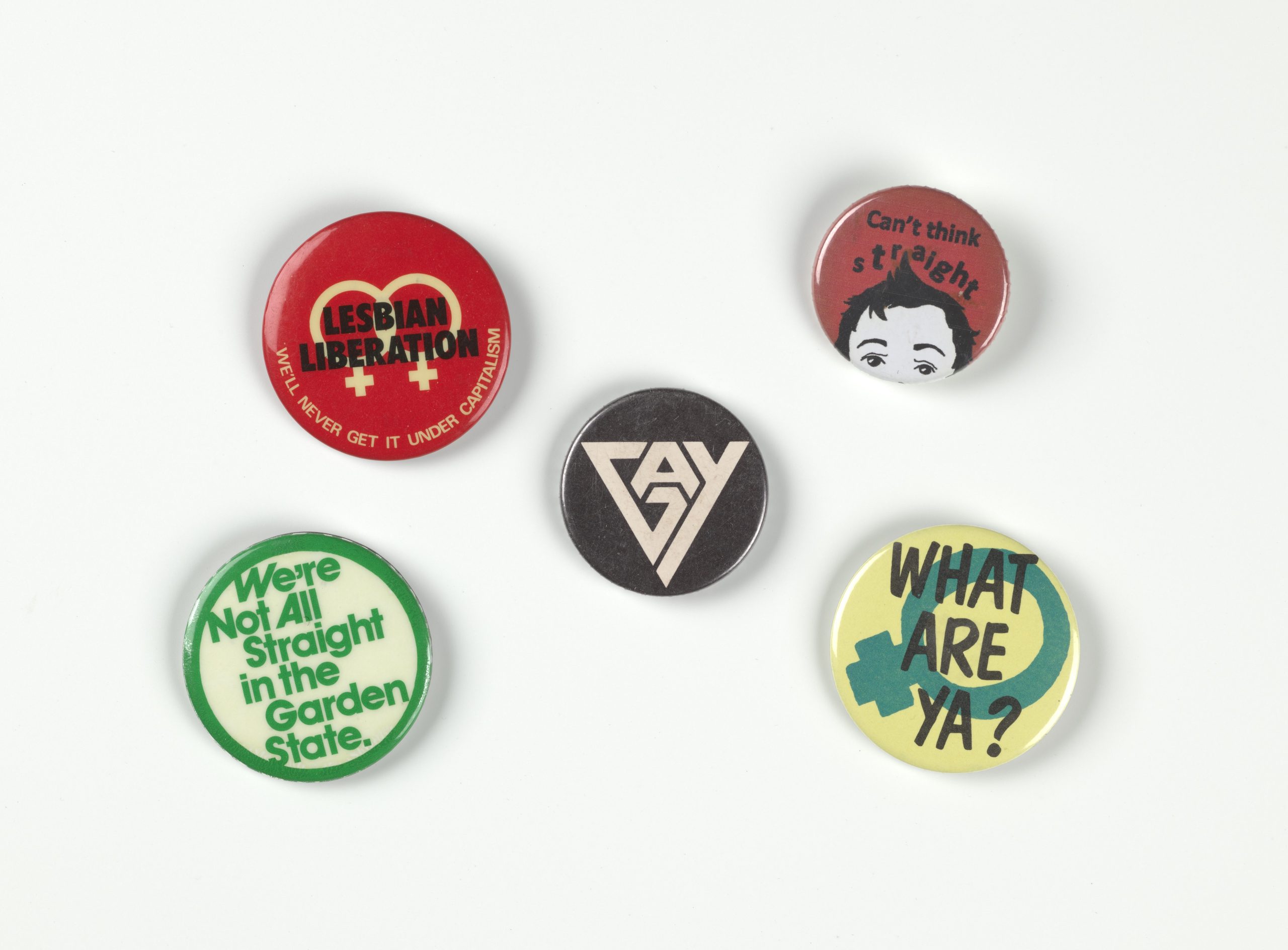
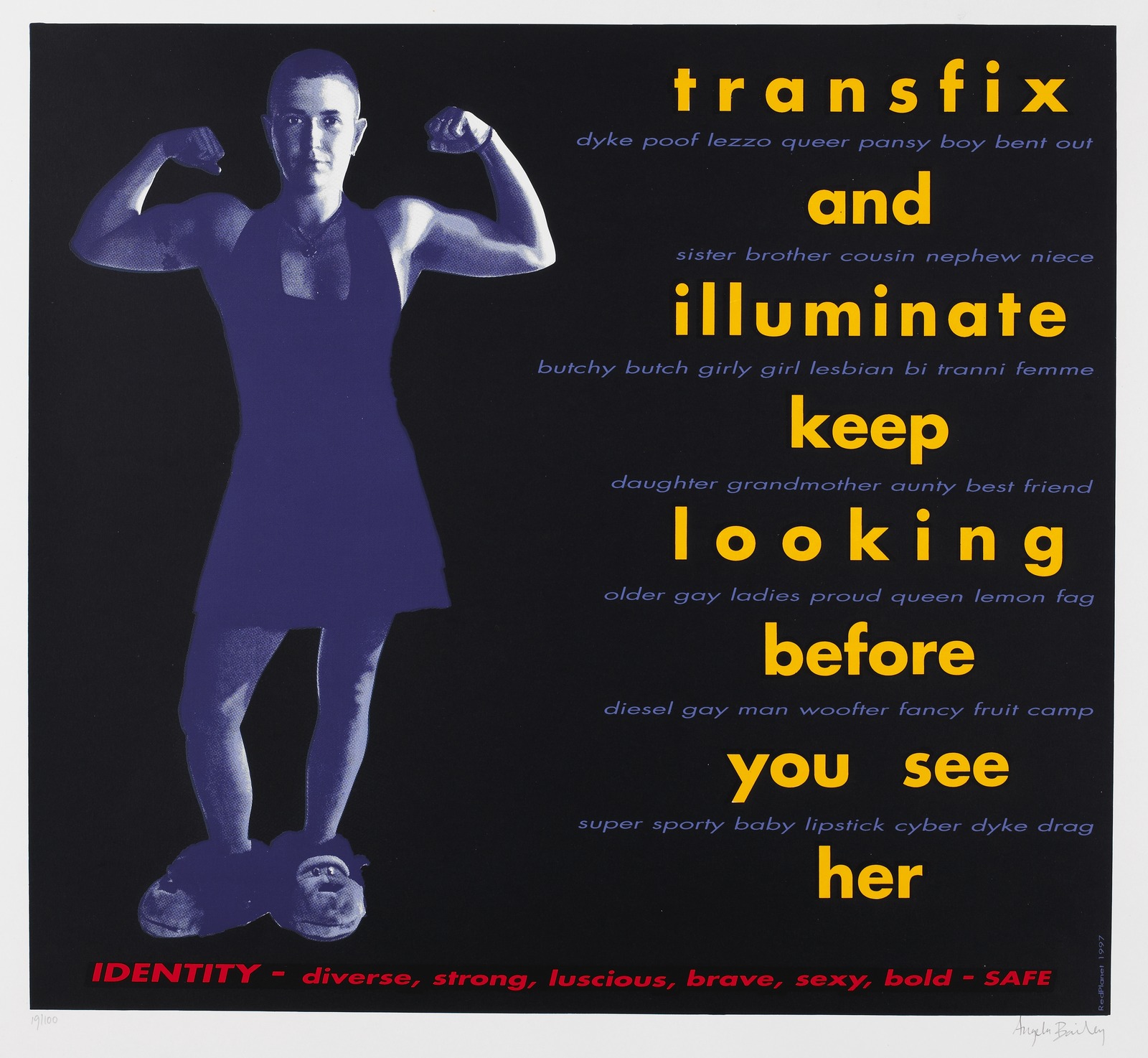
Leslie Feinberg’s Stone butch blues is an iconic work of queer fiction, working class fiction and activist fiction. Feinberg, a self-described ‘…secular Jewish communist, a working-class, lesbian transgender Marxist’1 wrote a lot in their 2 too-short life. Stone butch blues is their best-known novel; it is the first thing most people come across and an incredible read. The story told in the book is mirrored by stories of the book itself. One thread is the book as a piece of art, a piece of intellectual property owned and shared. The other thread is of the book as object — as the thing itself. 3 The book tells the story of the struggle to find self and community as a trans person in the later 20th century. Many of the illustrations included here come from the Library’s Riley and Ephemera Collection; these artefacts echo the struggles of similar folks in the queer communities over the same period.
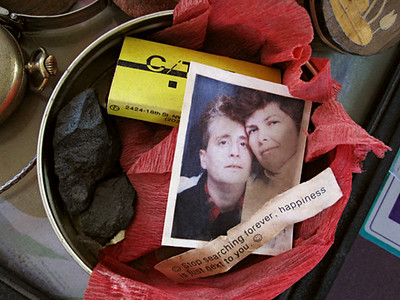
I came to read the text when a trans friend at the State Library told me that we had acquired a copy for the Rare Books Collection. They were excited about the acquisition and thought I should celebrate it by writing about it. Everyone’s journey to the book is different. Feinberg was aware of the complexities of seeking and serendipity to such an extent that they included a section in the 20th anniversary edition asking readers to let them know how they found it. In explanatory and exploratory notes to the 20th anniversary edition written by Feinberg and their wife Minnie Bruce Pratt, the pair ask fans and readers to please let their local libraries know about an at-cost version of the novel and provide a link to the publisher. 4 Also included is a thankyou, by name, to the librarians who helped to catalogue the book and assign it appropriate subject headings in order to make it findable.5 Feinberg’s engagement with the many and varied aspects involved in sharing the book and manufacturing physical copies speaks to their work as an artist and as an activist for working people.
Stone butch blues is the story of fictional character Jess Goldberg and their struggle to find their identity as a trans person growing up in Buffalo and New York City. The story is fictional yet many aspects mirror Leslie Feinberg’s own life. Both Jess and Leslie were union organisers, both spent time working in a PVC pipe factory, both struggled to find and foster community. Feinberg stated:
Stone butch blues is a complete work of fiction. It’s not autobiographical. Although I am a non-fiction writer, I wrote a novel because of the power of fiction to reach readers. I also chose a novel because of its ability to reach down into emotional truths. 6
Throughout the novel Jess struggles with oppression, violence and derision as well as poverty, health concerns and housing insecurity. They also find love and belonging, professional admiration, activist communities and senses of purpose. Jess is not Leslie. Yet in some ways Jess stands in place of Leslie and many in their community in the reader’s imagination, making us able to experience those emotional truths Feinberg wanted to capture via the relative safety of a novel.

It’s a wonderful book, winner of awards such as the Stonewall Book Award (named the Gay, Lesbian, and Bisexual Book Awards at the time) and a Lambda Award for best lesbian fiction in 1993. Since its publication the novel has also been included on numerous ‘best of’ and ‘must-read’ lists and was named as one of the most important post-war queer reads by The New York Times. 7 The novel ‘…has been translated into Chinese, Dutch, German, Italian, Slovenian, Turkish, and Hebrew (with earnings from the latter edition going to ASWAT Palestinian Gay Women).’8
Beyond the story Feinberg wrote is a story of the book as a series of physical items; of editions passed around as treasured objects and the item’s status as a rare book. There is also the story of this novel as a piece of art, a piece of intellectual property that is given, sold and controlled. Together, these stories weave around the book over decades, providing a nest of narratives that, while not required before approaching the text, can definitely enrich the experience.
Publishing and sharing
First published by Firebrand Press in 1993 to much acclaim the book was successful in the way that books by and about marginalised peoples are — a kind of sleeper hit, an ‘if you know, you know’ text. It is a book that made people feel less alone. When Jess talks of finding community, of spending time learning ‘…about people like me…’ 9it let queer, trans and nonbinary people around the world know they weren’t as alone as perhaps they thought. Notably in this exchange Jess also says, ‘This hope thing is kinda new for me. I’m a little afraid to get my hopes up too much all at once.’10
Firebrand Press, the small publishing house charged with preparing and issuing this groundbreaking work, filed for bankruptcy not long after the work was released. Thus began the first battle by the author to regain control of their work. What followed was a 10th anniversary edition released by Alyson books, another publisher that proved to be financially unstable. When the publishers ran into business troubles, the work was left in a no-mans-land. The publishers still retained the rights, but they couldn’t afford to publish the work, leaving the creator stifled and their story all but left behind. Feinberg fought for many years to wrest back control of the publishing rights: not because they wanted to make money but because they wanted to make the book freely available for all.
In the burgeoning days of the early internet, Feinberg saw in the new technology an opportunity to share Jess/ie’s story with everyone — be it in their home, at a net café or at the library. Feinberg was a humble person, but they saw the impact that the book had had, they’d heard the stories of how it had changed people’s lives for the better and had helped them navigate the world and their identities. In the front matter to the 20th anniversary edition, Feinberg writes of giving the novel ‘…back as a tiny handmade gift, flaws and all, to the workers and oppressed of the world.’11
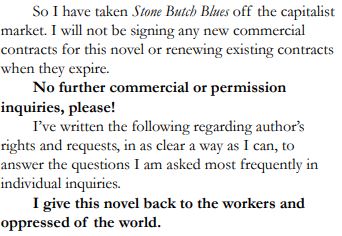
Given the acclaim the work received, offers and attempts at adaptation were not uncommon. Feinberg quickly learned that adaptations would not be kind. They took the step of asserting their author’s right to emphatically say ‘no adaptations’. Feinberg wanted to retain the rights to the story in order to share it widely, yes. It was also to control the story and to ensure it wasn’t watered-down, altered or mangled in the pursuit of other people’s desires to use it for their own art, or to line their own pockets. They had seen other works about marginalised peoples turned to milquetoast and stripped of their soul for commercial audiences; had indeed seen efforts to adapt Stone butch blues which went against the spirit of the work. In the ‘Author rights and requests’ statement accompanying the 20th anniversary edition, 12 Feinberg mentions the flaws in proposed film adaptations, and their instinct that switching the novel from the written (or heard) to the visual would essentially take away some of its power. Feinberg’s fiction is that of ‘show don’t tell’, with characters’ actions and personalities informing each reader’s inner vision of them. Feinberg’s strong view was that turning the work into a visual format would take away an important element of its power and rob readers of the opportunity to build their own versions of the characters that inhabit the novel.
The thing itself
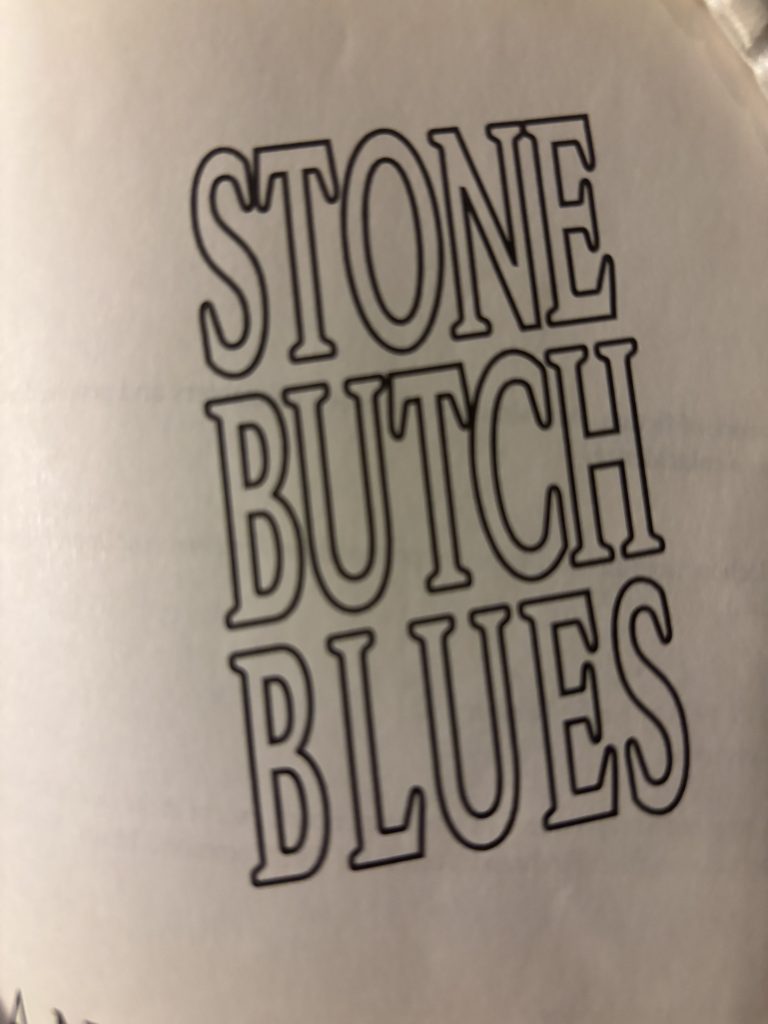
The fact that Firebrand Press produces such a small number of copies of Stone butch blues has contributed significantly to the fact that these are now rare books. Scarcity can be a value marker and the fact that this is a rare book is one of the reasons this copy was acquired. The other major reason this paperback is held in the State Library’s Rare Books Collection is that it is a signed copy. Leslie Feinberg signed many copies over the years and, it seems, signed many with the same inscription: ‘In the spirit of Stonewall’.
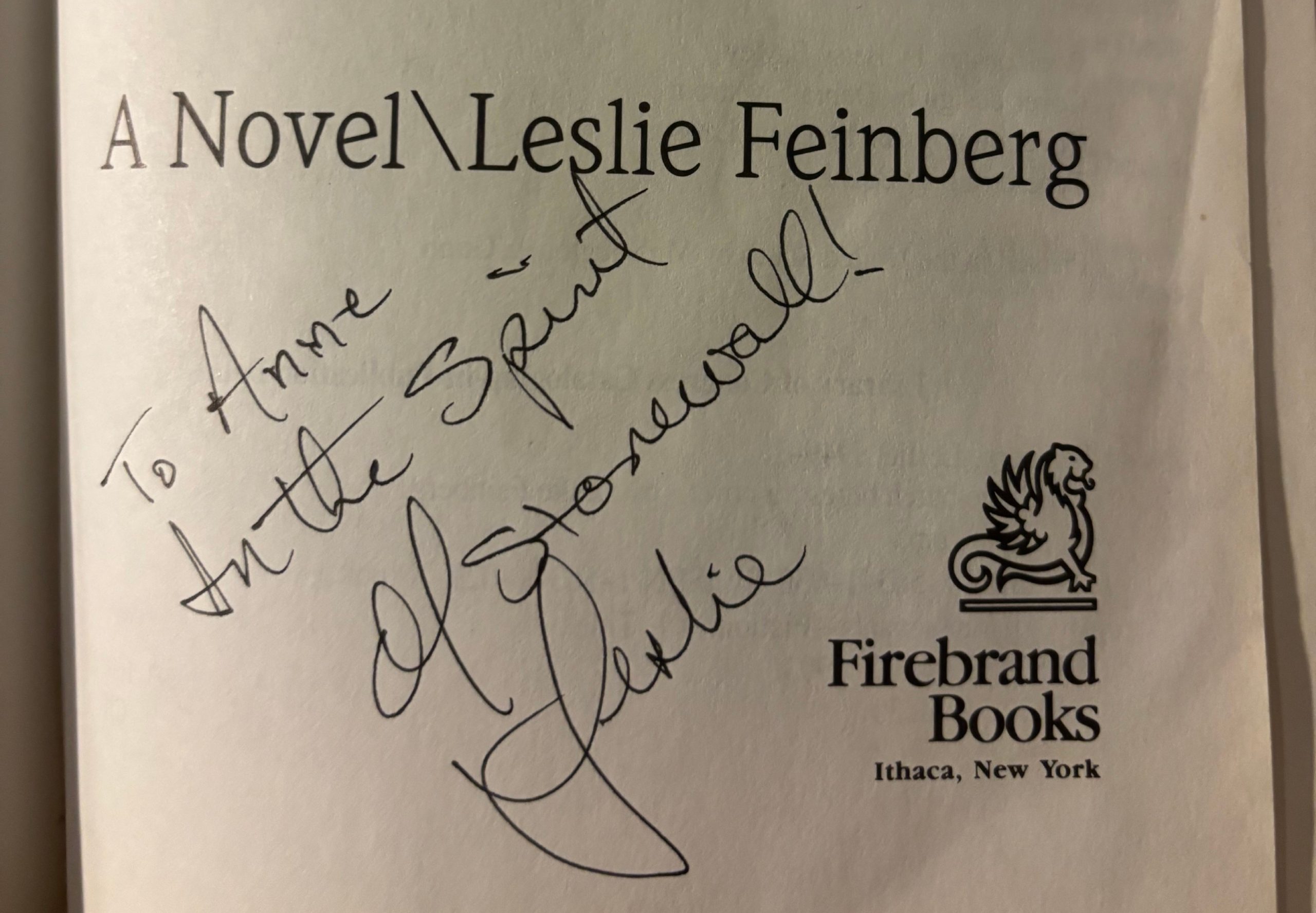
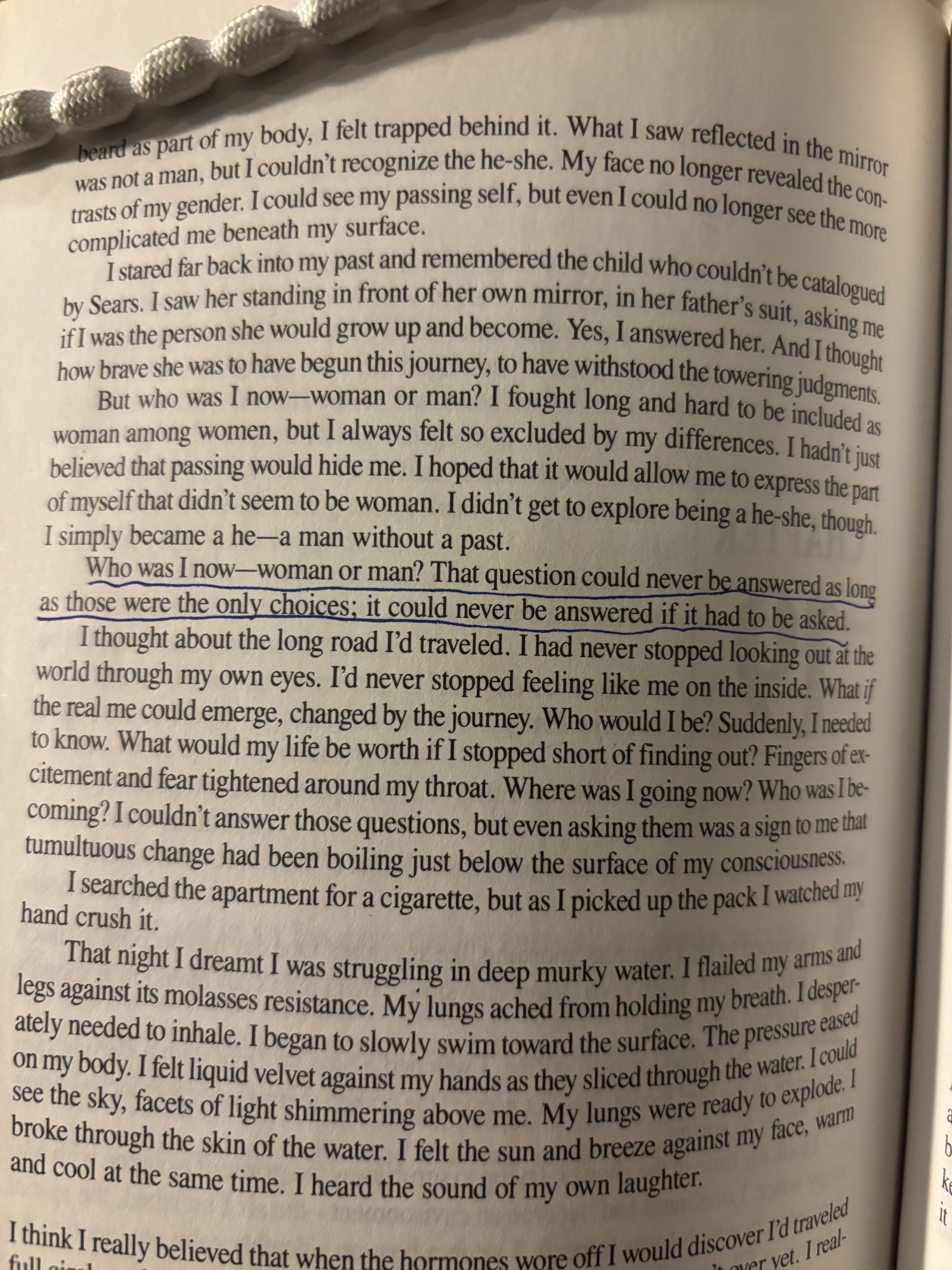
The copy held in the Rare Books Collection at the Library is well-loved. It has wear on the corners from being carried around and the spine shows it has been opened and read more than once. While we don’t know the Anne for whom the book was signed, they underlined extremely selectively, with only 2 sentences in the whole volume underlined. These marks on the book connect us with ‘Anne’ and with the history of this particular book as an object — used, shared and owned in a physical sense.
The Library also holds a copy of the 20th anniversary edition on the shelves in the Redmond Barry Reading Room, where it is available to anyone who visits the Library. The catalogue record for the book contains a link to the pdf which Leslie shared on their WordPress site, free for any with internet access to read — as the author intended.
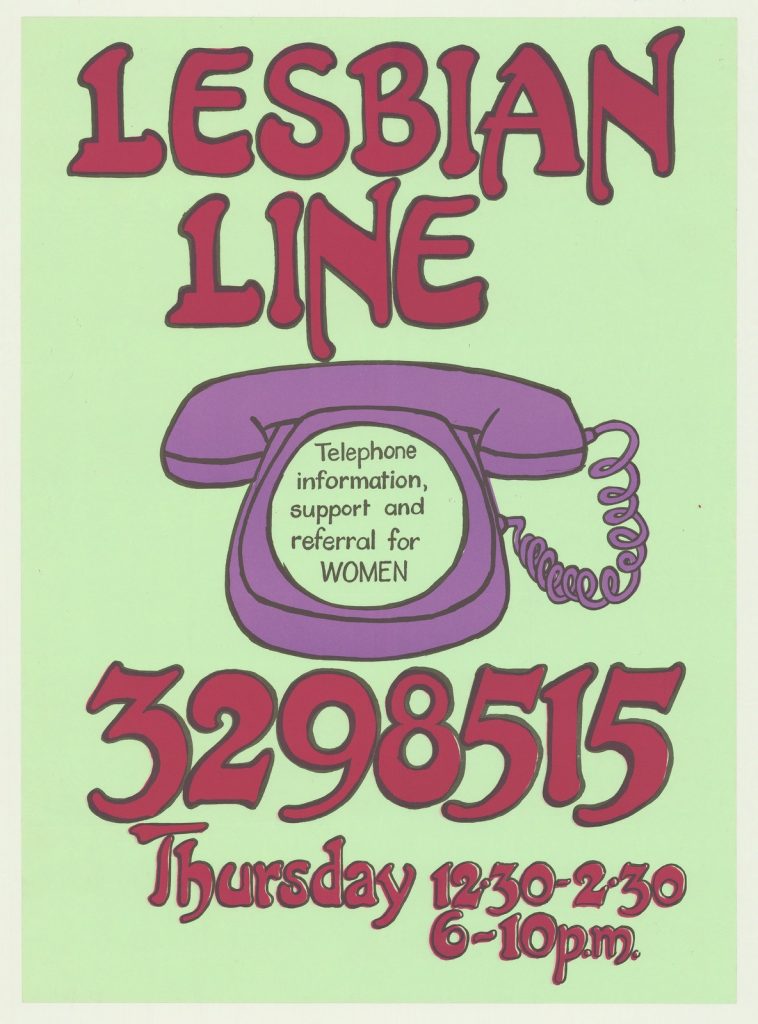
[between 1980 and 1989], Riley and Ephemera Poster Collection.
Leslie Feinberg was a powerhouse in life who left behind a wealth of writing, speaking and photos about queer issues, workers rights, trans history and prisoners rights, and this only touches the surface. A humble person who spoke of ‘…the distance between who I am and who I strive to be,’ 13 their works continue to speak to people who care to listen. With the stories-outside-of-the-story of Stone butch blues, we can see the complexities of Feinberg’s legacy continue: in the rarefied nature of these precious objects (the rare books) as well as in the staunch effort to make the work as accessible as possible to as many people as possible.
In these stories the missions of State Library Victoria are mirrored. We are the archive and preserver of Victoria’s history, honouring its people and ensuring the safety of documents and artefacts from the state’s past and present. Collecting can be a radical act — the decision to preserve the political ephemera and posters featured here gives people an insight into past hopes and struggles, just as preserving today’s materials will give future generations an insight into our current preoccupations.
The second key mission is connection. When we collect, we connect Victorians (and people around the country and the world) with the information, stories and knowledge they seek. The State Library Victoria is committed to free, accessible access to information and history — just as Leslie Feinberg was committed to sharing their work with as many people as possible.
I hope you’ll take the time to read.
Postscript
The title of this blog post includes a quote from Jess Goldberg, the main character in Stone butch blues. It is from page 37 of the 20th-anniversary edition.
Further reading
More by Leslie Feinberg
Trans liberation : beyond pink or blue
Transgender warriors : making history from Joan of Arc to RuPaul
lesliefeinberg.net [website]. See sections on: author rights and permissions, casualty of an undeclared war, and the Screened-in series (photography)
More scholarship:
Who’s afraid of gender? by Judith Butler
A feminist post-transsexual autoethnography : challenging normative gender coercion by Julie Peters
More blogs:
Think globally, act locally: feminist posters by Australian women artists from 1970s-1990s by Olga Tsara
Speculating upon the archive: woman+pants=key search by Susan Long
Capturing politics & protest through ephemera by Michael Harvey
More of the rest:
You better be lightning by Andrea Gibson
Hijab butch blues by Lamya H
Hello, cruel world : 101 alternatives to suicide for teens, freaks, and other outlaws by Kate Bornstein
A restless truth by Freya Marske
References
- Workers World, ‘Solidarity in the struggle for social transformation,’ Workers World, 31 October 2007, accessed May 2025.
- Please note that Leslie Feinberg went by a variety of pronouns in their lifetime. Indeed they have written and spoken at length about the changing nature of language as regards to gender. Their obituary written by their longtime partner Minnie Bruce Pratt used she/her pronouns. This author has chosen to adhere to the pronouns most familiar to readers, while taking Feinberg’s wishes into account.
- For more on books as objects, see Emma Smith’s Portable magic: a history of books and their readers.
- Feinberg, L (n.d.) ‘Stone butch blues’, lesliefeinberg.net [website], accessed 15 July 2025.
- Feinberg, L (2014) Stone butch blues: a novel, 20th anniversary author edition, [New York?].
- Peters, J (1997) ‘Making connections: Leslie Feinberg in conversation with Julie Peters’, Screaming Hyena, issue 7 (June), pp 25-6.
- Soller, K, Brown, L, Courteau, R, et al (22 June 2023) ‘The 25 Most Influential Works of Postwar Queer Literature’, The New York Times, accessed 21 July 2025. The author acknowledges the complexity of recognition by The New York Times given recent coverage of trans issues. For more see this column from Leslie’s Worker’s World colleague, Teddie Kelly: ‘The New York Times can’t claim Leslie Feinberg as their queer courtier.’
- Feinberg, L (n. d.) ‘Stone butch blues,’ lesliefeinberg.net [website], accessed 15 July 2025.
- Feinberg, L (2014) Stone butch blues: a novel, 20th anniversary author edition, [New York?] p 327.
- As above, p 328.
- Feinberg, L (2014) Stone butch blues: a novel, 20th anniversary author edition, [New York?] p 353.
- As above, p 352.
- Workers World, ‘Solidarity in the struggle for transformation,’ Workers World, 31 October 2007, accessed May 2025.


“Stone Butch Blues” sounds like a powerful and important addition to the collection. It’s great that the State Library Victoria is actively working to diversify their holdings and highlight marginalized voices.
It’s fantastic that the State Library Victoria is making a concerted effort to spotlight underrepresented voices and diversify its collection.
What a wonderful tribute to Leslie Feinberg and their iconic novel, Stone Butch Blues. The article beautifully weaves together the story of the book, its history, and its significance, highlighting the importance of accessibility and preservation.
This article captures something essential about why Stone Butch Blues matters—it’s not just the novel itself, but how it circulates, who finds it, and the deliberate work of making it discoverable. Feinberg’s attention to cataloging and subject headings shows they understood that marginalized stories need infrastructure to survive. The connection between the book’s themes of finding community and the actual archival work of preservation is really well done here.