
This winter, do you: Need something bold to vanquish your cold? Can’t shake off that menacing cough? Want to get a grip on that persistent nasal drip? Well then, look no further than these historic winter health tonics that were all manufactured right here in Victoria. The State Library has been collecting resources advertising Victorian pharmaceutical products for more than 150 years. So grab a hot cuppa, rug up and let’s explore the advertising history of three Victorian winter tonics that were promoted through captivating campaigns, featuring everything from racing cars to bombing planes and involving everyone from VFL footballers to Indian Maharajas!
Advertising health remedies in Victorian pharmacies
The advertising of health remedies in Victoria has a complex history, involving considerable conflict experienced by pharmacists, who were often reluctant to sell these unconventional products in their establishments.
Melbourne, by 1841, had a population of 20,000 including 18 physicians and surgeons, and 8 chemists and druggists.1 All prescribed treatments, but self-diagnosis was also common — early newspapers and magazines included many advertisements testifying to the power of a powder or a potion, such as this 1845 promotion of Rowland’s Alsana Extract, claiming to be sold by ‘every chemist throughout the entire civilised world’.

Rowland’s Alsana Extract advertisement, Port Phillip Gazette and Settler’s Journal, 30 Aug 1845, p 1
In the early 1850s, poor conditions on the Victorian gold fields, such as inadequate roads, made it difficult for gold field chemists to obtain new supplies. This opened up opportunities for hawkers to roam the gold fields, advertising lightweight health remedies, with ‘heavily advertised nostrums [ineffective medicines prepared by an unqualified person] being spectacularly popular’.2 From the mid-1850s, the term ‘quack’ was used to describe ‘anyone who fell outside the borders of what was becoming orthodox medicine’.3
Concerns were raised at an 1894 meeting of Victorian pharmacists, who were opposed to becoming distributing agents for ‘confidence tricksters’ advertising their proprietary medicines through ‘swindles that exploited the public’.4 A 1907 Report of the Royal Commission on Secret drugs, cures and foods conducted for the Australian Commonwealth Government revealed the ‘gullibility and desperation of the public’5 when it came to believing the advertisements of health remedies. In Volume I of the report, Royal Commissioner Octavius Charles Beale declared that ‘quack secret cure-systems embrace everything conceivable in health and disease under like trickery, treachery, humbug and fraud.’6
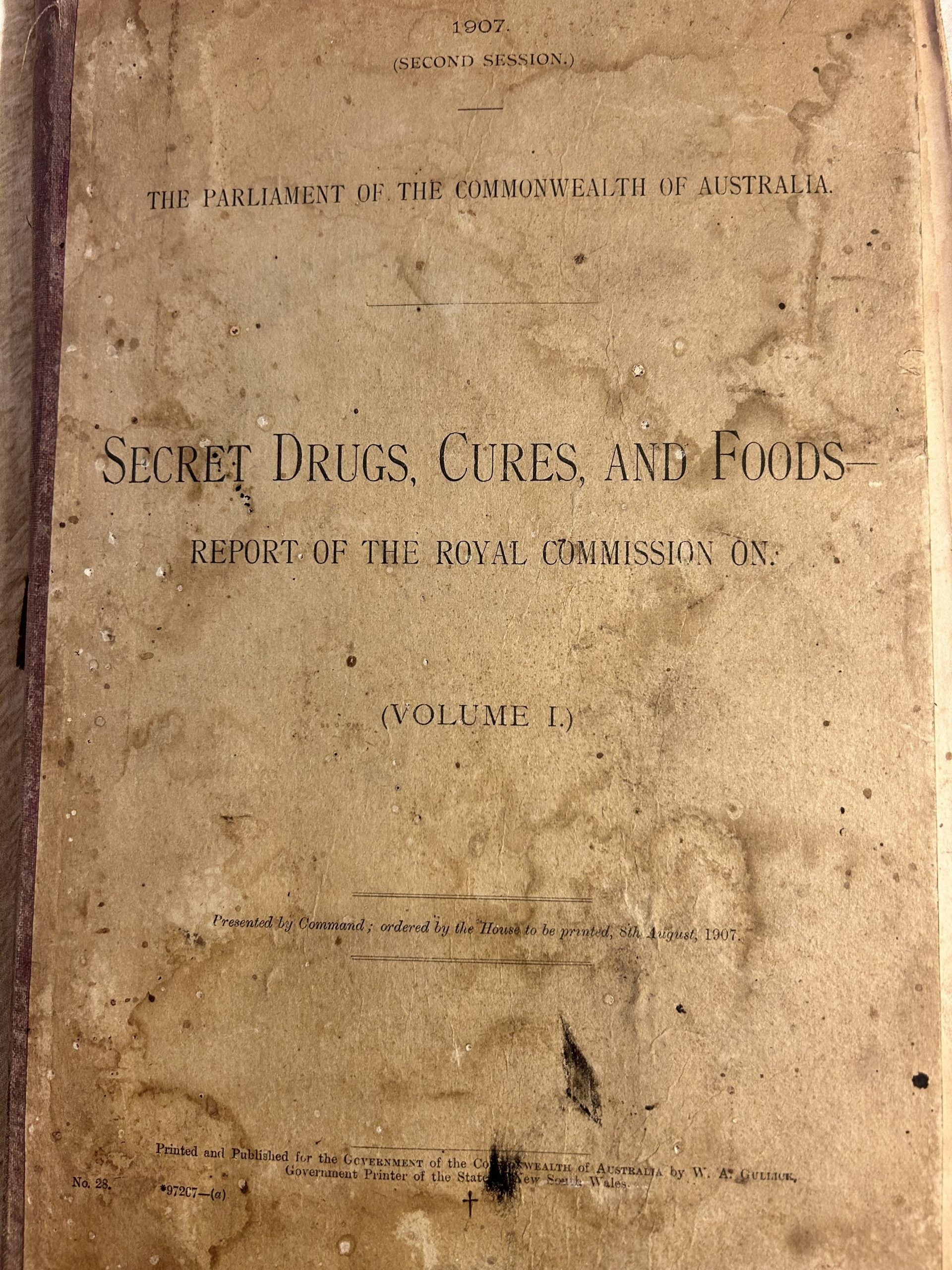
Secret drugs, cures and foods: Report of the Royal Commission on, Volume I, Octavius Charles Beale, 1907
Throughout the early and mid-20th century, these ‘cures’ were widely advertised and available, not just through pharmacies, but also from grocery stores and through mail order catalogues.7
In many instances, it was the remedy’s catchy name that drew people in. One such product name was the heavily alliterated Dr Williams’ Pink Pills for Pale People, which advertised a cure for several conditions, including ‘the terrible influenza’:
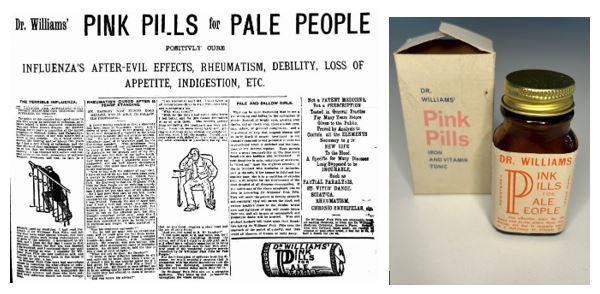
Left: Advertisement for Dr Williams’ Pink Pills for Pale People from The Australasian, 29 May 1897, p 33
Right: Dr Williams’ Pink Pills for Pale People bottle and box, Bottles and packaging for Hood & Co. pharmacy medicines, 1890-1970, State Library Victoria
The following three winter health tonics were all manufactured in Victoria and proudly advertised their establishments as being in North Melbourne, Prahran and Geelong. Their bold promotional strategies had it all: effective name branding, well-designed packaging and fervent testimonials touting their effectiveness. Let’s take a look at their fascinating stories and advertising campaigns.
Greathead’s Mixture: ‘the people’s remedy’
In 1875, North Melbourne engineer8 Robert Greathead, produced his signature mixture as a cure for diphtheria, fevers and other chest complaints.
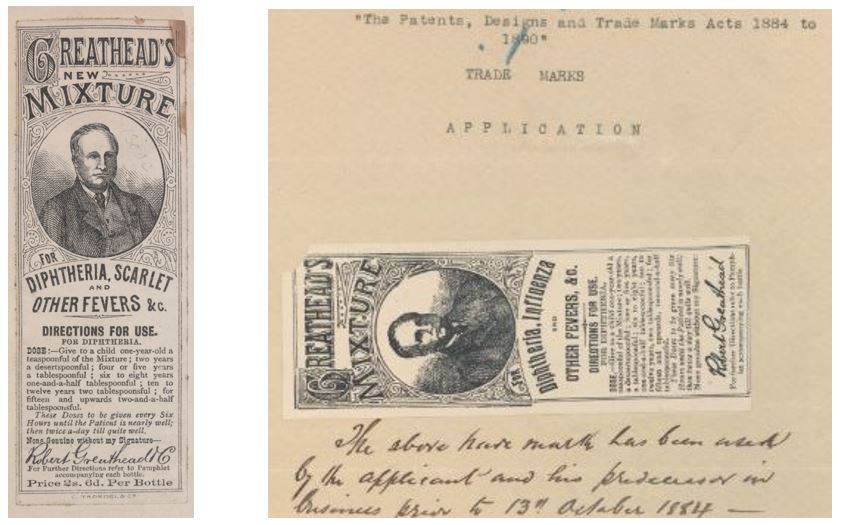
Left: Greathead’s Mixture bottle label, Portrait of Mr. Robert Greathead, 1879, Troedel & Co., lithographers H96.160/232
Right: Application for trade mark titled Greathead’s Mixture depicting a man’s head in respect of a medicine for human use, NAA: A11708, 3131 National Archives of Australia
State Library Victoria holds this Greathead’s Mixture bottle label as part of its vast Troedel and Cooper archive. The trademark design of this bottle label was registered at patent offices across the country, from Queensland to Western Australia.
Featuring audacious statements about the medical profession at the top of his 1870s newspaper advertisements and publicising his Chetwynd Street premises in Hotham (now known as North Melbourne), Greathead declared that his extraordinary cure ‘gives the best of health and completely does away with doctors’:9


‘The Board of Health and doctors superceded by Greathead’, North Melbourne Advertiser, 4 Feb 1876, p 3
Newspapers published accounts (perhaps now considered to be advertorials) of Greathead’s Mixture curing the deadly disease, diphtheria, and called for the medical profession to recognise his remedy as an approved cure.10 However, doctors were never persuaded to verify the mixture as a legitimate medicine due to what they labelled as Greathead’s ‘non-acquaintance with the simplest principles of pathology’.11
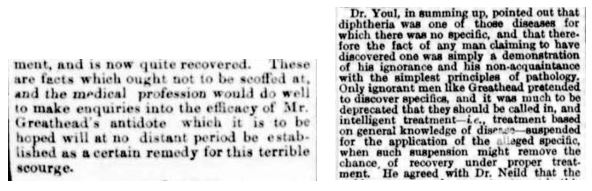
Left: ‘Diphtheria at Coburg’, North Melbourne Advertiser, 8 Oct 1875, p 2
Right: ‘Diphtheria and Greathead’s medicine’, The Argus, 2 October 1874, p 5
Nevertheless, Greathead’s Mixture went on to use portraits of leading politicians (or ‘Great Heads’) from Australia and the UK in its advertisements, accompanied by testimonials verifying the tonic’s success in combating stubborn family coughs and colds:
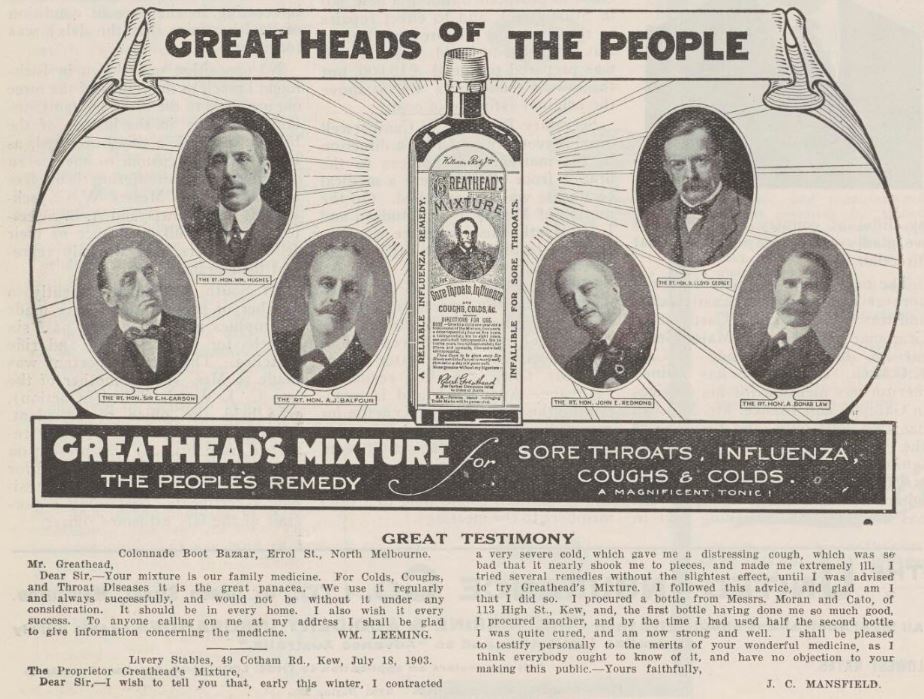
‘Great heads of the people’, The Advance Australia, 15 May 1918, vol 22 no. 5, p 144
Robert Greathead died in 1899, however, his popular product went on to be marketed with a limited set of 12 Greathead’s football cards produced in 1906. The cards depicted players wearing fine suits instead of their team guernseys, with photographs taken at the Swiss studio in Melbourne. ‘In an era dominated by cigarette company releases of football cards, Greathead influenced others (mainly confectioners) to use football cards as a promotional tool’.12 The cards were distributed with bottles of the mixture sold at pharmacies and grocery stores.
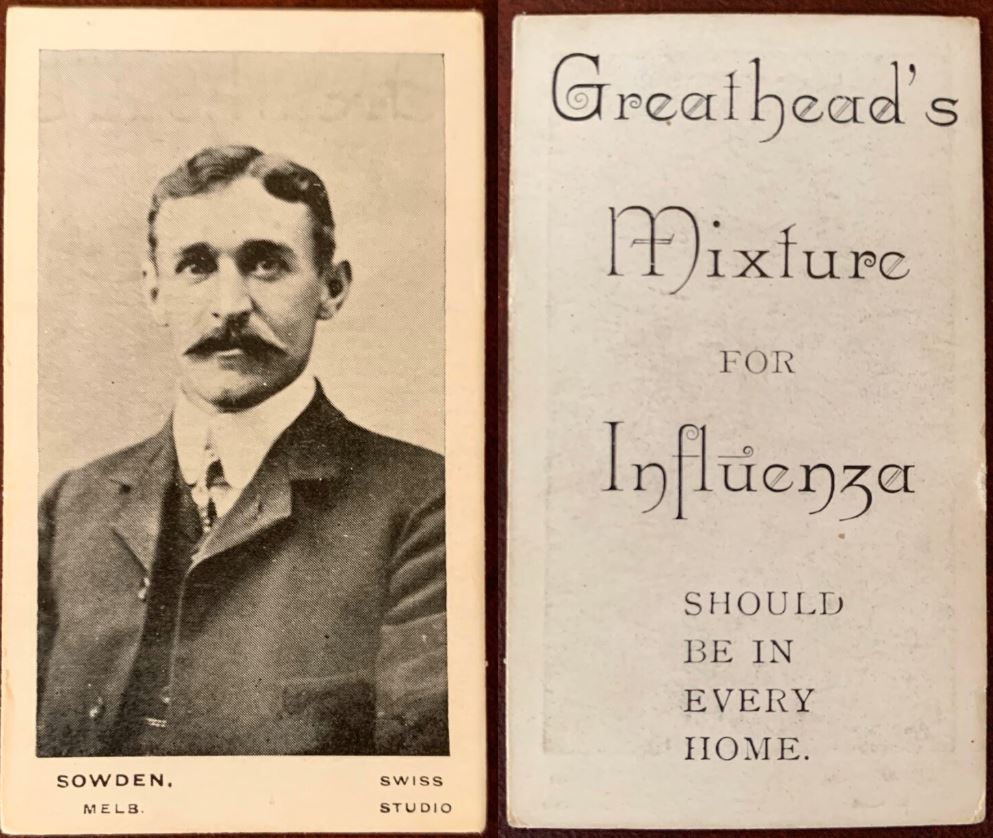
Greathead’s football card (1906) depicting VFL Melbourne captain, Arthur Sowden, with Greathead’s Mixture advertisement for influenza on the back. Card image courtesy of Joel Williams.
Although Robert Greathead’s Mixture may not have actually cured diphtheria, it was a popular winter chest tonic in family medicine cabinets and featured prominently in Australian newspaper advertisements from the 1870s until the 1940s.
Hearne’s Bronchitis Cure: ‘Best by test for the chest’
Pharmacist William Goodall Hearne put Geelong on the map with Hearne’s Bronchitis Cure, a mixture that entered the market in 1888 and was advertised as having ‘the largest sale of any chest medicine in the world’:13
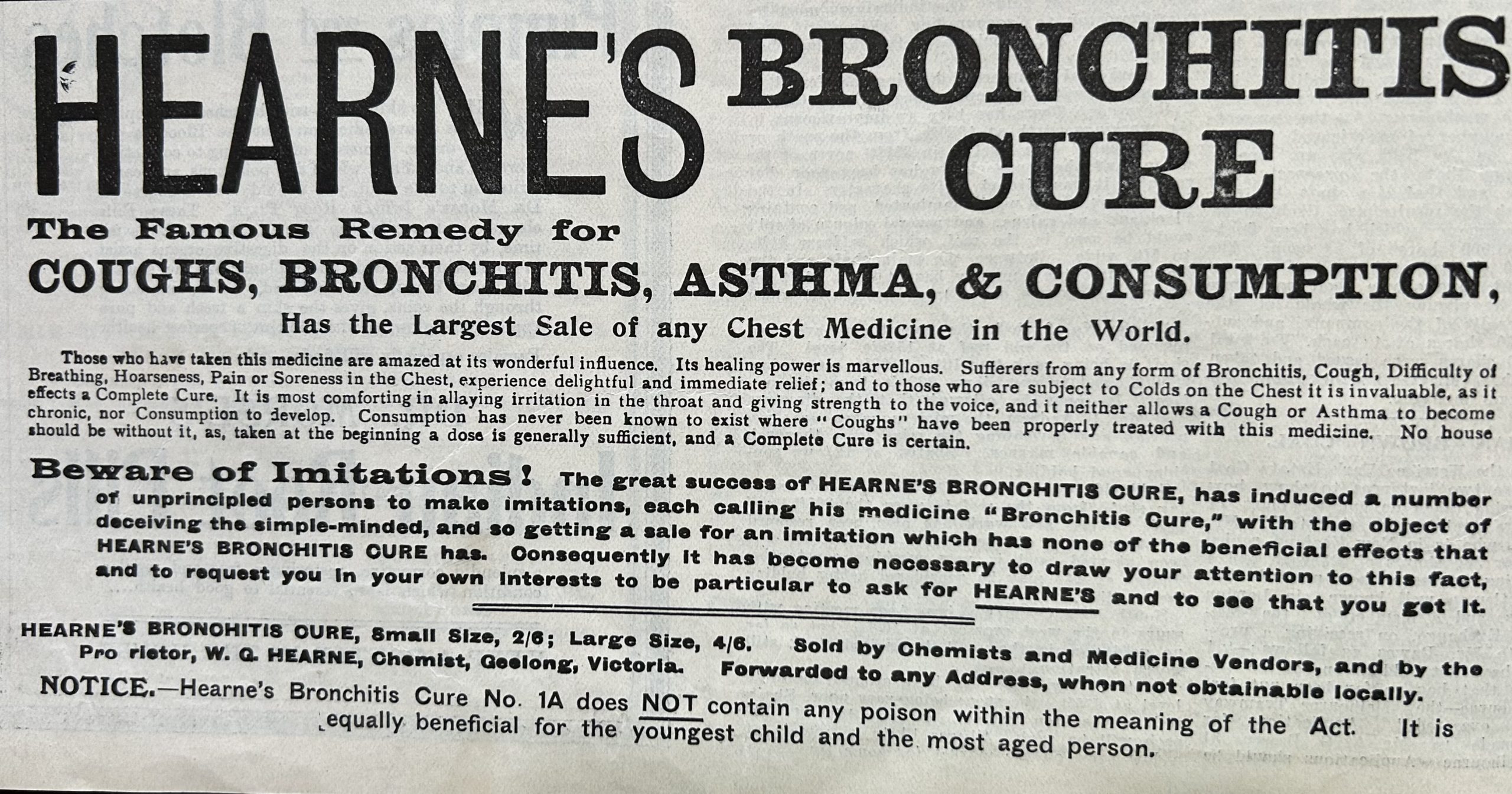
‘Hearne’s Bronchitis Cure’, Punch (Melbourne), 21 Feb 1907, p 10
Listed in the Government Dentists’ Register on 20 March 1888 as ‘W.G. Hearne of Geelong — Practising Dentistry in Victoria, with Pharmacy’,14 Hearne offered dental services, including ‘teeth extracted with or without the aid of the anaesthetic spray’, as well as the sale of ‘fine healthy leeches’, at his pharmaceutical dispensary on Great Ryrie Street in Geelong:
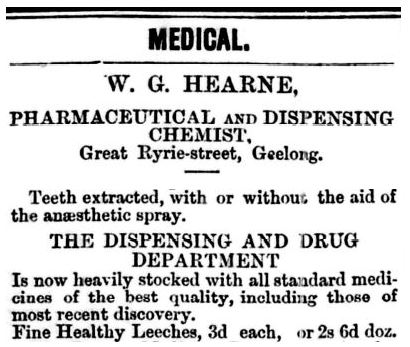
W.G. Hearne advertisement, Geelong Advertiser, 6 April 1878, p 4
Deeply distressed by ‘the grim fact that more than one half of the population die before they attain the age of 25 years’, Hearne vowed that he was ‘prepared to prove that out of the 11,471 deaths from disease recorded, 7221 could have been saved’.15 He authored a detailed guide that provided definitions and symptoms of several diseases, ranging from ague to whooping cough:
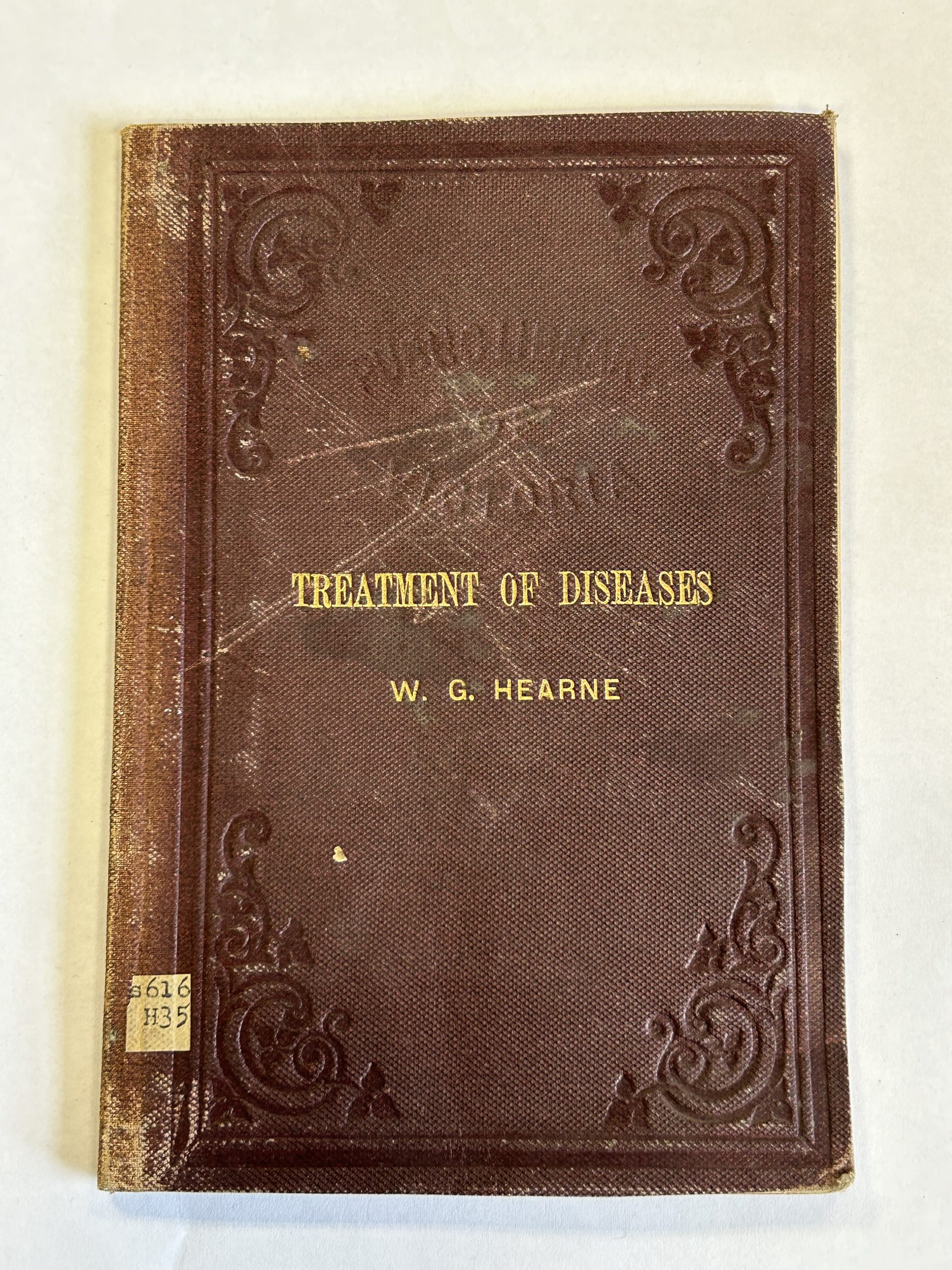
Treatment of diseases : a short treatise to secure advancement in the science of medicine, W.G. Hearne, 1880
Hearne prepared and marketed a range of his own specialty medicines, such as this bottle of Hearne’s Medicine No. 21, held in the State Library Victoria collection. The label indicates that it is to be taken for conditions such as consumption, emaciation and wasting of the flesh:
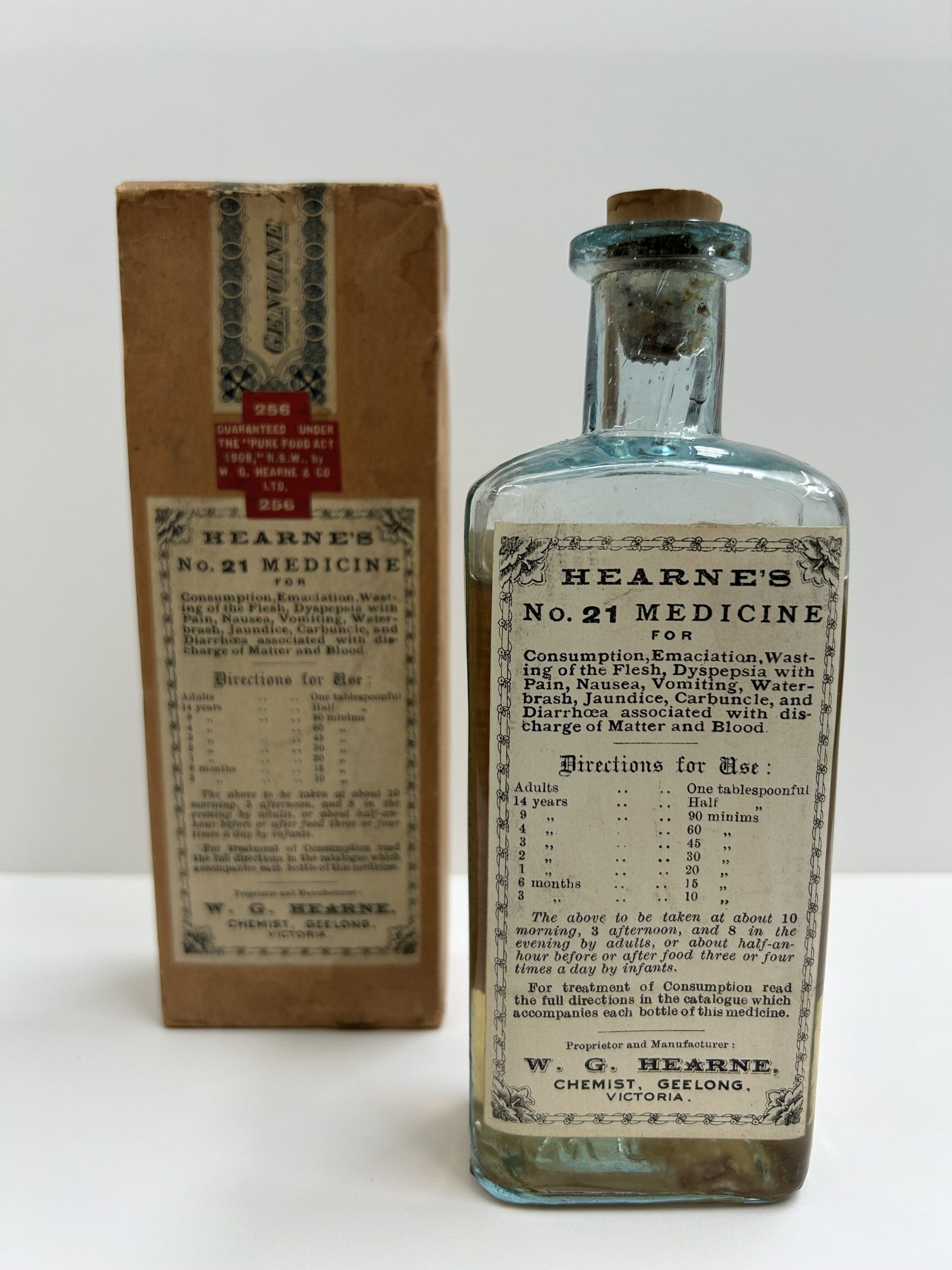
Hearne’s No. 21 Medicine bottle and box, from Medicine bottles and packaging relating to Hood & Co. pharmacists, 1890-1970, State Library Victoria
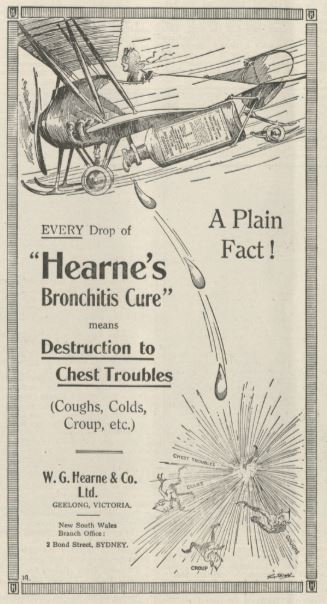
Hearne’s products were advertised in more than 700 newspapers across Australia16 and always proudly promoted the company’s home as Geelong, Victoria. Hearne’s Bronchitis Cure had wildly imaginative advertisements, incorporating racing cars and bombing planes obliterating pesky gremlins that represented bronchitis, colds, coughs, chest conditions and lung troubles:
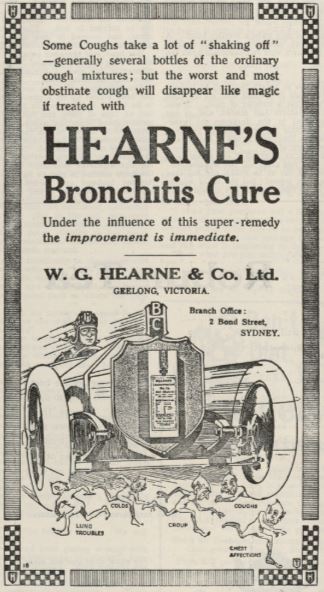
Left: Madame Weigel’s Journal of Fashion, June 1925, p 172
Right: Madame Weigel’s Journal of Fashion, July 1920, p 157
Then there was the advertising campaign pitched at worried parents, who were encouraged to trust the Hearne’s knight as the vigilant protector of their children’s young immune systems:
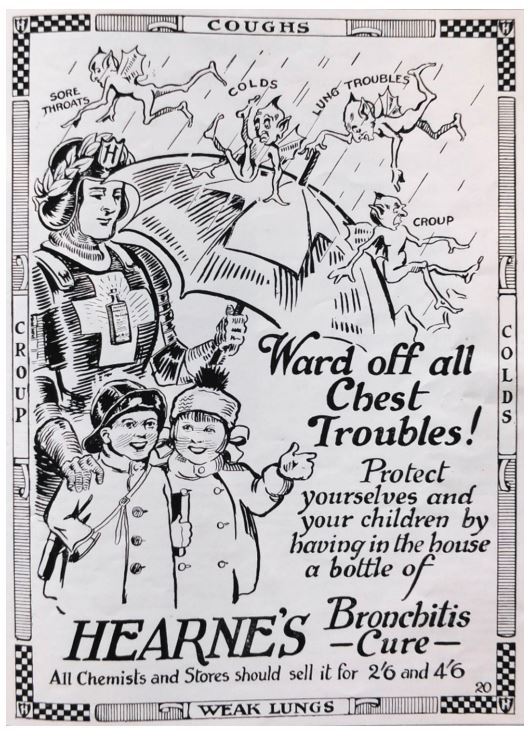
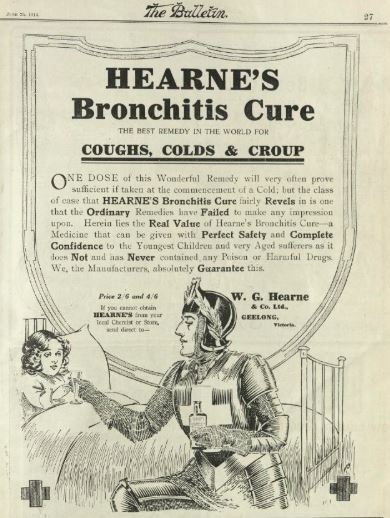
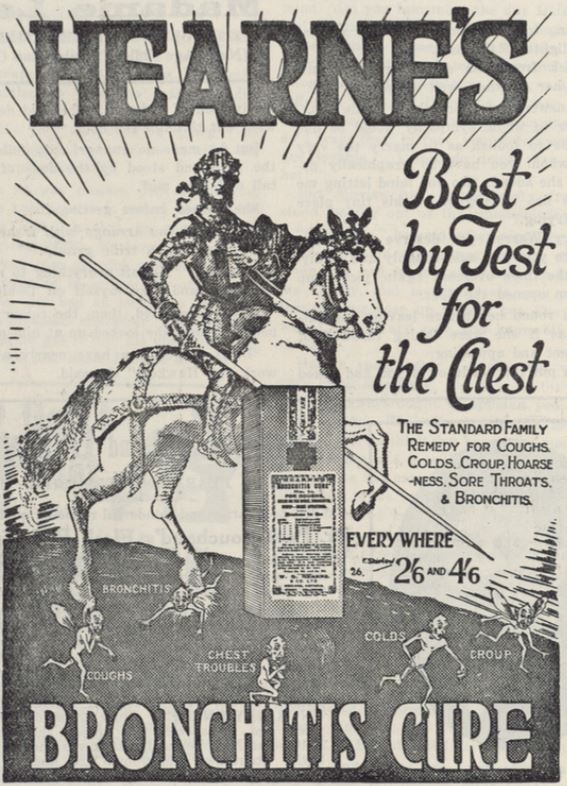
Left: Australian Home Builder, March 1924, p 67; Centre: The Bulletin, 25 June 1914, p 27; Right: Madame Weigel’s Journal of Fashion, July 1928, p 40
By the time he died in 1921, W.G. Hearne had become a household name.17 His son, Oswald, took over the family business at Hearne’s dispensary, located at 16-18 Ryrie Street, Geelong. Next time you’re visiting this vibrant regional Victorian city, look out for the distinctive building with its Mughal-like façade designed by Geelong architect, Fred Purnell.
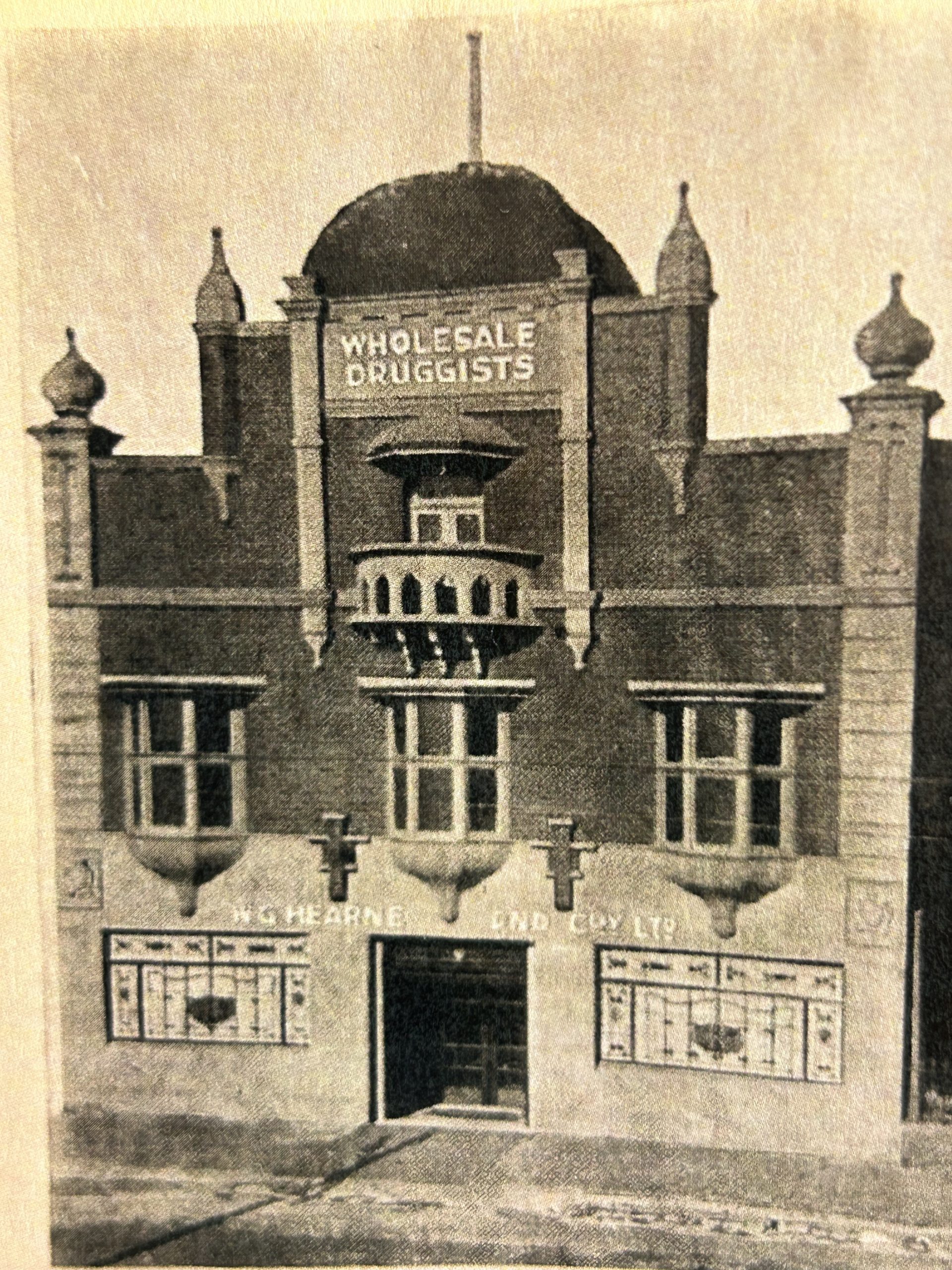
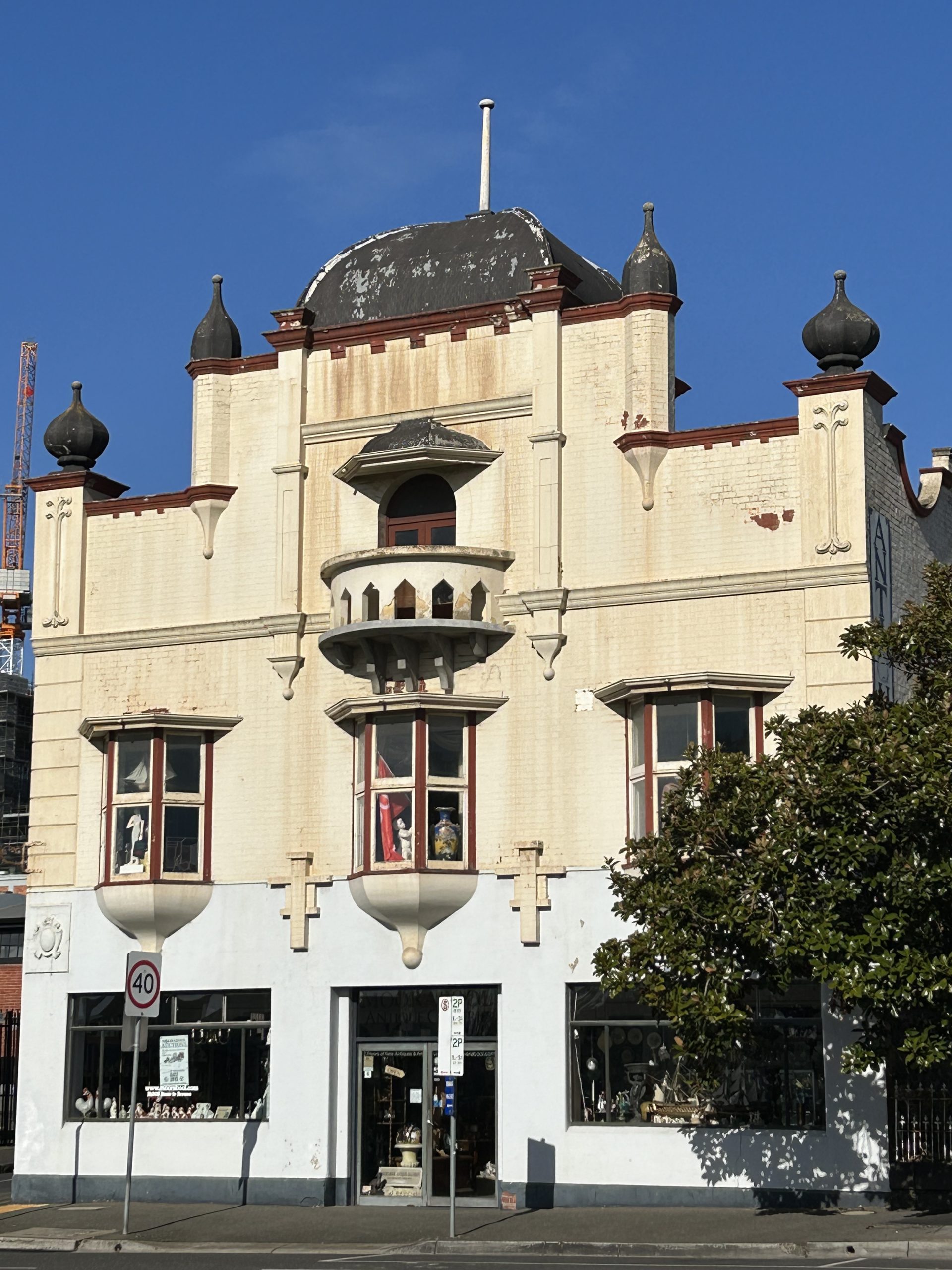
Left: Hearne’s Wholesale Druggists building, Australian Home Builder, 1922, p 61
Right: Moorabool Antique Galleries, © Photo by Alison Ridgway, 2025
The historic building is currently operating as the Moorabool Antique Galleries, where the owner has carefully curated a remarkable display cabinet filled with Hearne’s memorabilia:
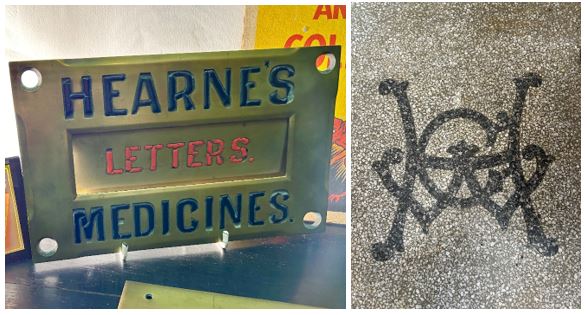
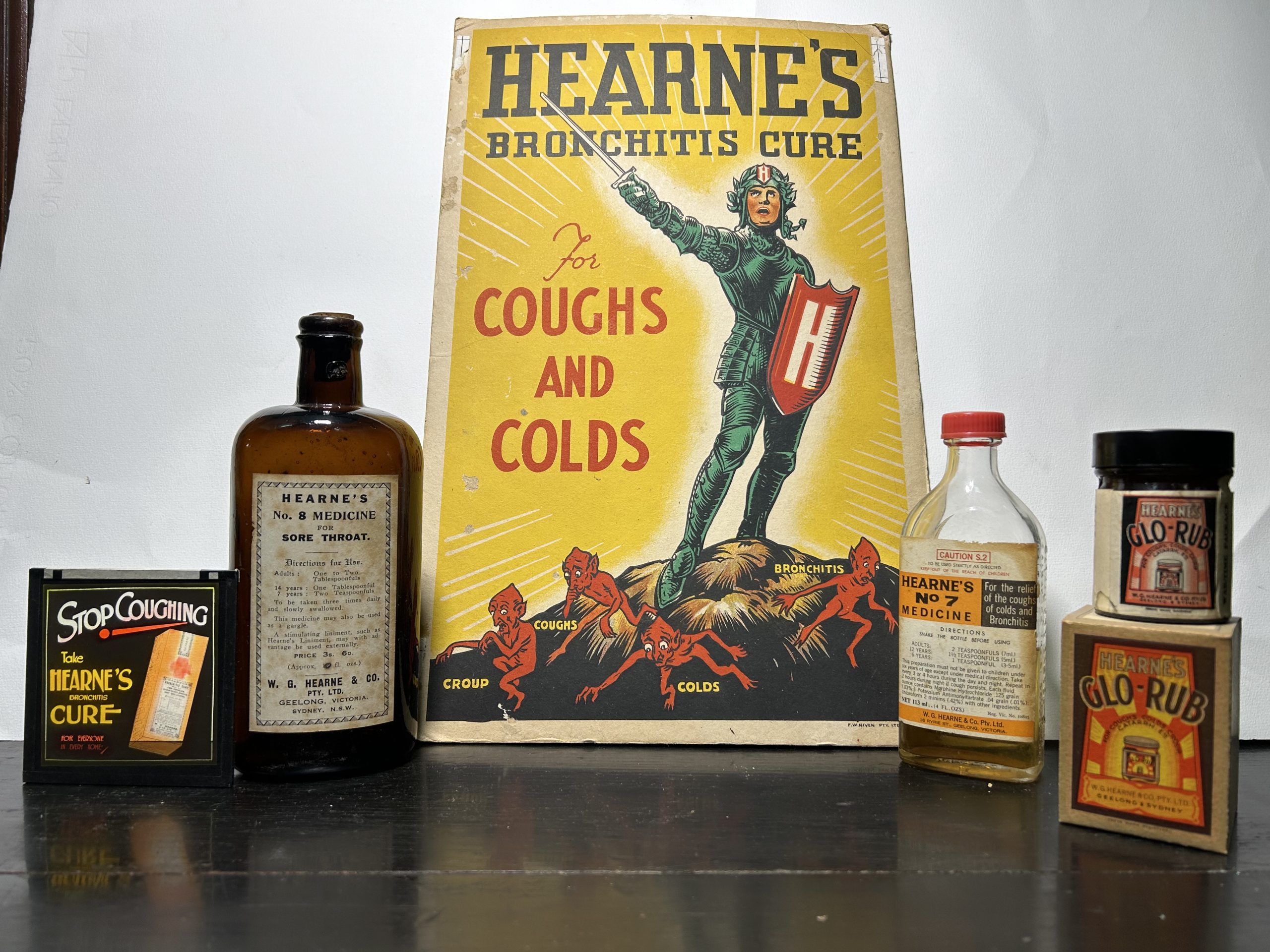
Above: Hearne’s Medicines letterbox and monogram tiled entry
Below: (L to R) Hearne’s ‘Stop Coughing’ cinema advertising glass slides; Hearne’s No. 8 Medicine for Sore Throats; Hearne’s Bronchitis Cure advertising poster; Hearne’s No. 7 Medicine for Coughs and Colds; Hearne’s Glo-Rub for Coughs and Colds
With thanks to Paul Rosenberg of Moorabool Antique Galleries for providing access to these historical artefacts.
O.T. Beverage: ‘Break up that cold!’
In 1904, John Dixon, the fruit cordial manufacturer and owner of Kia-Ora Ltd (formerly the Prahran Aerated Water Company), manufactured a drink that was ‘not a medicine, but a health-giver’.18 It was described as being ‘simply a wholesome drink with a skilful blending of fruit juice combined with chillies’.19 Chillies? Yes, chillies. Apparently, the use of this fiery signature ingredient was attributed to the special recipe being obtained from an Indian Maharaja,20 no less. The bright red chilli was emblazoned on the bottle label and trademarked as the O.T. logo in 1905:
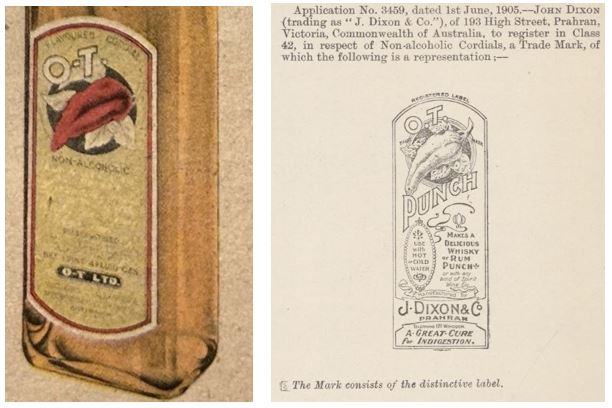
Left: O.T. bottle label with chilli logo, The Argus Weekend Magazine, 22 June 1946, p 25
Right: Application for Trade Mark titled Punch in respect of non alcoholic cordials by John Dixon trading as J. Dixon and Company, 1905; NAA A11802, 3459, National Archives of Australia
O.T. became incredibly popular as a healthy beverage, rich in high vitamin content from lemons that were marketed as preventing scurvy. Dixon’s success producing fruit cordials in his factory on High Street, Prahran, afforded him the opportunity to open a lemon-processing factory in Messina, Italy and a factory to extract orange juice from orange groves in Valencia, Spain.21
But why the name O.T.? When asked about the evolution of the name, Dixon quipped that it was ‘short, distinctive and possibly suggested to many people “HOT”. When the need arose, there was the name.’22
The hot, fruity drink had huge international success, with high demand for shipments to the UK, the US, Canada, South America, China, Hong Kong, Sri Lanka, South Africa, Mauritius and even Iceland.23
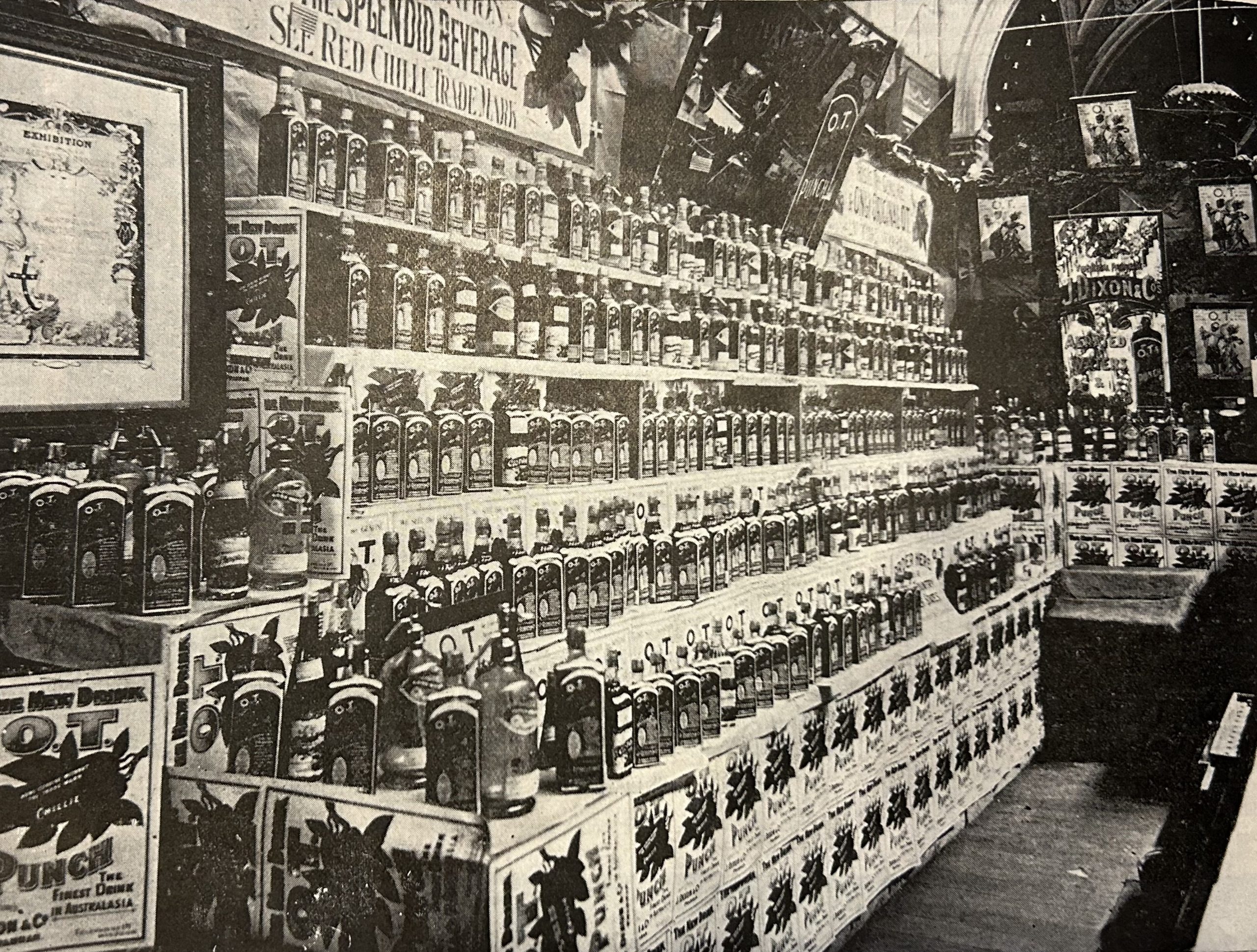
‘John Dixon’s O.T. exhibit at the ANA Exhibition’, Punch (Melbourne), 21 Feb 1907, p 252
As with the innovative marketing campaign of Greathead’s Mixture, Dixon’s advertising also expanded to VFL promotions, including football cards that featured the O.T. chilli logo nestled in team flags, with advertising slogans on the back of the cards. The tab at the base of these cards allowed them to be inserted into spectators’ hat bands to be displayed proudly during the game:
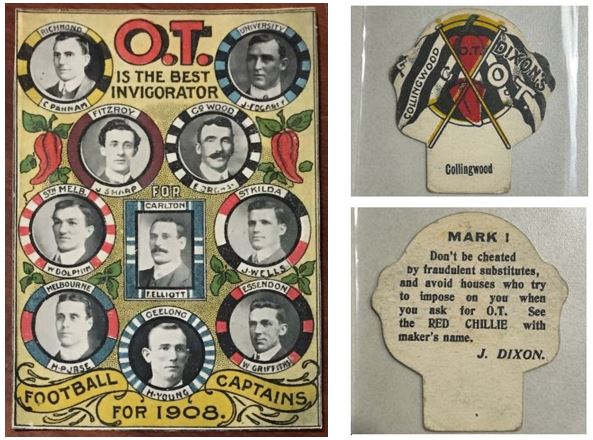
Left: O.T. bottle label featuring VFL captains (1908); label image courtesy of Joel Williams.
Right: ‘Dixon’s O.T.’ Collingwood football card (c. 1910) featuring chilli logo on front and advertising message from manufacturer John Dixon on back; author’s collection.
A true businessman, Dixon knew the power of advertising in newspapers: ‘Advertising is the great factor in business expansion. With intelligent effort, a good article, and judicious advertising, anyone can make a fortune. We advertise O.T. in the newspapers of all countries from Egypt to China, and we find that newspapers give by far the best results. One other point. The man who advertises his goods as the best and then supplies a poor line is a fool.’24
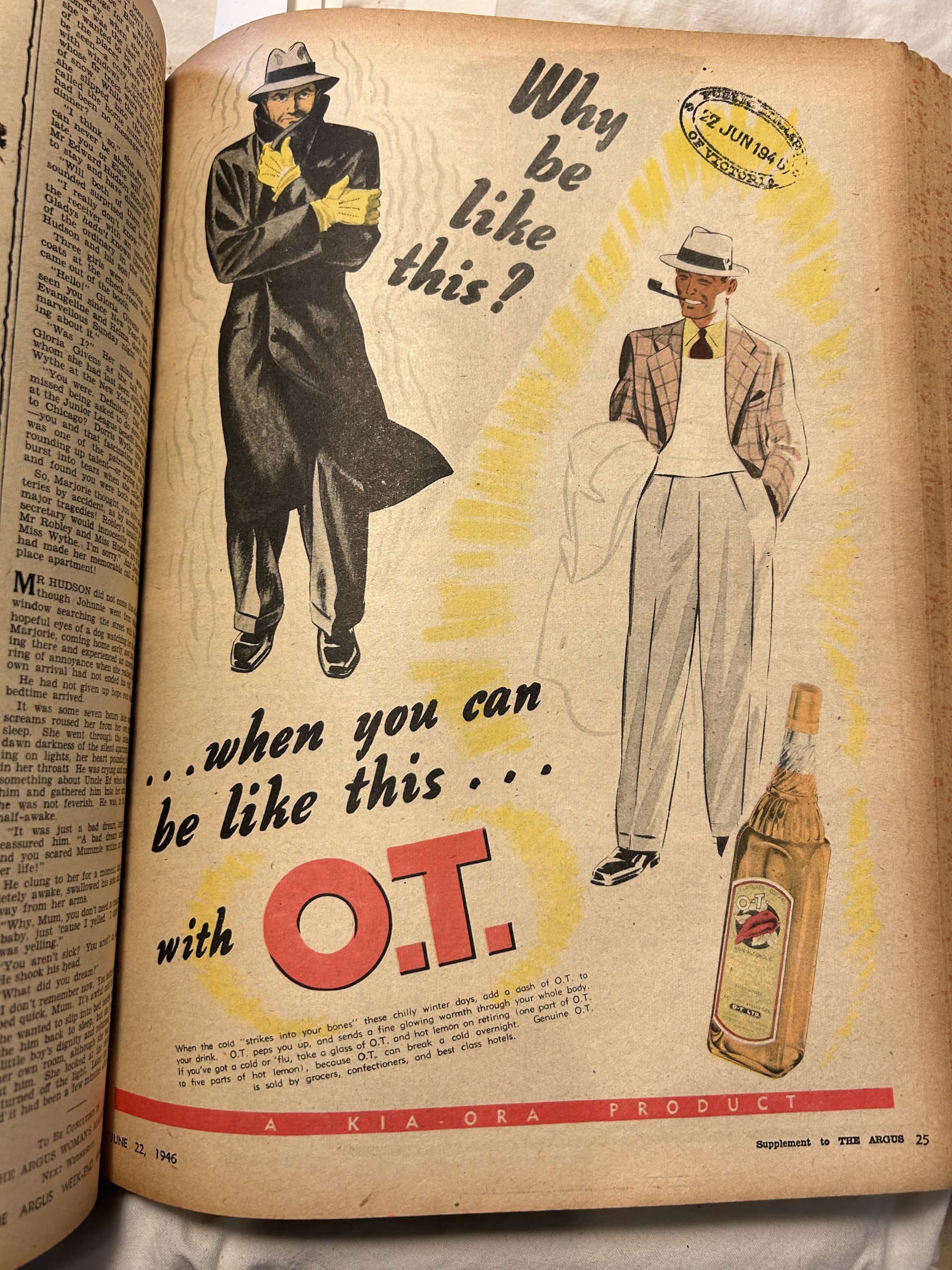
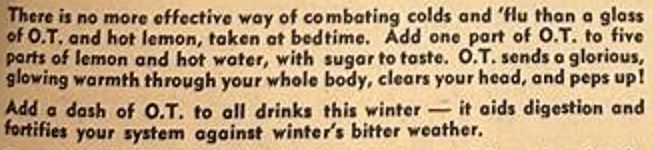
Left: The Argus Weekend Magazine, 22 June 1946, p 25
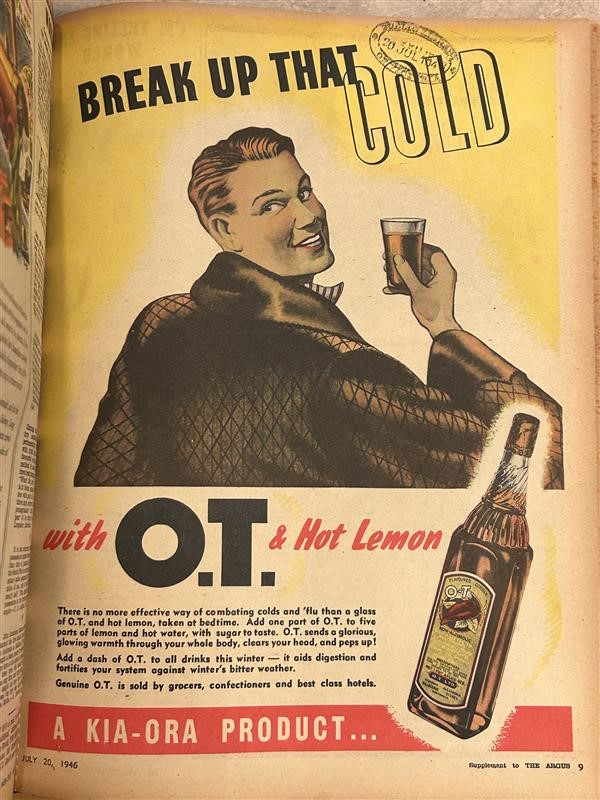
Right: The Argus Weekend Magazine, 20 July 1946, p 9 (with small print enlarged below)
And with such vibrant newspaper advertisements radiating warmth during the chilly months, readers were compelled to buy Dixon’s remedy. Curious about the taste? Well then, let’s brew up a pot…
Make your own winter health tonic
As the above advertisement proclaims: ‘There is no more effective way of combating colds and flu than a glass of O.T. and hot lemon, taken at bedtime’. With that objective, I embarked upon a mission to replicate Dixon’s health tonic for my family, as we were all struck down by dreadful colds this winter.
Searching old newspapers, I discovered several recipes for homemade O.T. from people attempting to recreate John Dixon’s special mixture during the early 1900s:
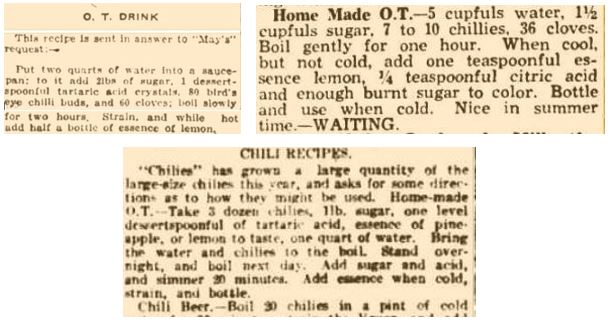
Above left: The Newcastle Sun, 17 Oct 1923, p 7; Above right: Weekly Times (Melbourne), 16 June 1934, p 20; Below: The Argus, 7 May 1919, p 12
The top left recipe prescribes 80 bird’s eye chillies, which I thought would be too intense. However, the recipe on the top right suggests using only 7 to 10 chillies, which might not have much of an effect. So I went with the bottom recipe’s recommendation of 3 dozen chillies. Yes, that’s 36 chillies. (Feel free to count them in my preparation photo below.) Combining different ingredients and methods from each of these recipes, I concocted this special brew:
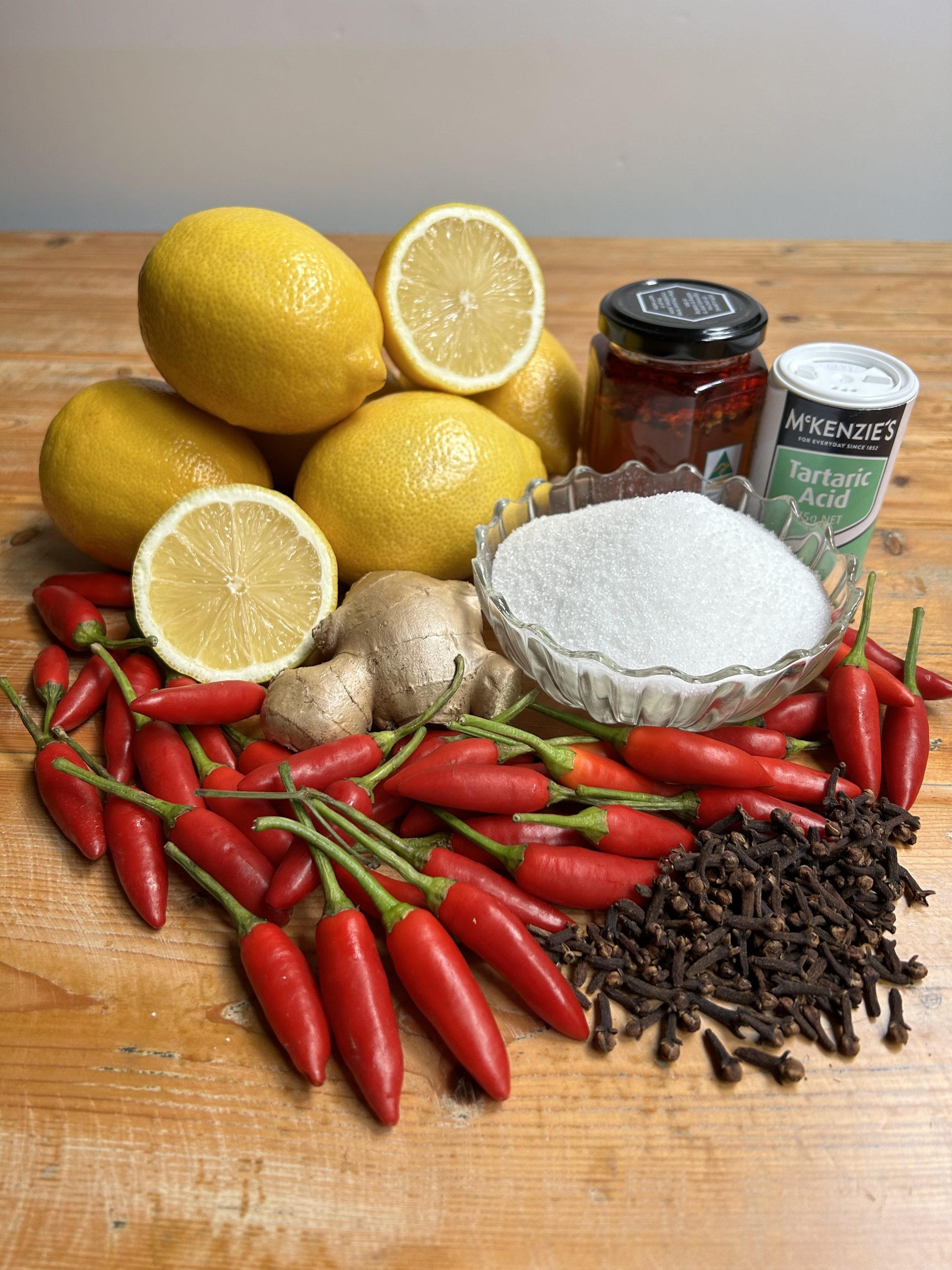
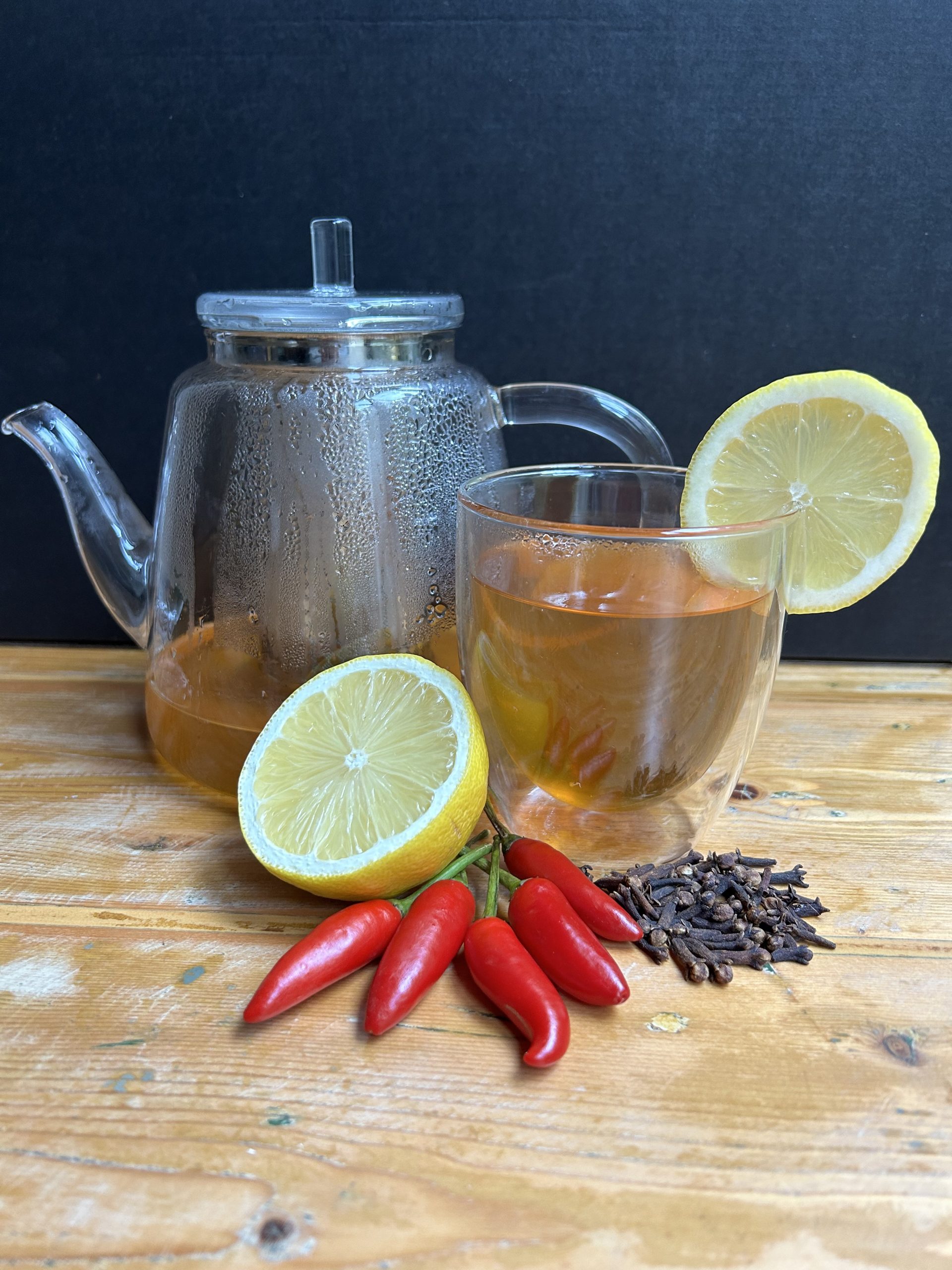
Left: Ingredients to make homemade O.T. Right: Freshly brewed homemade O.T.
The result? Well, our undiluted hot cordial was deliciously sweet and comforting…for the first five seconds. Then, of course, the heat of the fiery chillies kicked in and blew our socks off. (Note to self: next time, use half the amount of chillies.) However, after topping up the cordial with boiling water and squeezing in lots of fresh lemon juice, we ended up with a pleasant vitamin-packed health tonic to warm our chests and ease our cold symptoms during this chilly Melbourne winter. As the above advertisement promises: O.T. really does ‘send a glorious, glowing warmth through your whole body, clear your head and pep you up!’. Why not try it yourself and create your own perfect blend? Stay warm and happy sipping this winter!
References
- Kerr W (1978) Kerr’s Melbourne almanac and Port Phillip directory for 1841 : a compendium of useful and accurate information connected with Port Phillip, Mona Vale, NSW: Lansdown Slattery
- Haines G and Pharmaceutical Society of Australia, Victorian Branch (1994) A History of pharmacy in Victoria, Melbourne: Australian Pharmaceutical Publishing Co. in association with the Pharmaceutical Society of Australia Victorian Branch, p 45
- Martyr P (2002) Paradise of Quacks: An alternative history of medicine in Australia, Macleay Press, Sydney, NSW, p 8
- Bomford JM, Newgreen DB and Pharmacy Board of Victoria (2005) The Pharmacy Board of Victoria : a history, 1877-2005, Parkville, Vic: Pharmacy Board of Victoria, p 58
- Roseby G and Medical History Society (1968) The patent medicine racket in Victoria, 1880-1914, 1968, MS 14525, p 1, State Library Victoria
- Beale OC (1907) Secret drugs, cures and foods: Report of the Royal Commission on, Sydney, WA Gullick, Govt. Printer of the State of NSW for the Govt. of the Commonwealth of Australia, p 427
- Knehans MM (2005) The archaeology and history of pharmacy in Victoria, Journal of the Australasian society for historical archaeology, 23, p 42
- Sands & McDougall Limited (1870) Sands & McDougall’s Melbourne and suburban directory : 1870, Melbourne: Sands & McDougall
- Medical advertisement, North Melbourne Advertiser, 4 Feb 1876, p 3
- ‘Diphtheria at Coburg’, North Melbourne Advertiser, 8 Oct 1875, p 2
- ‘Diphtheria and Greathead’s medicine’, The Argus, 2 October 1874, p 5
- Doherty F (2023) The Australian football card : an illustrated history, Francis Doherty, Greensborough, Victoria, p 21
- ‘Hearne’s Bronchitis Cure’, Punch (Melbourne), 21 Feb 1907, p 10
- Victorian Government Gazette, no. 16, 8 February 1895, p 533
- Hearne W (1880) Treatment of diseases : a short treatise to secure advancement in the science of medicine, Melbourne: Sands & McDougall, p 4 and p 7
- ‘Send off to Mr W. G. Hearne, whose advertisements appear in 700 newspapers’, Geelong Advertiser, 16 Dec 1911, p 4
- ‘Personal’, Geelong Advertiser, 28 July 1921, p 3
- ‘O.T. Exhibit’, Punch (Melbourne), 21 Feb 1907, p 14
- As above
- ‘Dixon & Co. Cordial Manufacturers. The O.T. Punch’, The Herald, 6 Feb 1906, p3
- ‘Romance of Industry’, The Argus, 5 April 1930, p10
- As above
- ‘The popular O.T.’, The Prahran Telegraph, 16 January 1909, p 3
- ‘Virtues of O.T.’, The Herald, 7 Feb 1914, p 11


Amazing research producing an interesting and informative article.
What a lovely ramble through the world of old-fashioned cures, related with wit and underpinned with some impressive research. Most enjoyable!
This well presented research has found and linked information and artefacts in ways that provide intriguing insights into Victoria’s early health care, as well as the commercial approaches to and, eventually, regulation of the provision of health-related products and services at that time. Importantly, it provides a base for further inquiry into how these sometimes helpful and sometimes outlandish health remedies were manufactured, distributed and accepted. Sadly, it also marks how many relevant and important social and cultural records, objects and places have been overlooked or lost. The blog is timely, thorough and thoughtful.
What a wonderful article Alison. Really interesting. You must have enjoyed your research, especially making the OT. A stand-out!
The exploration of historic Victorian winter tonics is fascinating, highlighting the creativity and boldness of early advertising while revealing the intriguing interplay between health, commerce, and public perception in that era.