
Several years ago, I was intrigued to discover that I had a female publican in my family tree. It made me wonder: how many other women ran hotels in the 1920s? And what was the pub she worked in like?
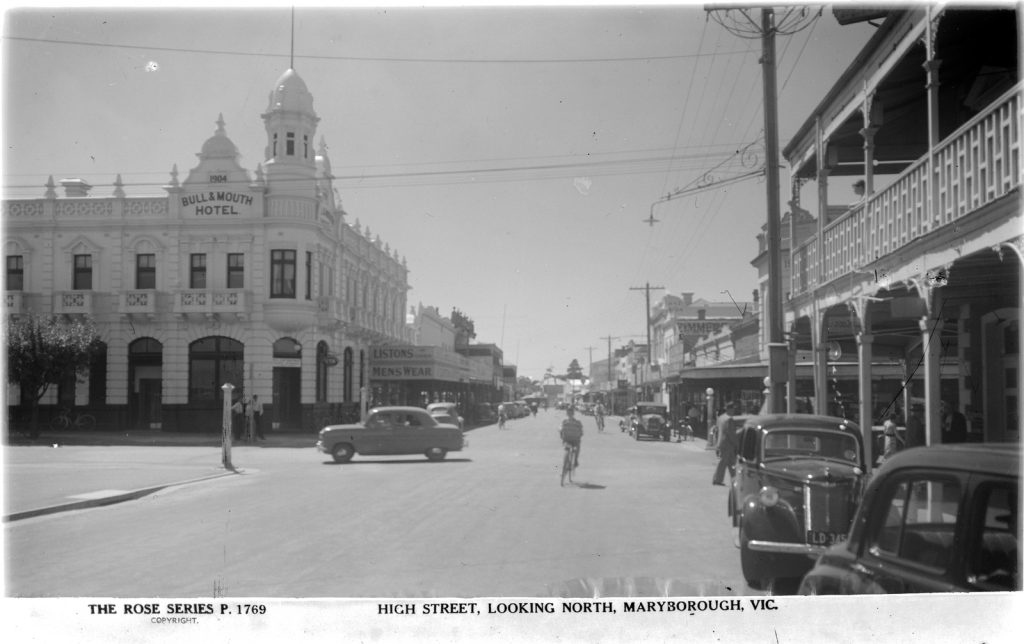
As it turns out, a great many women ran pubs in the 19th and 20th centuries. Some, like my great great aunt Florence, were spinsters who became involved in the family business. Others took over after their husband died, or got into some sort of legal strife. Still others had no family background in pubs at all, but decided to strike out in the industry alone. 1
So, aside from quizzing surviving relatives, how can we find out more about these women? Let’s take a look at some useful resources by examining the story of my great great aunt Florence.
But first, some basic facts…
Marion Jane Florence Lord was born in Maryborough in 1890 to her parents, Benjamin and Ellen. Benjamin was the manager of the Maryborough Gas Company, whilst Ellen was busy running the family home and looking after Florence’s five older brothers.
The first mention I can find of Florence in relation to the Bull and Mouth Hotel is via the National Library’s Trove newspaper database. It appears that Florrie’s initial introduction to the industry may have been through a family connection, because I find a newspaper notice from 1917 announcing her brother Davenport’s intention to transfer the hotel’s liquor licence into her name.
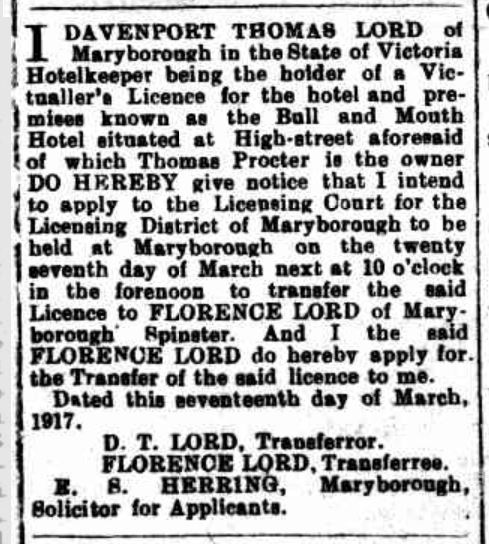
Public notices such as this were common, as the Licensing Act 1915 required that any intention to apply for or transfer a liquor licence be published in the local newspaper.2
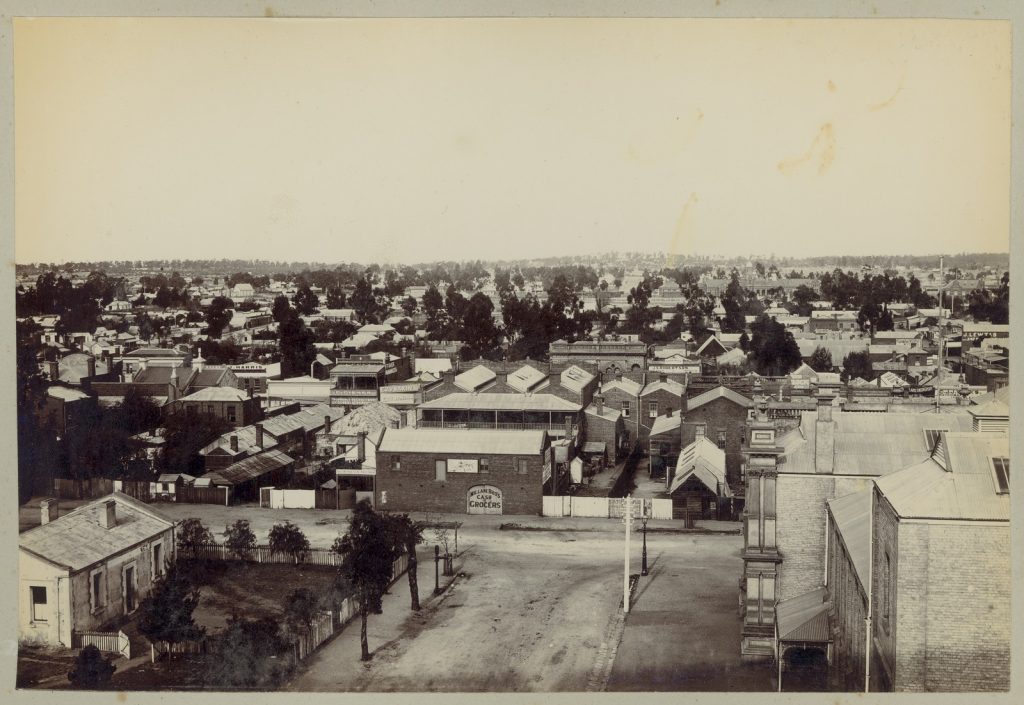
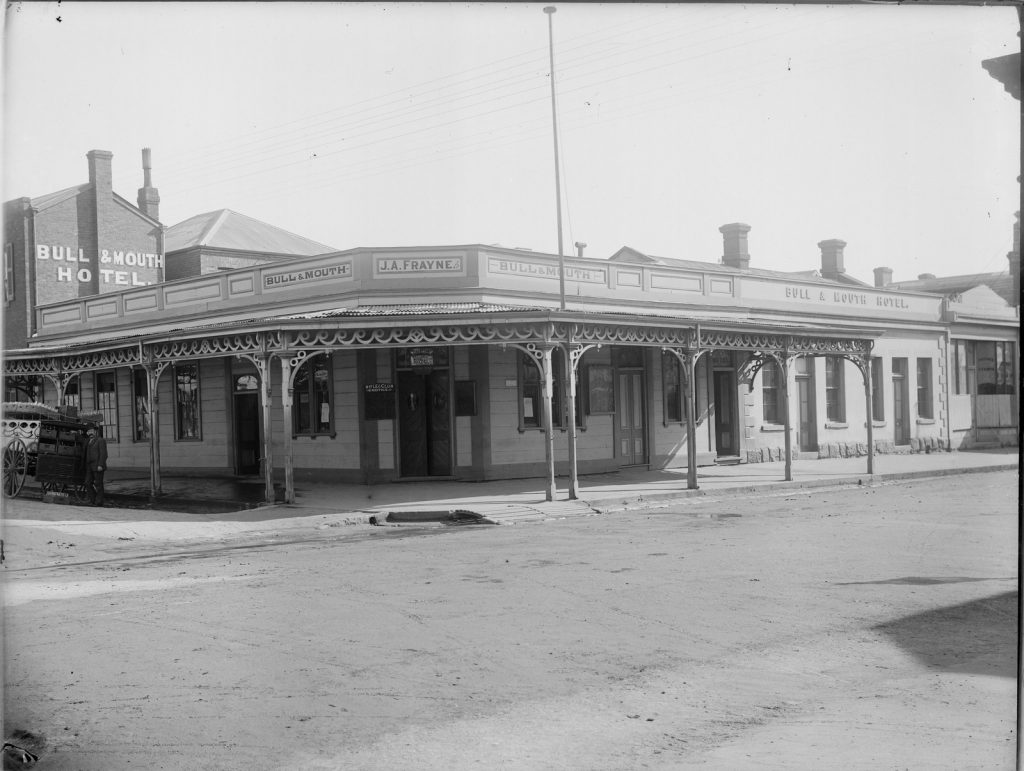
According to this entry I found in the Victorian Heritage database, the original Bull and Mouth Hotel was a single-storey stone building that operated on the corner of High St and Nolan St from around 1855. You can see a picture of what it looked like below:
A civic square was located directly behind the hotel and was an important meeting place for the Maryborough community. 3
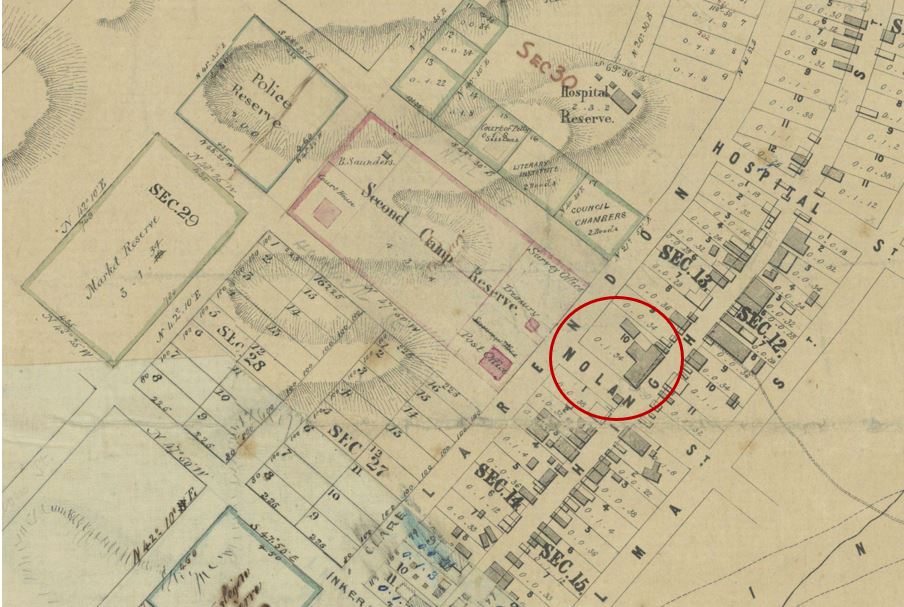
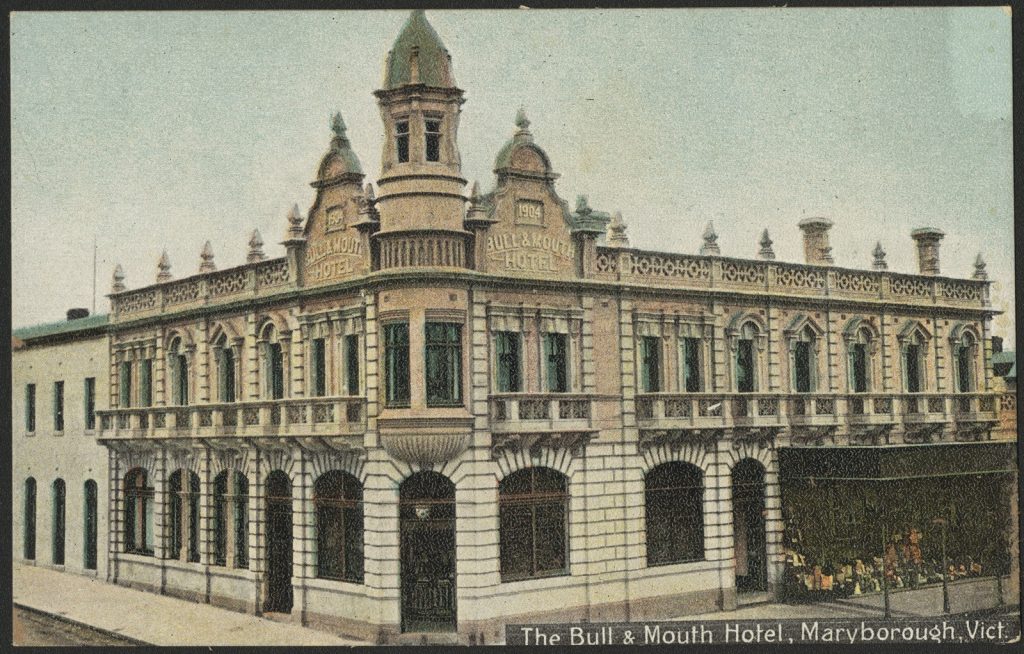
The hotel Florence took over in 1917 would have been vastly different to this original building, because in 1904, owner Thomas Proctor ordered the pub’s demolition4 and a new two-storey hotel was built in its place.
According to the entry in the Victorian Heritage Database, the ground floor of the new hotel consisted of a public bar, a private bar, a parlour, a spacious dining room, a commercial room, billiard room, kitchen and laundry. Upstairs consisted of a large drawing room, more than 15 bedrooms and 3 bathrooms. The hotel also had piped hot water and a telephone system.5
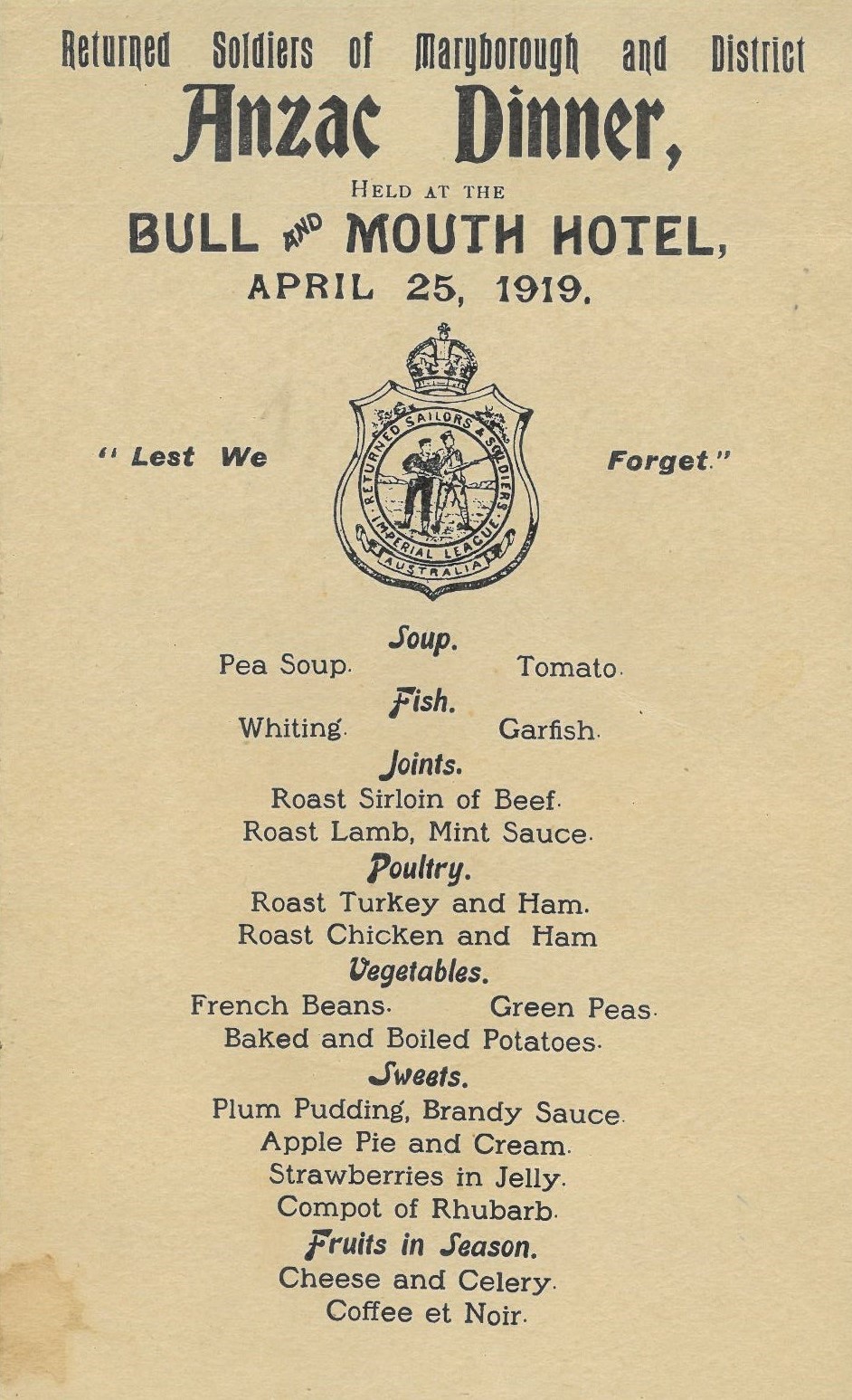
This menu from Anzac Day in 1919 gives us some idea of the meals on offer:
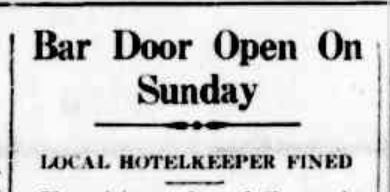
In 1918, Florrie’s licence was renewed. She was still there in 1919, as she had a run in with the law, the Ballarat Star reporting:
At the police court on Tuesday… F. Lord, licensee of the Bull and Mouth hotel, was fined £5 for having the bar door open at 8.30 pm on 3rd May, and £2 for serving after hours. (Ballarat Star, 29 May 1919, p 6)
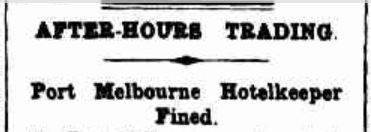
Such brushes with the law were not uncommon. Early closing laws were first introduced during World War I, but even after the war was over, pubs were still required to close at 6pm.6 For some hotelkeepers, the lure of greater profits proved too tempting. Trove’s newspapers are full of reports of hotelkeepers ‘leaving the bar door open’ and trading after hours.
The character of an individual was important when applying for a hotel licence. Applicants were required to provide the Licensing Court with testimonials as to their character and suitability to run a premises.7 Marriage was one indicator of respectability,8 but for spinsters such as my great great aunt Florence, testimonials were everything. The family archive bears witness to Florrie’s diligence: there are letters of recommendation from the town clerk and the Mayor of Maryborough, former customers, and even members of the Legislative Assembly.
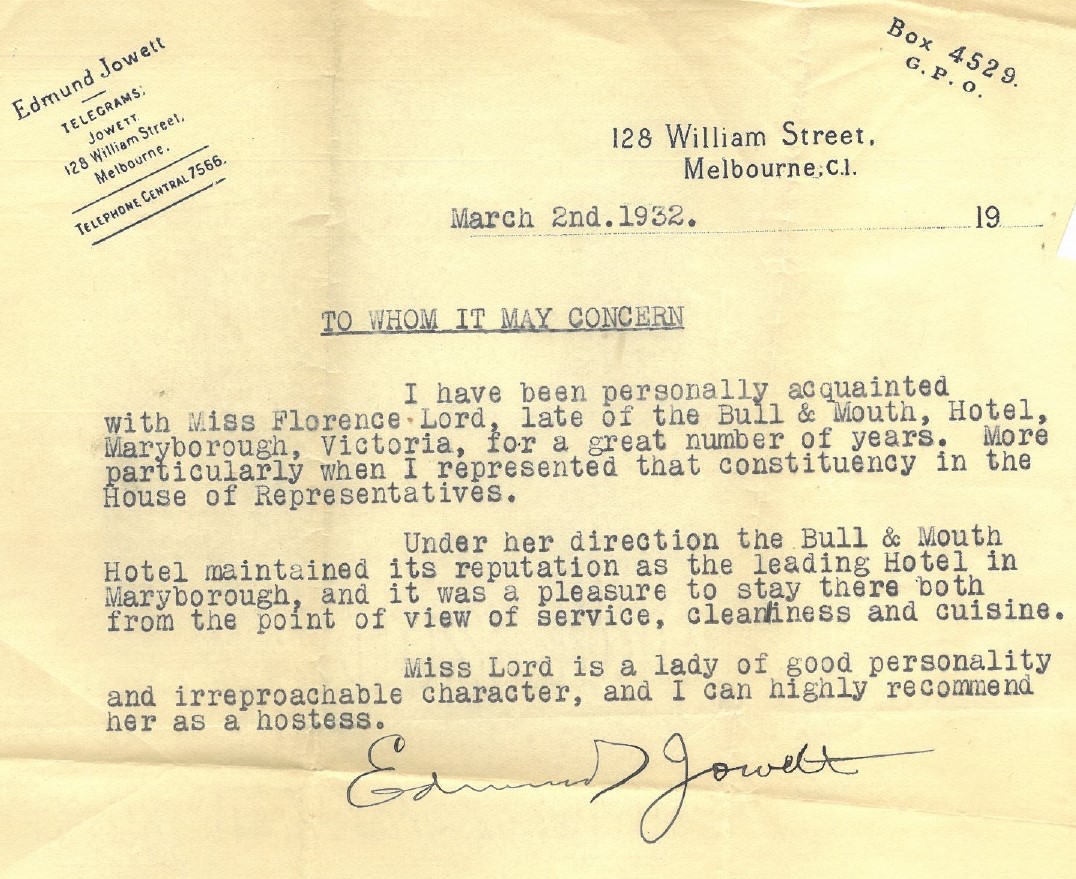
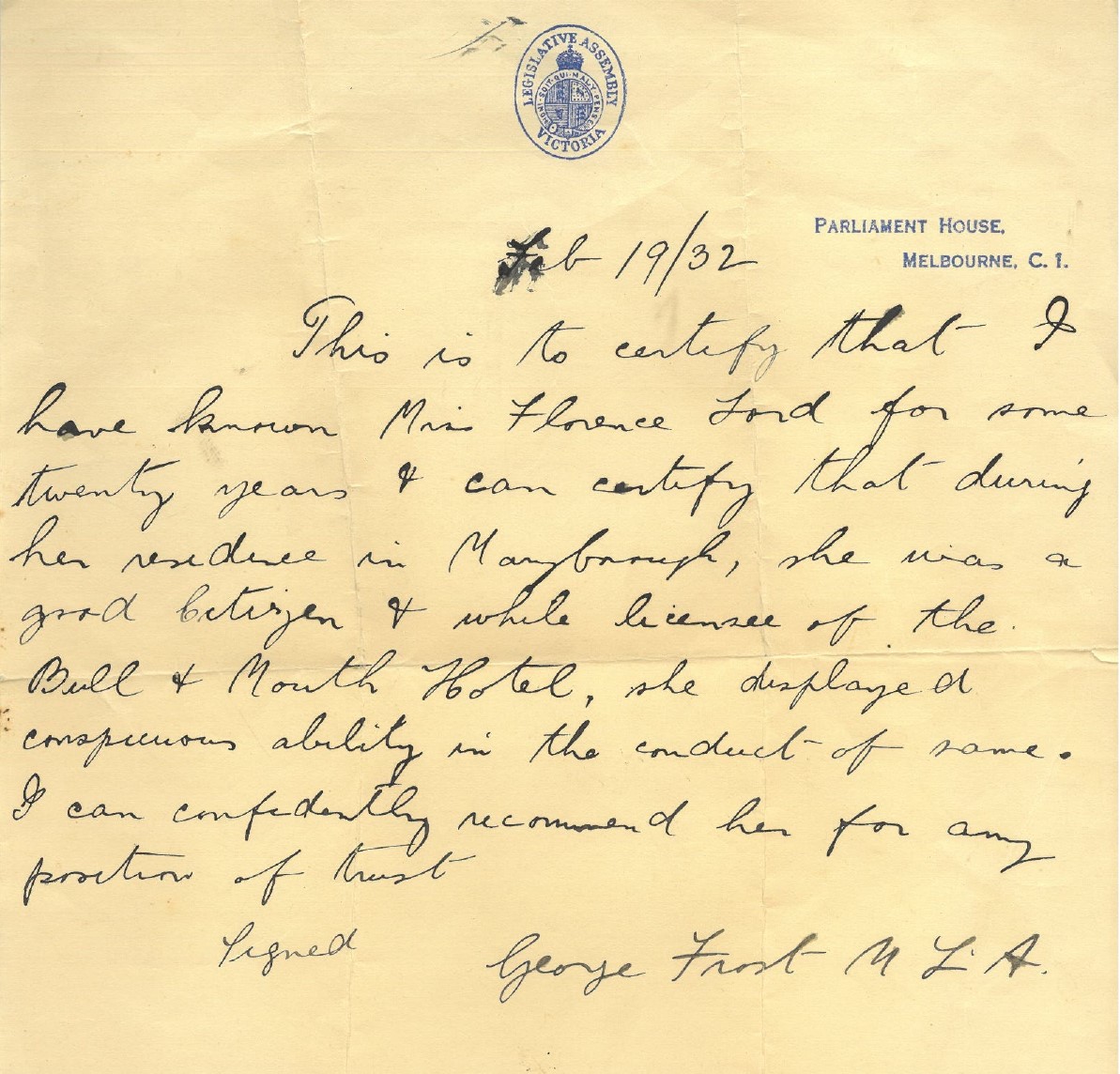
Recently, I donated these documents to the Library for safekeeping. Once they are processed, they will be housed in our Manuscripts collection, where future generations will be able to find them.
Perhaps your family archive holds documents you’d like to offer to the collection too.
Through newspaper notices and Victorian electoral rolls, I find that Florence continued to work at the Bull and Mouth Hotel until 1923, when she transferred her interest in the hotel to another female publican: Alice Capdedo.

However, the transaction did not go smoothly. Owner Thomas Proctor was unhappy that Florence had not consulted him about the transfer, asserting that he was not going to be treated ‘like a figure-head for any old ship’ 9 and demanding she pay him 105 pounds.
Florence had little choice except to give him the money, but she later sued him for its return, arguing that he was not entitled to charge her for his consent. Ultimately, she lost the case, with the judge ruling that Proctor had rights which he could sell, and therefore the £105 which was paid could not be recovered.
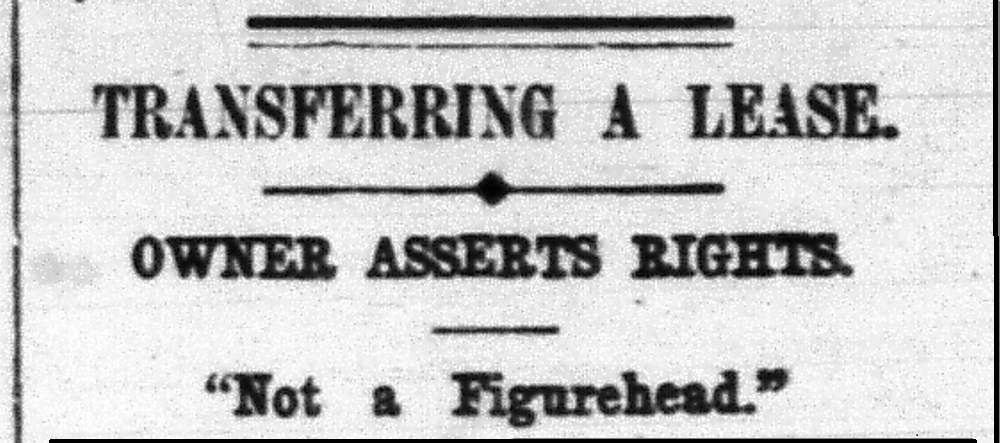
The case was widely reported in the newspapers. To my surprise, it even managed to set a legal precedent (although not in Florence’s favour), which meant I was able to find a law report in the AustLii database. 10
After her years in Maryborough, Florence worked as a publican in numerous other hotels around Victoria, including the Kensington Hotel in North Melbourne and the Commercial Hotel in Murtoa. The latter appears to have been a disaster, with Florence and her business partner, an 80-year-old retired boilermaker, eventually being declared bankrupt on account of Florence failing to keep any books.
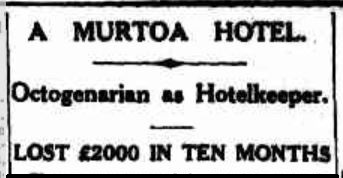
It seems that Florrie did not learn her lesson, as the following year, she was in court again, this time for failing to keep the books for an apartment house she was managing in Flinders Street.11
Reading all this made me wonder about what kind of education Florrie had received, and how much she’d simply ‘learnt on the job’. But this is a research task for another day.
According to the electoral rolls, Florence spent most of her remaining years as a hotelkeeper — returning to live in her beloved Maryborough — before finally passing away at age 92.
Postscript
In the course of researching my great great aunt Florence, I have examined public notices and historical newspaper articles in Trove, legislation and court cases in the AustLii database, building records in the Victorian Heritage Database, Victorian electoral rolls, pictures and a historical plan from the Library’s Maps collection.
You can find information about how to find these resources, and many more, in our research guide on Pubs and Publicans.
Further reading
Kirkby, D et al (2010) The Australian pub, UNSW Press, Sydney.
Wright, C (2014) Beyond the ladies lounge: Australia’s female publicans, Text publishing, Melbourne.
References
- Wright, C (2003) Beyond the ladies lounge: Australia’s female publicans, Melbourne: Text Publishing Company, p 5.
- See sections 89 and 109.
- Heritage Victoria, ‘Bull and Mouth Hotel’, Victorian Heritage Database, accessed 19 May 2025.
- ‘Fires’, The Age, 10 October 1904, p 6.
- Heritage Victoria, ‘Bull and Mouth Hotel’, Victorian Heritage Database, accessed 19 May 2025.
- Harden, M (2010) ‘Unique and Deplorable: Regulating Drinking in Victoria’, Meanjin, vol 69, no 3.
- Wright, C (2003) Beyond the ladies lounge: Australia’s female publicans, Melbourne: Text Publishing Company, p 23.
- As above.
- ‘Transferring a lease. Owner asserts rights, “Not a figurehead”’, The Argus, 1 September 1923, p 29.
- Many people are surprised to learn that official summaries of court cases (ie law reports) and judicial decisions (unreported judgments) can usually only be found for cases heard in the Supreme Court and higher, or cases heard at VCAT, and that set a precedent (change the way the law is interpreted or applied), and where a decision was made by a judge (not by a jury). See our research guide: Court Cases in Australia for more information.
- ‘No books kept. Source of insolvency troubles’, The Argus, 21 November 1924, p 9.


Very interesting. I assume the Maryborough hotel is no longer there. A lack of literacy or numeracy could well be the reason she didn’t keep books.
Hi Andrew, thanks for your interest. The hotel is still there – I’m hoping to visit it some time soon. Sarah
A pleasurable read, thank you, but you didn’t answer your own question: how many other women ran hotels in the 1920s? In the further reading perhaps?
Hi Brett, thanks for your interest. The answer is in the second paragraph: ‘a great many’. Sarah
Loved this piece!
Great article!
I can recommend the Bull & Mouth at Maryborough, Victoria. It has been beautifully refurbished and the “Cuisine” excellant. It is a regular lunch/dinner spot for us when visiting my daughter, the local Vet.
In researching family trees I have come across quite a few female Publicans. The most interesting is a lady from Amsterdam 1826 who had a pub/beer house which stillstands today. On coming to Australia she followed her trade and had public houses in Nth Central Victoria.
Thank you Sarah for your interesting article.
Nice to read another informative story. I would support Andrew C’s comment regarding literacy or numeracy. Girls were often taken out of school as soon as practicable before the law indicated pupils had to stay at school till a certain age. They may have basic levels, but more detailed work might have been challenging for them. One just doesn’t know. We have to sometimes guess what has happened. Glad to see the archive is going into the collection.