
In the early hours of the morning of 24 January 1895, the crew of the appropriately named ship Antarctic, in the midst of a monumentally unsuccessful whaling expedition deep within the Antarctic circle, found themselves in calm weather close to Cape Adare, at the edge of the Ross Sea. A group of men from the ship launched a whaling boat and rowed to shore. It seemed a forgettable achievement in the midst of a fractious, failed commercial voyage.
Expedition manager Henrik Bull had drolly commented that the sensation of the Antarctic landing could happily be exchanged for a Right Whale of any dimension. However this brief sojourn on a rocky Antarctic beach could be seen as the beginning of the famous “Heroic Age” of Antarctic continental exploration, and it had a particular relevance to Melbourne.1
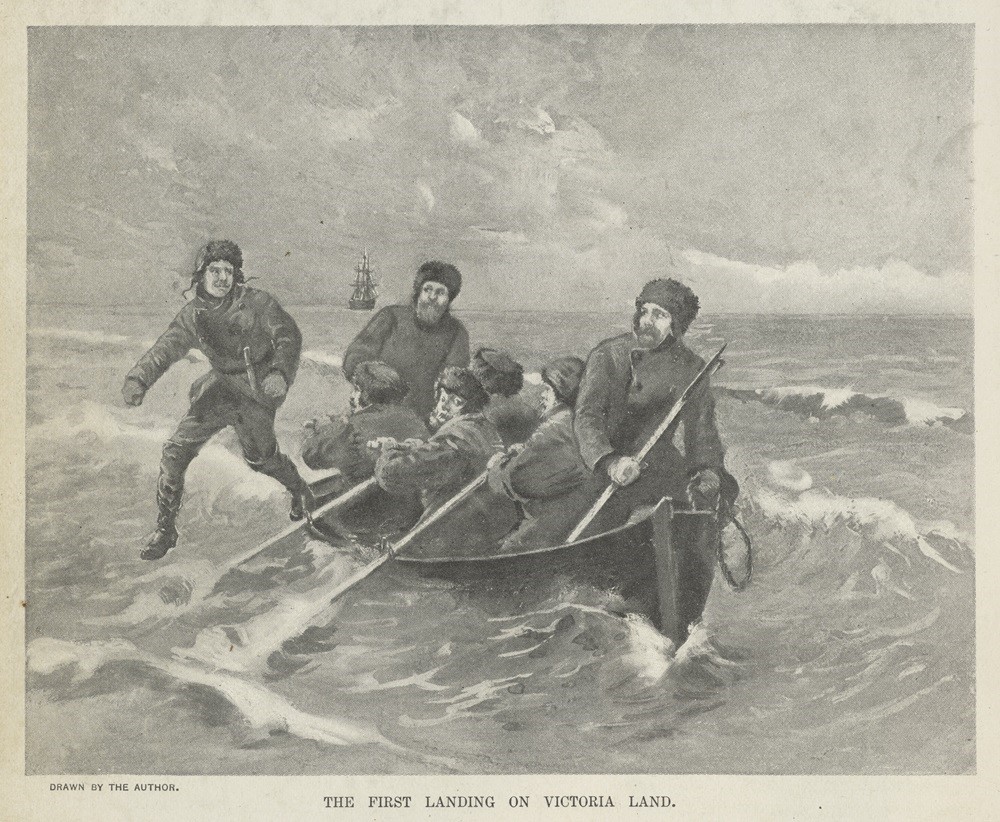
‘First landing on Victoria Land’, Century Illustrated Magazine, (1896) vol 51, issue 3, p 446. Illustration by Carsten Borchgrevink.
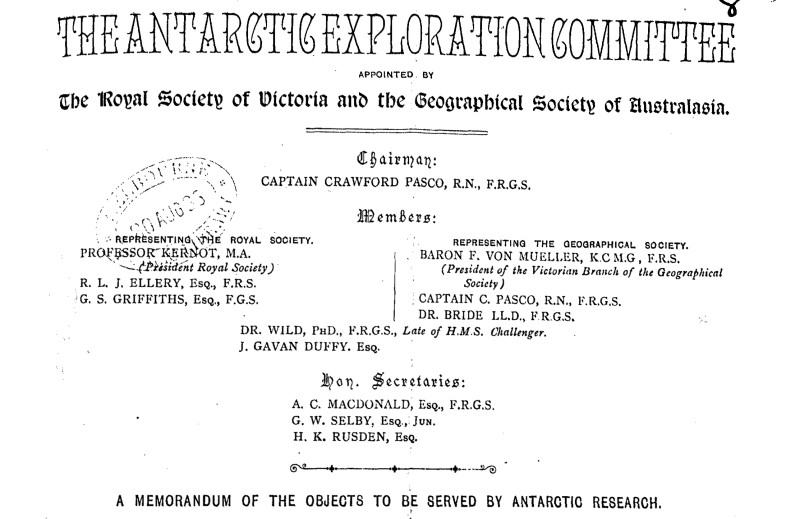
The expedition had left Melbourne late September 1894 with enthusiastic good wishes from Victoria’s Royal Society and Royal Historical Society, who, a decade before had formed a joint Antarctic Exploration Committee in an attempt to revive the exploration of the Antarctic.
Interest in the Antarctic had languished since the great British scientific expedition under Arctic veteran James Clark Ross. His famous ships Terror and Erebus had sailed as far south as was possible in a series of voyages from Hobart in 1841 and 1842
But then the powerful nations turned away. Wars, disasters and political upheaval all played their part and while little was known of the southern continent, what was known suggested there was little economic or strategic potential, and great danger to ships and crews.
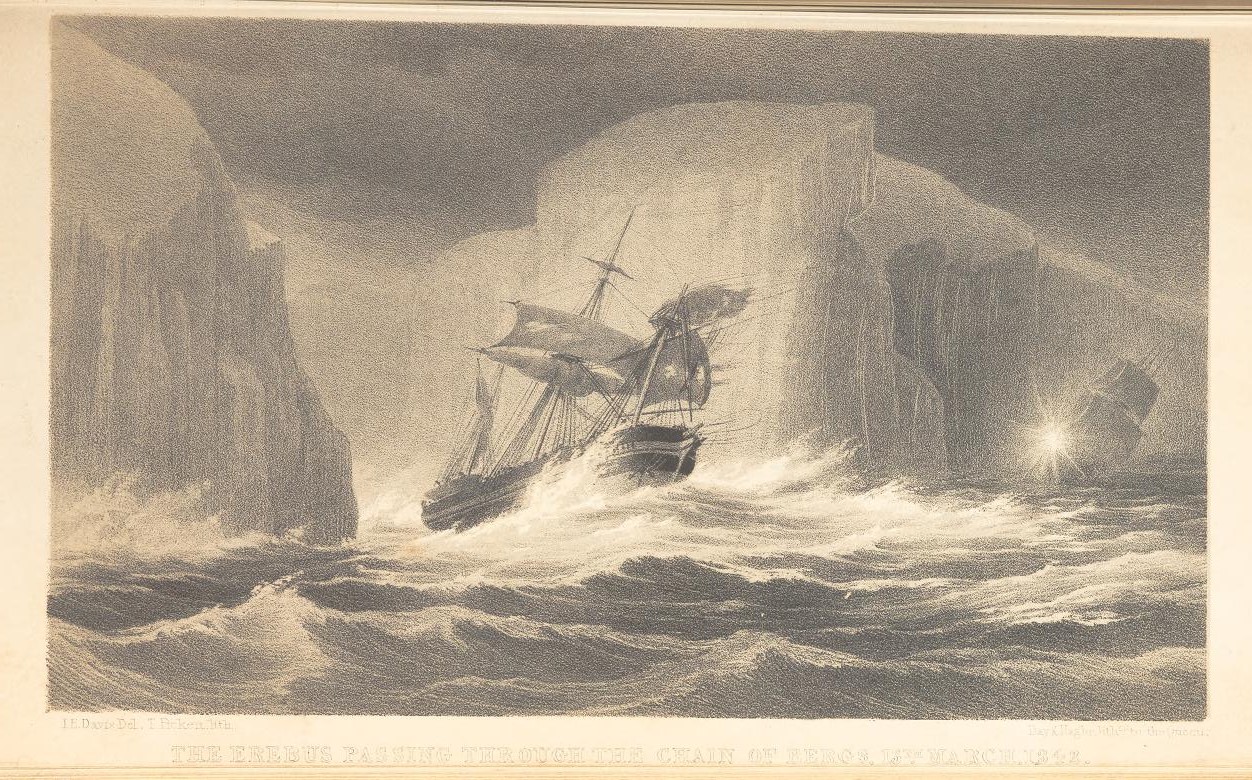
The Erebus passing through the chain of icebergs, from JC Ross (1847) A voyage of discovery and research in the Southern and Antarctic regions during the years 1839-43, opposite p 220.
In 1886 Norwegian Henrik Bull, having frittered away his business earnings and much of his wife’s inheritance, arrived in Melbourne determined to create a whaling company and restore the family fortunes.2
He hoped to partner with the Antarctic Exploration Committee in a joint whaling and scientific expedition.
Despite several promising opportunities the Antarctic Exploration Committee were never able to raise enough money to sponsor an expedition and when the colonial economy collapsed in 1892, Henrik Bull successfully sought funding in his native Norway
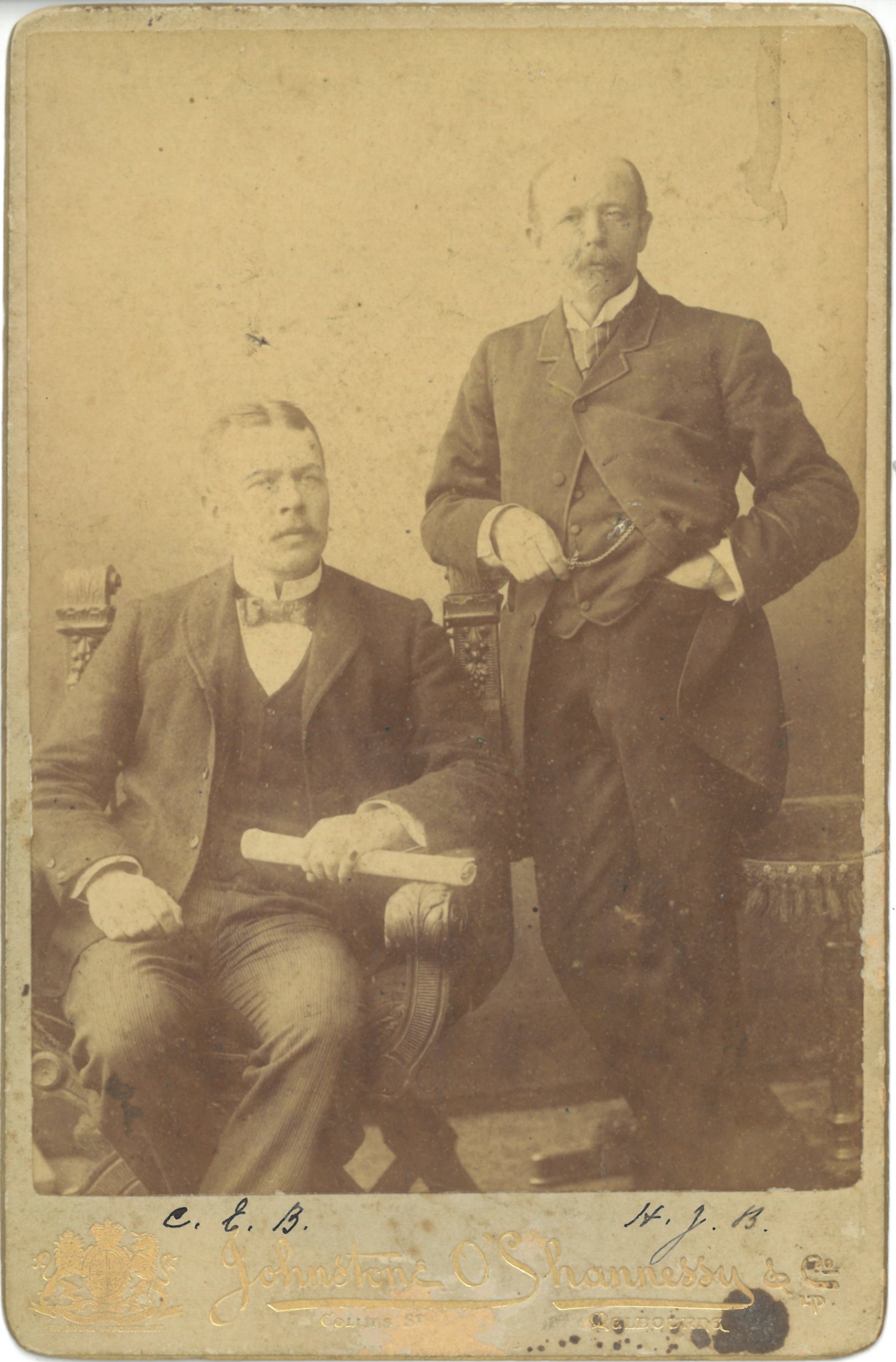
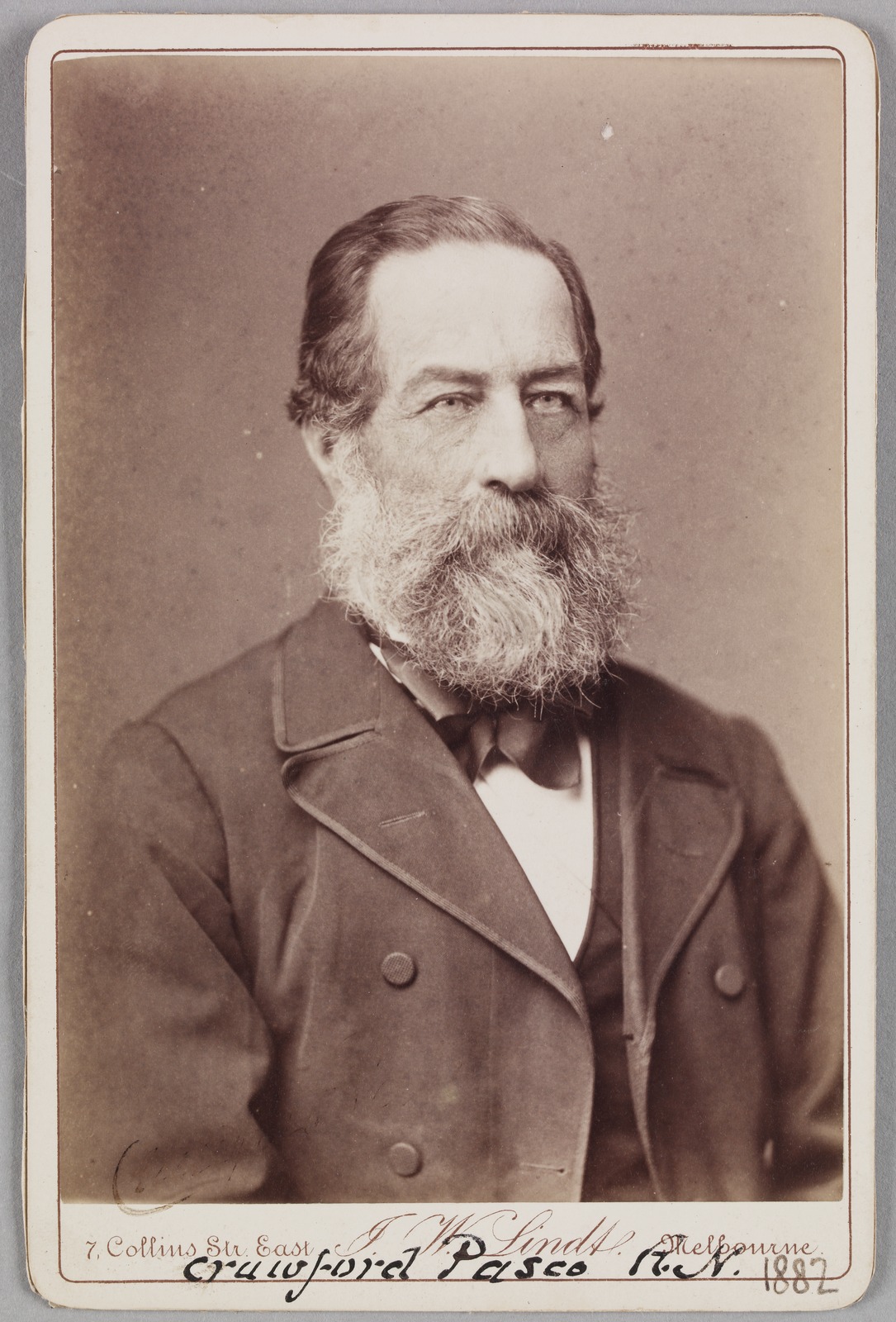
At left: Carsten Borchgrevink (sitting) Henrik Bull (standing; image courtesy of Warnambool Library). At right: Lindt, J. W. (1882) Crawford Pasco RN. [President of the Antarctic Exploration Committee] H12989
When Bull arrived back in Melbourne in February 1894 he offered to incorporate a scientific element to his Antarctic voyage, suggesting two Melbourne scientists might care to join the expedition. The local scientists took a look at the rough little whaler and the rougher looking crew and decided they wouldn’t join. This opened the way for another Norwegian resident in Australia, Carsten Borchgrevink.
Borchgrevink was an utterly obscure character. He had done some work in outback Queensland and some teaching in northern NSW. When he heard of the proposed expedition he raced to Melbourne and was allowed to join the ship as a general useful hand, able to collect scientific data when time allowed. 3
Henrik Bull’s commercial plan seemed sound, only the whales were missing. While James Clark Ross had reported vast numbers of whales in Antarctic waters, 50 years of relentless whaling later, numbers migrating to the Southern Ocean were drastically reduced.
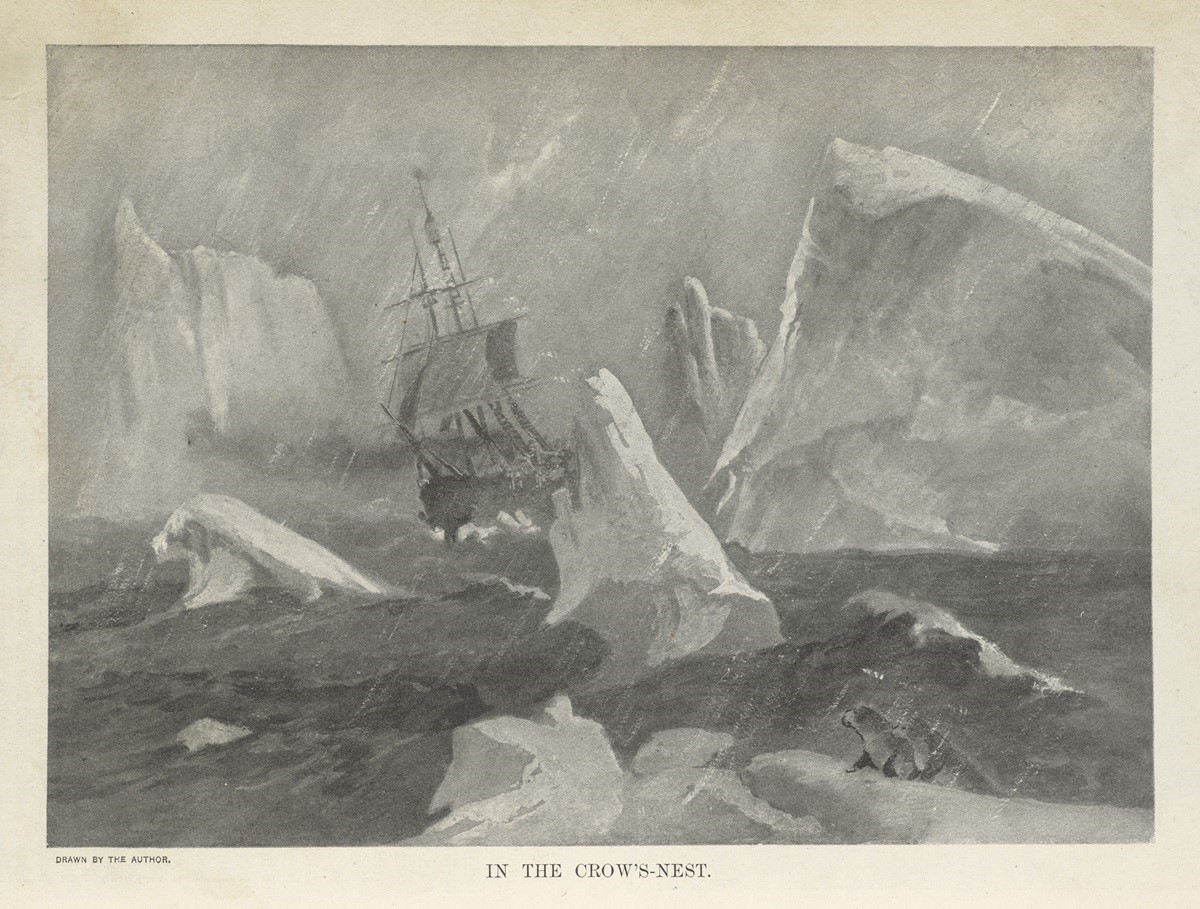
Borchgrevink, Carsten (1896)’In the Crows nest’, Century Illustrated Magazine, vol 51, issue 3, p 442.
The voyage proved to be an unhappy one. Gregarious, opinionated manager Henrik Bull and dour ship’s Captain Leonid Kristensen didn’t get on, and the crew, usually paid a percentage of profits, endured brutal conditions on an expedition that yielded no profits, only financial loss.
It was a desultory group that sailed back to Melbourne, but to their surprise the commercial failure of the voyage was completely overshadowed by their brief visit to the rocky beach at Cape Adare. This, at the time, was considered the first landing on the Antarctic continent and Bull, Kristensen and Borchgrevink were greeted with great excitement.4 Receptions were held, speeches given, news articles written. Professor Kernot, president of the Royal Society of Victoria, introduced them as the Columbuses of the south.5
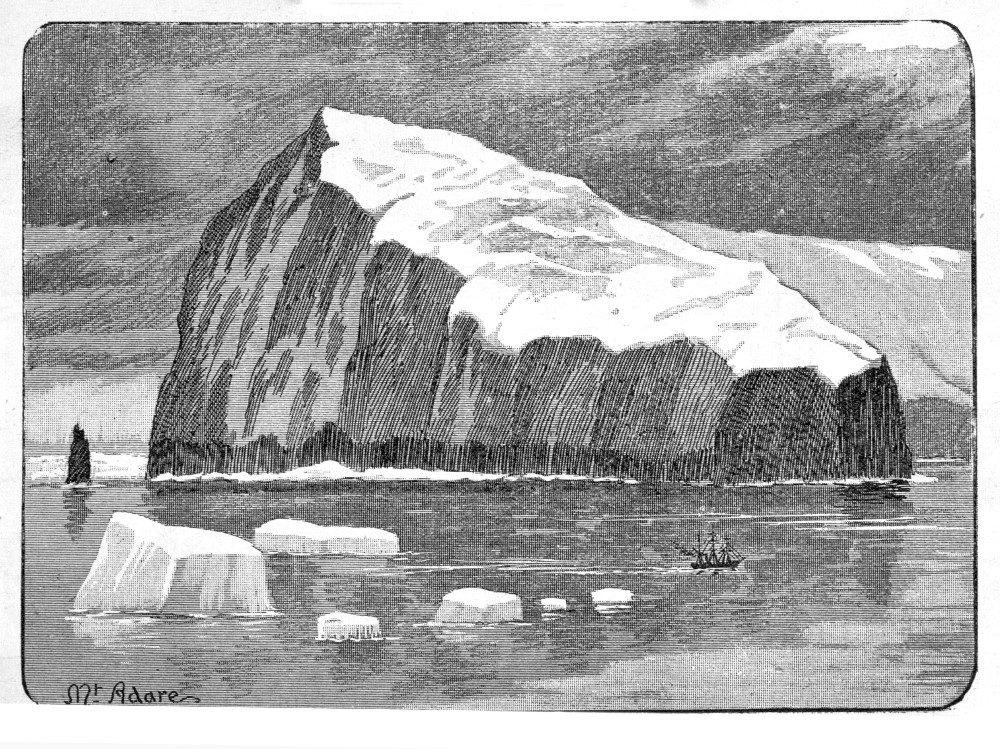
Borchgrevink, Carsten (1 April 1895, p 22) ‘Mt Adare’, The illustrated Australian news, IAN01/04/95/22
As it happened the International Geographical Congress was being held in London, running for a week from 26 July, 1895. This was a huge event, hosting famous explorers, geographers, historians and academics from around the world. Carsten Borchgrevink sensed an opportunity and took a ship to England.
Arriving after the Congress commenced, Borchgrevink insisted on delivering a paper. His was a modest presentation, outlining his own observations. Fashioning himself as the first man to set foot on the Antarctic continent, his appearance was a sensation. The world’s most eminent explorers and scientists queued up to shake his hand. 6
The 1895 International Geographical Congress was a catalyst for Europe to turn back to the Antarctic with British, German and Swedish expeditions planned for the start of the new century. Quite remarkably, Carsten Borchgrevink was able to convince wealthy English publisher George Newnes to give him the princely sum of £38,000 to lead his own expedition. This expedition was the first to overwinter on the Antarctic Continent.
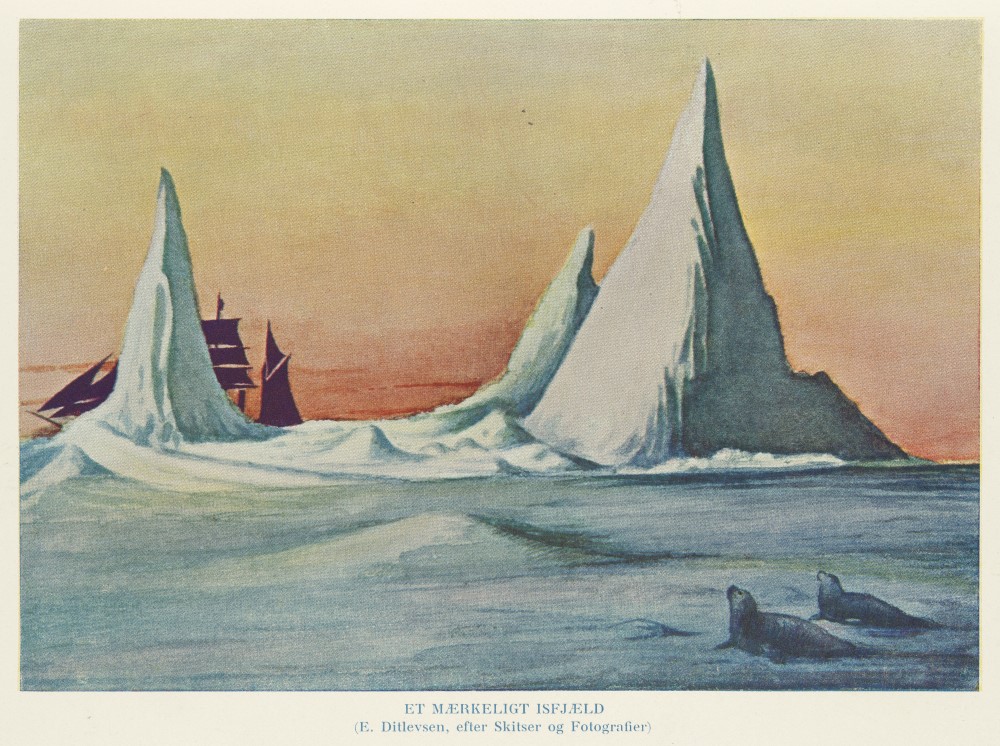
Borchgrevink, CE (1905) Nærmest Sydpolen aaret 1900 København, opposite p 82.
His British Antarctic Expedition sailed from Hobart in December 1898 and, after a difficult passage through the ice, landed on the Antarctic Continent in mid-February 1899 and set up their camp, farewelling their ship, the Southern Cross which would not return to collect them until late January 1900.7
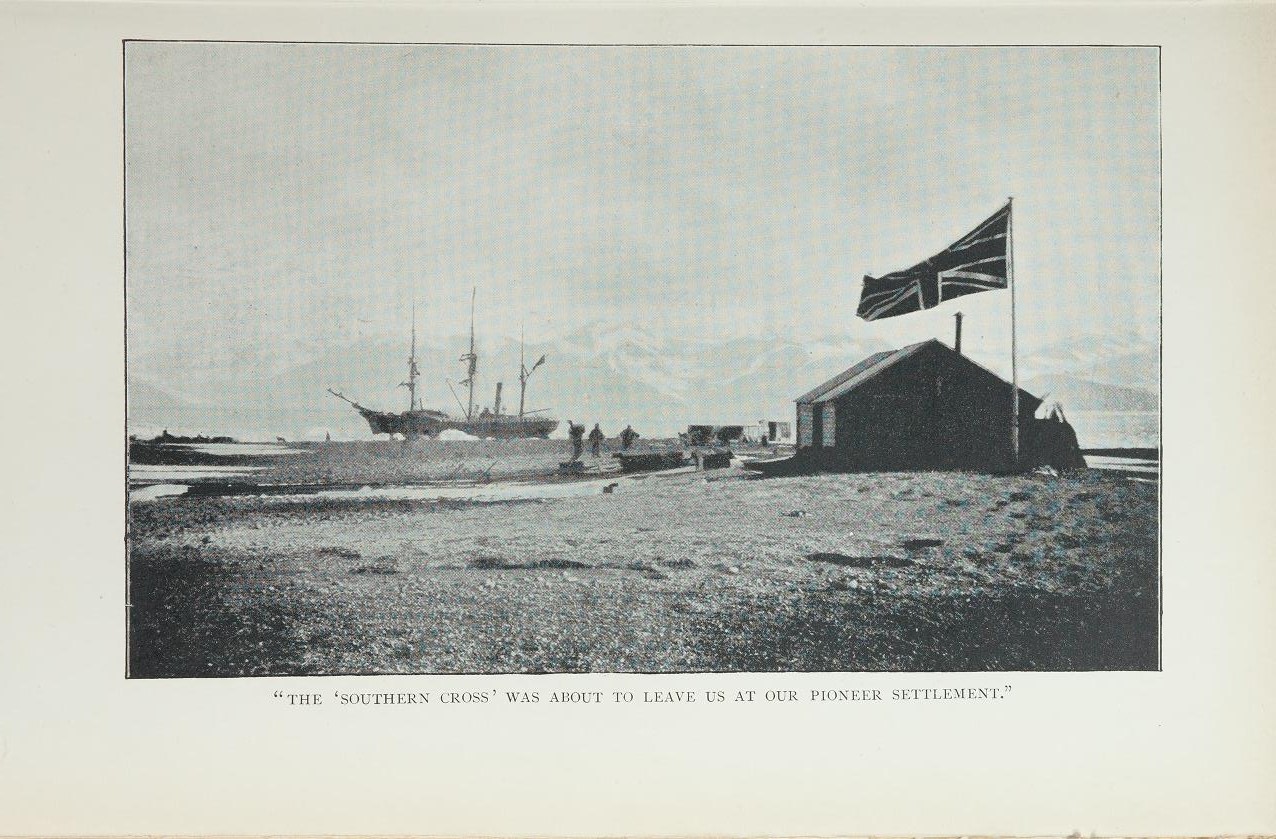
Borchgrevink, CE (1901) First on the Antarctic continent : being an account of the British Antarctic expedition, 1898-1900, p 87
While funded from England, it was predominantly a Norwegian expedition. 7 of the 10 man party were Norwegian, two English and one, Louis Bernacchi, was Australian.
Successful as a scientific expedition, exploration was thwarted by cliffs and mountains. Borchgrevink had enormous drive and organising this great geographical first was a logistical triumph. He was, though, a poor leader of men.
This most challenging environment, cut off from the world, enduring months of darkness with a random group of men, would test the best leader. Borchgrevink was far from that. He was quick to take credit, loathe to give it. Sensitive to his own feelings but insensitive to others; jealous that his scientific knowledge was greatly outshone by the scientists in his team. 8
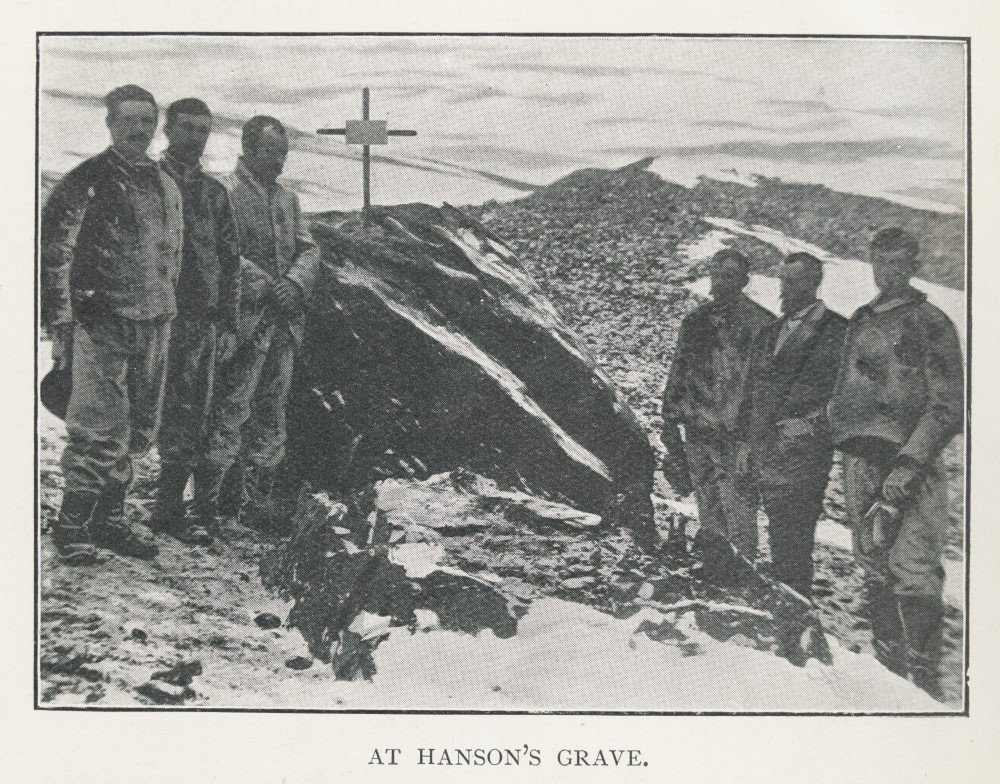
Perhaps the loneliest grave in the world. Nicolai Hanson, the popular and talented young zoologist, became ill and died during the expedition. His was the first grave on the Antarctic continent. Borchgrevink, CE (1901) First on the Antarctic continent : being an account of the British Antarctic expedition, 1898-1900 , p 192.
The group emerged from the ice a year later, but when Borchgrevink arrived in London, his reception was muted. Borchgrevink was a difficult personality and the English, annoyed at the money Borchgrevink had raised under their noses, were deep in preparations for their own Antarctic expedition.
Meanwhile Henrik Bull, despite subsequent shipwreck and failure, could never shake the thrall of the frozen south.9.
Names such as Mawson, Shackleton, Scott and Amundsen dominate Antarctic history obscuring much of what came before. While Henrik Bull’s expedition 130 years ago is often just a footnote in Antarctic history, it was the first return to the Ross Sea since James Clark Ross in 1842 and the landing at Cape Adare led directly to Borchgrevink’s expedition, opening the so-called Heroic Age of the terrestrial exploration of the Antarctic.
Further Reading
- Bernacchi LC (1991) To the South Polar regions : expedition of 1898-1900, Bluntisham, Denton, England.
- Borchgrevink, CE (1901) First on the Antarctic continent : being an account of the British Antarctic Expedition, 1898-1900, G Newnes, Ltd, London.
- Bull HJ (1896) The cruise of the Antarctic to the South Polar regions, Edward Arnold, London.
- Crawford J & Bernacchi LC (1998) That first Antarctic winter : the story of the Southern Cross Expedition of 1898-1900 / as told in the diaries of Louis Charles Bernacchi ; written and edited by Janet Crawford, South Latitude Research in association with Peter J. Skellerup, Christchurch, NZ.
- McConville A (2022) In search of the last continent : Australia and early Antarctic exploration, Australian Scholarly, Melbourne, Victoria.
Footnotes
- Bull HJ (1896) The cruise of the Antarctic to the South Polar regions, Edward Arnold, London, p 181
- Harboe-Ree, Anders. (1995). The diary of Anders Harboe-Ree extracts translated and edited by Eva and Cathrine Harboe-Ree (includes letter from Henrik Bull). Republica, 2, p.11
- Swan RA ‘Carsten Egeberg Borchgrevink (1864–1934)‘ (2006), Australian Dictionary of Biography website, accessed 1 June 2025.
- It is likely a landing on the Antarctic Peninsula was made in 1821, but unknown until the 1950s see Stackpole EA (1955) The voyage of the Huron and the Huntress : the American sealers and the discovery of the continent of Antarctica, Marine Historical Association, Mystic, Conn, p 51.
- Royal Geographical Society of Australasia (Victoria). [RGSA. Vic] 1883– 1913. Minutes . Melbourne: Royal Historical Society of Victoria MS 000688 (1886– 1913)
- Report of the sixth International Geographical Congress, held in London, 1895 (1896), John Murray, London, pp 169-176.
- Report of the sixth International Geographical Congress, held in London1895. Edited by the Secretaries (1896), John Murray, London.
- Crawford J & Bernacchi LC (1998) That first Antarctic winter : the story of the Southern Cross Expedition of 1898-1900 / as told in the diaries of Louis Charles Bernacchi , South Latitude Research in association with P J Skellerup, Christchurch, NZ.
- In 1903 Henrik Bull became a citizen of the new Commonwealth of Australia. After that he mainly resided in Norway, so it is likely his citizenship was primarily to facilitate his Antarctic ambitions as an Australian (and therefore British) citizen


What a great post Andrew – we’re convening Kids’ Conference Antarctica at the Royal Society next week as part of National Science Week. Students will be presenting their projects with a focus on Antarctica and our guest speaker will join other researchers to talk about his recent visit to Antarctica to look at restoration of the original huts and some of the artefacts left behind by different groups. We’ll pass this post on to the teachers involved as I’m sure it will make great teaching material to.
Thanks Megan, the Kids’ Conference Antarctica at RSV sounds great
Great post Andrew. I’ve stood on the narrow spit of beach and land at Cape Adair, amazed at the bravery of the explorers and scientists. The main hut of the first overwintering group is still solid and usable as the builders had polar expertise and experience. Behind it are the ruins of the 10-year-old younger hut erected by Scott’s men with no real polar expertise.
Bernachi went on at least one more expedition, and his story is interesting in itself..I am looking forward to the next post!
Wow Keith, that’s so great that you have been to Cape Adare! Yes after Borchgrevink’s expedition Louis Bernacchi signed up for Scott’s first expedition so by 1904 he had spent more time on the Antarctic continent than any other human being in history! He took many wonderful photos of that first overwintering that appear in both his and Borchgrevink’s books. They can be viewed online at the internet Archive https://archive.org/details/FirstonAntarcti00Borc
https://archive.org/details/tosouthpolarregi00bern/page/n7/mode/1up
Thanks, Andrew, great suggestions. The Japanese expedition journal has been re-translated. The prior was effectively rewritten to match the English writing of the time, which was very disappointing and bland, as the original described things with vivid imagery, such as flowers. The new translation has been translated as it was. I gave my copy to an older Macquarie Island expeditioner, so I will have to wait until I can borrow it back or find a site that sells it. I am very interested in cultural focus and different approaches.
Andrew that was a fascinating article and only confirms my opinion that Melbourne has such a powerful Antarctic legacy which is rarely acknowledged at home or overseas. I would love to catch up with you again for another meal, and in January I am going to the Ross Sea and Ross Ice Shelf plus Cape Adare, Mt Erebus and the 3 oldest huts. There are still a couple of spare cabins if you want to join me.
Hi Tony, Great to hear from you, your next Antarctic trip sounds amazing. I’ll send you an email. Cheers Andrew
Fascinating article. It solved one mystery for me, – last week I went to see the Lake Augusta dam in Tasmanian highlands, my father worked on it as his first job after migrating to Australia. Later an Antarctic training centre was built there and the locality was called Bernacchi as I found on a local map. As I just found out, highly appropriate!