
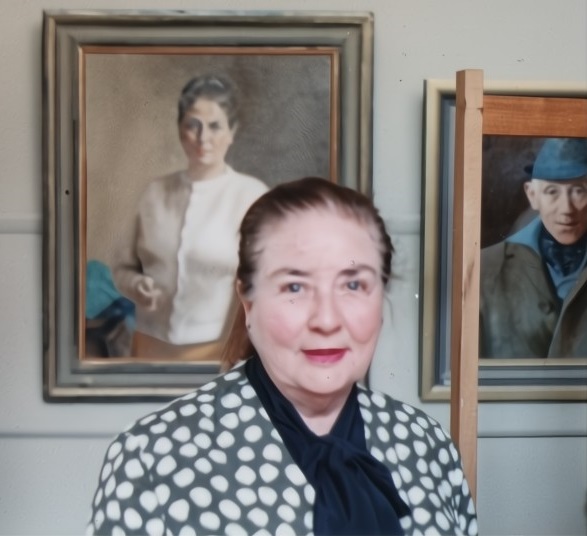
Joyce McGrath — who died on 13 September, one month short of her 100th birthday — was a determined, visionary figure who developed the State Library’s Art, Music and Performing Arts Library (AMPA) into ‘a circle of sunlight’, as her biographer, Jan Harper, wrote. 1
‘In its field, the State Library’s fine arts collection is unrivalled by any other in the State’, the Library’s 1966 annual report noted, 2 although a dramatic blossoming was still to come. This was largely the result of Joyce’s extensive 1968 tour of art and music libraries in Europe, the United Kingdom and North America, enabled by a Churchill Fellowship. Joyce’s detailed report to the Winston Churchill Memorial Trust gives much insight into what she then set out to achieve at the State Library. 3
The American Archive of Art in Detroit may well have provided a light-bulb moment, inspiring an Australian equivalent. It was Joyce who established the State Library’s Australian Art Archives (AAA) collection, with thousands of files on Australian artists, art societies and galleries. This provided a much-needed tool for all art researchers, and it was this ‘service to the collection and preservation of historical documentation relating to art and music, particularly through the establishment of the Australian Art Archives’ that earned Joyce the Medal of the Order of Australia. 4 She also received the inaugural Distinguished Service Award of the Arts Libraries Society of Australia and New Zealand. 5
Joyce was forever collecting material. When overseas, she sought out Australian artists and musicians; she interviewed them and obtained from them exhibition catalogues and whatever else they cared to give. The Library’s 1969 annual report mentions ‘over 2,500 exhibition catalogues from collector Peter Cochrane of Tooth’s Gallery in London, and manuscripts, paintings, drawings and other documentation relating to the career of Australian artist, Percy Leason, from Mrs Isabel Leason of New York.’6
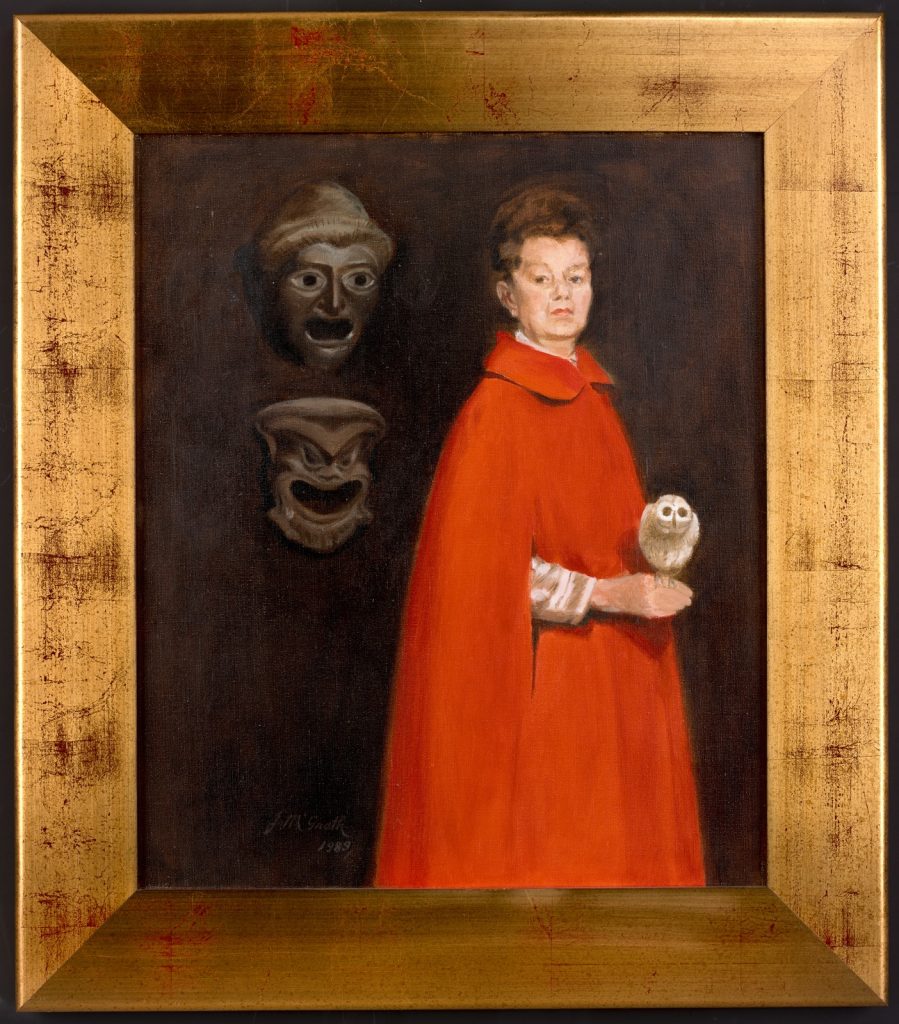
It also mentions priceless gifts from the composer Peggy Glanville-Hicks, who at that time was in Athens. 7 Joyce and Peggy Glanville-Hicks, or PGH, as she would announce herself whenever she telephoned the State Library, became firm friends. Joyce’s striking portrait of Peggy (above), held by the State Library and reproduced in an array of publications, 8 remains a treasure.
A determined, engaged librarian, Joyce was also an accomplished artist, trained by Archie and Amalie Colquhoun. Her portrait of the Dominican friar, Peter Knowles, Master of Mannix College at Monash University from 1981 to 1990, 9 was awarded an Alice Bale Art Award for oil painting in 1990, ‘the year in which she became a professional artist.’ 10 In that year she also became a committee member of the Victorian Artists’ Society. 11
Her life was extraordinary, filled with one obstacle after another; yet, when speaking in 2013 with the authors of a book consisting of 100 World War I stories, Joyce stated that she had lived ‘a fortunate life’. 12 In the chapter, ‘A very different childhood’, Joyce is described as the daughter of John (Jack) McGrath, a young farmer from Poowong, who had enlisted in June 1915 and was in Gallipoli by October.
There he succumbed to a host of ailments, including pneumonia, pleurisy and malaria, and was sent home in January 1917 (tuberculosis was diagnosed in 1918). 13 Jack married Nellie Watson, from nearby Glen Forbes, and they became soldier settlers in Red Cliffs on the Murray, 14 where Joyce was born on 19 October 1925.
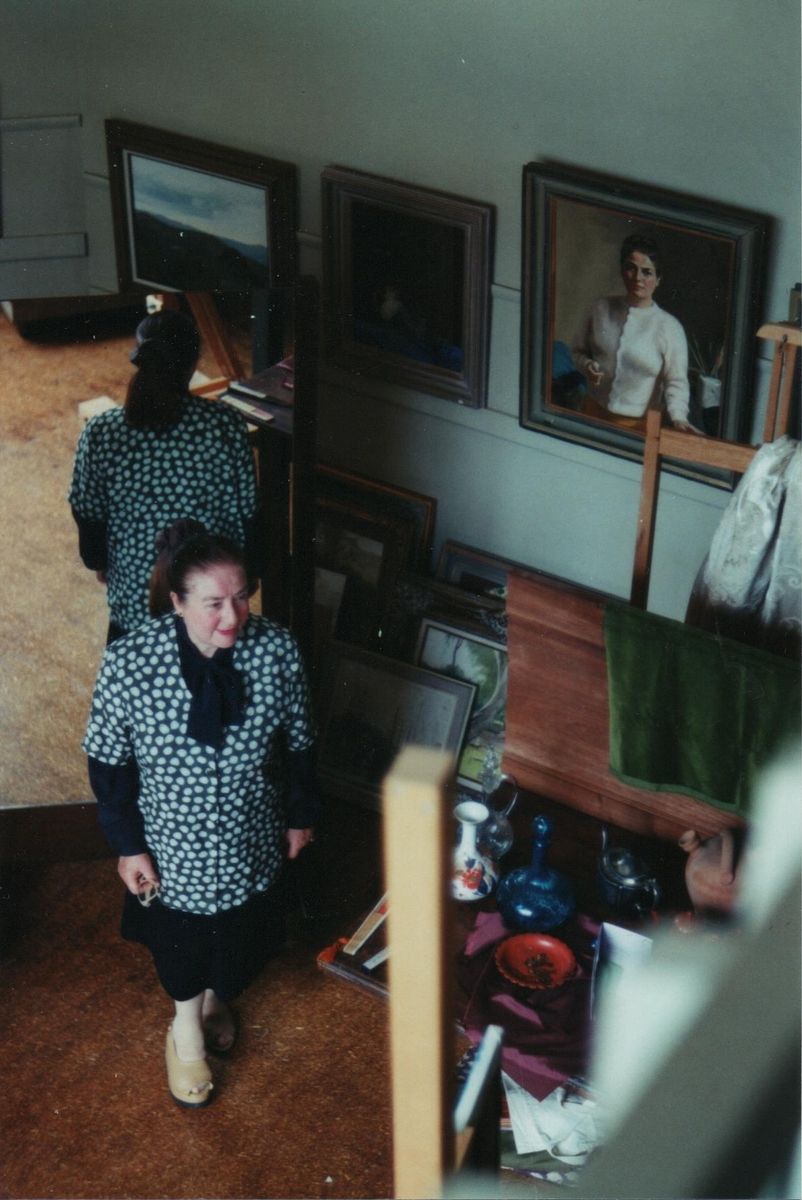
Tragically, at the age of 4, Joyce succumbed to a tuberculous disease of the hip and was hospitalised until the age of 9. 15 She saw her father only one more time before his death in June 1933, and yet, in 2013, insisted she ‘had always sensed that Jack was looking after her’. 16
Joyce emerged from hospital – ‘after five years in plaster lying on her back’ – with her right leg 1.5 inches shorter than her left leg. Joyce ‘was permanently disabled’, 17 but did not let this get in her way.
Her pathway to the State Library included time in the Commonwealth Public Service, where she worked with writers such as Leonard Mann, Frank Dalby Davison, Vance Palmer and Flora Eldershaw; there were also two years in the United Kingdom and Europe, ‘hitchhiking and painting’, before she arrived at the State Library in 1952 as ‘a cadet attendant’. 18 Ten years later, the State Library’s art collection was in her hands and developed into, as Jan Harper noted, ‘a first-rate reference facility recognised worldwide’. 19
Joyce retired in October 1990, in the week of her 65th birthday. Those of us who worked in Joyce’s Arts Library remember it and Joyce with much fondness. We remember also astonishing acts of generosity, such as the 30 artworks she bequeathed to the Mildura Art Centre; paintings by Max Meldrum, Archie and Amelia Colquhoun, Shirley Bourne, Rex Branleigh, and many more: ‘paintings with huge cultural significance’, the Sunraysia Daily reported. In Mildura, Joyce (born in nearby Red Cliffs) was adopted as one of their own, with the paper proclaiming she was ‘Mildura-born’. 20
Joyce remained a part of our lives. May her vision now live on, even in those who did not know her. It was real and it was profound.
References
- Harper, J (2007), Plaster and Paint: John Colquhoun, Orthopaedic Surgeon and his Patient, Joyce McGrath, Portrait Painter, Arcadia, North Melbourne, p 304.
- Library Council of Victoria (1966), Annual Report: Year ended June 30, 1966, p 3.
- McGrath, J (1968), ‘Report on a Tour of Art and Music Libraries in Europe, United Kingdom and North America, 31st January to 28th October 1968: Presented to the Winston Churchill Memorial Trust’.
- ‘Australia Day Honours’ (26 January 2002), Age, p 3.
- Harper, J (2007), Plaster and Paint: John Colquhoun, Orthopaedic Surgeon and his Patient, Joyce McGrath, Portrait Painter, Arcadia, North Melbourne, pp 305-6.
- Library Council of Victoria (1969), Annual Report: Year ended June 30, 1969, p 8.
- As above.
- See McGrath, J (1998), A Survey Exhibition, 1949-1997: Victorian Artists Society Galleries, 5-18 March 1998, Linden Press, Melbourne, p 33.
- Monash University Catholic Chaplaincy, ‘History of the Chaplaincy’, https://monashcocweb.wixsite.com/catholicsoncampus/history, accessed 1 October 2025.
- McGrath, J (1998), A Survey Exhibition, 1949-1997: Victorian Artists Society Galleries, 5-18 March 1998, Linden Press, Melbourne, p 4.
- Peers, J (1993), More than Just Gumtrees: A Personal, Social and Artistic History of the Melbourne Society of Women Painters and Sculptors, Melbourne Society of Women Painters and Sculptors in association with Dawn Revival Press, p 244.
- Scates, B, Wheatley, R and James, L (2015), ‘A Very Different Childhood: Joyce McGrath’, in World War One: A History in 100 Stories, Penguin Group (Australia), Melbourne, p 55. (The interview with Joyce was undertaken in October 2013).
- For details of his afflictions, see McGrath, J, 4th L.H. Regiment, ‘Casualty Form – Active Service’, National Archives of Australia (NAA): B2455, MCGRATH J, pp 24-27.
- Wright, K M (1995), A Land fit for Heroes, Ken Mackenzie Wright, Mildura, p 33; and Petschel, H, Cook, C and Cook, M (2022), Red Cliffs Recollections: A Century of Soldier Settlement, 1921-2021, Red Cliffs, Red Cliffs & District Historical Society, p 136.
- Rodda, Christine (2023), ‘Dr Michael Johnson’s “An RCH Orthopaedic Origins Tale: The Machine-Gunner, the Artist, and Seaside Heliotherapy”’, Aluminations, June, pp 4-5
- Scates, Bruce, Wheatley, Rebecca and James, Laura (2015), ‘A Very Different Childhood: Joyce McGrath’, in World War One: A History in 100 Stories, Penguin Group (Australia), Melbourne, p 57
- Yule, P (1999), The Royal Children’s Hospital: A History of Faith, Science and Love, Rushcutters Bay, Halstead Press, p 212.
- McGrath, J (1998), A Survey Exhibition, 1949-1997: Victorian Artists Society Galleries, 5-18 March 1998, Linden Press, Melbourne, p 4; and Marks, R (1990), ‘Joyce McGrath: An Appreciation’, Update: Journal of the State Library of Victoria, November-December, p 3.
- Harper, J (2007), Plaster and Paint: John Colquhoun, Orthopaedic Surgeon and his Patient, Joyce McGrath, Portrait Painter, Arcadia, North Melbourne, p 291.
- Gibney, J (2015), ‘Gallery Tones Up’, Sunraysia Daily, 16 May, p 16. See also Mildura Rural City Council (2015), ‘Much anticipated exhibition opens its doors at MAC’, Media Release, 12 May.


Very nice portrait of an obviously remarkable woman.
A wonderful piece of biographical writing by Walter Struve. He and his subject Joyce McGrath make life as a librarian sound like the best job in the world.
What a wonderful tribute to Joyce McGrath and all she achieved in the Art, Music and Performing Arts Library at the State Library. Her passion and vision were inspirational. Makes me proud to be a librarian.
Joyce McGrath was a wonderful person who taught me how to paste and label the sheets of articles on artists and galleries for the Australian Art and Artists files. I always enjoyed our conversations and she had a wonderful sense of humour. So sad she didn’t get to her 100th! Regardless, she survived a horrendous illness and literally kicked on. Thank you for such a wonderful piece of writing, full of respect and admiration.
Thanks for this piece Walter. You’ve been able to ‘paint a portrait’ of her and her achievements. She was a wonderful human being and you’ve captured that. My fond memories of AMPA library (Art, Music and Performing Arts) will always be attached to Joyce. What a pity it is no longer in the Queens Hall.
I know she used the title ‘A Fortunate Life’ herself but for me it doesn’t seem quite right to describe her life because it somehow suggests an element of luck. What distinguishes her life is the fact that she was able to achieve so much despite what life threw at her. “Grabbing fate by the throat” as Beethoven would say.
She had a fascinating and creative life and I’m honoured to have known her. The last time I saw her was twenty years ago at the opening of my studio/gallery – she was still relatively young then. I remember her telling me how happy she was that I had finally achieved my dream. I’m so thankful that she achieved hers.
Hello Walter
I writing to inform you of a current exhibition Portraits: Past to Present Mildura Arts Centre Collection which opened on the 10 October 2025 and will be on display until 1 February 2026.
The late Joyce McGrath artwork Self Portrait at Kew is part of this exhibition which brings together a rich selection of portraiture from the Mildura Arts Centre Collection, spanning centuries and styles. Portraits: Past to Present explores how artists have captured identity, character, and culture through the human face.
Regards Jillian and the team at MAC
Joyce was born October 1925 in one of Red Cliffs cottage hospitals, the daughter of first settlers, Jack and Nellie McGrath. Red Cliffs was a Soldier Settlement with land cleared from 1920 and planned for irrigated horticulture, mostly vines for dried fruit. Jack’s allocated block, 72A, was part of the site of the temporary vine nursery so he could not take possession until the nursery was no longer needed, then, after planting he had to wait a few years for the vines to bear. In the meantime, he built and ran a successful billiard saloon, the Beehive Billiard Parlor, in the developing soldier settlement town.
Although Joyce’s family were not long residents of Red Cliffs due to her father illness, in that short time they created a sporting contribution to community life.
Jack’s vine property sold in 1931. The family were in Melbourne. Joyce and Jack were hospitalized. Jack died in 1933. The Billiard saloon remained in ownership with Nellie but leased to various managers. After a fire in April 1938 destroyed the building Nellie rebuilt with the help of Red Cliffs friends. Mr McCallum a surveyor with the State Rivers & Water Supply sought the expert advice of Walter Lindrum in the building and refurbishment. Nellie and Joyce stayed with the McCallum’s until the build was complete. On completion it was the finest world class standard billiard room in Australia. Walter was pleased to lease it as the Walter Lindrum Recreation Parlors. The opening, September 1938, included exhibition play by Lindrum to a packed audience. At first the Parlors were managed by Walter’s nephew Bill Dunn until he enlisted WW2. During the War business declined and by1944 it was leased by another but still owned by Nellie McGrath. In March1952, another fire destroyed the tables and equipment and damaged the building. It was restored but the business was for sale in August 1953.
Joyce’s memories of Red Cliffs would have been as a very young child before she became ill, when life here was a big adventure for all. Then as a young girl in the exciting events of visits with her mother, creating the Walter Lindrum rooms and his popular exhibitions. Maybe later as a visitor to a booming post war country town.
I would have loved to have met her. We are pleased to honour her.
Very sad to read of Joyce’s passing. My grandmother Irene was her best friend in the hospital when they were being treated for tuberculosis as children. My grandmother passed when my Mum was 7, but my mother stayed close friends with Joyce. I have many fond memories of visiting her house in Melbourne as a young child, watching her paint in her studio, looking at her art books, listening to all her wonderful stories, and playing card games with her. She was well travelled, kind, and I remember hearing her talk about Red Cliffs often. She painted a portrait of me as a child and I’m lucky enough to still have one of the copies. She was a remarkable woman and I’m honoured to have known her.
I met Joyce in about 2010, as her gardener via a librarian friend. My gardening role finished at her house and studio about twelve years later when Joyce moved into care, Joyce was always interesting and interested. We talked a lot about art. Not too long after working in Joyce’s garden, she mentioned her friend Mary who lived in Tuscany, just north of Greve-in-Chianti not too far from Florence. Joyce said, “You should go and stay at Mary’s.” I did!.. A two-storey Tuscan farm house with a converted stone stable for artists, old olive trees, ancient stone terracing, long walks through Tuscan hills with irises abundant, wisteria and may flowering, and long vistas down the valley. bus trips to Florence, a visit to Sienna – you get the picture!
And all because of that one idea from Joyce: as I’ve said, ‘interested’, and insightful!
I am forever grateful Joyce.