
From 1864 to 1925, two life size lion sculptures, made of galvanised zinc with a bronze coating, stood at the entrance to our Library.
Occupying such a prominent position and greeting all visitors to the Library, National Gallery and Museums, the lions were amongst the most popular (and earliest) public statues in Melbourne. 1
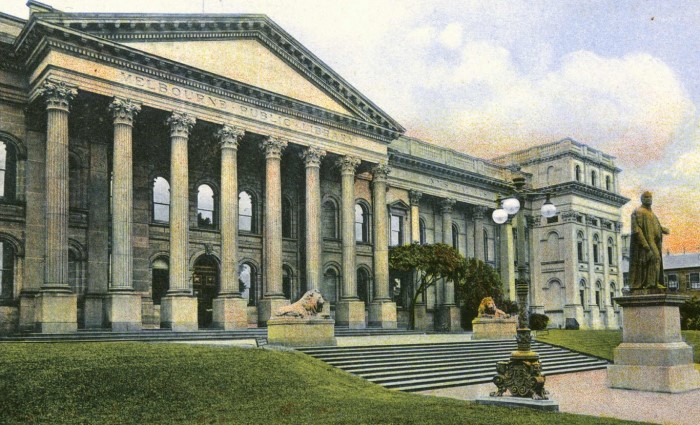
Public Library, Melbourne, ca 1907; H96.200/190
It appears that lion sculptures were always envisaged in the original full plan of the Library and they made their first appearance in 1863 at an exhibition of sculptures that could be seen as the beginnings of the National Gallery of Victoria (NGV).2
Tracing their origin has been a challenging task, though. In fact it has become rather an obsession for myself and my colleague Angus Hamilton. It has taken us (virtually) from Melbourne to London, Belgium, San Francisco, France and back again.
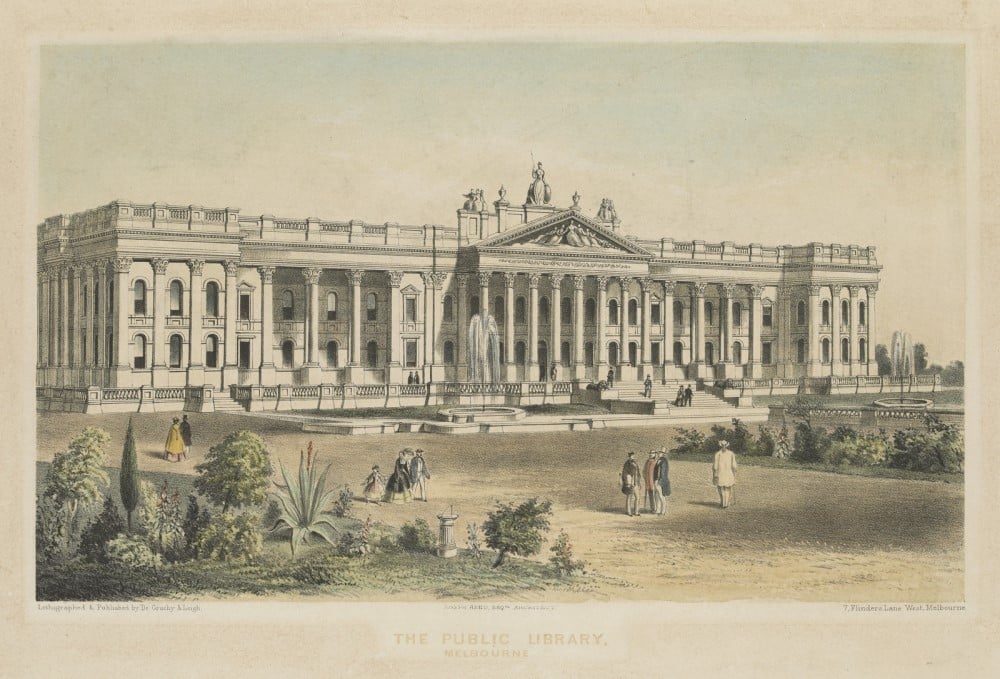
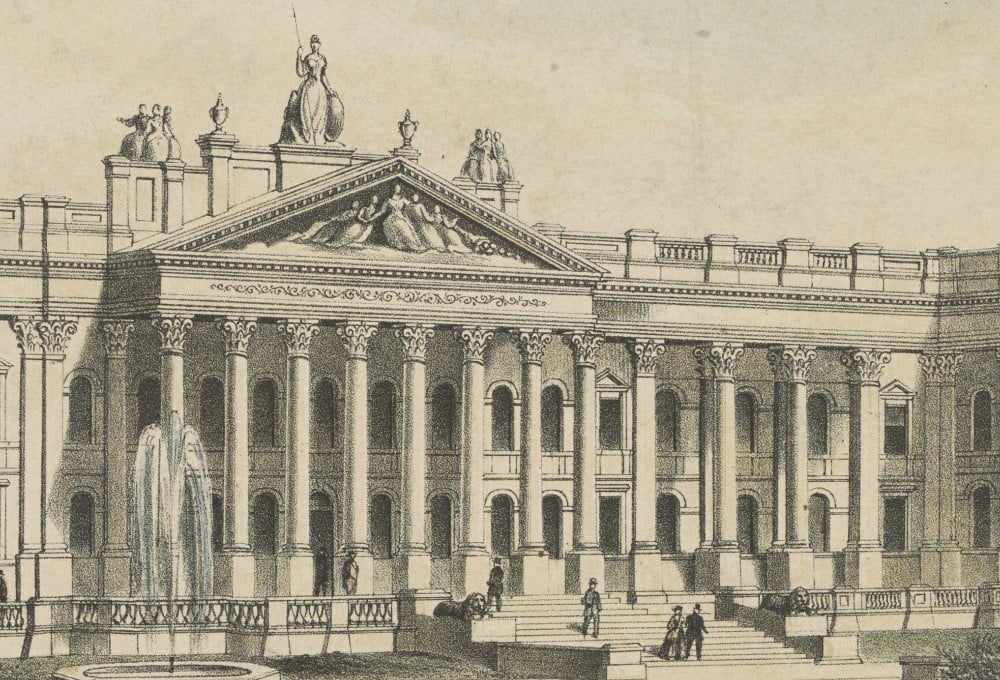
The Public Library, Melbourne, ca 1858. Lithograph by HG De Gruchy, ST Leigh, & J Reed; H3949. Illustration of the vision for the Library show two lions either side of stairs. Slide image to see closer view of the lions.3
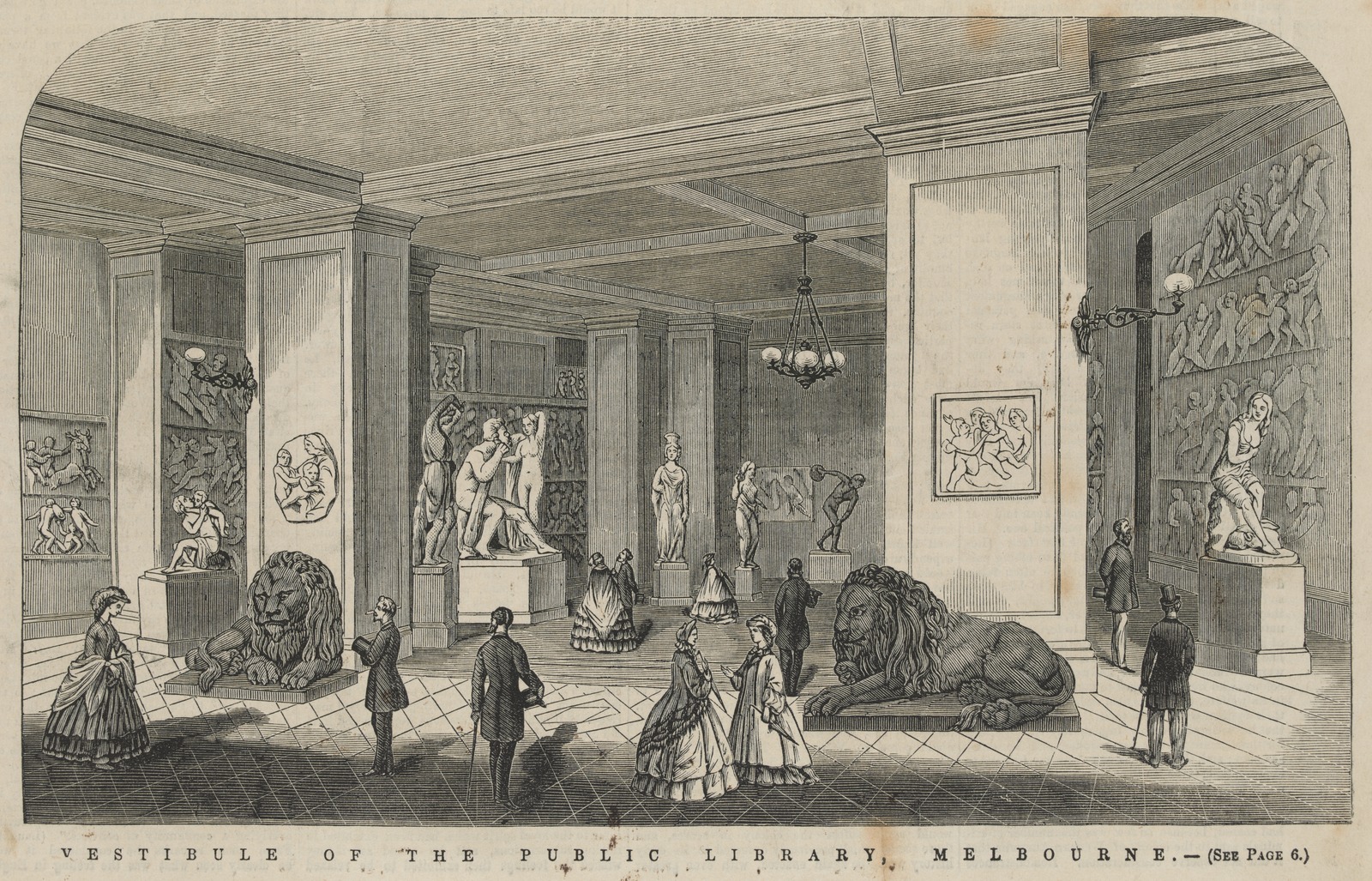
Vestibule of the Public Library Melbourne, 1863; IAN21/10/63/1. Shows our lions guarding the Library’s Museum of Art (now the Keith Murdoch Gallery).
London International Exhibition 1862
The first clues to the origin of the lions were documents at the Public Records Office of Victoria (PROV) recording Victoria’s London Agent-General reimbursing Mr J.G Knight an amount of £68.5s for “two bronze lions” from the Library account. They were shipped back to Melbourne identified as “cast metal lions from Belgium purchased by Sir R Barry for the Public Library”.
Mr Knight and Redmond Barry were in London at the time with Victoria’s contribution to the London International Exhibition. Redmond Barry multi tasked in his commissioner role, taking the opportunity to travel widely in Europe, collecting books and artworks for the Library. (The Argus, 14 November 1862)
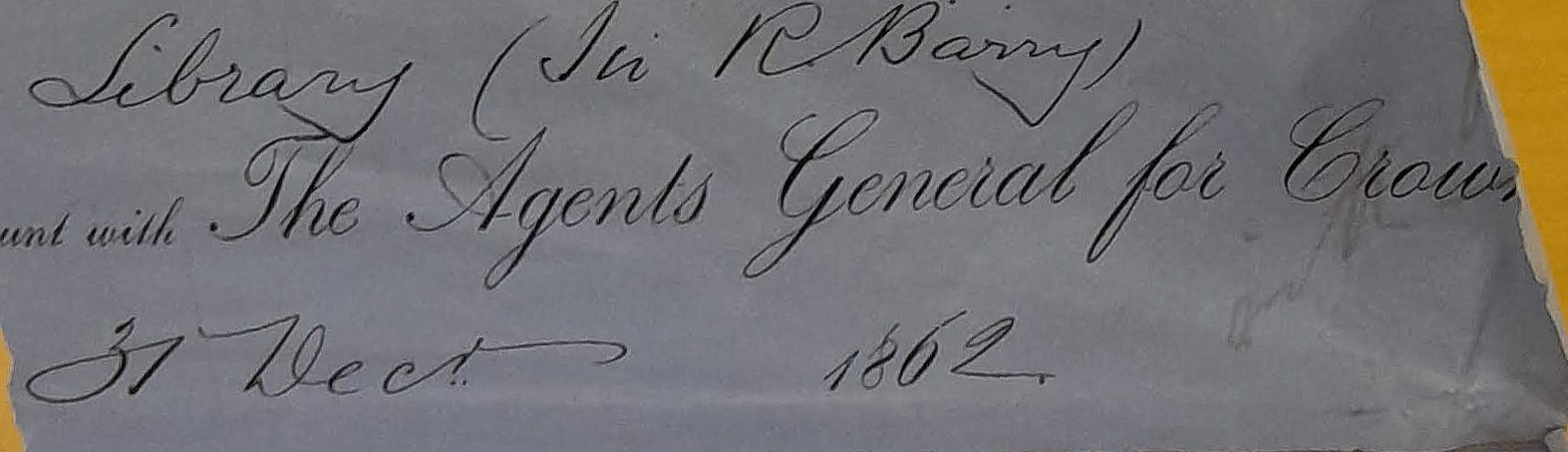

Agent-General For The Crown Colonies Accounts VPRS 5886/P000 (1857-1866),
Public Records Office Victoria (PROV). Shows purchase of lions
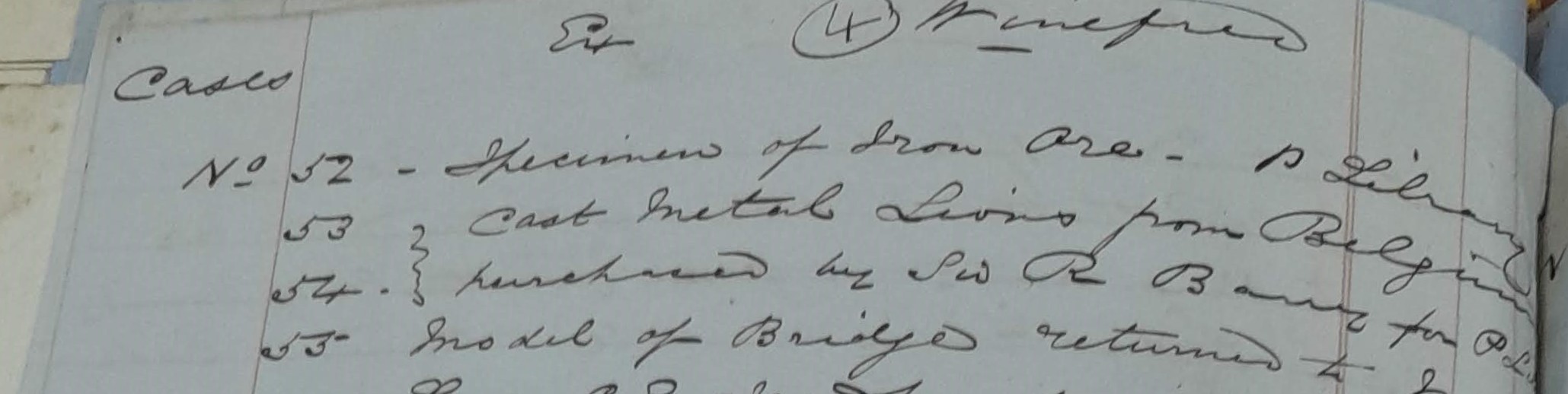
Museum of Art (National Gallery) London Accounts VPRS 5846/P0000 (1860 to 1862), Public Records Office Victoria (PROV). Listing of lions on manifest of sailing ship Winifred of items returning to Australia from the London International exhibition.
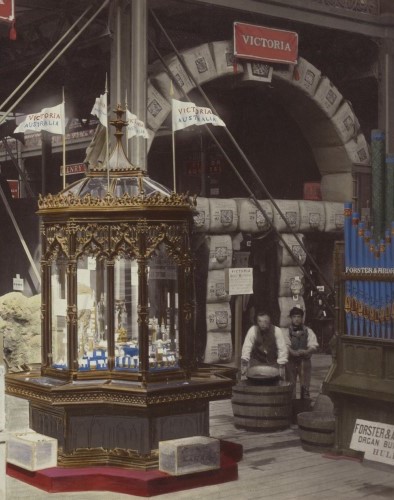
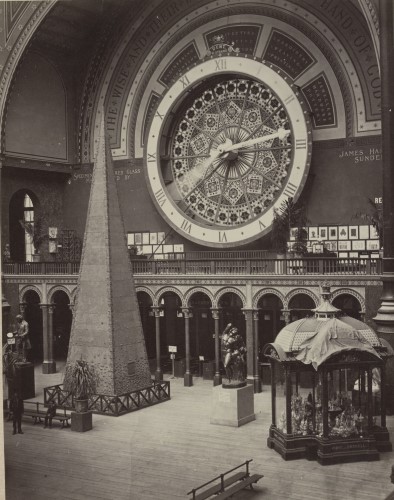
Views of the Victorian Court at the London International Exhibition, 1862. Photos by London Stereoscopic & Photographic Company; H37246 & H37252
Belgian lions
Amongst the Belgian contribution to the London Exhibition were ‘deux grand lions en zinc galvanesé et bronzé’ from Compagne Anonyme pour la fabrication du zinc, du bronze et des appareils d’eclarage . (Public company for the manufacture of zinc, bronze and lighting equipment) 4
This reference became much more interesting with the discovery of an image featuring two lions the company had fabricated. 5 While this photo was taken some time after our lions arrived in Melbourne they appear clearly to have been from the same cast. It seems most likely that the lions at our Library were purchased from this company.
The artist who sculpted the lions is also a bit of a mystery. Initially the lions were described as being ‘after Canova’, the great Italian sculptor of the 18th century. The lions, though, bear no resemblance to Canova’s great sleeping lions adorning the grave of Pope Clement XIII 6.
Our research suggests that our lions (from Belgium) have similarities to the work of great Belgian sculptor Guillaume Geefs. They appear to be almost identical to two lions guarding the gates of the 19th century Sutro Heights mansion in San Fransciso, identified as ‘by Geefs’.
This is not definitive. Geefs was from a family of sculptors, so it may be the work of one of his brothers, students or imitators, but they are very similar to his style. In fact one of his most famous public sculptures – the Monuments to martyrs – features a lion that could well be from the same litter as our lions!
With the completion of both wings of Queen’s Hall the lions moved outside and were placed either side of the entrance to reflect the symmetry of the building.
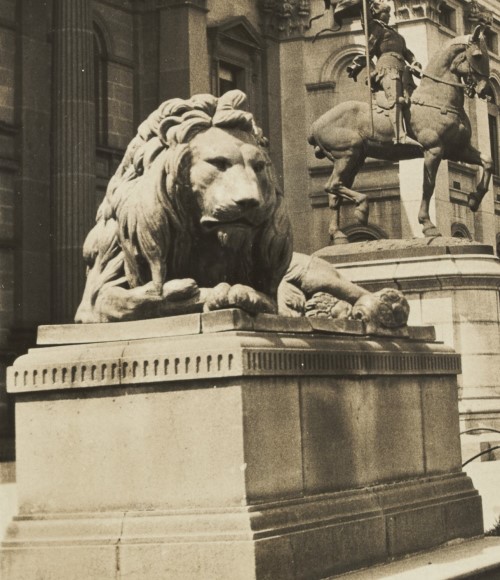
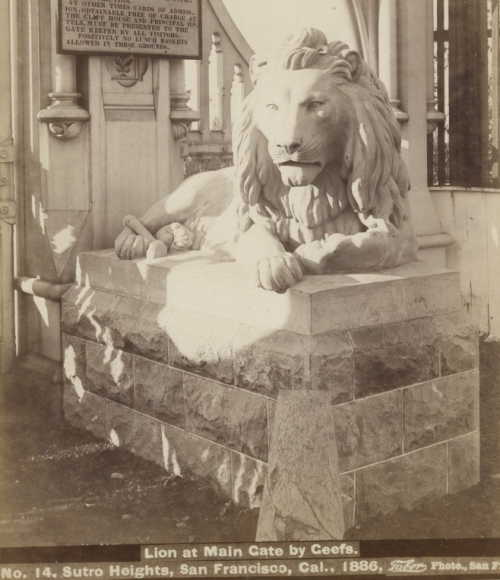
At left: Library Lion, 1918; H5361. At right: Lion sculpture at Sutro Heights mansion, San Francisco, 1886; 2013-0958SUT. IW Taber credited as sculpture by Geefs; courtesy California State Library. Our Library lion and the Sutro Heights lion appear to be from the same cast.
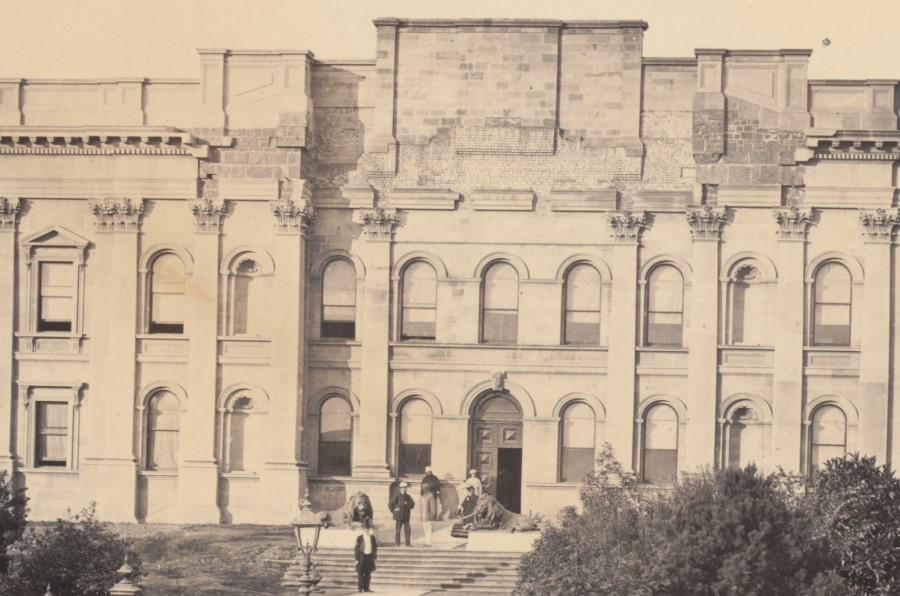
The Public Library, 1864. Photo by F Cornell; H296
Shows the lions when first placed either side of entrance to the building, immediately after the completion of the northern section of Queen’s Hall.
Bernard Hall visits Rodin
Over time the lions began to show the effects of age and weather 7.
By the end of the 19th century, director of the National Gallery of Victoria (NGV) (1892–1935), Bernard Hall was of a mind to replace the lions. In 1905 he visited famous French sculptor Auguste Rodin. Hall admired Rodin’s small sculpture Le lion qui pleure (The Crying Lion) and discussed commissioning Rodin to sculpt two life size lions as replacements, (a lion and lioness with cubs) or perhaps a life-size cast of The Crying Lion.
While Rodin showed enthusiasm for both ideas, ultimately the NGV didn’t go ahead with the commission. 8 Instead the commission was offered to Englishman John Macallan Swan who was a noted sculptor of animals and produced several preliminary sketches. Unfortunately, Swan died before the project could be completed. (The Argus, 7 November 1925)9
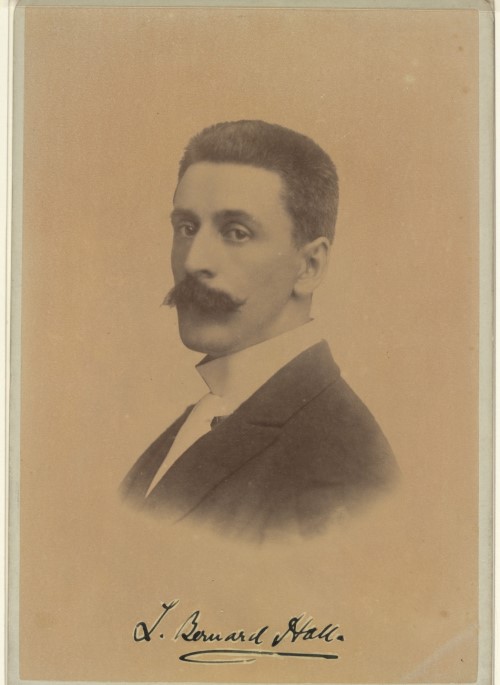
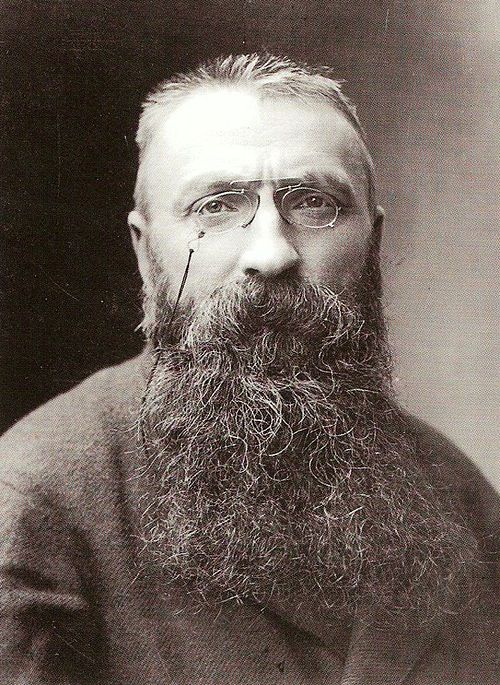
At left: L. Bernard Hall, ca 1895. Photo by U Catani; H88.71/2
At right: Auguste Rodin, 1891. Photo Nadar (Gaspard-Félix Tournachon)
Lions at the Library
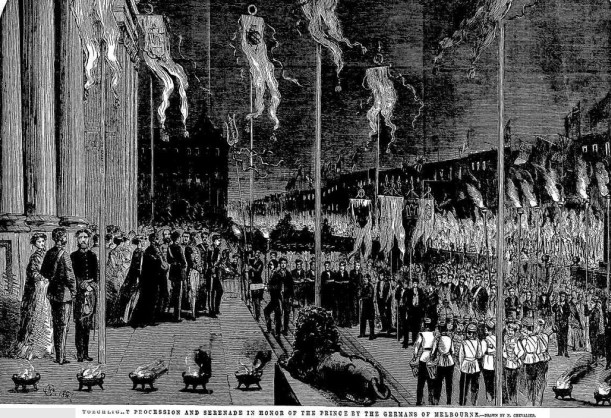
‘Torchlight procession and serenade in honor of the Prince by the Germans of Melbourne’, Illustrated Australian News for Home Readers, 27 December 1867, p 8. Illustration by Nicholas Chevalier.
Prince Alfred addresses the crowd under the watchful eye of one of our Library lions.
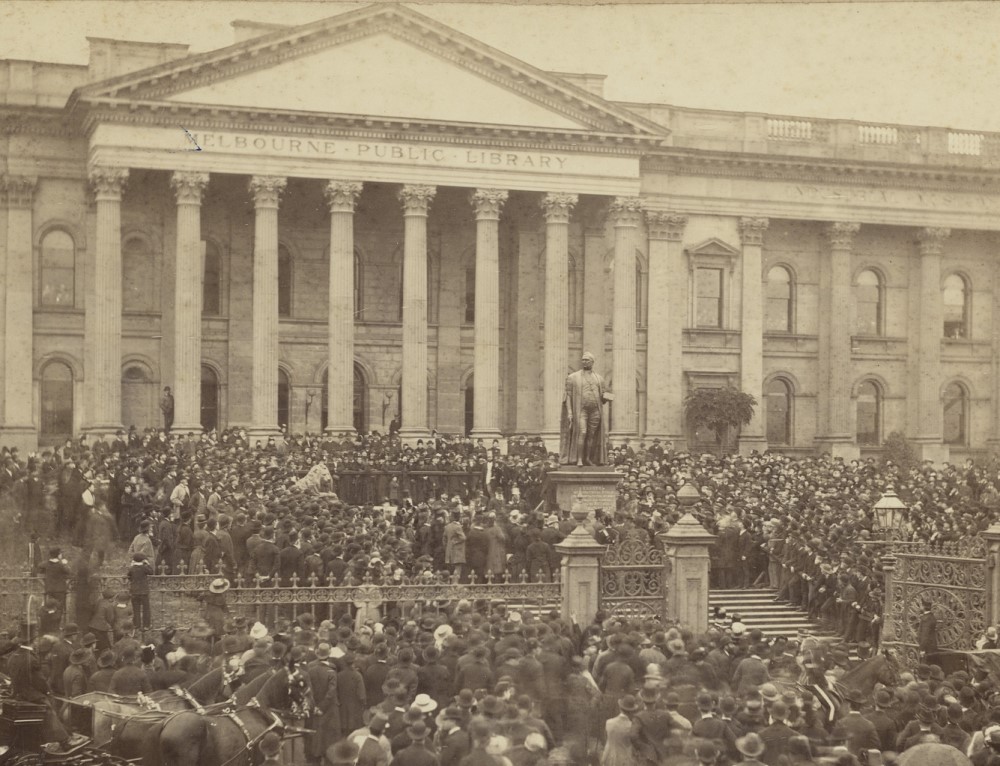
Unveiling the statue of Sir Redmond Barry, 23rd August 1887, by William Cain (mayor). Photo by WJ Pierce; H42343. One of the lions purchased by Redmond Barry watches the ceremony.
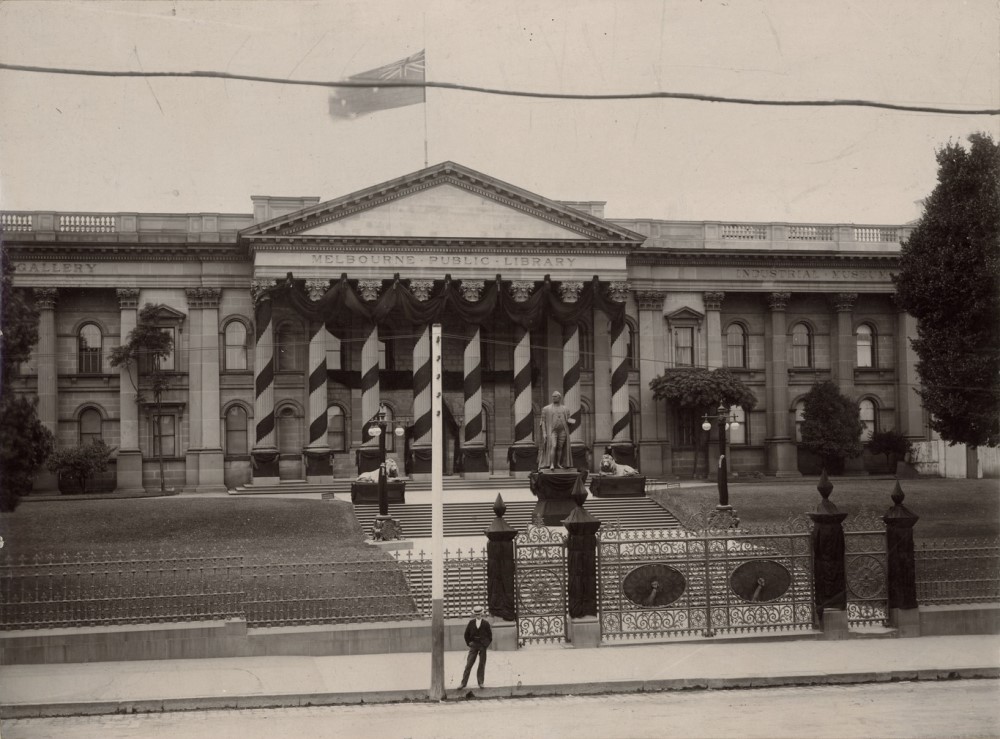
Library Building in mourning for Queen Victoria’s death, 1901. Photo by TM Hill; H2004.84/18.
The lions pedestals are swathed in black.
The Lions’ demise
The lions had observed a great swathe of the Library’s history but they had become quite dilapidated 10. In fact a crack in the mane of one of the lions was used by the students at the Gallery School to deposit messages.
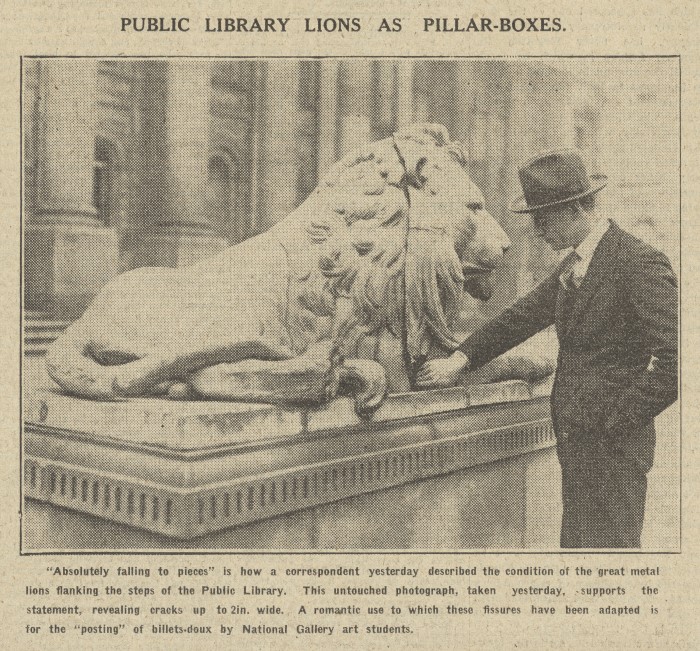
Public Library Lions as pillar boxes, The Argus, 20 June 1924, p 9
In 1923 the decision was made to finally remove the lions from the forecourt and they were dismantled in January 1925 and taken to the Melbourne Zoo, despite pleas to save them. Perhaps the feelings of Library visitors was best summed up in this letter at the time of their removal.
SPARE THE LIONS Sir, — If the lions are removed, half the beauty of the front of the Public Library is gone. As children, we loved them when our mother took us there and told us stories about them. I take my own children there now, and they love the lions, Just in the same way.
Can’t they be mended in some way and left there?
MUM (Aged 48),
South Yarra, Nov 28, 1924 11.
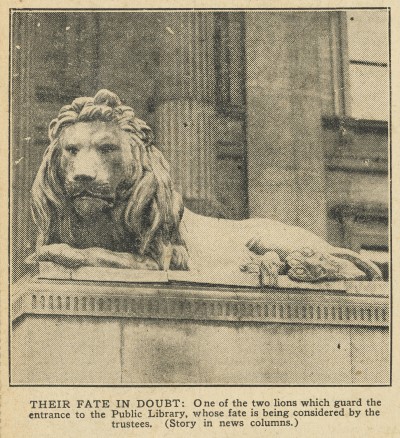
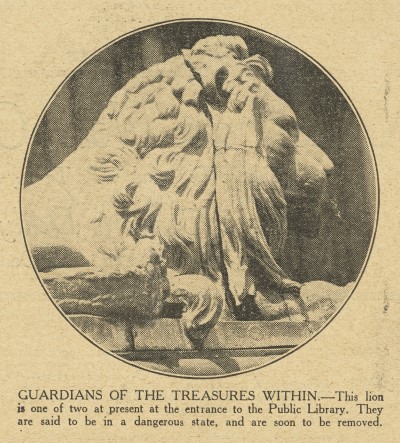
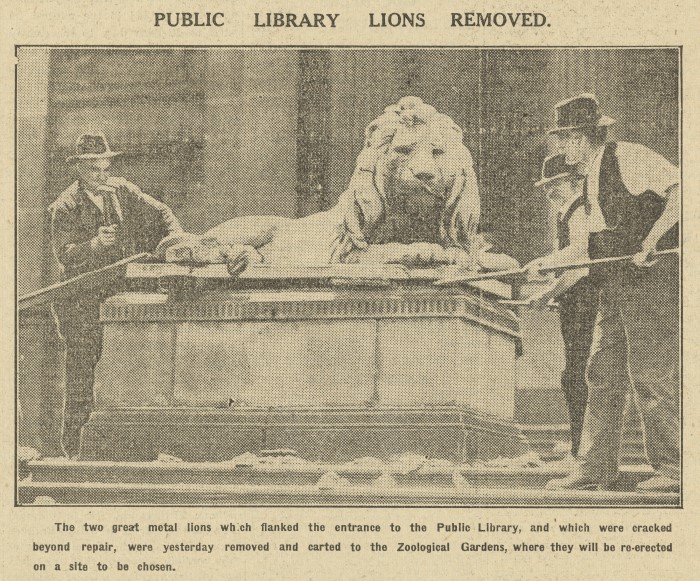
Newspaper images of lions removal
Top left: Library Lions, The Herald, 27 November, 1924, p 30
Top right: Guardians of the treasures within, Sun News-Pictorial, 12 December, 1923, p 12
Above: Public Library lions removed, The Argus, 21 January 1925, p 17
While the Zoo seemed a logical home for lions, the promise of restoration and display appears never to have been carried out and they were eventually discarded – an ignominious end for such loyal guardians.12
There was one more attempt to replace the lions a decade after they were removed. Noted sculptor Paul Montford had proposed sculpting new lions for the entrance. The Trustees unanimously rejected the proposal with Mr. John Shirlow remarking ‘This building will assume the appearance of a glorified wedding cake if anything more is put in front of it’. 13
References
- The Industrial & Technological Museum was established at the Library in 1870 and the Natural History Museum moved from Melbourne University to the Library complex in 1899.
- A sculpture room opened on 24 May 1861. The Lions were placed on display in 1863.
- The fountain and statues above entrance were never built.
- Belgique : catalogue des produits industriels et des œuvres d’art (1862), Imp. de Charles Lelong, Bruxelles, p 185.
- Image held at La Fonderie – Musée bruxellois des industries et du travail (The Foundry – Brussels Museum of Industry and Labor).
- This mistaken reference was acknowledged later by the Library, The Herald, 26 September 1922, p 8. See also details of Canova’s lions.
- It appears they suffered some damage on the long ship journey from England in 1863 and this may have contributed to their failing condition. Consignments for Library, Gallery and Museum VPRS 1071/P0000, Public Records Office Victoria (PROV).
- NGV did however purchase a cast of Rodin’s small sculpture Le lion qui pleure (the Crying Lion).
- See copy of a preliminary sketch held by National Gallery Victoria. See also Anderson, Jaynie with Paul Paffen (2001), ‘Sculptor writes: Rodin in correspondence with Melbourne’ in National Gallery of Australia, Rodin : sculpture and drawings pp.125-137.
- When they arrived after the long voyage from England in 1863 they were listed as ‘broken’. The original damage was repaired but may have hastened wear and tear. See Consignments for Library, Gallery and Museum (Winifred (ship) Case 23 and 54 VPRS 1071/P0000, Public Records Office Victoria (PROV).
- Spare the lions, Herald, 28 November 1924, p 4.
- See our State Library Victoria – history research guide.
- Lions on pedestals, The Argus, 21 December 1934, p 10.


So, where are the statues?
Someone must have taken possession of them after they never turned up at The Zoo for display?
Thom
When they were sent to the Zoo they were in poor condition and needed considerable repair. There is no record in the Zoo archives of whether they were repaired and displayed or what became of them. It is likely the repairs proved too challenging and they were stored and forgotten. Anecdotal reports suggest that they were discarded during the big Zoo clean-up in the 1960s.
I had always wondered about the lions. I remember somebody telling me about their first visit to the Library or Museum back in the 1920s and they recalled seeing the lions. Not sure if they invented it or not, but I knew they existed.
Great research to tell an intriguing story
Long before the students of the Gallery School, Marcus Clark was supposed to have placed a cigar in the mouth of one of the lions on days when he wished his friends to take him out to lunch
Yes that is one of the famous stories of Marcus Clarke’s career at the Library
Bring our beloved Lions back.
Surely they must be part of the Barry collection and belong(ed) to the National Gallery of Victoria? – Festivale Online Magazine, ed.
The Lions were purchased by the Library, while the Gallery purchased Joan of Arc and George and the Dragon. They became the responsibility of NGV Ultimately the trustees of the Library, Gallery and Museum made the decision to have them removed due to their poor condition.