
In 1836, Robert Russell was the lead surveyor appointed to the Port Phillip District1, the European name given to the area now known as the state of Victoria. He published an early printed topographical survey of the site of Melbourne. It shows the position of huts and buildings before the foundation of the township in 1837. You can see the layout of the Central Business District which later became known as Hoddle’s Grid. Robert Hoddle drew the standard grid plan that features in the survey after he succeeded Russell as surveyor-in-charge in 18372.
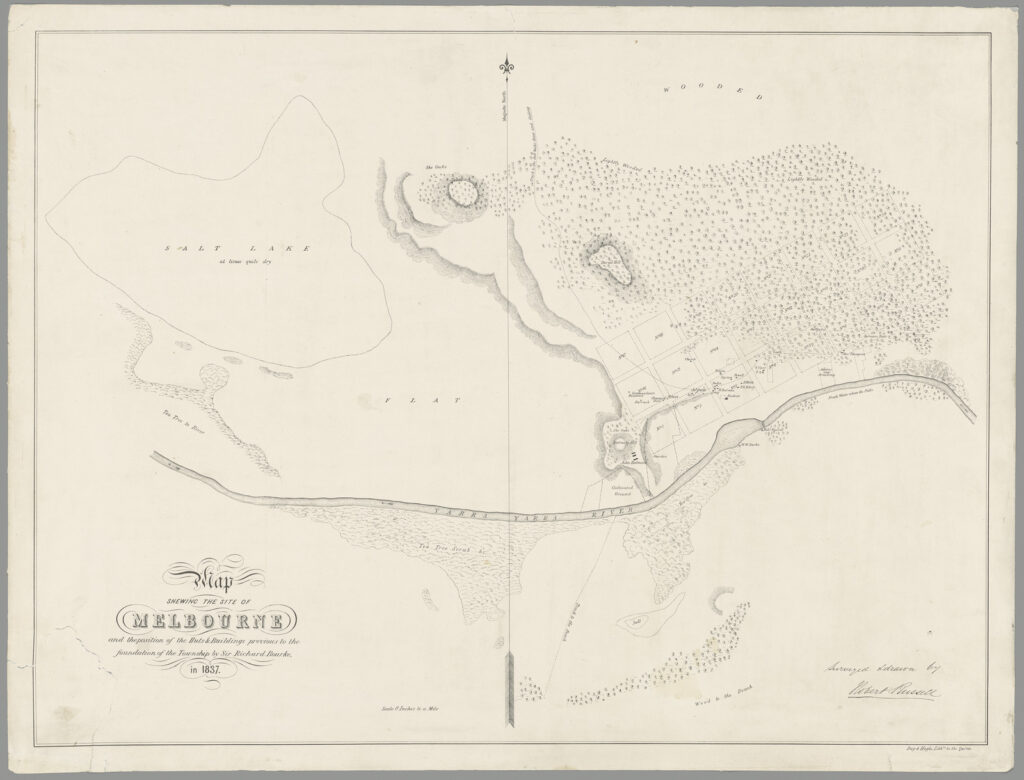
Details of native vegetation are noted such as tea tree scrub and she oaks. Prominent landmarks include Batman’s Hill, now Southern Cross Station, Burial Hill the site of Melbourne’s first cemetery, now Flagstaff Gardens, the large salt lake known as Batman’s Swamp (later known as the West Melbourne Swamp) and the Yarra Falls that determined the site for the foundation of Melbourne3. Located west of present-day Queen Street, the Falls marked the merging of tidal water downstream and the freshwater upstream. In the 1880s they were removed for the construction of Queens Bridge4.
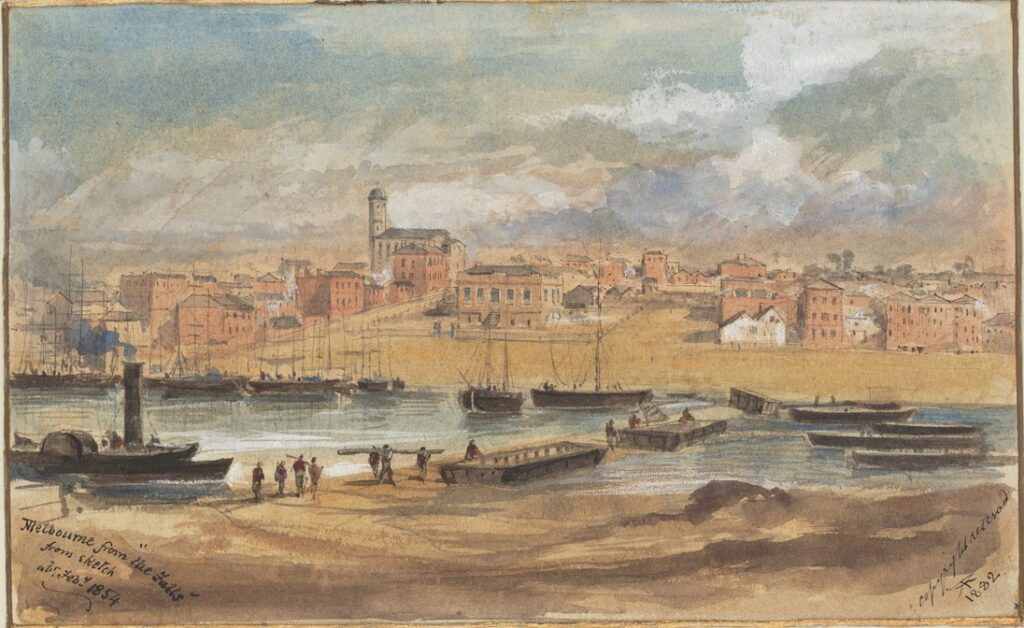
Robert Russell was also an artist, and he produced a series of drawings and watercolours of the Yarra Falls. His cottage on the south side of the river just opposite the rocky bar of the Falls provided the perfect vantage point for these artworks. Russell sometimes used sketches drawn in the early years of the Melbourne township as the basis for watercolours he painted decades later.
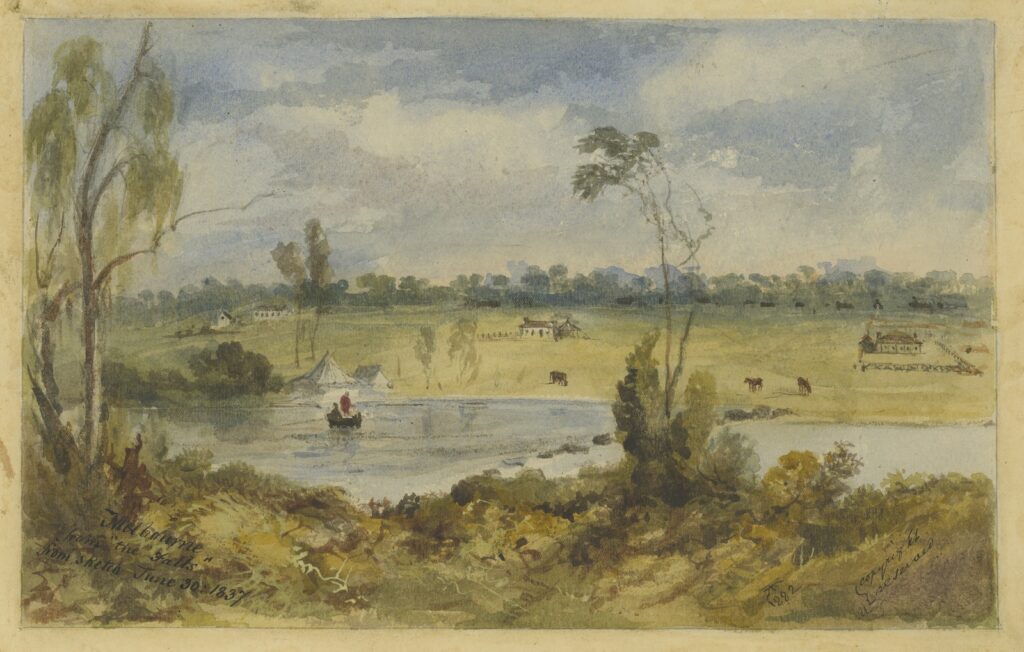
The survey and artworks document the natural landscape of early Melbourne as it was shortly after European colonisation and before the major industrial changes to the environment that followed in the years to come.
This ‘Treasures of the Library’ video shows a close up of Russell’s survey and watercolour. You can browse other artworks by Russell featuring the Yarra Falls on the catalogue.
- Parker JR (2008) ‘Surveying‘, eMelbourne [website], accessed 31 July 2026.
- Preston H (2006) ‘Robert Russell (1808-1900)‘, Australian dictionary of biography [website], accessed 31 July 2026.
- May A (2008) ‘Yarra Falls‘, eMelbourne [website], accessed, 10 August 2026
- As above


Sarah, thank you for another wonderfully enlightening post. Your exploration of Robert Russell’s early survey and the Yarra Falls really brings Melbourne’s landscape before the city we know today vividly to life.
Having had the pleasure of organising your fascinating HHP presentation on Melbourne’s historic maps, I know how generously you share your knowledge. Please keep up the wonderful work — these stories and treasures are so important in helping us understand and appreciate Melbourne’s remarkable past.
Hi Stephen, thanks so much for taking the time to read the blog and for your lovely comments.
Kind regards
Sarah
My 2x great grandfather, Robert Ryburn, arrived from Paisley, Scotland into Hobson’s Bay (I assume) on unknown ship circa early-mid-1855. He left his wife and three children behind. He came chasing gold in Central Victoria to be joined by his wife Mary (nee McLachlan) and only surviving child, Duncan. Mary and Robert went on to have another nine children and a carting business in Emerald Hill/South Melbourne. These old images and associated text help me ‘put flesh on the bones’ of Robert and Mary’s life in Port Phillip. Thanks for your work.
Hi Peter, thanks for taking the time to read the blog. I’m glad it helped you give depth to the stories of your ancestors.
Kind regards
Sarah
Fascinating!
My Gilchrist Ancestors arrived in Melbourne in December 1852 by ship the Bombay (at about same time the Tychondra arrived). They were “removed’ from the depot on January 3 1853 and went to an house in Swanston Street”. This information was from ‘The Voyage’ about the Bombay by my great grandfather Archibald Gilchrist who contributed to the journal of this voyage.
Would you have any pictures of Swanston Street about that time?
Hi Kathy
I’ve lodged your query with our Ask a Librarian service. One of our reference librarians will be in touch with a response.
Kind regards
Sarah
My Irish ancestor and his wife Bartholomew Donovan and Julia (Walsh) Donovan came to Sydney as bonded immigrants in the Magistrate from Cobh, Ireland, landing in Sydney in 1838. He was a carpenter and she a pastry cook. They were transferred in 1839 to Port Phillip Bay and he was set to work building wharfs. He had ambitions and set himself up as a builder along with a fellow Irish man under the business name of Donovan and Crosby. Under this name they built a bank premises in Collins Street as part of the development of Collins Street They also built the core of the Melbourne Institute which has been covered up by later additions. He had ambitions to be a leading businessman in the colony which was thwarted at every turn by the Anglo establishment who tried to pressies him on anti Irish prejudice feelings. In response he took his family to Valparaiso in Chile ahead of bankruptcy proceedings in Melbourne to take advantage of the building boom and from there to the Hawaiian Islands to take advantage of another building boom there with the conversion of the Hawaiian land ownership system from tribal ownership to the United States form of individual ownership. From there to San Francisco and then back to Melbourne using an expanded name adding an “O’ “to Donovan and “John” as a middle name. He settled in Fitzroy and was a spec builder there in the development of that suburb. At every turn he suffered discrimination for his Irishness and for the second time went to San Francisco ahead of bankruptcy where he and his wife, younger children and adult daughters remained. He left behind in Melbourne his eldest child also Bartholomew O’Donovan who became a builder based n Collingwood. (I am descended from this person).
When he built the original Institute on Collins Street the Institute Committee including the Governor LaTrobe as chairman withheld rightful periodical payments which meant he could not pay his workers. In turn the workers staged what must be the first sit-in in the history of Australia until they were paid when the Committee gave in and resumed payments to the builder. However the payments were few and far between and never on time until Bartholomew John O’Donovan left the discrimination behind again for safety in San Francisco after bankruptcy in Melbourne. The Institute Committee took the right to finish the Institute from Bartholomew John O’Donovan and gave it to another local builder.
Thank you Sarah! This map shows Melbourne as it was 2 years before my partner Robert’s GGGGt-grandmother Kalloongoo (1st wife of Wm Dutton of Portland) arrived with the family of Geo Aug Robinson, (first Protector of Aborigines at Port Phillip) from Wybalenna at Flinders Island. From memory Robinson and family first lived in the Police Hut (is this shown here?) and I think Robinson purchased Lot 8 in 1840 and built “Tivoli” where he and his family lived until 1849 when he resigned from his position. Tivoli St remains in Prahan. Kalloongoo lived with the Robinson family at Tivoli until Jan 1849, keeping house for the Robinson family, and thereafter moving to Clarke Island with Robinson’s daughter Maria Allen and her family. I believe Asst Protector Wm Thomas may have lived with his family in the old Police Hut after the Robinsons, but that the Police Hut was demolished by 1850. Can anyone confirm that date for the demolition please, and can you tell me where on the map Wm Thomas built his home near the falls please, Sarah?
Many Thanks and Kind Regards, Shirley.
Hi Shirley, thanks for taking the time to read the blog and for sharing your partner’s connection to early Melbourne. I’ve lodged your enquiries with our Ask a Librarian service. A reference librarian will be in touch soon with a response.
Kind regards
Sarah
Great article- thanks for your work Sarah.
Hi Ron
Thanks for taking the time to read and comment on the blog post.
Kind regards
Sarah