
Family historians often talk about the `thrill of the hunt’, being the most satisfying aspect of family history research. This is the process of using family history detective skills to analyse known facts, identify useful clues, and painstakingly going through all available records in the hope of finding that crucial piece of information—ultimately leading to the long-awaited ‘Eureka!’ moment.
I was recently given a task that I thought would be impossible to answer and which really tested my research skills. As luck would have it, I found that one important clue, which was enough to lead me down a fascinating research path, until I eventually had my own `Eureka’ moment. It occurred earlier this year, when I was handed a framed photograph of an unknown WWI soldier and was asked to find out who he was.
The photograph had been discovered by one of our Security staff during a routine morning check of the La Trobe Reading Room. Whilst walking through the room he saw the photograph propped on one of our desks, under a green desk light. A tiny Post-it note was attached to the frame, bearing the message – `Can you please return this to the family?’ The photo, from Monteath Studio, Melbourne, bore the inscription `Yours sincerely Hal. 30/7/16’.
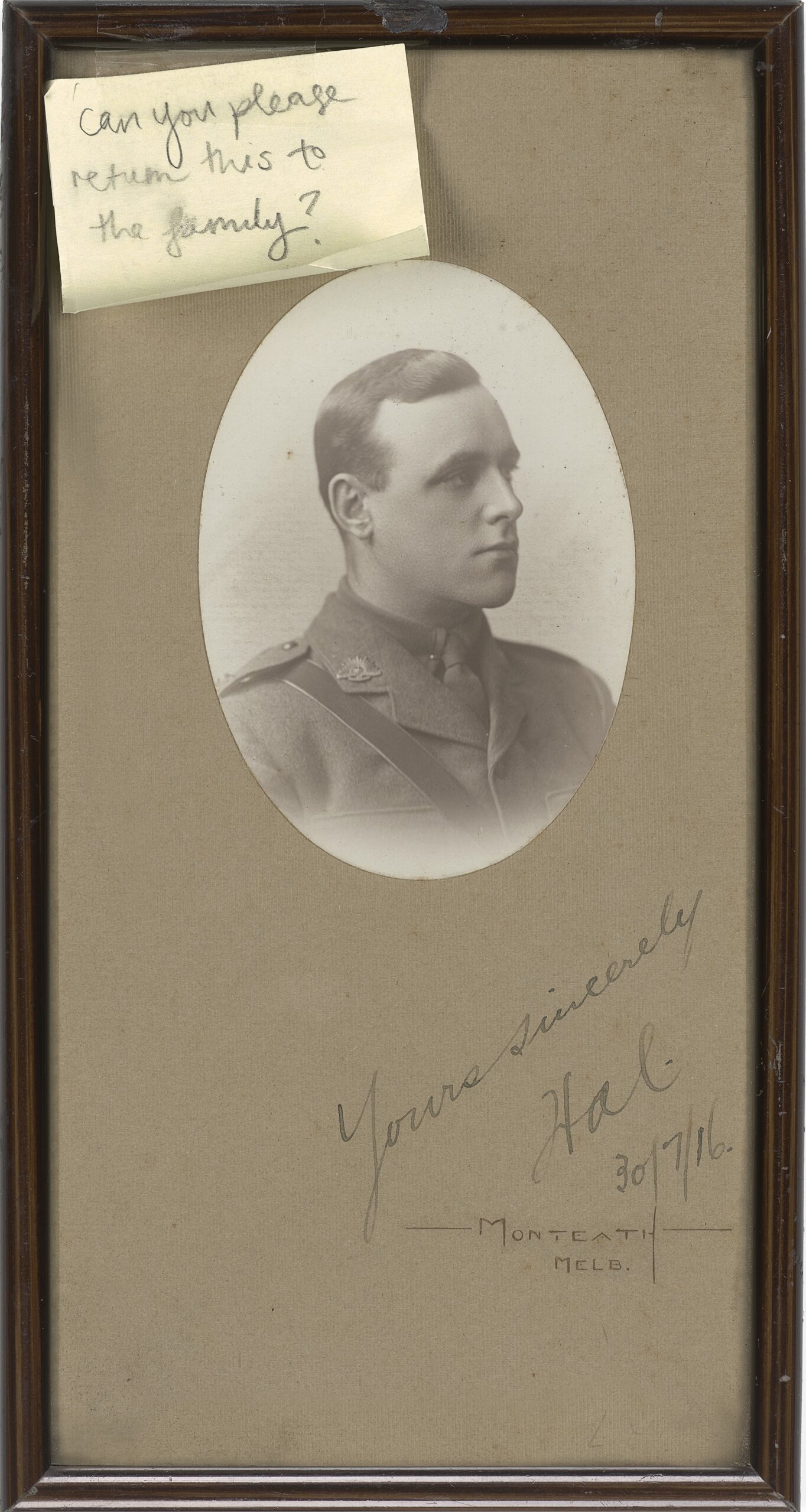
Upon examining the photograph, I could see there was very little to go on – that I’d probably have no luck identifying Hal; and without knowing who he was, there would be no way that I’d be able to return the photo to his family. Yet at the same time, I felt compelled to give it my best shot – partly because it was such a poignant portrait, but also because I was moved that someone had such faith in the skills of the State Library’s reference librarians.
My first step was to analyse the photograph, which showed that Hal was a WWI soldier, who was in Melbourne in July 1916 – when the photograph was taken. I also knew that the name Hal was probably a nickname – Hal being a common diminutive form of such names as Henry, Harold and Harry. Not being a military expert, I approached my colleague David Flegg, who confirmed that Hal was wearing the uniform of the Australian Imperial Force (AIF) and that the insignia on his uniform meant that he was an officer – possibly a lieutenant.
My next step was to see if I could identify any AIF soldiers named Hal, who had served in WWI. Using the Australian War Memorial’s Search for a person index I tried searching for each of the proper names that Hal stood for, and then limited the results to those who fought in the First World War. But of course, this brought up thousands of results. Next, I searched for each of these names in the National Archives of Australia’s (NAA) digitised collection of WWI service records – but once again there were too many. I then explored the Australian War Memorial’s index to First World War Embarkation Rolls, which allowed me to search by name, role title and place of embarkation. Although this cut the results down considerably it still wasn’t possible to determine if any of the listed soldiers was Hal. By this stage I was starting to think that it was indeed an impossible task.
The following morning, I happened to show the photograph to my colleague, Angus Hamilton. As he stood examining it, the sunlight caught the back of the frame, revealing some faint handwriting that had previously gone unnoticed. As we took a closer look we managed to decipher the words: `Killed in action 16/9/17′. This was one of those bittersweet moments, where I was thrilled to find a tangible piece of information, but also devastated to know that this young soldier had died, just 14 months after the photo was taken.
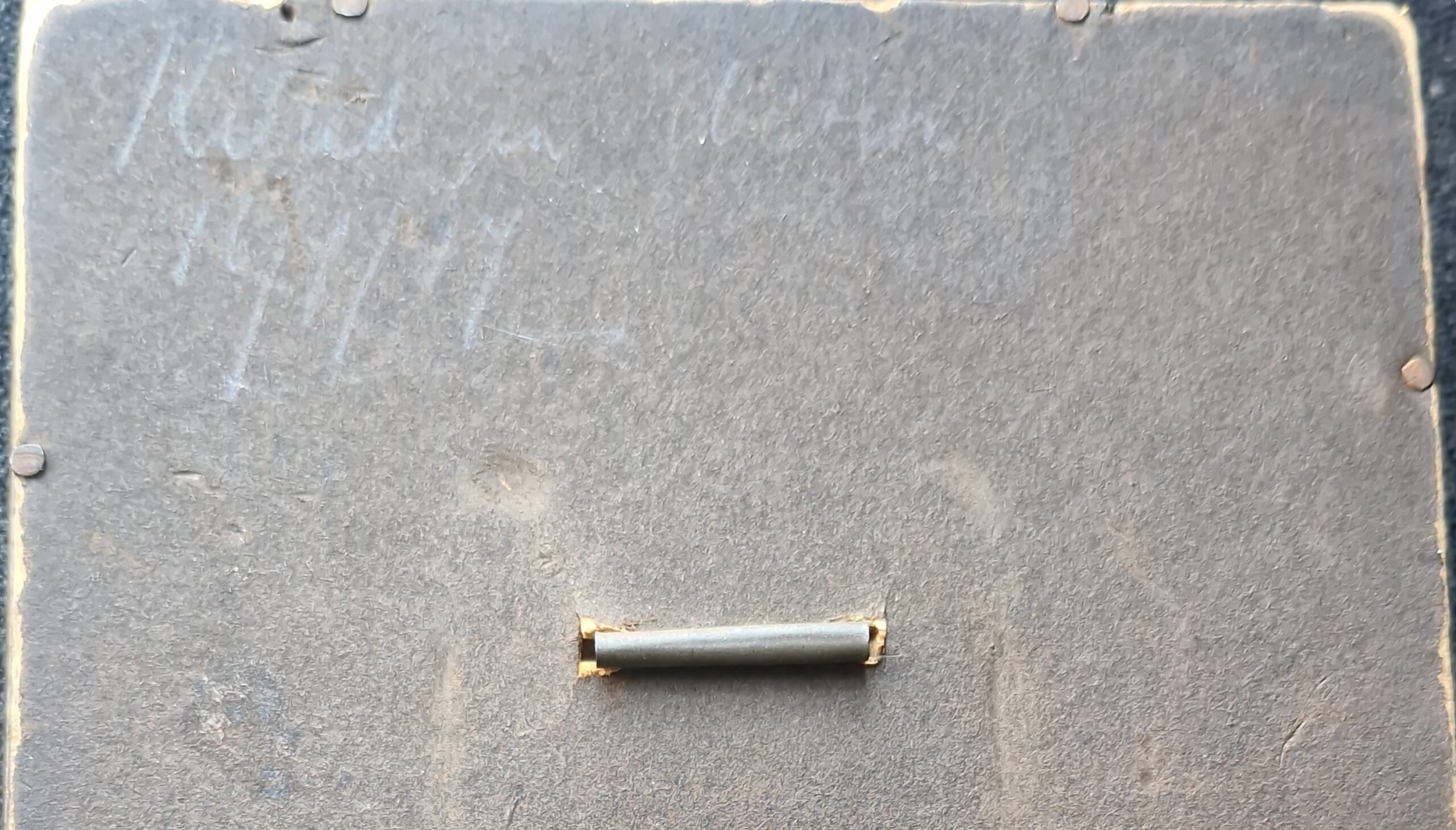
Close-up of the back of the frame. `Yours sincerely Hal’ 30/7/16, 1916, Monteath Studio, Melbourne
With this new piece of information I returned to the Australian War Memorial’s First World War – Roll of Honour for a list of military personnel who died on September 16, 1917. It retrieved 38 results, but only one was an officer with the initial H – Harold Ross Clark. Could this possibly be Hal?
I then started searching through a range of family history resources, desperate to find out more about Harold Ross Clark. On the Commonwealth War Graves website I found a record of his burial, which included a transcription of his headstone, place of burial, and names of family members. Through the National Archives of Australia (NAA) I located his service record, which contained a wealth of information. It all looked promising, but I still couldn’t be sure that Harold Ross Clark was actually Hal.
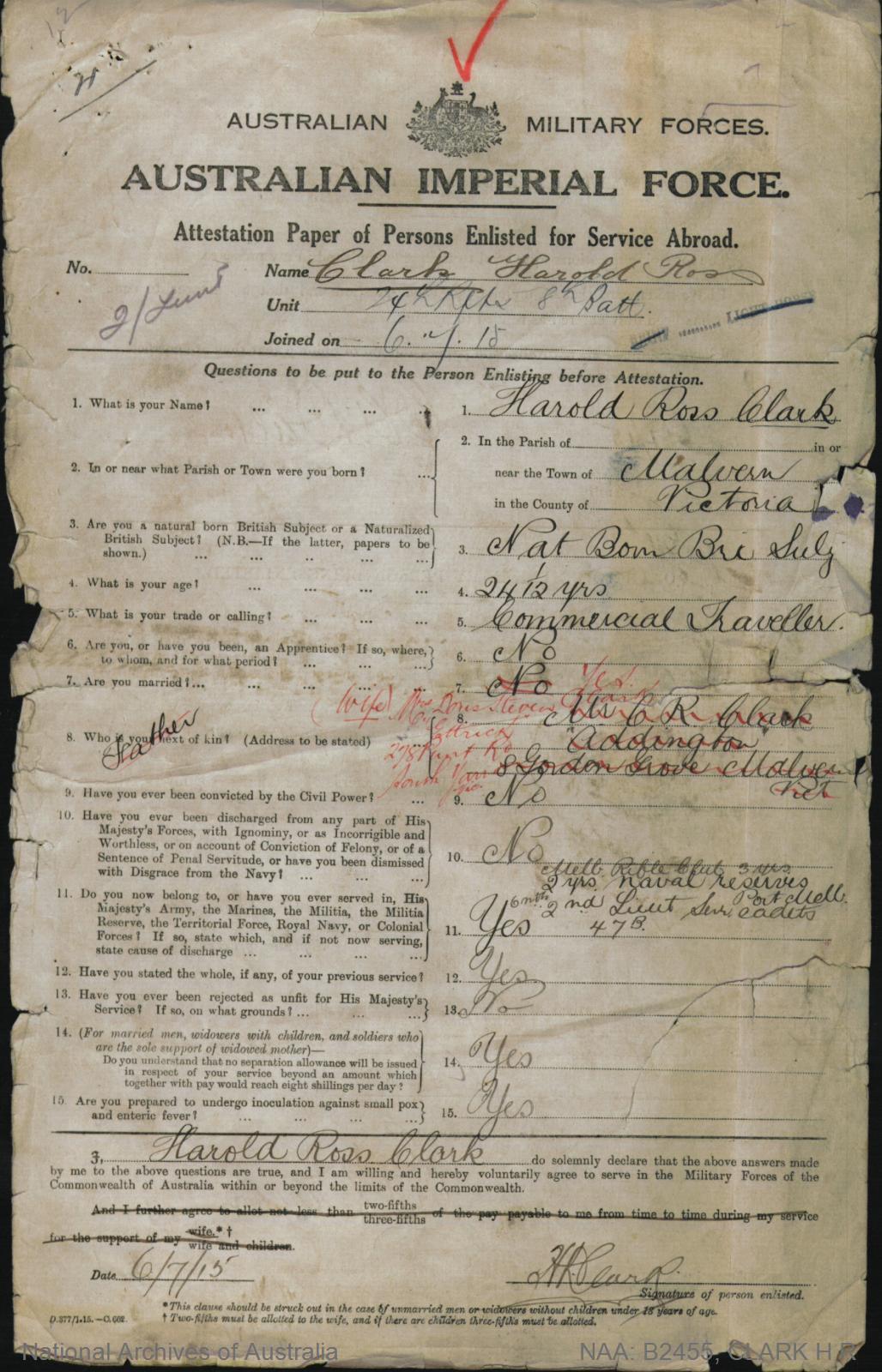
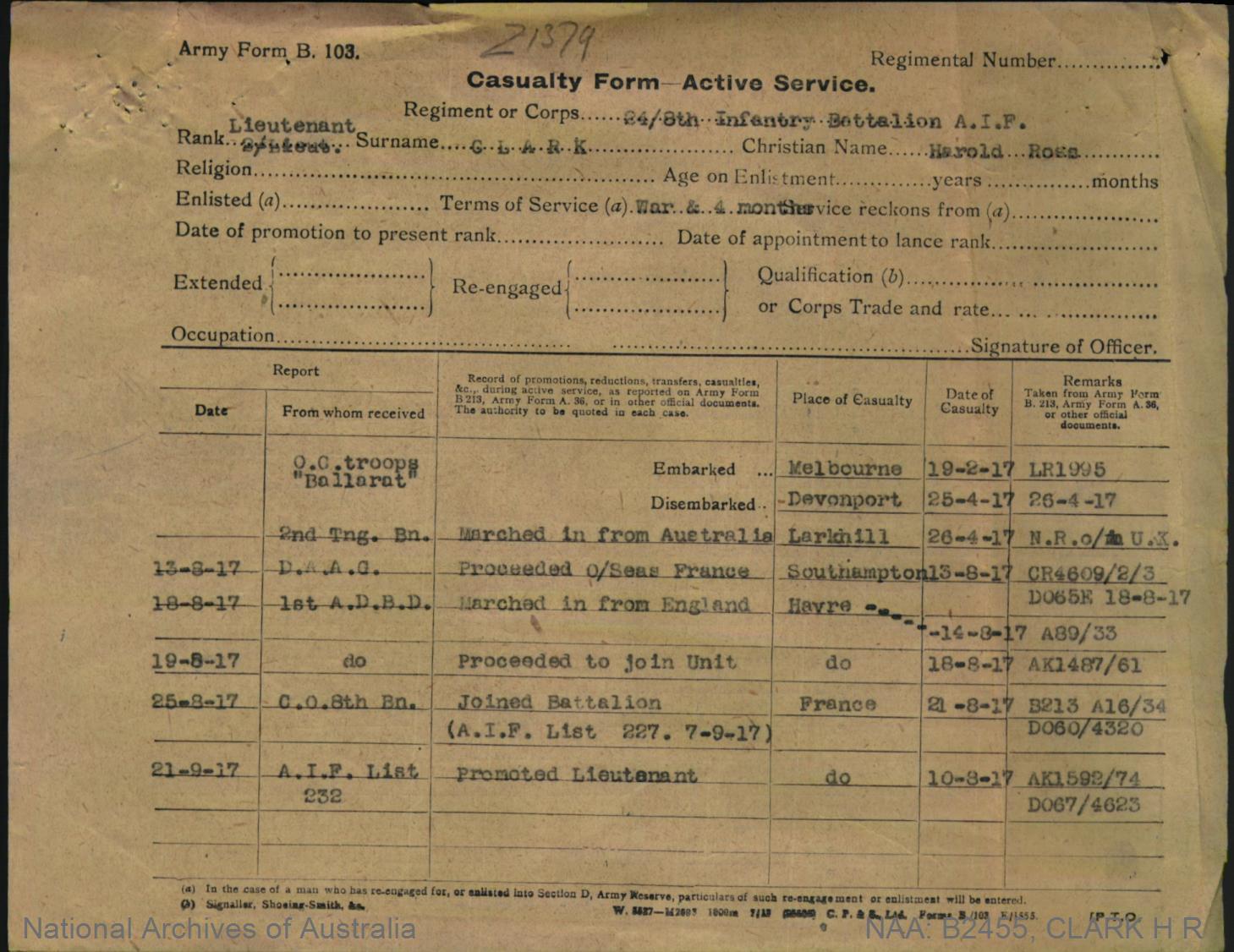
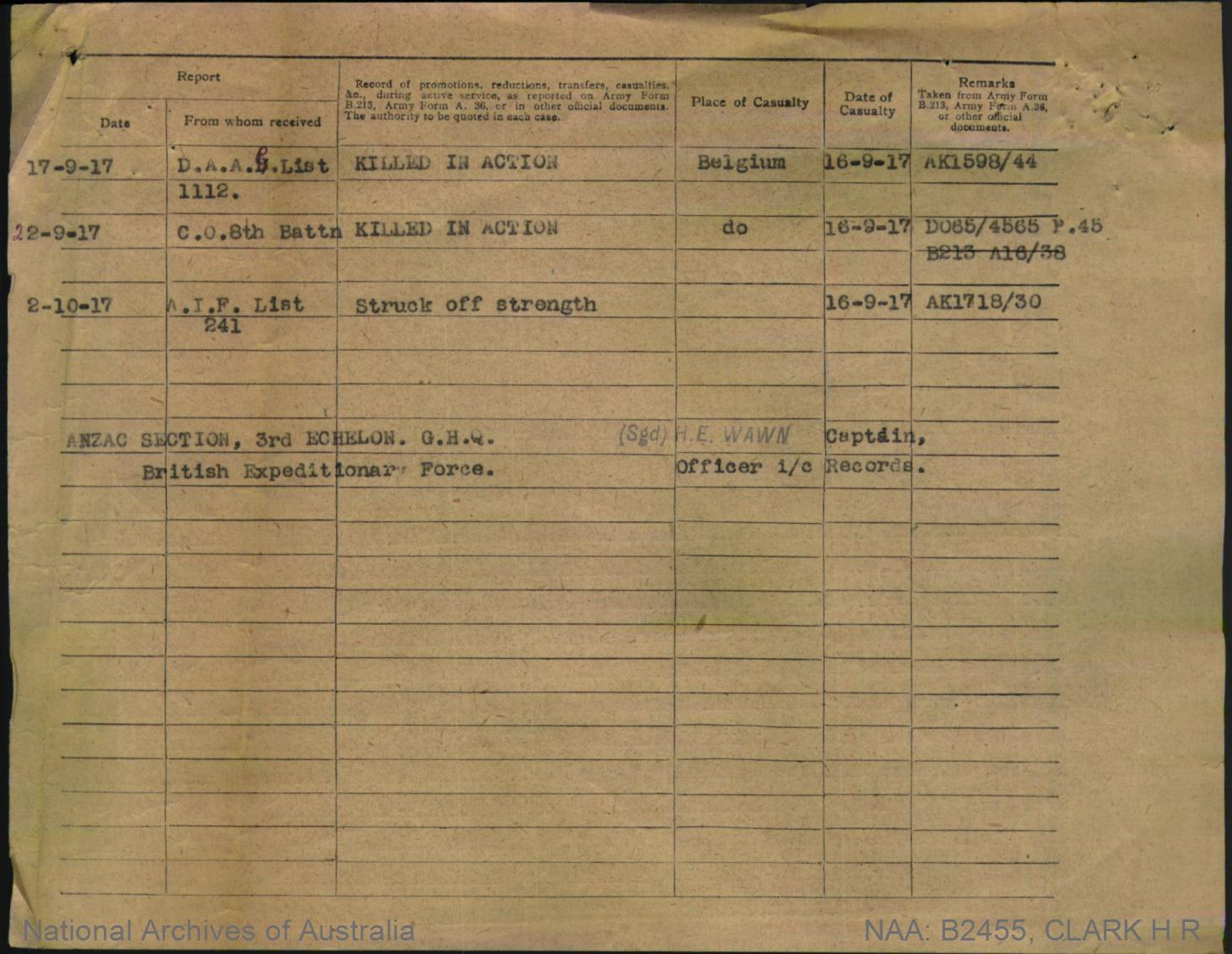
A selection of pages from the service record of Lieutenant Harold Ross Clark. Images courtesy of the National Archives of Australia NAA: B2455, CLARK H R
I then turned to the Trove Digitised Newspaper database, and it was here that I struck gold. A search for the phrase `Harold Ross Clark’ retrieved sixteen articles. As I opened the first article – ‘Their lives for the Empire‘, the portraits of three WWI soldiers appeared. The moment I saw the first portrait, I knew I had reached my ‘Eureka!’ moment. It was the same soldier as the one in the framed photograph. I had found Hal!
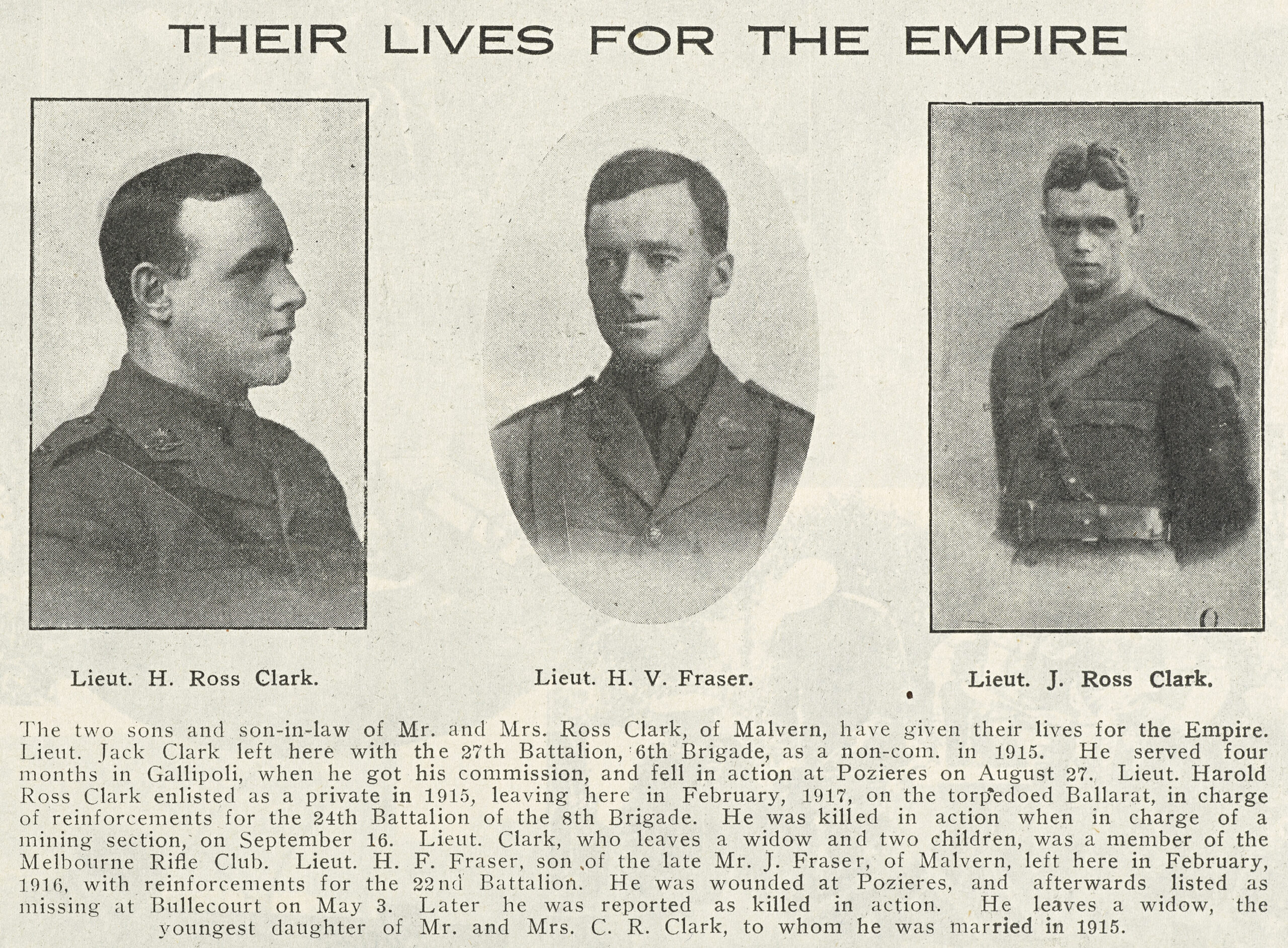
The article reported on the deaths of Harold (Hal) Ross Clark, his brother Jack in Pozieres in August 1916, and his brother-in-law Hubert (Hugh) Percy Fraser in Bullecourt in May 1917.
By reading through additional newspaper articles and Harold’s service record, I managed to piece together his story. Harold enlisted in July 1915 and was initially stationed at Royal Park before being transferred to Seymour, where he helped train recruits. In February 1917, he sailed for England aboard the troopship SS Ballarat. During the voyage, the ship was torpedoed and sank in the English Channel. Harold survived the incident and, on 13 August 1917, proceeded to France. One month later, he was detached with a party carrying trench mortar shells – when they came under heavy enemy fire, Harold was killed instantly.
Harold left behind his wife, Doris, and their two young sons: Laurance (Laurie), aged 20 months, and Douglas (Dougie), who was only 12 days old when his father was killed.
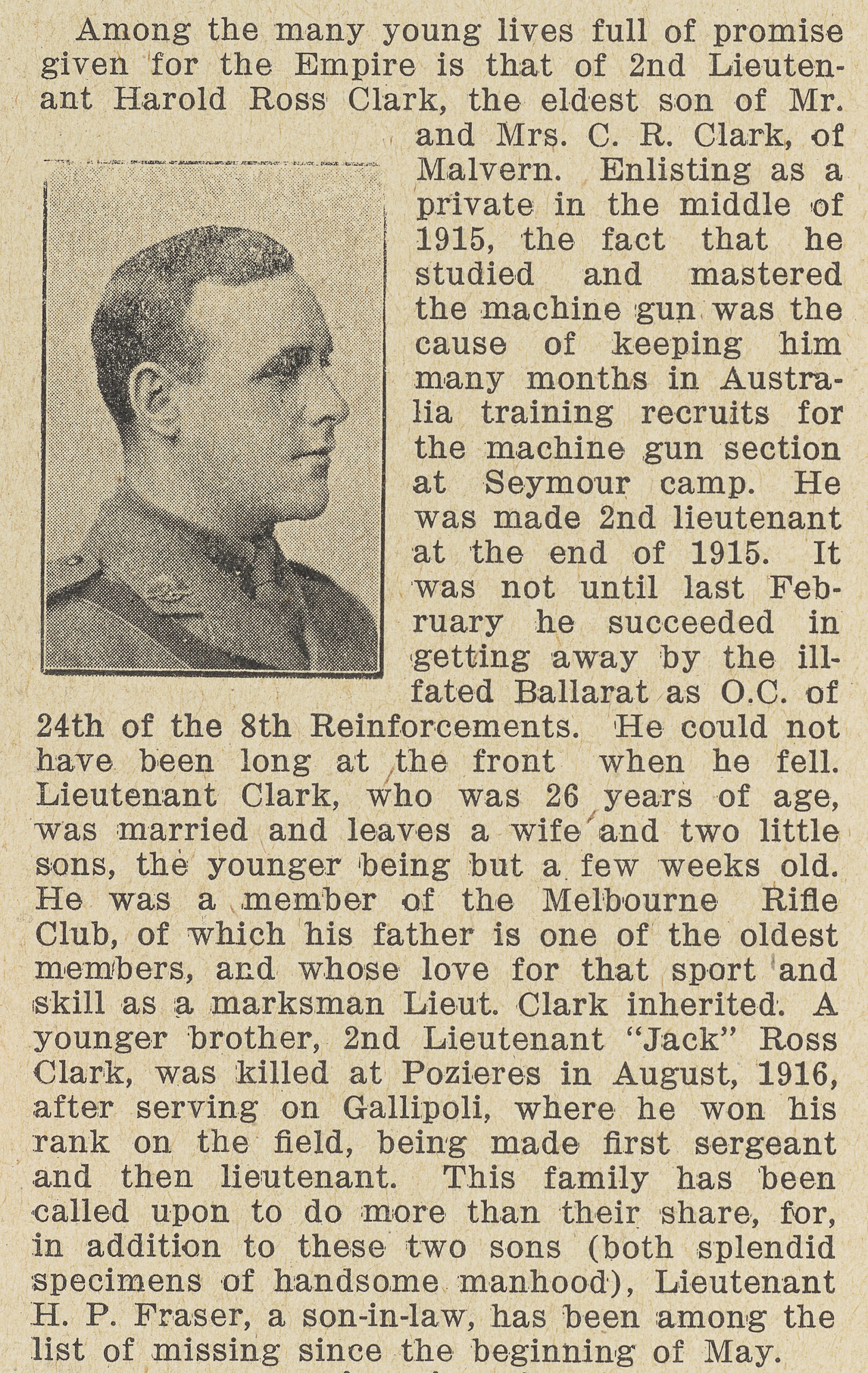
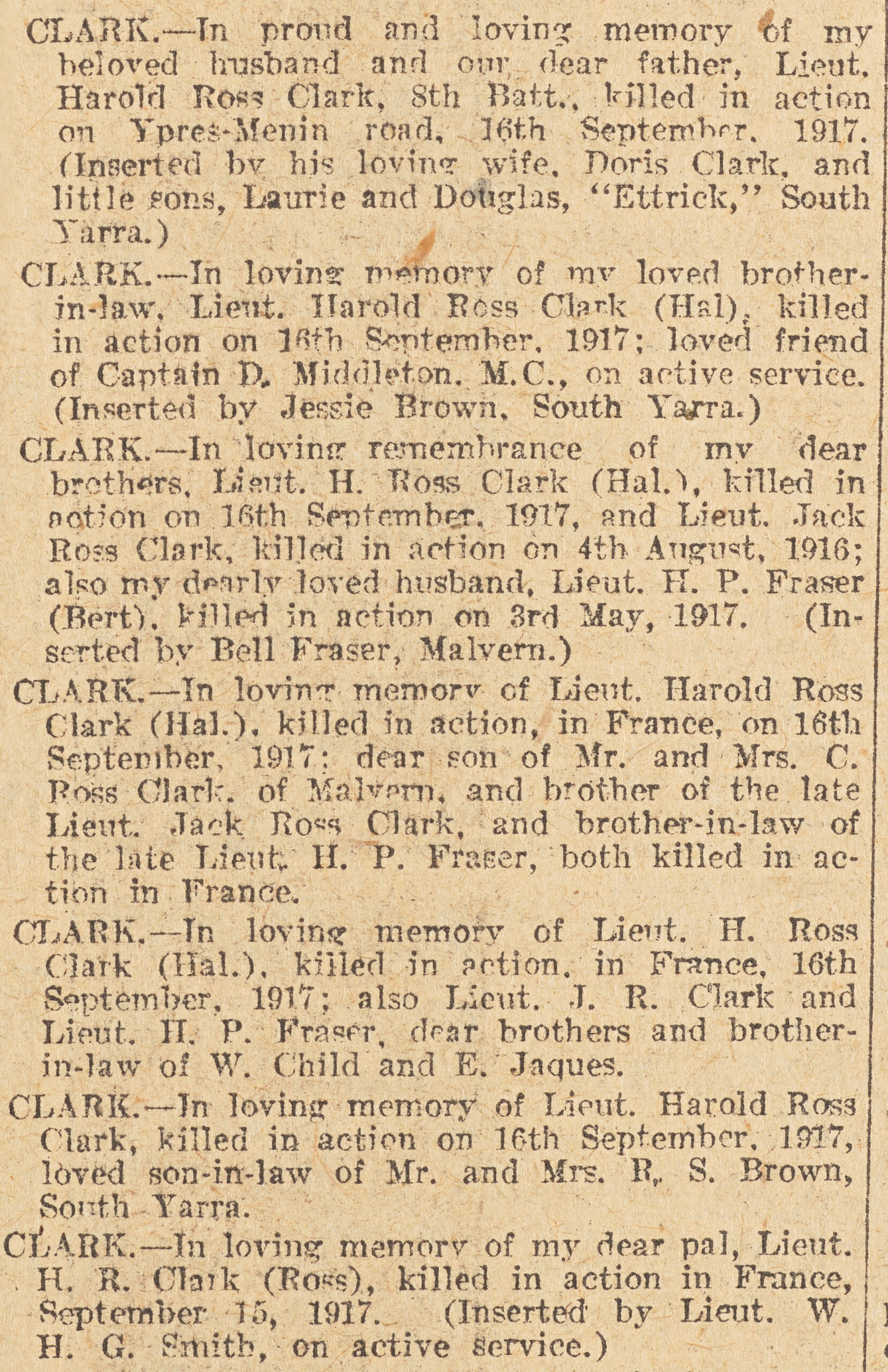
Having identified Harold my next step was to try and find information on his descendants, beginning with his sons – Laurance Ross and Harold Douglas Ross. A search of the Victorian registry of births, deaths and marriages confirmed their birth details and on the Ancestry database I found several entries for the brothers in the Australia, Electoral Rolls, 1903-1980 collection.
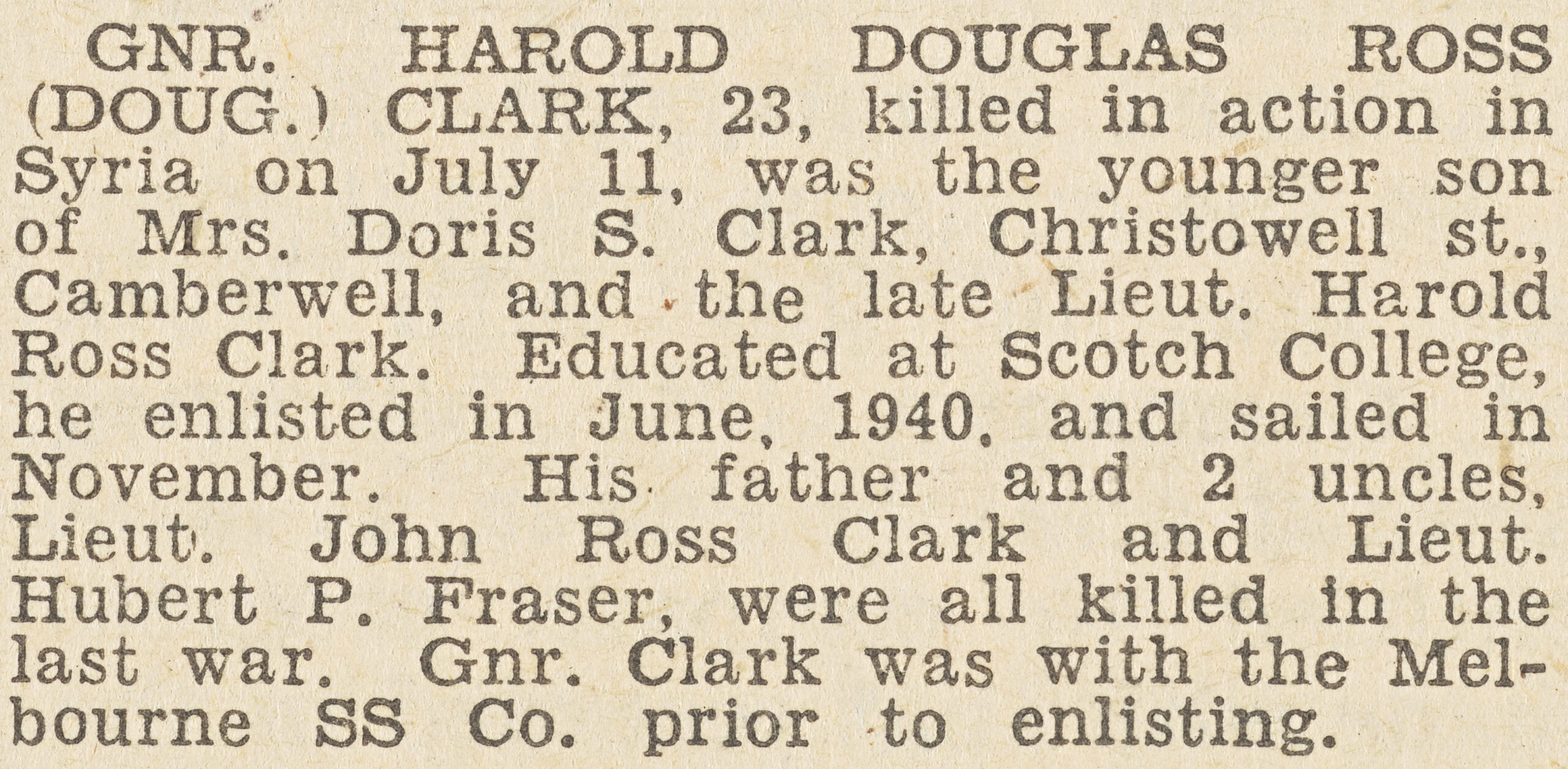
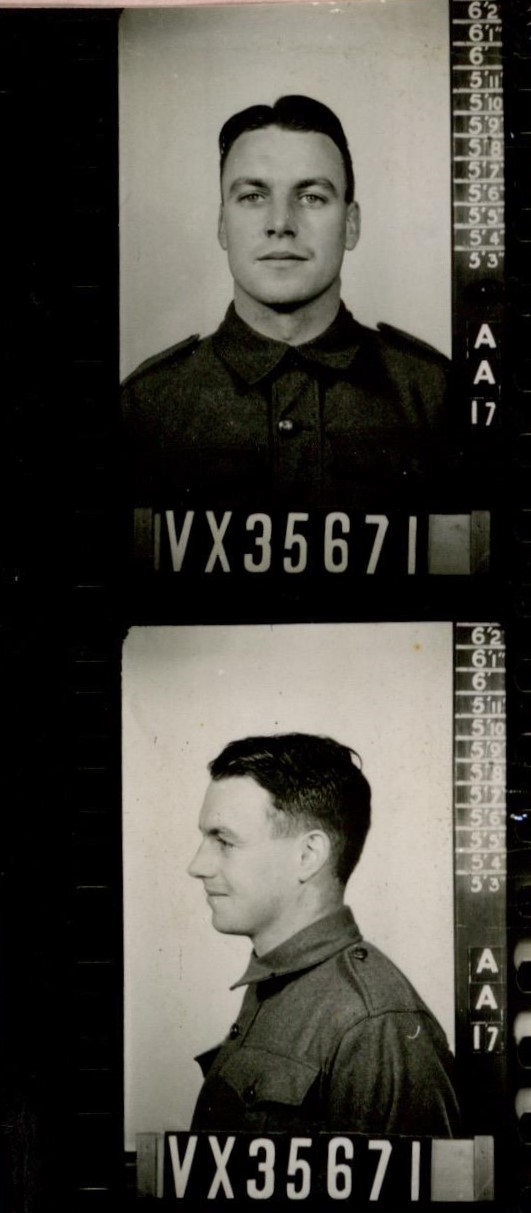
I then returned to Trove in the hope of uncovering more information about the family. It was there that I found news I had not expected – and did not want – to find. A newspaper report which revealed that Harold’s son, Harold Douglas “Dougie” Ross Clark, a gunner with the 2/4th Field Regiment, Royal Australian Artillery, had been killed in action in Syria on 11 July 1941.
It was devastating to know that nearly twenty six years after Harold was killed on the Western Front, his youngest son, Dougie, had also lost his life while serving his country.
I then directed my attention to Laurance and his descendants. Using a range of resources, I managed to find the details of Laurance’s first and second marriages and information about his successful career as a scientist. The Ryerson Index helped me to locate a copy of his death notice in 2002 and from this notice I identified the names of his children. I eventually managed to find the contact details for his daughter Dinah Stehr, who lives in New South Wales.
A few days after being handed the photo of Hal, I found myself ringing Dinah and explaining to her how a photograph of her grandfather had been left in the library. Dinah was thrilled to learn of its discovery and amazed at how I had managed to trace her. As it happened, she was planning to visit Melbourne in April, so we arranged to meet in the library, so I could present her with the photograph of her grandfather in person.
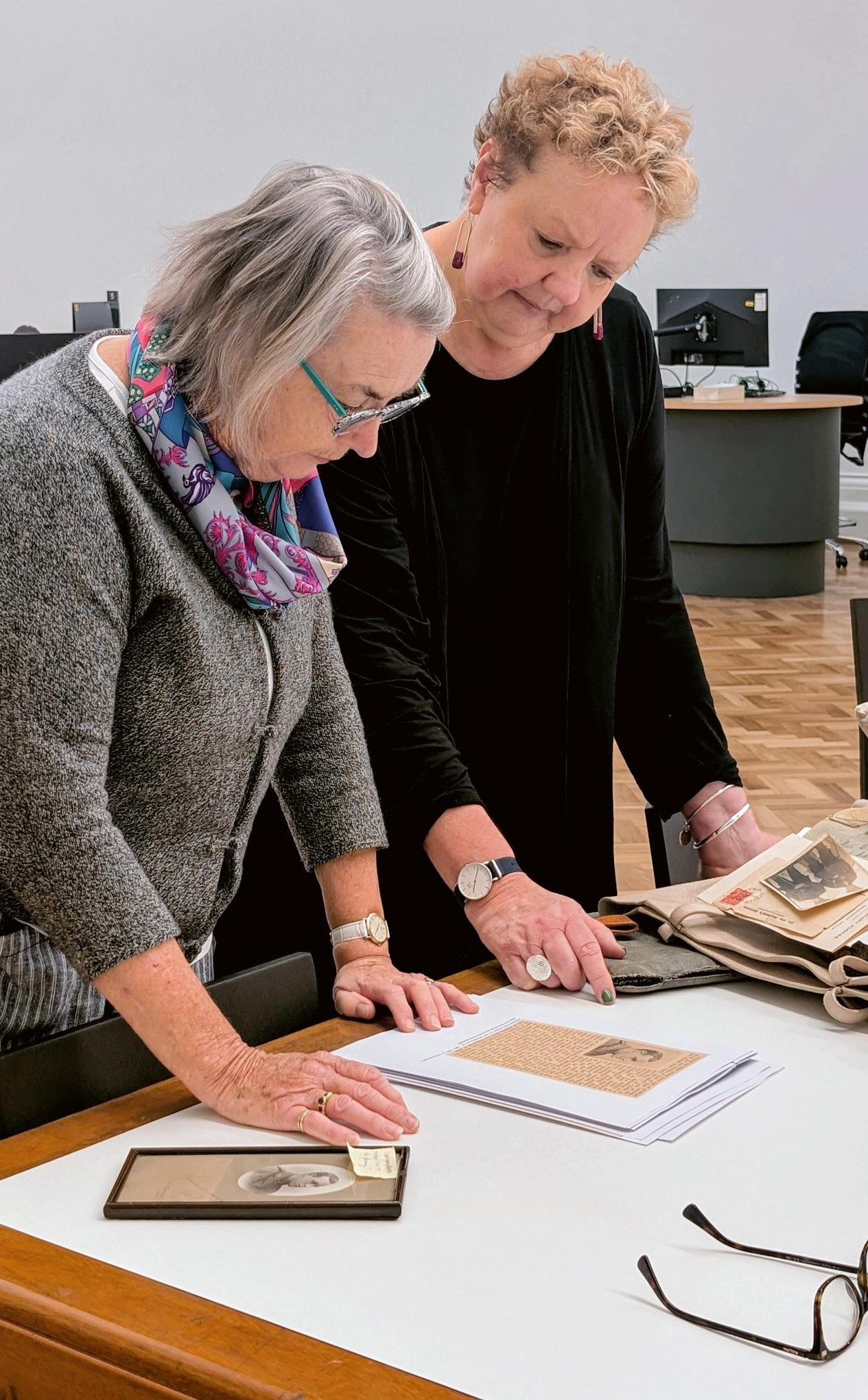
I was so pleased to have had the opportunity to meet with Dinah and to hear stories about her family. Like me, she was also intrigued as to who the good Samaritan was who left the photograph in the library; where did it come from and what was the connection between the original owner and Harold? We were both also thrilled to find out that news of the photograph had reached the journalist Caroline Webb, who published an article on Hal, in The Age on April 17, 2026.
Since then, I have often found myself thinking about Hal’s wife, Doris, and how profoundly her life was shaped by the impact of the two World Wars. Dinah told me how difficult Doris’s life had been and how the deaths of both her husband and her son left an enduring mark, not only on her but on all of the Clark descendants. The dry, formal words in the newspaper reports never really convey any of the shock and grief felt by the family at home, or the sadness and hardship that would be experienced in the years afterwards. Doris’s story is a reminder of that reality.
Of the hundreds of family history enquiries I have researched during my time as a librarian at State Library Victoria, this has been, without doubt, the most rewarding. The experience has also reinforced for me that family history is far more than just documenting names, dates and places. It’s about uncovering our ancestors’ stories, preserving those stories for future generations, and understanding how their lives may have helped shape ours.
I am so delighted that, 110 years after it was taken, the photograph of Hal has finally been returned to his family – where it rightfully belongs.
Further information
For further information on how to research World War I and World War II resources please see the following guides and collections –
Australians in World War I – research guide
Researching your ancestors’ occupations – Armed forces – research guide
Researching your World War II ancestors – blog post
War – a collection of online databases
World War I Unit Histories – digitised collection


That was a great read and a terrific story, thanks.
Thank you so much for sharing this incredibly moving and beautifully told story, Ann. Your dedication, detective work, and compassion in bringing Hal home to his family after 110 years is truly inspiring. It’s a powerful reminder of the human stories behind the names and dates, and the profound impact our work can have. Thank you for preserving this legacy and reminding us all why family history matters.
Bravo! An incredibly moving story. Ann, as you say, a rewarding effort piecing together all the information to arrive at yr Eureka moment for Hal’s family .Dear Doris had to endure a lot. Makes me think of Pete Seeger’s anti war song “Where have all the flowers gone”.
Wow amazing work! What luck Angus and you saw the faint inscription—- this was the key that unlocked the whole story!
Great story, one point I noticed wasn’t correct is the acronym AIF stands for Australian Imperial Force, otherwise a great bit of detective work
Hi Dan. Thank you so much for pointing out the AIF error. I have now corrected it. Kind regards, Ann
Wow! That’s incredible. Thank-you for your diligence and perseverance, and letting us read about it.
Wow Ann! As a family history researcher myself I can understand the Eureka moment so well – they do happen infrequently though, if family members have a clean out and delegate ‘old stuff no-one wants’ to the bin. My heart weeps. Well done for your hours of painstaking work going through those very familiar resources – you should be very proud of your efforts.
What amazing research skills you have. You really have achieved with this piece of work.. Congratulations to you
Thank you Ann. The details of this work are most interesting. It has certainly reminded me to get back to the task of preserving family history .
The sad loss of so many young men women and children in wars
is truly tragic.
Thank you Ann
An amazing piece of work on your part!
I can’t help but think of poor Doris, who had more than her fair share of grief. And to lose one of her sons in the next war!
War is never OK. We really must learn to talk and listen and use negotiation instead of killing each other!
How wonderful that you could trace the family. Wbat a tragic,sad story. As you say until you can speak personally to the descendants you can not feel the effect of tge sad events suffered. The parents losing two sons and son-in-law and then their grandson, we can only imagine what they endured. A really great effort on the part of Ann and tbe library.
Congratulations on such a satisfying result! Such a tragic story for the family to endure.
This is an amazing story. Mystery solved! Thanks to the wonderful and committed team who work on these old historical documents and I assume mainly volunteers. It pulls at my heart strings! If only everyone could piece together info for just one family member…it would be a wonderful memorial to our servicemen and women. I treasure the diaries, papers, photos and stories handed down to our generations.
Lest we forget!
As an Ex. Detective Sergeant I commend you on your detective work. I see you work in the right place.
Congrats Anne
Great outcome and story!
Well done Ann. After visiting the WW1 battlefields and cemeteries of France/Belgium I sometimes trace the fate of some of those who lie here. It helps me understand a little of what these men went through and the effect on their families. Rather than just a name it makes them human.
thank you for sharing , loved reading this story
Excellent story, you did well. Thanks for sharing
Ann, you have inspired me with your sleuthing. I have a great uncle from Melbourne who was killed in France on September 11, 1916, so I know more about him than you did about Hal. However, I know little else about him including about his family. I do have his diary and 40 or so letters he wrote home before he was killed (given to me late last year): they have remained untouched for 110 years. I now feel obliged (and privileged) to write his story, but there are many gaps. You have given me some terrific clues for further research. I also need to work out where these documents should reside. SLV?
Hi Andrew,
Thanks for reading the blog. Yes SLV collects diaries/ letters in our Manuscripts Collection. If you would like to offer collection material to the Library, you can do it via our online form:
https://www.slv.vic.gov.au/collection-offers
Thanks
Paul
Andrew, write about you do know, first and foremost, from what has been entrusted to you. His immediate family you should be able to find from family sources, Ancestry.com and the newspapers via Trove.
His Diary and the 40-odd letters home show the soul of the man and this is the most important thing to capture.
His official records can be added later and woven in. Don’t put it off till you get time to research fully, or it may wait another 110 years…Shirley
Such an amazing story! Well done Ann on your persistence. It certainly paid off.
Being a family historian and a Library Technician I know what it is like to get on that research train and the thrill of finding what you have been searching for.
My grandmother lost her beloved oldest brother and my great-grandmother her baby brother in WW1. Very sad for the families. One of my related families had a similar story where they lost both a husband (WW1) and a son (WW2).
Congratulations and well done researchers.
You have shown so much respect to Hal and his family. A very sad, true story and one which many families at the time, and even now, identify with.
And shows what a fine person you are.
Thank you.
Joan Fitzpatrick
Thank you for sharing this story and for all the good work that is done at SLV.
Heartwarming and heart rending. I looked up CR Clark in Malvern via the SLV’s 1915 Sands and McDougall, and found their house long gone at Gordon Grove.
Harold lived about 250 metres from Malvern Station, and may’ve caught a train to Monteath’s Studios at 296 Collins Street, Melbourne.
Vale Harold and his youngest son
Intriguing. Devastating, Thankyou for your hard work and the story.
A fantastic result and a compelling read. The feeling of accomplishment when you unlock or uncover information is so rewarding. Well done and thank you for sharing.
An emotional and amazing story, thank you for sharing. I have a rather sad story about my Step
Grandma and a WW1 Soldier, Killed in Action on the same battlefield in 1916. Grandma always believed John or Jack Sparks was her Brother who had brought her to Melbourne from their home in Wonthaggi to find work before he enlisted for Service. Grandma had lost her Mother in Childbirth and always believed Jack Sparks was her Brother.
My Cousins visited the War Graves and found the details of Jack Sparks.
Growing up without a Mother must be difficult at any time let alone in a country mining town where the Miners made little money and worked like Navvys and lived as best they could, usually having large families. Grandma often referred to her Cousin or a relative whose name was Frances (Fanny) and apparently Grandma had been staying with her and her very large family and one of France’s Daughters had a Birthday and Grandma asked when her Burthday was and she was told the 19th July. The day of France’s Daughter.
Grandma celebrated her Birthday on that date every year until she was wanting to apply for Passport
Hannah Isabel Sparks was not recorded and one way and another we found her Birth Certificate with her Birthday in June rather than July. Grandma was registered as Hannah Isabel Hutcheson (her Mother’s maiden name. Grandma sailed on that World Tour in 1967 with her Sister in Law.
We all have a story don’t we?
What a wonderful article and an impressive piece of research. I’m glad the photo has finally found its way back to the family. It’s a powerful reminder that the losses of WWI and WWII continue to echo across generations even today.
I think of Doris too! Such tragic loss. Very moving story of dogged persistence to do a favour for a family, Inspiring, thank you for the story but most of all for your humanity and kindness.
Ann, this is a wonderful story! Thank you for sharing it. I can only imagine how hard the lives of those left behind by Hal would have been. That a photo of him should surface to remind us that his life & journey mattered & that someone was kind enough & thoughtful to entrust this with you, unknowingly that you would follow through; wow that is something else !
Terrific story Ann, keep up the good work
Kudos to you, your knowledge and your persistence. You really appreciate the treasures of our past that are placed in your trust.
Great story Ann. The impact of both world wars on those at home dealing with such dreadful losses has implications for generations. My grandfather worked for the agriculture department teaching farmers how to prune fruit trees was given a white feather by a woman during the first world war. Marking how m as a coward. Even so he was personally against Australian men being recruited for what he termed an English war that had nothing to do with Australia.
My heart goes out to the Clark family. Ann, you have, no doubt, shared in their grief but rewarded with finding Dinah.
We are so fortunate to have the research facilities, services and people to help us piece together our family history.
It truly is a rewarding and sometimes heart wrenching journey.
Thank you!
A moving account and a wonderful example of research by skilled librarians and the accessing of reference resources we are so lucky to have available through the SLV.
Well done Anne, what a great bit of detective work, and how sad that Dougie was killed also.