
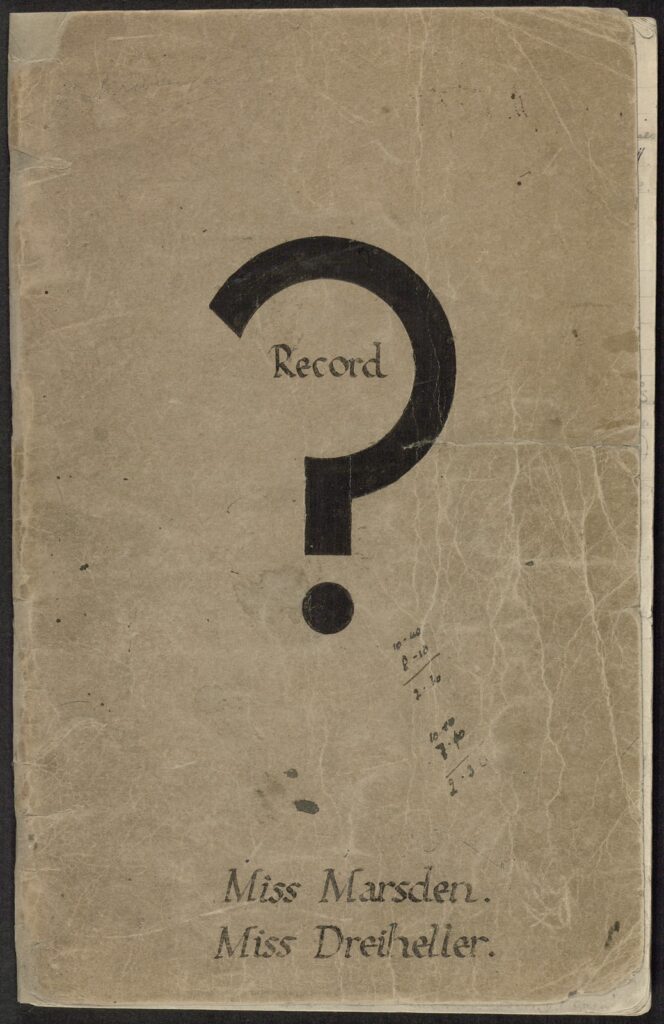
Front cover: Enquiry register, 1946-1949; MS 10628
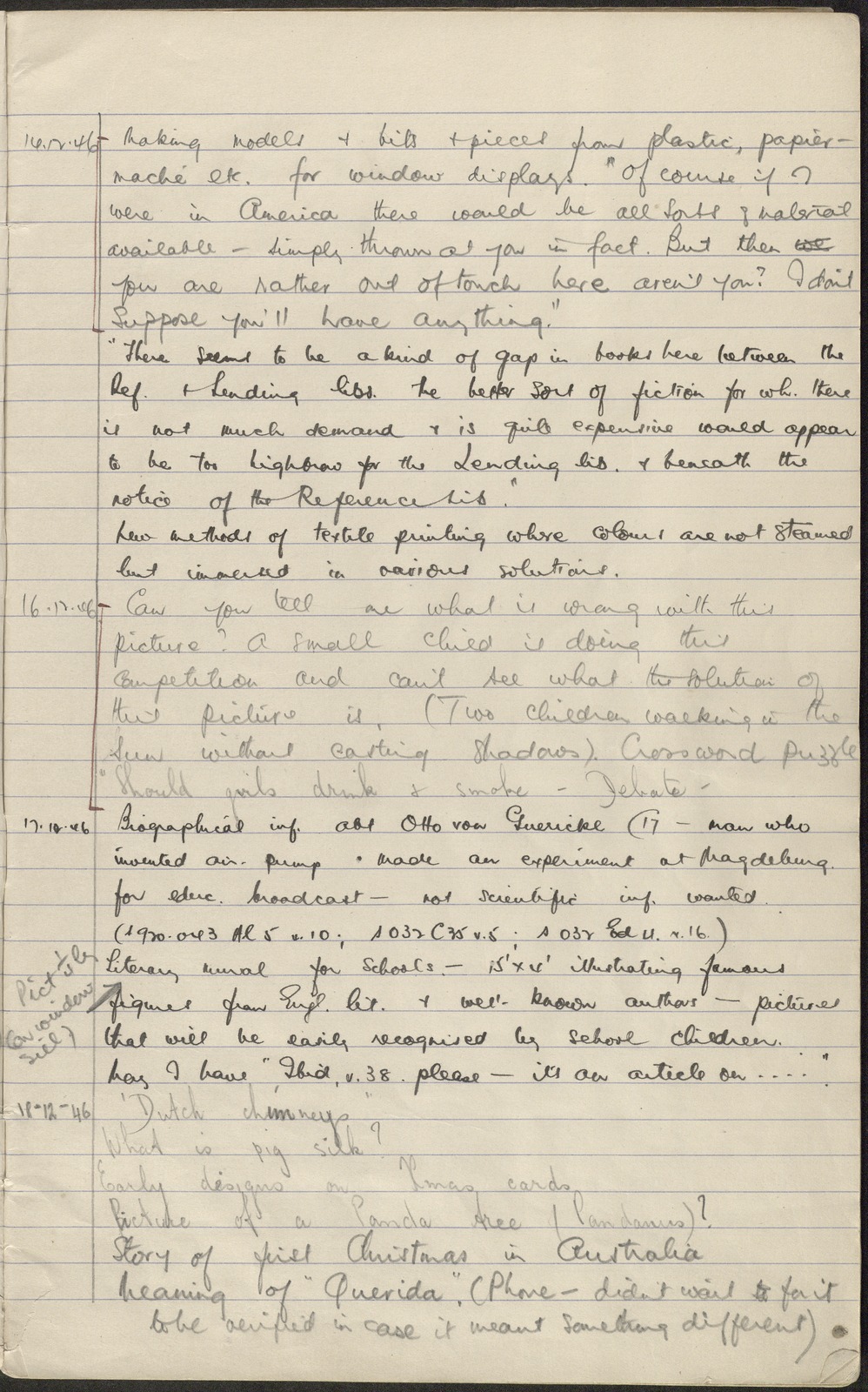
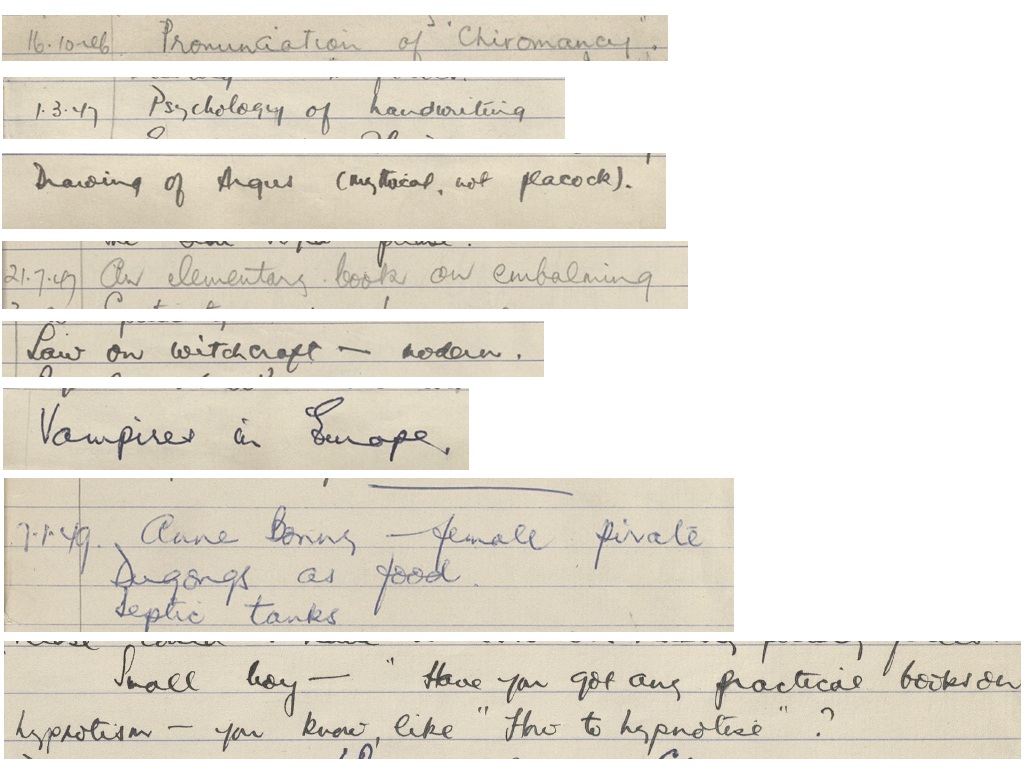
‘Orrery, Movie cartoons, Head shrinking. Pisé houses. Log cabins. Picture of devil. Elephant’s Child. Origin of popular songs…’1
So reads some of the first entries in a curious handwritten notebook held by State Library Victoria: Enquiry register, 1946-1949 (digitised and available online). This is a record of questions2 asked by members of the public of two Library staff working front of house in the late 1940s (credited on the cover as Miss Marsden and Miss Dreiheller). The impetus to create such a record is unknown3, though, as a member of the reference librarian4 team staffing an equivalent service – approximately 140 years after the first enquiries desk was established at the Library (The Australasian, 11 September 1886, p 43) – I understand the desire to record the varied and interesting questions we get asked everyday.
With dated entries running from 1946 to 19495, this notebook, often directly quotes patron interactions.
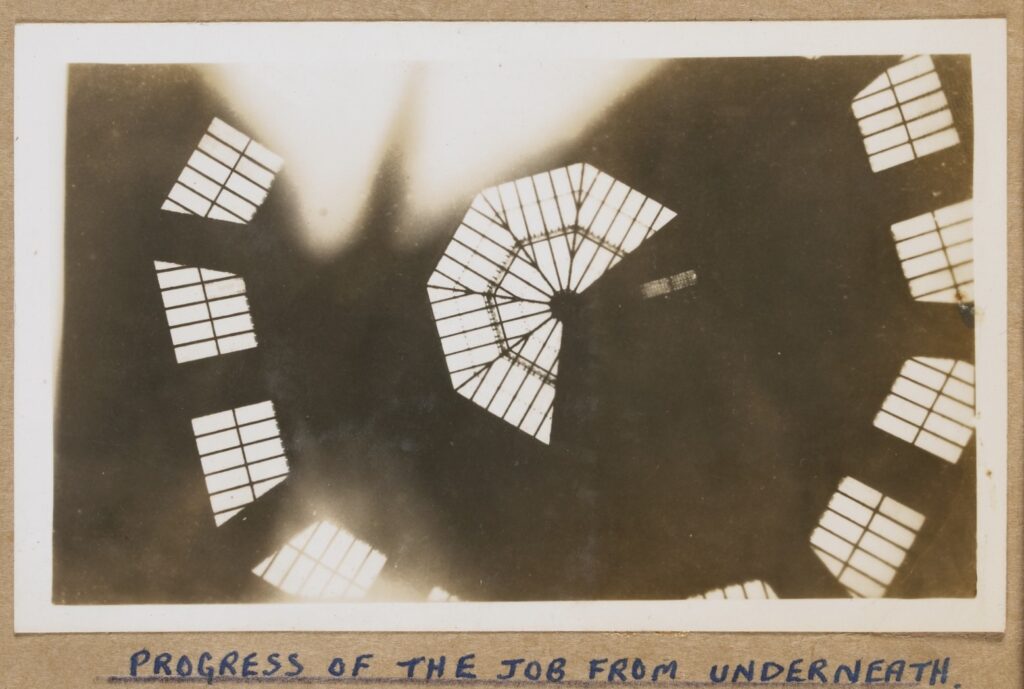
During WWII the windows of the domed reading room were painted black as part of a brown out across Melbourne.6 This eventually damaged and cracked the panes (The Herald, 14 November 1946, p 5), leading to a patron in 1946 commenting: ‘It’s very dark in the reading-room, isn’t it (NSW visitor)’.7 In June 1947 the glass was eventually replaced (The Argus, 9 May 1947, p 20).
H2003.67/9Patrons asking what the library hours are on Sunday, or if the library is open, would have received very different answers depending on when they asked. Although there was a public desire to have the Library open on Sundays, it only opened in the afternoons from June 1944, and closed once more from December 1946.8
There are details of an interaction with a patron, which sadly shows what some returned WWII soldiers were dealing with – highlighting the role that libraries play as a place for people to connect, seek support, or ease loneliness and social isolation with a listening ear. This entry refers to Mont Park which was known as the Mont Park mental hospital at the time.
Schizophrenic on leave from Mont Park for xmas wanted to read bk. on insulin & electric shock treatment – had been drinking – very odd. (Brought on during war but must be hereditary – sister has it too but won’t get treatment.)9
It also shows the Library as a place people could go to do their own research with no associated cost. It was potentially the only place where such an enquiry would be taken seriously.
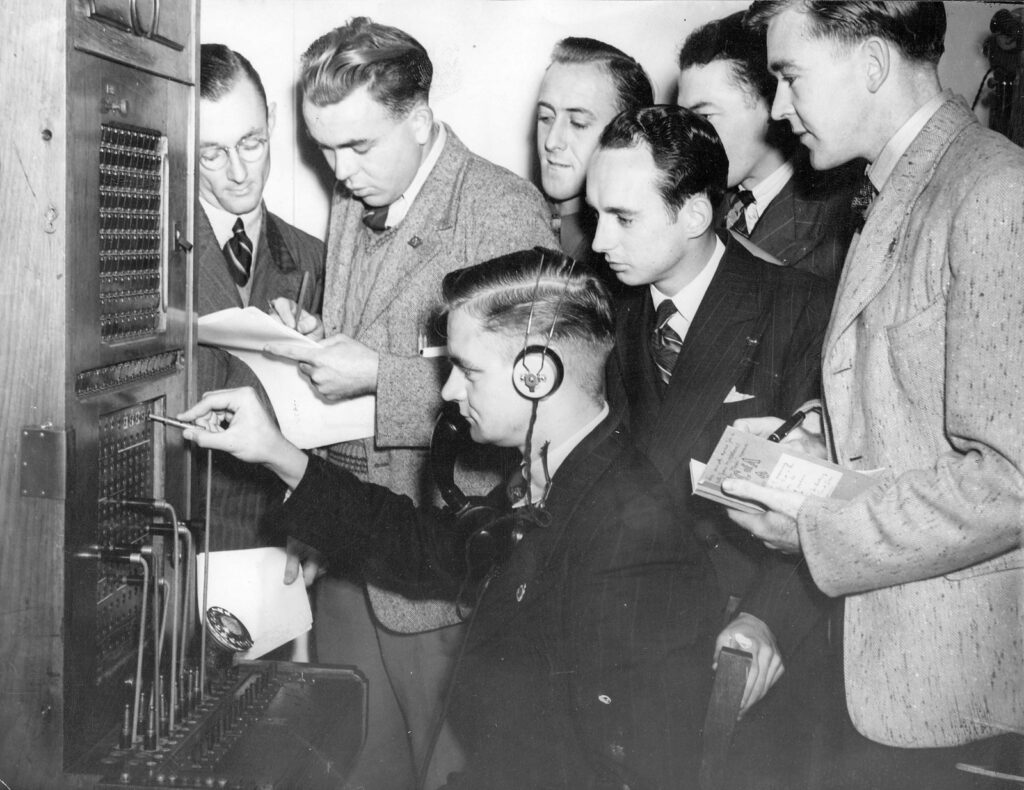
As happens today, people would call the Library on the telephone to ask their questions (The number was Cen 384810 which would have gone through the central telephone exchange). There is more than one example of someone calling to settle an argument or bet, using the library to verify a fact.
Phone – “You’ll probably think I’m screwy, but can you tell me who wrote – the Assyrian came down like a wolf on the fold11” ? Ys. Byron “Oh, dear – not Walter Scott?” no Byron. “you’re quite sure that it was Byron & not Scott?” Yes “oh, well, thank you, I’ve just lost five pounds”12
The register is full of fact hunting/confirming enquires that are not asked so much anymore. A question such as ‘is Einstein still alive?’13 (At the time it was asked the answer would have been ‘yes he is’14. He died in 1955: The Argus, 29 April, 1955, p 2) is now quickly answerable on devices most people have in their pockets or bags. Questions about hours and services, such as ‘is the library open on Cup Day?’15 on the other hand are still regularly asked (Yes we are open on Cup Day!).
This book is a peek behind the curtain, sometimes revealing the frustrations of a difficult interaction, often with a bluntness that wouldn’t be evident in a face to face interaction, saving impassioned exclamations (and occasional unflattering descriptions) for the written page.
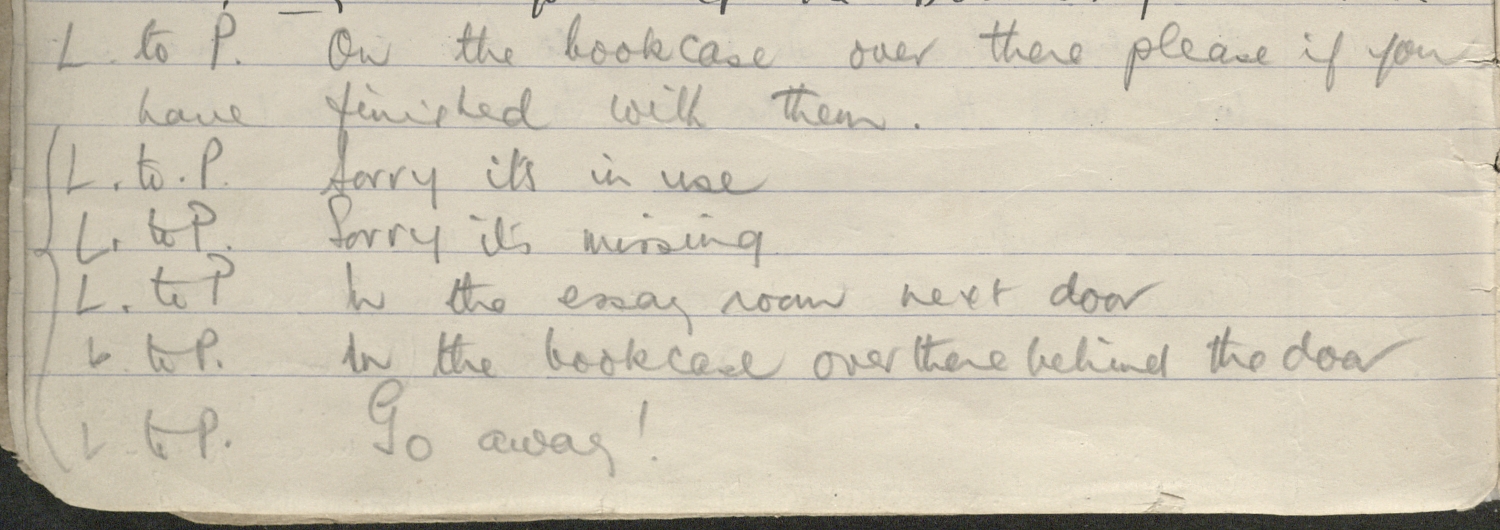
Sometimes the patron doesn’t have a query so much as having something they want to get off their chest. I’m not sure what the response to the following interaction would have been at the time.
Widows old age pensions. “She’s not a widow at all & lives in the next street to her husband – ran away from him and won’t acknowledge him to be her husband who is pretty old & can’t get the old-age pension because he is English & can’t get his birth certificate. She gives him a dreadful time. She’s got a good job & besides goes around after any man she can get hold of & they don’t do that for nothing so she’s pretty well off & besides all that she says she’s a widow & gets the pension. She’s a wicked woman that’s what she is & something has got to be done about it”16
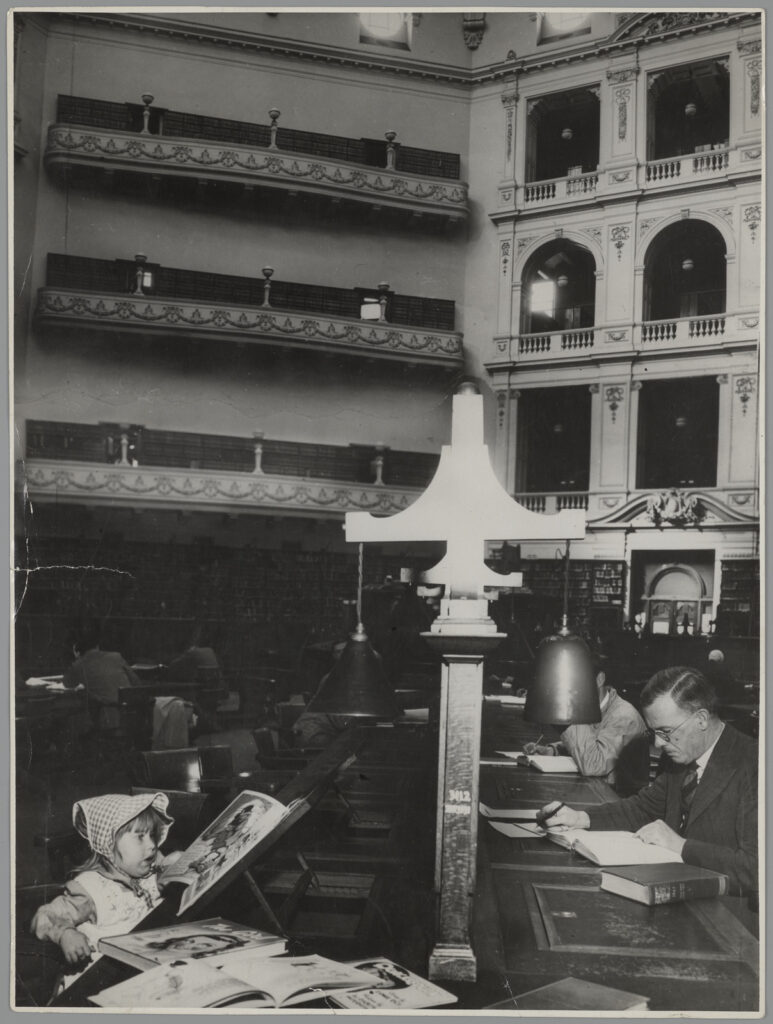
Unlike public or university libraries, once material is in the State collection, it remains there, meaning the collection of the Library is an unbroken history from when the doors first opened in 1856 to today. It also means that material asked for and references used in the enquiry register are (for the most part) still in the collection and still able to be consulted.18
Who were they?
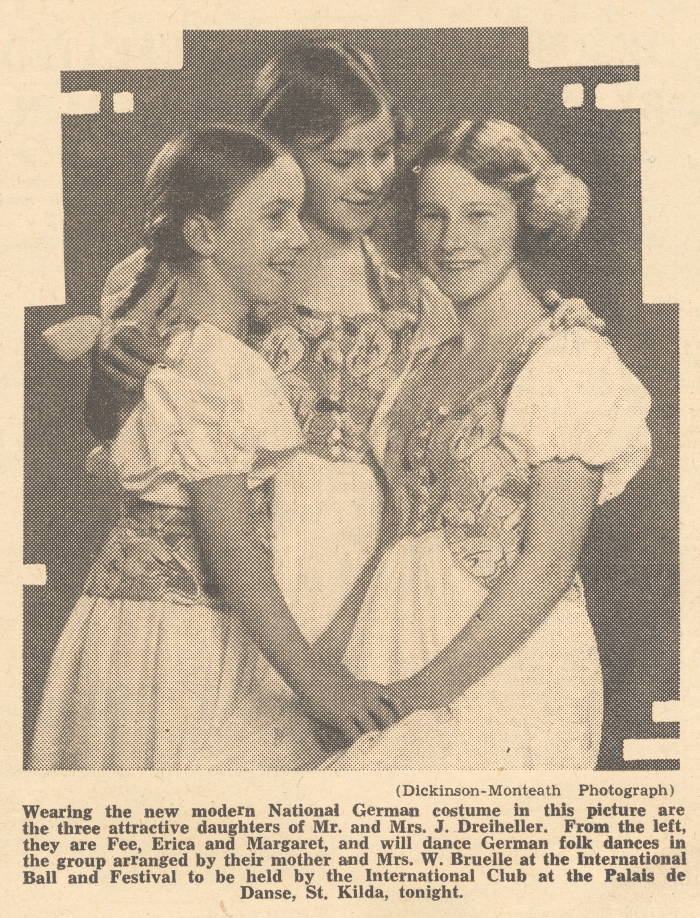
Who were the two women who compiled this enquiry register? While full names are not given in the notebook, a bit of digging reveals the authors to be Mary Marsden and Erica Dreiheller, both in their 20s at the time, who worked as Library assistants in what was then known as the ‘Public Library of Victoria’.
One of the early questions asked in the register is ‘how do you become a librarian?’19 Both Mary and Erica started at the Library before the Library school (in 194820) and before the existence of a dedicated Library degree. The prerequisite to work as a librarian – was a Bachelor of Arts degree21. Mary and Erica both graduated from The University of Melbourne with a Bachelor of Arts degree (with honours) in 194122 and 194623 respectively.
Mary Marsden was employed in a temporary capacity as an assistant librarian around 194124, becoming a permanent employee in February 1946.25 Erica Dreiheller was employed as a temporary assistant librarian around 194626, becoming a permanent employee in September 1947.27 By April 195028 Erica had left the Library, with Mary leaving around 1951.29 This was still a time when, once married, a woman could not continue in a permanent public sector role.30 This practice was not officially overturned until 196631 (Canberra Times, 17 November 1966, p 20).
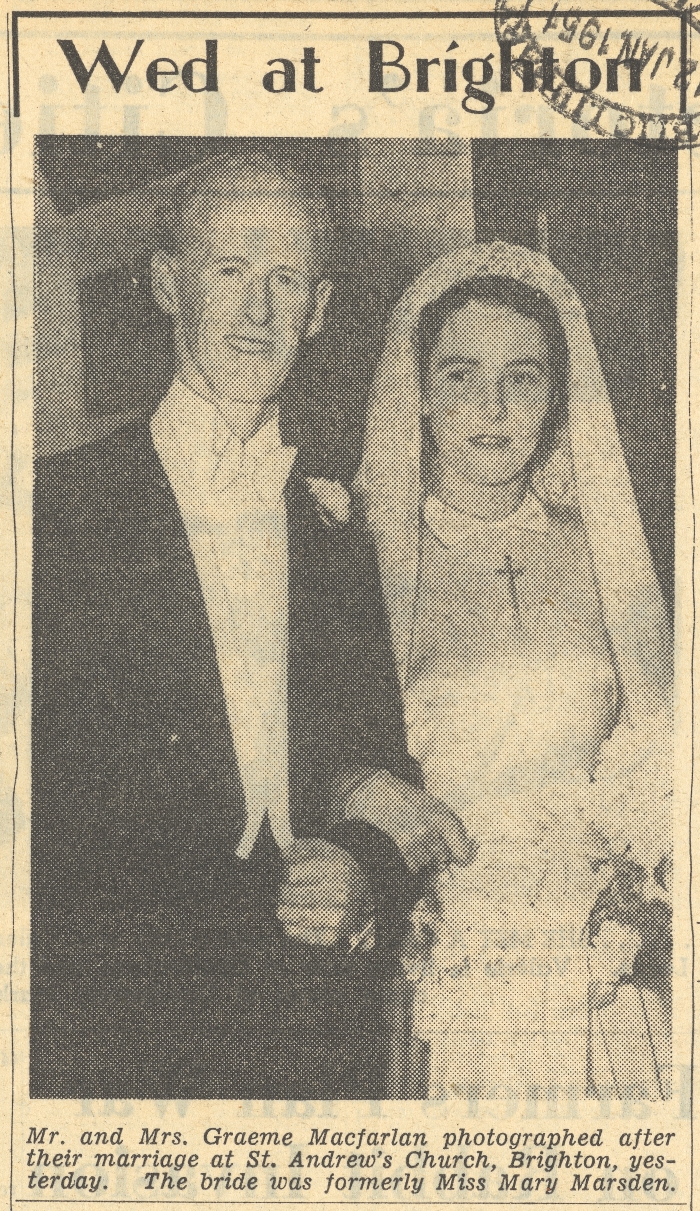
Mary was born in Sandringham 1920 (The Argus, 18 May 1920, p 1), and married fellow ‘Public Library of Victoria’ librarian, Graeme MacFarlan, in 1951. She died in 1994 aged 7432
Erica was born in South Melbourne in 1924 (The Argus, 5 January 1924, p 11) (her parents having emigrated from Germany a few years earlier). She married William Barrett in London in 1950 (The Age, 32 August 1950, p 5) and moved to New Zealand, where she died in 1988 aged 64.33
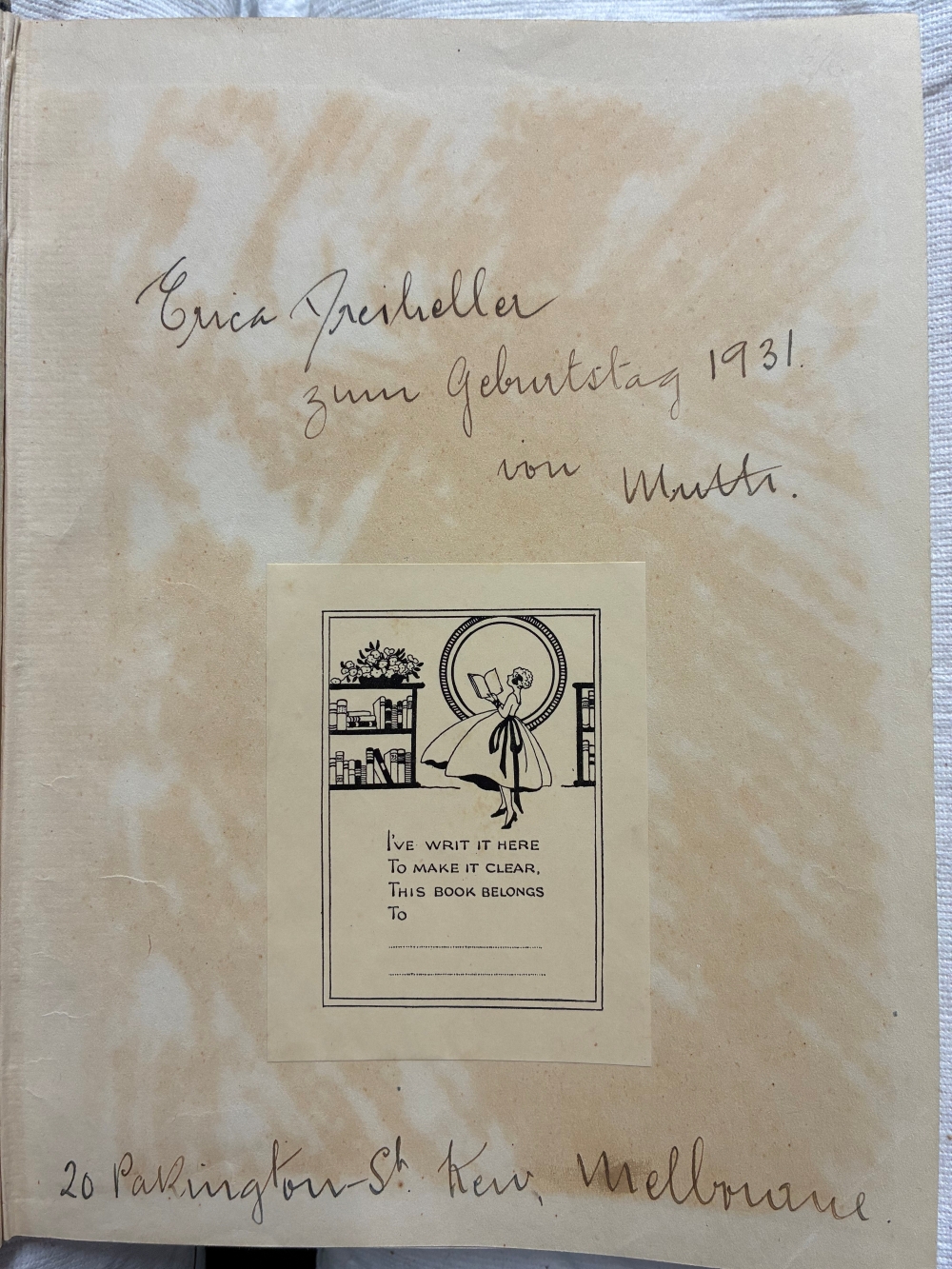
The National Library of New Zealand holds a copy of the children’s book Fairies & Fancies (Published in 1929, featuring poems by Sydney based poet Ruth Bedford, with illustrations by Austrian illustrator Mela Köehler-Broman) which is of particular interest. It has a handwritten inscription ‘Erica Dreiheller, zum Geburtstag 1931, von Mutti.’34 essentially translating to ‘happy birthday, from mum’. This book made its way to New Zealand with Erica (who would have been 7 when she received it) and found its way into the Library collection – important and loved enough to travel with the adult Erica.
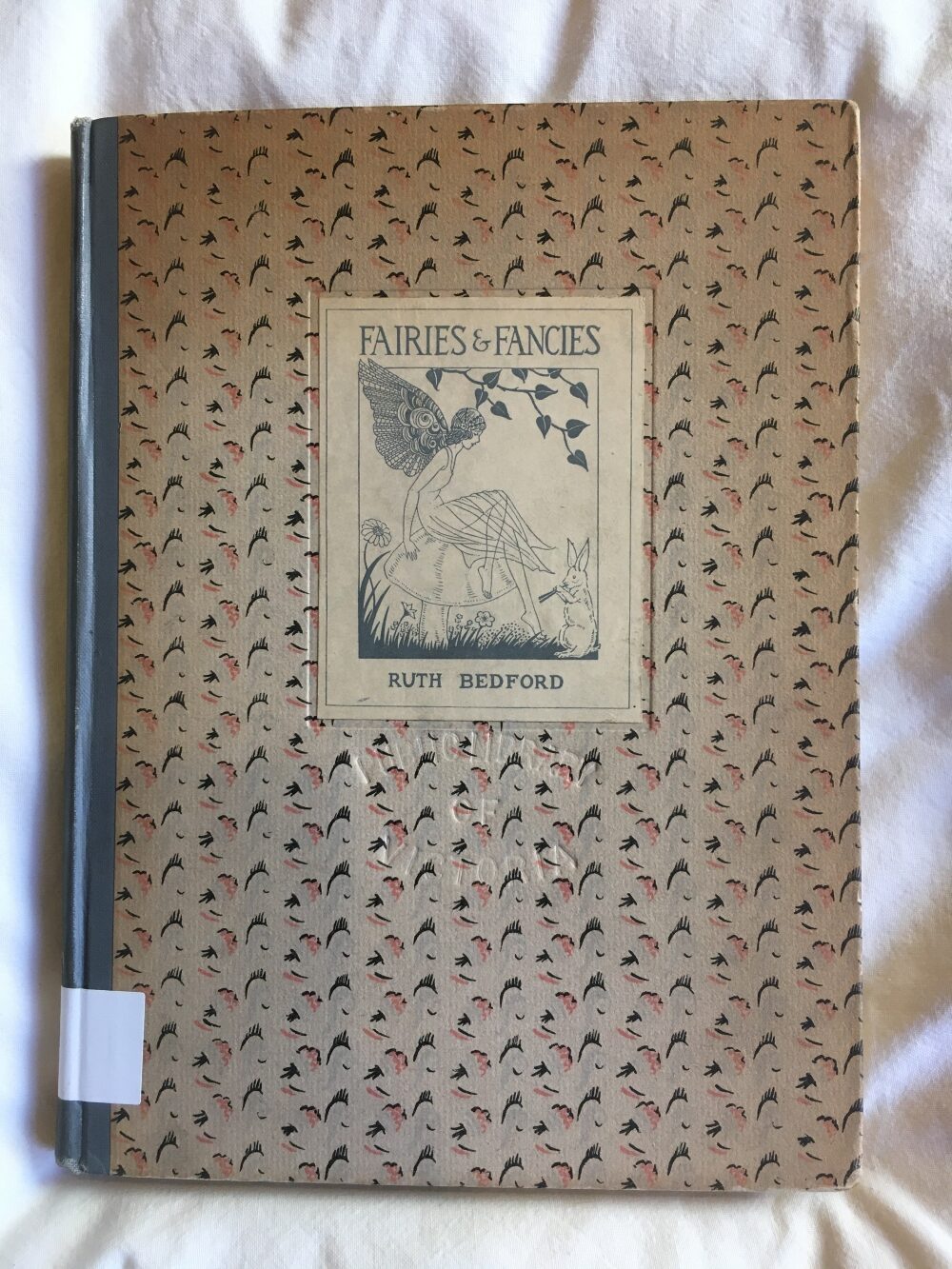
Left: The State Library Victoria copy of the book which would have been in the library collection when Erica worked there (note ‘Public Library of Victoria’ embossed below the author’s name). Fairies and fancies / by Ruth Bedford ; with seventeen page illustrations by Mela Koehler Broman. Photograph by author.
Right: Inscription and bookplate on flyleaf of the National Library of New Zealand (Dorothy Neal White Collection) copy of Fairies and fancies / by Ruth Bedford ; with seventeen page illustrations by Mela Koehler Broman. Photograph courtesy of National Library of New Zealand.
Changing times
There is a clear change in the makeup of staff at the Library post WWII. In 1944 there are 3 women working as assistant librarians35, in 1950 there are 15.36
There are a few examples in the book of patron interactions which show a dismissive attitude towards women in the workforce.
Thanks, but the other gentleman is getting my book37
Debate on “Woman’s place is in the home” !!!38
There are queries that give a window into some of the behavior women had to deal with from men at the time.
Phone ” Can you tell me what the word … means? a man said ‘you’re a …’ to a girlfriend of mine & I don’t know what he meant, but probably it wasn’t complementary” (looked up Partridge & decided not to tell her anything)39
While the following interaction reads a bit like a comedy routine, it happened at a time (1948) when it was illegal be to gay, with the death penalty still in force in some cases40:
Well dressed elderly man (nice bloke) “could you tell me where your Webster’s dictionary is kept? -perhaps you might be able to tell me this – you people are supposed to know just about everything. What is the meaning of this word – Lespian?[sic] I’ll tell you why I want to find out – a friend of mine called a lady that the other day “you’re quite a … these days aren’t you?” and she slapped him in the face. He said to me after that he had meant to say thespian & we must find out what this word means” Suggested Lesbian – looked in Webster’s & then he realised what the face slapping was all about41.
The following transcription captures the verbal nuance of an inappropriate proposal, directed to one of the female librarians-
“you’re a niche respectable girl, now why don’t you get shome nishe fella who lovesh you and marry him? I’m a bit too old f’you yshee I’m 46 and beshides I’ve got thish vishe – everybodysh got one vishe and mine ish I drink too much I shpend a fiver a week on beer – you’re sush a nishe reshpecble girl.”42
This was not the only patron who was a bit worse for wear after imbibing alcohol. I’m not sure the 8000 words described in the following interaction were ever written:
“I’m in a bit of a hole Miss. It’s like this – it was my birthday last Thursday and I drank a good bit of beer – probably more than was good for me but that’s no crime is it? Anyway I promised that I’d write 8000 words by Monday on women in industry, and here it is Saturday and 8000 words is a lot of words to write. Now I haven’t got any ideas and what am I going to write about can you tell me Miss I’ve got to do it by Monday eight thousand words” (had been consoling himself with even more beer)43
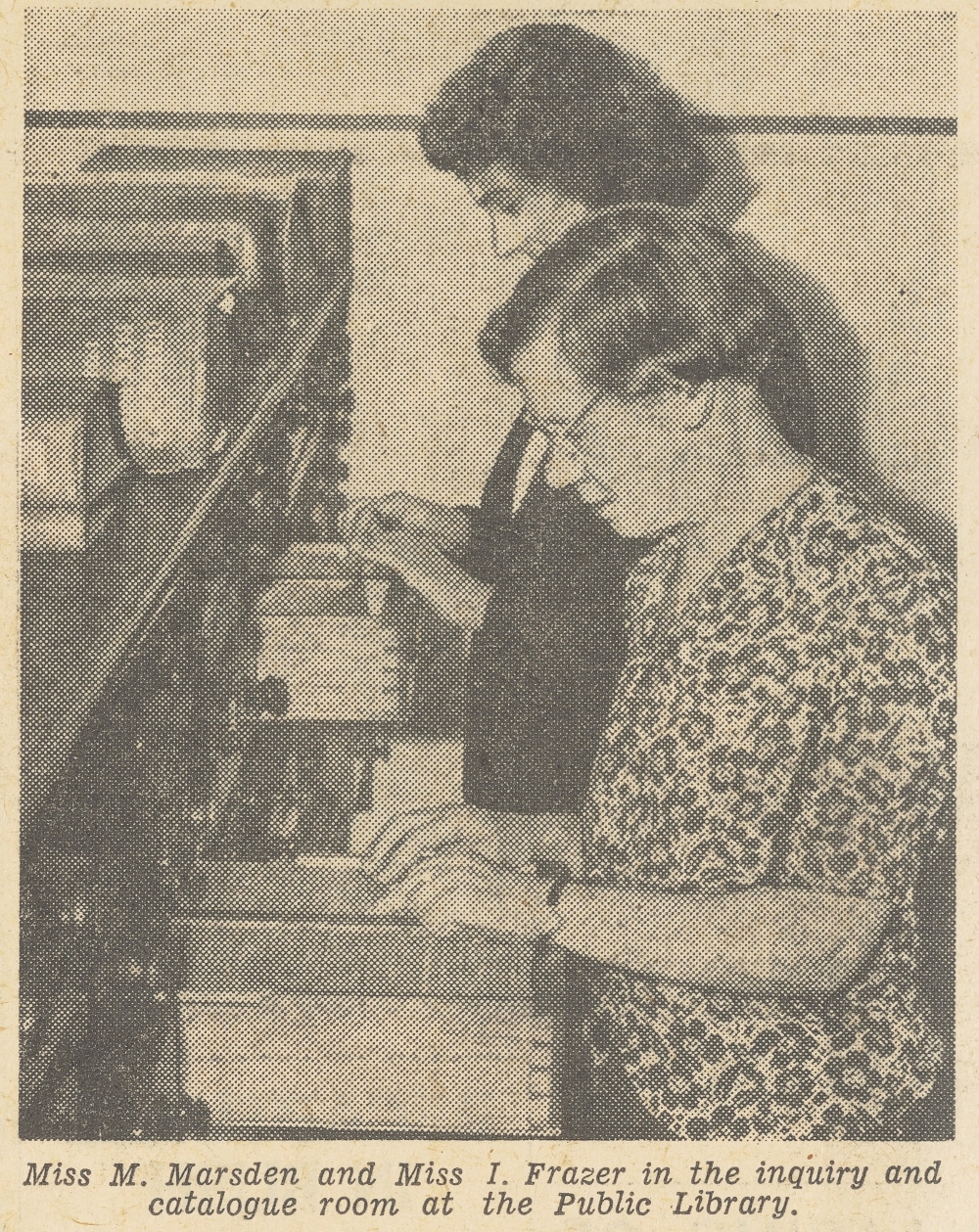
It seems that all sorts of questions were taken in their stride. The answers given in a 1945 newspaper interview by two unnamed librarians (most likely Isabella Fraser and Mary Marsden) not only reflect the questions captured in the register, but show that the core of the job has remained unchanged, a spirit that has carried through to the current reference team.
“The work is not only fascinating, but absorbing and satisfying.” One is kept abreast of all modern developments and happenings, and at the same time is able to make endless interesting contacts with people of all types and ages. “We have to be alert and able to cope with a variety of questions, some of which are staggering and even embarrassing, but we really love the job,”
The Age, Wednesday 14 March, p 4
All things must pass…
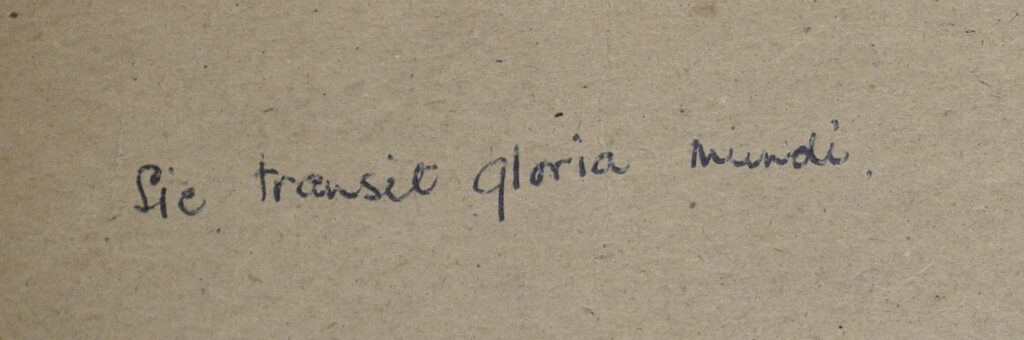
Inside the front cover of the Enquiry Register there is a Latin phrase inscribed ‘Sic transit gloria mundi’ loosely translated to ‘thus passes away the glory of this world’45 (or ‘so passes away the glory of the world’)46 which acts as an epitaph for Erica and Mary’s time at the library, and to the book itself (or perhaps it was an answer to a question about the first line of one of the first published Emily Dickinson poems47). Time moves on, this record of the present becomes a relic of the past.
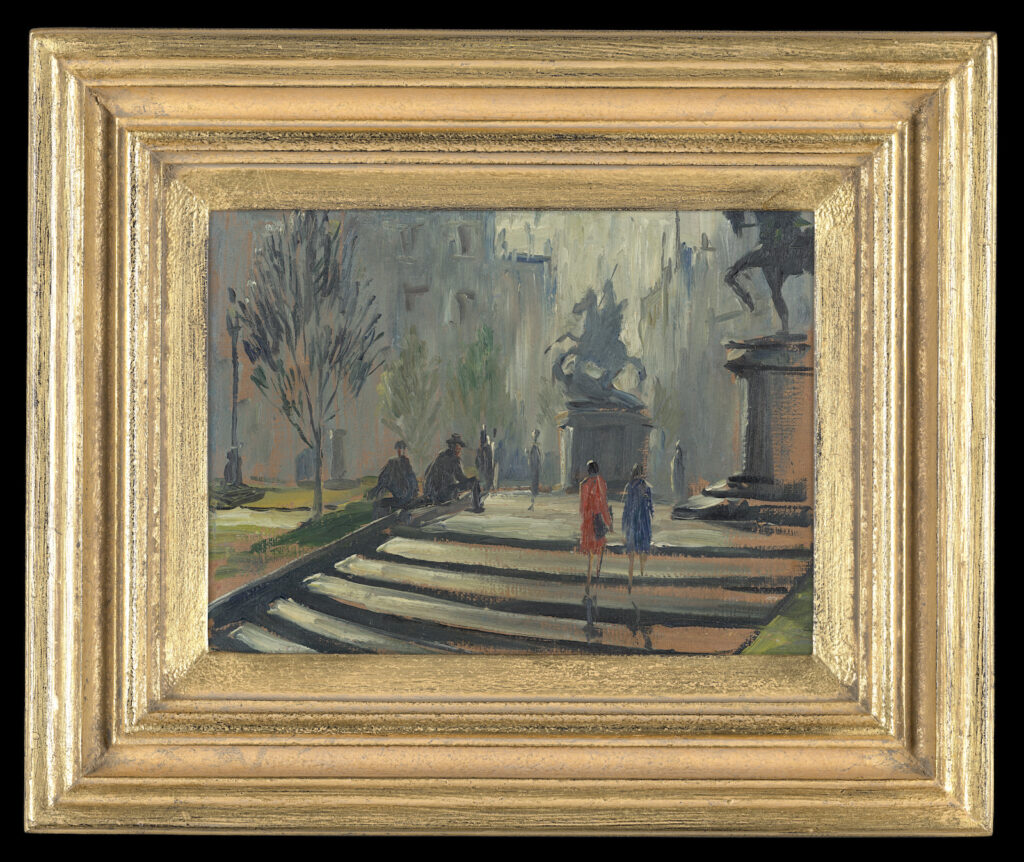
I like to think that artist Alan Moore unwittingly captured Erica and Mary heading into work, up the Library steps when he sketched the forecourt around 1947. This is but a flight of fancy, but the image does capture the bustle of the city and the grandeur of the Library entrance, flanked by its two frozen equestrian guardians: St. George and Joan of Arc – a place where questions can still be asked and answered, where information is sought and found, a place with endless possibilities and hope.
Further reading
Reference enquiries are not just a thing of the past, read about current queries and the current reference librarian team at State Library Victoria in Kylie Best’s blog: ‘A map in the maze’: Ask a Librarian at State Library Victoria
Got a question? our Ask a librarian service is available to anyone, in person, over the phone, or using the online ask a librarian form.
Find out more about the history of State Library Victoria and it’s staff on our State Library Victoria – history research guide
The La Trobe Journal No 101 features reminiscences from various Library staff who worked at the Library from the 1880s to the 2000s. Including Colin McCallum who was Chief Librarian during the period Erica and Mary worked in the library.
The La Trobe Journal No 103 features Ursula O’Connor’s memories of working in the library over a number of decades, including the 1940s.
More to explore
References
- An orrery is a mechanical solar system apparatus, which may well have been something seen on display in the museum at the time; Neilson WA (ed), Knott TA (ed) and Carhart PW (ed) (1939) Webster’s new international dictionary of the English language, 2nd edn, volume 2, G & C Merriam Company Publishers, Springfield, Massachusetts, p 1723. A pisé house is a rammed earth house, from the French ‘Pisé de terre’; Williams-Ellis C (1919) Cottage building in cob, pise, chalk and clay: a renaissance, Country Life, London, p 57. A baby elephant is called a calf; Eardley-Wilmot, S (1912) The life of an elephant, E. Arnold, London, p 12.; Dreiheller, E and Marsden M, ‘Enquiry register, 1946-1949’; MS 10628, State Library Victoria, p 1.
- Or according to the cover image a ‘question record’.
- It was at least known and shared among staff, as noted in reminiscences by the then Chief Librarian Colin McCallum, who wrote:
Miss Mary Marsden and Miss Dreiheller kept a register of their day by day enquiries over a long period. This makes most interesting and very amusing reading as the two girls were themselves interested in the calls made upon their knowledge and bibliographic skill and maintained a full and high-spirited record.
McCallum C (2018) Looking back – the PLV, 1919–1960: recollections and reflections (Dewar S ed) LaTrobe Journal, vol 101, March, p 71.
- In Visitor & Information Services – Digital Access & Family History, who alongside the Information Services team staff the front of house reference service.
- The pages aren’t numbered but I have taken the first page as page 1 and cited references accordingly, in the digitised version the file page count is 2 higher than cited because the digitised cover and verso are included. For example page 45 in the digitised version would be file 47.
- Best K (2021) ‘Put out that light!’ Brownout Melbourne during World War II‘, State Library Victoria blog, accessed 4 July 2026.
- Dreiheller, E and Marsden M, ‘Enquiry register, 1946-1949’; MS 10628, State Library Victoria, p 6.
- While there were some trials of Sunday openings before the 1940s, it wasn’t until February 1972 that the Library consistently opened on Sunday. Gionfriddo A (2021) ‘The Sunday question‘, State Library Victoria blog, accessed 4 July 2026.
- Dreiheller, E and Marsden M, ‘Enquiry register, 1946-1949’; MS 10628, State Library Victoria, p 15.
- Commonwealth of Australia (1946) Telephone directory, Melbourne, [Postmaster-General’s Dept,Melbourne] p 10.
- Byron GGB (1815) ‘The Destruction of Sennacherib’, in Coleridge EH (1904) The works of Lord Byron. A New, Revised and enlarged edition with illustrations. Poetry. Vol. III, John Murray, London, and Charles Scribner’s Sons, New York, pp 404-405.
- Dreiheller, E and Marsden M, ‘Enquiry register, 1946-1949’; MS 10628, State Library Victoria, p 50.
- As above, p 27.
- Geddie W (ed) and Geddie JL (ed) (1946) Chambers’s Biographical Dictionary : the great of all nations and all times, rev edn, Chambers, London, p 332.
- Dreiheller, E and Marsden M, ‘Enquiry register, 1946-1949’; MS 10628, State Library Victoria, p 2.
- Dreiheller, E and Marsden M, ‘Enquiry register, 1946-1949’; MS 10628, State Library Victoria, p 7.
- One of the books the girl on the left is reading can be visually identified and is still in the collection; The Girl (1948) Allied Enterprises, Sydney.
- Throughout this blog I have tried to cite sources that were in the Library at the time of the query and may have been consulted.
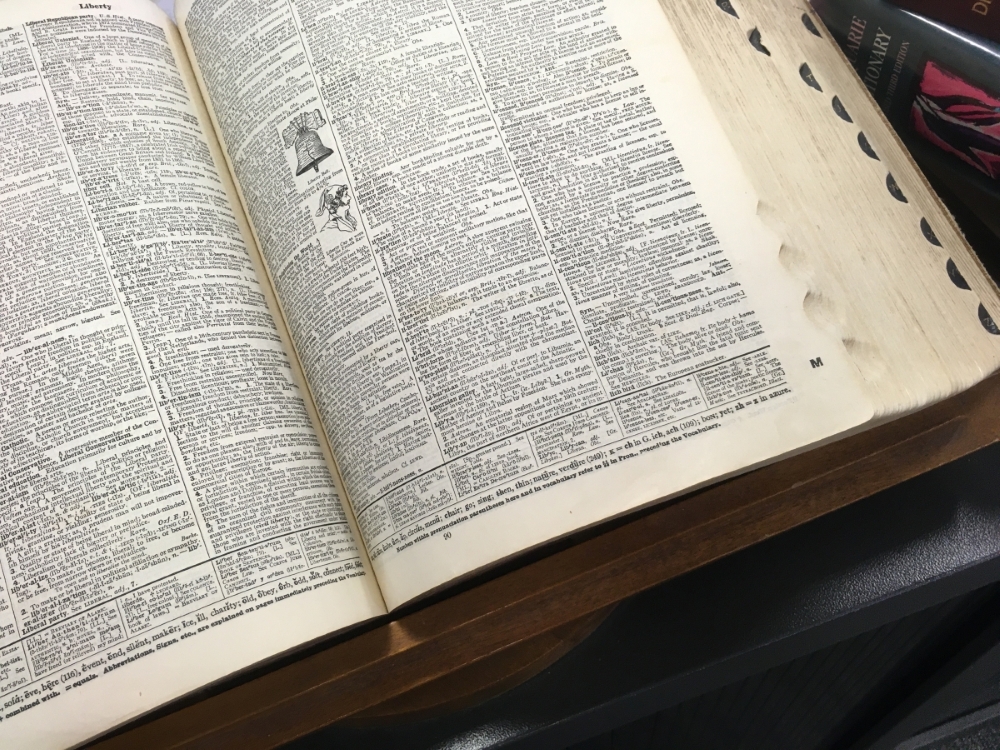
The library staff copy of Websters New International Dictionary of the English Language, second edition, 1947 Photo by author. This dictionary is still used regularly by reference staff today. It may have been in the collection since it was published, meaning it would have potentially been used by Mary, Erica and the team at the time. Interestingly in the listing for librarian is the term ‘librarianess’ ‘a female librarian’; Neilson WA (ed), Knott TA (ed) and Carhart PW (ed) (1949) Webster’s new international dictionary of the English language, 2nd edn, unabridged, G & C Merriam Company Publishers, Springfield, Massachusetts, p 1425.
- Dreiheller, E and Marsden M, ‘Enquiry register, 1946-1949’; MS 10628, State Library Victoria, p 2.
- Matthews S (2016) ‘So, you want to be a librarian?‘, State Library Victoria blog, accessed 4 July 2026.
- O’Connor U (2018) State Library of Victoria, 1927–65 (Dewar S ed) LaTrobe Journal, vol 103, September, p 60.
- Final year subjects were: French and French language and literature of the Middle Ages; Students’ Records Office (University Of Melbourne) (1855-1957), Mary Marsden, Student record cards to 1957 [UMA-SRE-19880051],University of Melbourne Archives, Melbourne, VIC, Australia.
- Final year subject was German (High German); Students’ Records Office (University Of Melbourne) (1855-1957), Erica Dreiheller, Student record cards to 1957 [UMA-SRE-19880051],University of Melbourne Archives, Melbourne, VIC, Australia.
- Office of the Public Service Commissioner, Public Service Board Victoria Return of persons employed in the Public Service (1941), The Board, [Melbourne], p 118. Available online in the Austlii Government Gazettes database: No 39, 31 January 1942.
- Office of the Public Service Commissioner, Public Service Board Victoria Return of persons employed in the Public Service (1948), The Board, [Melbourne], p 11. Available online in the Victorian Government Gazette online archive: No. 564, June 30, 1949.
- Office of the Public Service Commissioner, Public Service Board Victoria Return of persons employed in the Public Service (1946), The Board, [Melbourne], p 120. Available online in the Victorian Government Gazette online archive: No. 283 June 25 1947.
- Office of the Public Service Commissioner, Public Service Board Victoria Return of persons employed in the Public Service (1948), The Board, [Melbourne], p 11. Available online in the Victorian Government Gazette online archive: No. 564, June 30, 1949.
- She is no longer listed as an employee in the public service employee register, Mary is still listed: Office of the Public Service Commissioner, Public Service Board Victoria Return of persons employed in the Public Service (1949), The Board, [Melbourne], p 11. Available online in the Victorian Government Gazette online archive No. 276, April 6, 1950.
- Neither Mary or Erica are listed in the December 1951 published public service employee register: Office of the Public Service Commissioner, Public Service Board Victoria Return of persons employed in the Public Service (1951), The Board, [Melbourne], p 11. Available online in the Victorian Government Gazette online archive: No. 749 August 26 1952.
- Initially enforced in the Commonwealth Public Service Act 1902 Many articles can be found in the newspaper on the topic, for example: Argus, 25 January 1941, p 5 and Argus, 1 June 1955, p 4.
- Parliamentary Education Office (n.d.) ‘Marriage bar abolished‘, Parliamentary Education Office [website] accessed 24 July 2026.
- [death notice Mary MacFarlan] (12 July 1994) The Age, p 35.
- [death notice Erica Barrett] (21 December 1988) The Age, p 24.
- Bedford R and Köehler-Broman M (ill) (1929) Fairies & Fancies, A & C Black, London, Dorothy Neal White Collection, National Library of New Zealand.
- Office of the Public Service Commissioner, Public Service Board Victoria Return of persons employed in the Public Service (1943), The Board, [Melbourne], p 10. Available online in the Victorian Government Gazette online archive No. 17, January 29, 1944.
- Office of the Public Service Commissioner, Public Service Board Victoria Return of persons employed in the Public Service (1949), The Board, [Melbourne], p 11. Available online in the Victorian Government Gazette online archive No. 276, April 6, 1950.
- Dreiheller, E and Marsden M, ‘Enquiry register, 1946-1949’; MS 10628, State Library Victoria, p 8.
- As above, p 34.
- Dreiheller, E and Marsden M, ‘Enquiry register, 1946-1949’; MS 10628, State Library Victoria, p 48. I suspect the book being referred to is: Partridge E (1937) A dictionary of slang and unconventional English : slang-including the language of the underworld, colloquialisms and catch-phrases, solecisms and catachreses, nicknames, vulgarisms and such Americanisms as have been naturalized, Routledge, London.
- These laws only explicitly applied to men, but it didn’t mean society was more tolerant towards queer women. Carbery G (2014) Towards homosexual equality in Australian criminal law – a brief history, revised 2nd edn, Queer Archives [website] accessed 27 July 2026.
- Dreiheller, E and Marsden M, ‘Enquiry register, 1946-1949’; MS 10628, State Library Victoria, p 44.
- As above, p 45.
- As above, p 22.
- Isabella Fraser was the first female Library staff member, starting in 1924:Traian, A.-M. (22 August 2023) ‘Isabella Fraser, a library pioneer‘, State Library Victoria blog, accessed 6 August 2026. See the Staff section of the State Library Victoria-history research guide for more information on Isabella Fraser and Library staff over they years. The enquiry room was most likely located in the area now known as the Information Centre level 2 (ground) of The Dome. Confusingly it was previously referred to as the basement with what is now the La Trobe Reading Room (which is currently level 3), being level 1.
- Riley HT (ed) (1876) Dictionary of Latin and Greek quotations, etc., George Bell and Sons, London, p 430.
- Jones HP (ed) (1913) Dictionary of foreign phrases and classical quotations, etc., John Grant, Edinburgh, p 110.
- Dickinson E (1852) ‘A Valentine’ in Bianchi MD [1924] The life and letters of Emily Dickinson, Jonathan Cape, London, 147-149.


This is a fascinating post – both interesting and amusing. The extensive References add to the main story, and the “Further Reading” and “More to Explore” sections let me to do both – read and explore further. Thanks Angus for your research and storytelling.
Thanks Sue, glad you liked it, it was definitely an interesting and enjoyable one to research.
I enjoyed reading this and then looked to see who wrote it ! Very interesting
Thanks Catherine, there many more interesting enquiries I couldn’t squeeze into the blog, glad we have the whole thing digitised.
Regarding reference point 9 :
After World War Two Australian psychiatrist John Cade treating soldiers suffering from manic depression as bipolar disorder was then known, at Bundoora Repatriation Hospital (Mont Park) experimented with the use of Lithium. It proved effective in a percentage of cases and is still prescribed for some patients.
That is interesting. It looks like the Bundoora Repatriation Hospital was next door and took the bulk of the military patients. You can see John Cade’s name in a number of newspaper articles: The Argus Tuesday 29 October 1940, page 6 and articles on the shortage or nurses at Mont Park in 1946: The Age Wednesday 26 June 1946 page 5.